
A proposal kickoff meeting succeeds when every attendee leaves with a clear owner, a hard deadline, and a shared understanding of the win strategy. That is the single standard worth measuring against. Run it in 60–90 minutes, and your team walks out with five concrete outputs:
- Approved win themes and compliance approach (owner: capture lead)
- Signed-off proposal schedule with color team dates (owner: proposal manager)
- Draft compliance matrix with assigned section authors (owner: proposal manager)
- Completed RACI covering writing, review, pricing, and graphics (owner: proposal manager)
- Next review date confirmed on every attendee's calendar (owner: proposal manager)
The kickoff meeting agenda covers welcome, objectives, scope, timeline, roles, communication cadence, and risks — and for most proposals, that fits cleanly inside 90 minutes.
Key Takeaways
A proposal kickoff meeting produces decisions, not conversations — and the quality of those decisions depends on preparation, a timed agenda, and clear ownership before anyone leaves the room.
| Point | Details |
|---|---|
| Send pre-reads 48 hours early | Distribute the agenda, draft compliance matrix, and RFP highlights so attendees arrive ready to decide, not review. |
| Open with the sponsor | A 2-minute sponsor statement signals priority and increases team engagement across the full proposal cycle. |
| Assign every section at kickoff | Every RFP section needs a named owner and due date before the meeting closes — no shared ownership. |
| Circulate minutes within 24 hours | Post-kickoff minutes, updated schedule, and action tracker within 24 hours translate momentum into execution. |
| Rfpforgeai automates pre-kickoff prep | Rfpforgeai extracts requirements and generates a draft compliance matrix automatically, cutting preparation time before kickoff. |
Table of Contents
- Why does a proposal kickoff meeting matter?
- Who should attend and how do you assign roles?
- What does a timed kickoff agenda look like?
- Pre-kickoff checklist: what to send 48 hours before
- How do you run a kickoff so decisions actually happen?
- How do you assign work and track accountability after kickoff?
- Which tools make your kickoff process repeatable?
- Where does proposal technology help at kickoff?
- What experienced proposal managers get wrong about kickoffs
- Cut your kickoff prep time with Rfpforgeai
- Sources
Why does a proposal kickoff meeting matter?
Skipping a structured kickoff or running a weak one is one of the fastest ways to lose a bid before a single word is written. Shipley Associates frames the kickoff as a strategic event: alignment on win themes, compliance, roles, and schedule directly reduces rework and improves proposal quality. That is not a soft benefit. Rework in the final 48 hours before submission is where proposals lose compliance points and writers lose sleep.
The concrete goals of a strong kickoff are:
- Transition the team formally from capture to proposal activity
- Lock win strategy and discriminators before writing begins
- Assign every RFP section to an owner with a due date
- Surface compliance risks and ambiguous requirements early
- Set communication norms so no one is guessing who approves what
When those goals go unmet, the consequences are predictable. Hinz Consulting identifies the most common failure modes: starting without capture input, overloading the meeting with detail, unclear roles, and not circulating materials in advance. Each one has a direct cost. Missing requirements discovered at Pink Team cost two to three times more to fix than requirements caught at kickoff. Duplicate work across SMEs wastes hours that no proposal schedule has to spare.
A kickoff that produces decisions is worth ten kickoffs that produce conversation. The difference is preparation, a timed agenda, and a sponsor who shows up for the first two minutes.
Your capture plan should feed directly into the kickoff. If the capture lead cannot brief win themes and competitive positioning in five minutes, the team is not ready to write.
Who should attend and how do you assign roles?
The right attendee list is short and purposeful. Every person in the room should either make a decision, own a deliverable, or provide information no one else can. Padding the invite with observers slows the meeting and dilutes accountability.
Core attendees (required for every kickoff):
- Proposal manager — facilitates, owns the schedule and compliance matrix
- Capture lead — briefs win strategy, competitive intel, and customer relationships
- Volume leads / section authors — own writing assignments from day one
- Pricing lead — confirms pricing approach and schedule dependencies
- Contracts / legal — flags teaming, IP, and terms issues early
- Executive sponsor — delivers the 2-minute opening and signals organizational priority
Conditional attendees (invite based on RFP requirements):
- Technical SMEs — required when the RFP specifies unique technical approaches or certifications
- Security / compliance officer — required for classified, CMMC, or HIPAA-regulated solicitations
- Graphics / production lead — required when the RFP has strict formatting or page-limit rules
- Teaming partners — required when a subcontractor owns a key section or past performance reference
For federal solicitations, confirm the latest amendment on Sam before finalizing who needs to attend. A last-minute amendment can change section ownership entirely.
RACI for a standard proposal kickoff:
| Role | Responsible | Accountable | Consulted | Informed |
|---|---|---|---|---|
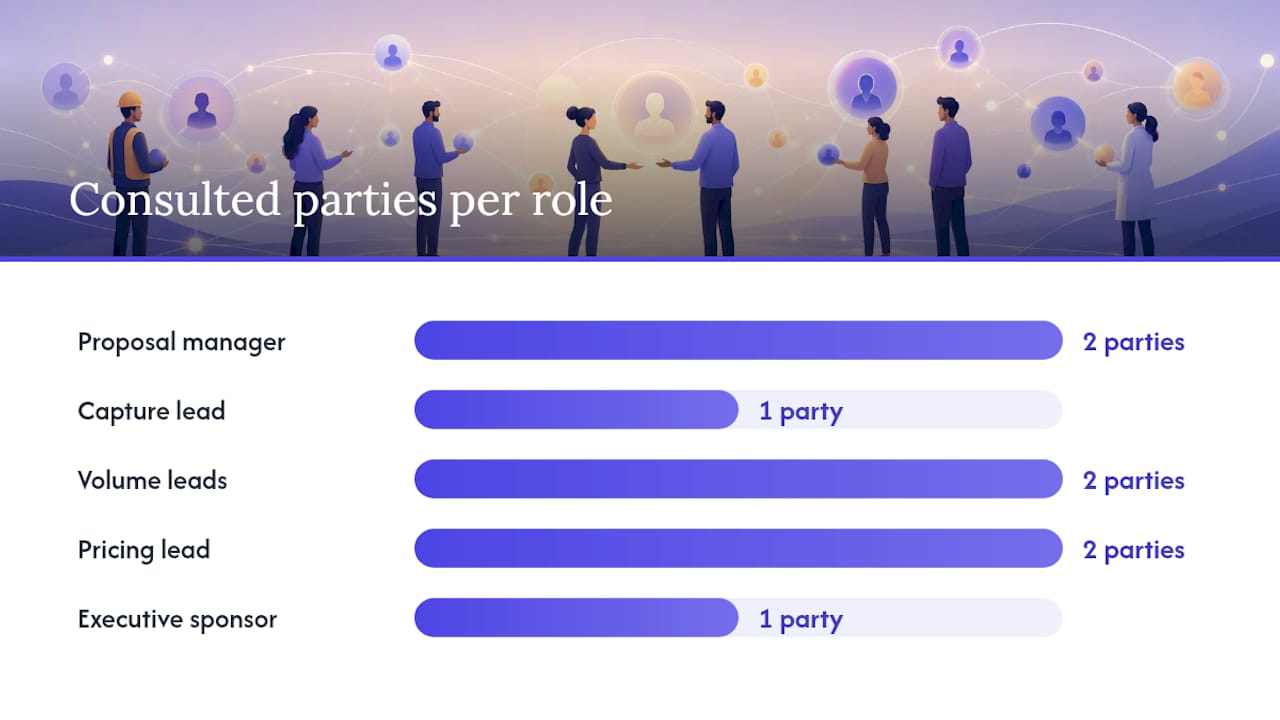
| Proposal manager | Facilitates meeting, owns schedule | Proposal manager | Capture lead, sponsor | All attendees |
| Capture lead | Briefs win strategy | Capture lead | Proposal manager | Volume leads |
| Volume leads | Own section drafts | Volume leads | SMEs, proposal manager | Proposal manager |
| Pricing lead | Owns price-to-win inputs | Pricing lead | Contracts, capture lead | Proposal manager |
| Executive sponsor | Delivers opening, approves go/no-go | Sponsor | Proposal manager | All attendees |
| SMEs | Provide technical content | Volume leads | Proposal manager | Proposal manager |
Industry-specific kickoffs in A/E/C, healthcare, or federal contracting should add role-specific checks. A construction proposal needs a safety SME at the table. A healthcare IT bid needs a privacy officer. Tailor the attendee list to the RFP's risk profile, not a generic template.
What does a timed kickoff agenda look like?
The standard proposal kickoff transitions the team from capture to proposal and covers win strategy, RFP overview (Sections L and M), compliance planning, schedule, and proposal organization. Here is how that fits into a 60–90 minute block.
Standard 60–90 minute agenda
| Time block | Agenda item | Facilitator prompt |
|---|---|---|
| 0–5 min | Welcome and sponsor opening | "Sponsor, please share why this opportunity matters and what winning looks like for us." |
| 5–15 min | Opportunity overview (RFP highlights, Sections L & M, evaluation criteria) | "Capture lead, walk us through the must-win requirements and any ambiguous clauses." |
| 15–30 min | Win strategy and themes | "What are our three discriminators? What does the customer care most about?" |
| 30–45 min | Compliance matrix walkthrough and section assignments | "Each volume lead, confirm your sections and flag any gaps or dependencies." |
| 45–60 min | Proposal schedule: milestones, color teams, submission | "Proposal manager, walk the schedule. Raise conflicts now." |
| 60–90 min | RACI confirmation and communication plan | "Confirm owners, review cadence, and agree on the file-naming convention." |
| 60–90 min | Risks, open questions, and parking lot | "What keeps you up at night about this bid? Log it now." |
| 60–90 min | Immediate next steps and close | "Every owner states their first deliverable and due date before we leave." |

Copy-paste agenda template
PROPOSAL KICKOFF MEETING
Opportunity: [Opportunity Name / Solicitation Number]
Date: [Date] | Time: [Start–End] | Location/Link: [Room or Video URL]

PRE-READ (due 48 hours before): RFP highlights, Sections L & M summary,
draft compliance matrix, draft schedule, draft RACI

AGENDA
0:00  Welcome and sponsor opening (5 min)
0:05  Opportunity overview — capture lead (10 min)
0:15  Win strategy and themes — capture lead (15 min)
0:30  Compliance matrix and section assignments — proposal manager (15 min)
0:45  Proposal schedule and color teams — proposal manager (15 min)
1:00  RACI confirmation and communication plan (15 min)
1:15  Risks and open questions / parking lot (10 min)
1:25  Next steps and close (5 min)

OUTPUTS: Signed-off RACI, approved schedule, compliance matrix with owners,
next review date confirmed.
Variant agendas
For small or single-volume proposals (45–60 min), compress the compliance walkthrough and schedule into one 20-minute block and skip the formal RACI in favor of a quick verbal confirmation. For large, multi-volume, or multi-partner proposals, Atlassian's team playbook recommends splitting the kickoff into multiple sessions by audience or workstream rather than running one long meeting. A practical split: Session 1 (all hands, 60 min) covers strategy and schedule; Session 2 (volume leads only, 45 min) covers section assignments and compliance.
Pre-kickoff checklist: what to send 48 hours before
Sending materials in advance is not a courtesy. Alex Berman's kickoff guidance is direct: distribute the agenda and pre-reads at least 48 hours before the meeting so attendees arrive prepared and the meeting spends zero time on background. When SMEs receive a draft compliance matrix in advance, they arrive focused on gaps rather than reading the RFP for the first time in the room.
48-hour pre-read package (send to all core attendees):
- Agenda with time blocks and facilitator prompts
- RFP highlights summary (2 pages max): key requirements, evaluation criteria, page limits, due date
- Sections L and M annotated (for federal solicitations)
- Draft compliance matrix with requirement IDs and blank "owner" column
- Draft proposal schedule with color team dates
- Draft RACI (pre-populated with names, pending confirmation)
- Teaming agreement summary (if applicable)
Tailor the pre-read by audience:
- Executive sponsor: one-page opportunity brief covering strategic fit, estimated contract value, and go/no-go rationale
- Volume leads and SMEs: annotated RFP sections relevant to their assignments plus the draft compliance matrix
- Pricing lead: pricing instructions from the RFP, any government-provided cost templates, and the draft schedule showing pricing milestone dates
For federal bids, pull the latest solicitation version from sam.gov the morning you send pre-reads. Amendments drop without warning, and sending an outdated compliance matrix is worse than sending none.
Pro Tip: Attach a requirements traceability matrix template to the pre-read package. Volume leads who map their sections to requirement IDs before the kickoff cut compliance review time significantly.
How do you run a kickoff so decisions actually happen?
The meeting's job is to produce decisions, not discussions. That distinction drives every facilitation choice.
Open with the sponsor. A 2-minute sponsor statement signals organizational priority and sets the tone for the entire proposal lifecycle. OCI's guidance is clear that a sponsor-driven opener materially increases perceived priority and engagement across the team. Keep it brief: why this opportunity matters, what winning looks like, and what the team needs from leadership.
Set mutual agreements in the first five minutes. Before the first agenda item, state the ground rules: phones down, decisions get logged in real time, disagreements go to the parking lot, and the meeting ends on time. This is not bureaucracy. Teams that skip this step spend the last 20 minutes relitigating decisions made in the first 30.
Facilitation techniques that keep the meeting tight:
- Decision framing: before any discussion, state the decision needed ("We need to agree on the technical approach for Section C.3 before we leave this item"). Discussions without a stated decision tend to run indefinitely.
- Parking lot: keep a visible list (shared screen or whiteboard) for questions that matter but do not belong in the current agenda item. Assign an owner to each parking lot item before the meeting closes.
- Call for consensus: after each agenda item, ask "Does anyone have a blocking objection?" rather than "Does everyone agree?" The first question surfaces real problems; the second invites silence.
- Decision capture: log every decision in a shared document during the meeting, not after. Include the decision, the owner, and the date. Circulate it before the meeting ends.
Icebreakers for proposal teams should be fast and relevant. A 60-second round of "one word that describes this opportunity" surfaces assumptions quickly and takes less than two minutes. Skip team-building games. Proposal teams are professionals with a deadline.
Handling disagreements: when two volume leads disagree on section ownership, do not mediate in the room. Assign a 24-hour resolution window, name a decision authority (usually the proposal manager), and move on. Unresolved conflicts in the room consume time and rarely produce better decisions than a short offline conversation.
How do you assign work and track accountability after kickoff?
The kickoff's value is realized in the 72 hours that follow, not in the meeting itself. Projectmanager is direct: document decisions during the kickoff and circulate minutes and action items within 24–72 hours to translate momentum into execution.
Post-kickoff deliverables checklist (due within 24–72 hours):
- Kickoff minutes (24 hours): decisions made, parking lot items with owners, attendance list
- Updated proposal schedule (24 hours): color team dates confirmed, submission date locked
- Compliance matrix with owners (24 hours): every requirement mapped to a section author
- Action tracker distributed (24 hours): every open item has an owner, due date, and status
- First check-in scheduled (48 hours): a 30-minute stand-up with volume leads to surface early blockers
- Color team invitations sent (72 hours): Pink, Red, Gold team dates on every reviewer's calendar
Action tracker fields (minimum viable template):
| Field | Description |
|---|---|
| Action ID | Sequential number for easy reference |
| Owner | Named individual, not a team or role |
| Description | One sentence stating the deliverable |
| Due date | Specific date, not "ASAP" |
| Status | Open / In Progress / Complete / Blocked |
| Blocker | If blocked, what is the dependency and who resolves it |
The first check-in is not a status meeting. Its only job is to surface blockers before they become schedule risks. Keep it to 30 minutes, use the action tracker as the agenda, and close every item with a decision or an escalation path.
Proposal teams that track kickoff measures of effectiveness — minutes distributed within 24 hours, percentage of assigned actions with named owners and due dates — get faster time-to-first-draft and fewer late-stage compliance findings, per Shipley Associates.
Which tools make your kickoff process repeatable?
The goal is a lightweight, repeatable system that any proposal manager can run without rebuilding from scratch each time. You do not need an enterprise platform to achieve this. You need the right tool categories and a small inventory of locked templates.
Tool categories to cover:
- Collaboration and meeting platforms: Microsoft Teams or Zoom for virtual kickoffs; Miro or MURAL for live compliance matrix walkthroughs and parking lot capture
- Project and task management: Microsoft Project, Smartsheet, or Asana for the proposal schedule and action tracker
- Document version control: SharePoint or Google Drive with a locked folder structure and a clear file-naming convention (e.g.,
[OpName]_[Section]_[Author]_[Version]_[Date]) - Compliance tracking: a dedicated compliance matrix spreadsheet or a purpose-built proposal software platform that maps requirements to sections automatically
Template inventory to prepare before kickoff:
- Kickoff agenda (copy-paste version above)
- Draft compliance matrix (requirement ID, RFP reference, section owner, status)
- RACI chart (pre-populated with standard roles)
- Decision log (decision, owner, date, status)
- Action tracker (fields listed above)
- Proposal schedule (milestones, color teams, submission)
When to lock documents: lock the compliance matrix and RACI within 24 hours of the kickoff. After that, changes go through a formal amendment process. Unlocked documents during rapid proposal cycles create version conflicts that cost more time to resolve than the original flexibility was worth.
For technical proposal writing, keep a separate template folder with approved boilerplate for past performance, corporate capabilities, and standard compliance language. Volume leads who pull from a vetted library write faster and with fewer compliance errors.
Where does proposal technology help at kickoff?
Automation earns its place in pre-kickoff preparation, not in the meeting itself. The highest-value use cases are the tasks that consume proposal manager time before the first attendee joins the call.
Where technology speeds preparation:
- Automated RFP parsing: AI tools can extract every requirement from a solicitation in minutes, producing a draft compliance matrix that would otherwise take two to four hours to build manually. Volume leads arrive at the kickoff with a pre-populated matrix rather than a blank spreadsheet.
- Compliance matrix generation: automated tools flag mandatory requirements (shall, must, will) and separate them from informational content, reducing the risk of missed requirements at kickoff.
- Ambiguous clause identification: AI parsing can surface clauses that contain conflicting instructions or undefined terms, giving the proposal manager a focused list of questions to raise with the customer before kickoff.
- Draft section outlines: some platforms generate section outlines from RFP instructions, giving volume leads a starting point rather than a blank page.
- Contact and calendar management: automated scheduling tools reduce the coordination overhead of booking a 10-person kickoff across multiple time zones.
Where human judgment still matters:
Automated compliance matrices are a starting point, not a final answer. An AI tool can identify that a requirement exists; only an SME can confirm whether your solution actually meets it. Never let an automated assumption substitute for a technical review.
Win themes, competitive positioning, and pricing strategy require human judgment grounded in customer knowledge and market intelligence. A tool that generates win themes without capture input produces generic language that evaluators recognize immediately. Use automation to eliminate administrative work, then direct the time saved toward the strategic decisions only your team can make.
The practical workflow: run automated RFP parsing the day the solicitation drops, review the output with the capture lead, and attach the draft compliance matrix and ambiguity list to the 48-hour pre-read package. Attendees arrive with a head start, and the kickoff spends its time on decisions rather than document review.
What experienced proposal managers get wrong about kickoffs
The conventional wisdom says a good kickoff is about having the right agenda. That is true but incomplete. The real differentiator is what happens in the 48 hours before the meeting, not the 90 minutes of the meeting itself.
Teams that send a thorough pre-read package consistently run shorter, more decisive kickoffs. When SMEs have already reviewed the compliance matrix and flagged their gaps, the kickoff becomes a confirmation meeting rather than a discovery session. That shift alone cuts the average kickoff from 90 minutes to 60 and produces better decisions because attendees have had time to think.
The second pattern worth noting: sponsor engagement drops sharply after the kickoff if the sponsor's only touchpoint was the opening statement. Build one deliberate sponsor check-in into the proposal schedule, tied to a specific milestone (Pink Team or pricing review), and the sponsor's investment in the outcome stays visible to the team throughout the cycle. A sponsor who reappears at Red Team having missed every interim milestone is not a sponsor. They are a reviewer.
Measure your kickoffs. Track whether minutes went out within 24 hours, whether every action item had a named owner, and whether the first check-in happened within 48 hours. Those three metrics predict first-draft quality better than any agenda format.
Cut your kickoff prep time with Rfpforgeai
The hardest part of running a great proposal kickoff is the preparation work that happens before the meeting: parsing the RFP, building the compliance matrix, and assembling a pre-read package that gives your team a real head start. That work typically takes a proposal manager two to four hours per solicitation.
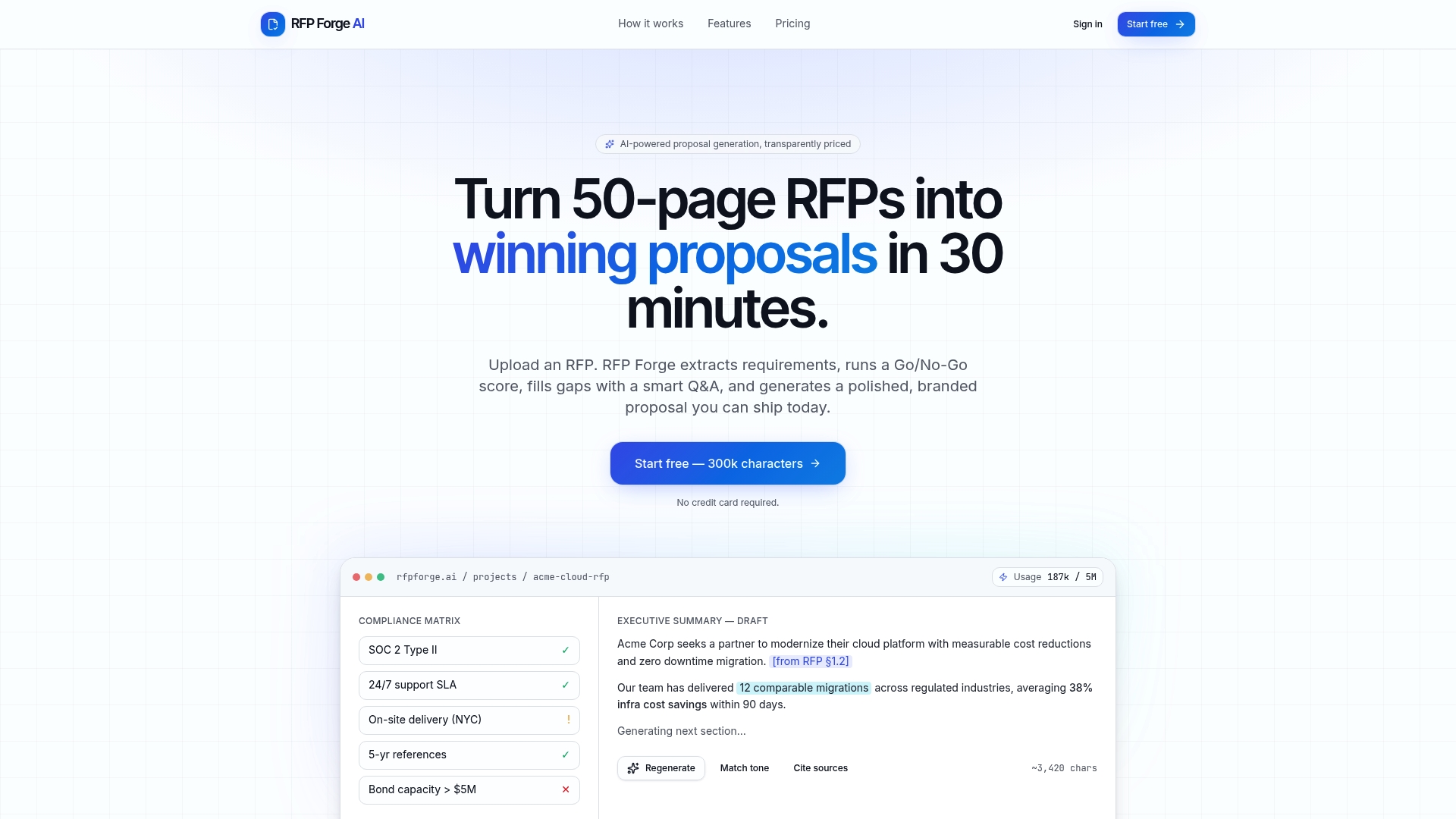
Rfpforgeai cuts that preparation time by automatically extracting requirements, generating a draft compliance matrix, and surfacing ambiguous clauses the moment you upload the RFP. Your 48-hour pre-read package is ready before most teams have finished reading the solicitation. The platform's compliance tracking carries through the entire proposal cycle, so the matrix you build at kickoff stays current through submission. Start your first automated kickoff prep and see how much faster your team reaches first draft.
Sources
- Cover & How to Run It — Project kickoff agenda (Alex Berman)
- Project kickoff meeting agenda template — ProjectManagementFormula
- Proposal Kickoff Meetings That Put You On The Path To Win | Organizational Communications Inc
- Proposal Kickoff Meetings That Set You Up to Win – Shipley Associates Blog
- Proposal Kick-Off Meeting Best Practices — Hinz Consulting
- Projectmanager
- Project Kickoff — Atlassian Team Playbook
- Sam