
A winning technical proposal delivers three things at once: a decision-ready summary a nontechnical sponsor can act on, a binding scope that prevents disputes, and a cost breakdown that holds up under scrutiny. Get all three right, and evaluators can say yes without a follow-up meeting.
Before you write a single section, confirm these essentials are in place:
- Problem statement: One clear sentence describing what is broken or missing and why it matters now
- Recommended approach: The specific solution you are proposing, not a menu of options
- Total cost: A single number with a phase-by-phase breakdown in an appendix
- Duration: Start date, end date, and the two or three milestones that matter most
- Top risks: No more than three, each with a named mitigation
- Compliance items: Every RFP requirement ID your proposal must address, confirmed against the solicitation
- Sign-off list: Technical lead, project manager, finance reviewer, and legal (if contract terms are included)
Pro Tip: Draft the scope and acceptance criteria before you write anything else. The executive summary is the last section you write, not the first. Trying to summarize a proposal you have not fully scoped yet produces vague, uncommitted language that evaluators notice immediately.
Table of Contents
- What is a technical proposal, and which type are you writing?
- How to organize your proposal: a ready-to-copy table of contents
- How to write an executive summary that gets a yes
- How to write a problem statement, objectives, and scope that hold up
- How to describe your technical approach so evaluators trust it
- How to build a schedule that reviewers will actually believe
- How to present your budget so it survives scrutiny
- How to handle risk, assumptions, and compliance notes
- How to build a compliance matrix that prevents disqualification
- What to put in appendices and how to use visuals effectively
- Writing style that persuades without overselling
- The pre-submission checklist: what to review before you send
- Practical templates and tools that speed the process
- How AI-assisted proposal platforms speed quality and compliance
- Key Takeaways
- What proposal teams actually learn the hard way
- Rfpforgeai turns your next RFP into a polished proposal in 30 minutes
- Useful sources and further reading
What is a technical proposal, and which type are you writing?
A technical proposal is a persuasive, commitment-style document that specifies deliverables, constraints, timeline, and cost for a defined body of work. It is not a brochure, a capabilities statement, or a white paper. Every claim in it carries weight because the proposal often becomes the baseline for the contract that follows.
The distinction from marketing collateral matters. Marketing copy sells potential. A technical proposal commits to outcomes, acceptance criteria, and a price. Evaluators read it looking for gaps, contradictions, and unverifiable claims, not enthusiasm.
Three types dominate in practice:
Solicited (RFP/tender response): A client or agency issues a Request for Proposals with defined requirements, evaluation criteria, and scoring weights. Your proposal must map directly to those criteria. Procurement officers and technical evaluators score it against a rubric, so compliance and traceability are non-negotiable.
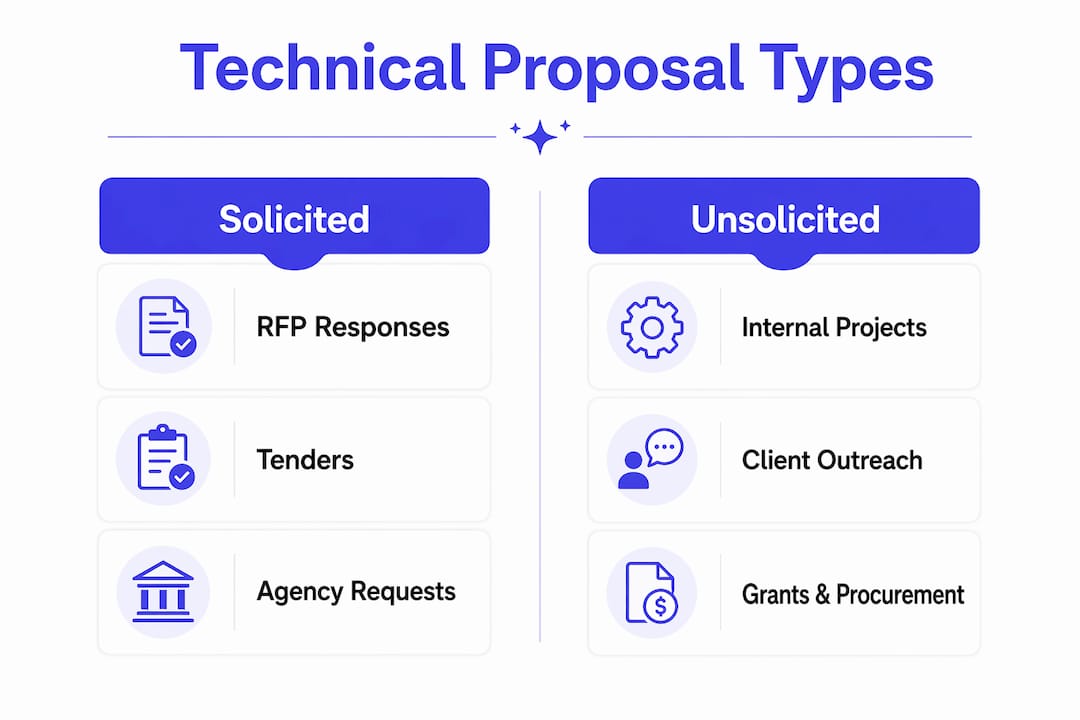
Unsolicited or internal: You are proposing a project to internal leadership or approaching a prospective client who has not issued a formal RFP. Structure is more flexible, but you still need a problem statement, a scope, and a cost. The audience is typically a business sponsor who cares about ROI and risk, not technical architecture.
Grant or procurement: Federal and state grant proposals follow agency-specific formats (think SAM.gov registrations, SF-424 forms, and narrative sections with strict page limits). Procurement proposals for government contracts layer in FAR/DFARS compliance requirements. These are the most structured of the three and the least forgiving of format deviations.
A brief memo works when the project is internal, low-budget, and the decision-maker already understands the problem. Once you are asking for external funding, responding to a formal RFP, or committing to deliverables across organizational boundaries, you need a full formal proposal.
How to organize your proposal: a ready-to-copy table of contents
The standard proposal structure covers executive summary through appendices, but the depth of each section scales with project size. Use the table below as your starting point, then expand or compress based on the guidance that follows.

| Section | Small Internal Proposal | Mid-Size RFP Response | Large Program Proposal |
|---|---|---|---|
| Cover page / transmittal letter | 1 page | 1 page | 1–2 pages |
| Executive summary | 1 page | 1 page | 1–2 pages |
| Background / problem statement | 1 page | 1–2 pages | 2–3 pages |
| Objectives and success criteria | 1 page | 1 page | 1–2 pages |
| Technical approach / methodology | 1–2 pages | 3 pages | 10–15 pages |
| Schedule and milestones | 1 page | 1–2 pages | 2–4 pages |
| Budget and pricing | 1 page | 1–2 pages | 3 pages |
| Risk register and mitigation | 1 page | 1 page | 2–3 pages |
| Compliance matrix | Optional | Required | Required |
| Qualifications / team bios | Optional | 1–2 pages | 2–4 pages |
| Appendices | As needed | As needed | As needed |
For small internal proposals, 10–15 pages is typical. Large program responses for federal contracts or enterprise software implementations can run 50–100 pages, with appendices adding more. When the RFP assigns separate scoring weights to technical, management, and cost volumes, expand the sections that carry the highest point values first.
Label every appendix with a letter and a descriptive title (Appendix A: Detailed Project Schedule, Appendix B: Team Qualifications). Reference each appendix by letter in the main text so evaluators can navigate without hunting.
How to write an executive summary that gets a yes
The executive summary is the one section every decision-maker reads. It must answer six questions on a single page: What is the problem? What is the recommended approach? What are the key benefits? What does it cost? How long will it take? What are the top risks?
Here is a sample structure for a single executive-summary paragraph:
That paragraph is 95 words. A nontechnical sponsor can read it in 30 seconds and make a decision. That is the goal.
Checklist for a decision-ready executive summary:
- Problem stated in business terms, not technical jargon
- Recommended approach named specifically (not "a solution will be designed")
- Total cost as a single number, with a note on contract structure
- Timeline with at least one concrete milestone date
- Top risks named and mitigated, not hidden
- A single call to action (sign, schedule a kickoff, request a demo)
Pro Tip: Add a three-row summary table immediately after the opening paragraph: one row for cost, one for duration, one for primary outcome. Reviewers who skim straight to the numbers will still get the full picture.
How to write a problem statement, objectives, and scope that hold up
Discovery comes before drafting. Interviews, workflow observation, and direct questions about budget and timeline are the inputs that make a problem statement credible. A problem section that reads like it was written without talking to the client is easy to spot and easy to reject.
A strong problem statement does three things: it quantifies the current pain (cycle time, error rate, cost, compliance gap), it explains why the status quo is no longer acceptable, and it sets up the proposed solution as the logical response. One to two paragraphs is enough.
Objectives must be measurable. "Improve system performance" is not an objective. "Reduce API response time from 800ms to under 200ms under peak load by the end of Phase 2" is. Tie each objective to an acceptance criterion so evaluators know exactly how you will prove success.
Scope definition is where most proposals fail or succeed. Use a two-column format:
| In Scope | Out of Scope |
|---|---|
| Requirements gathering and system design | Hardware procurement |
| API development and integration testing | End-user device configuration |
| User acceptance testing (UAT) support | Post-go-live helpdesk support beyond 30 days |
| Deployment to staging and production environments | Third-party vendor contract negotiation |
| Training for 20 named administrators | Training for general end-user population |
Explicit out-of-scope statements protect both parties from scope creep and preserve your margin. Follow the scope table with a short assumptions section: list what you are assuming about client-provided access, data quality, and third-party availability. If an assumption proves false, it is a documented change-order trigger, not a dispute.
How to describe your technical approach so evaluators trust it
The technical approach section is where you prove feasibility. Structure it in four layers: technology stack, methodology, integration plan, and deployment approach. Each layer answers a different evaluator question.
Key elements to cover:
- Technology stack: Name the specific platforms, languages, frameworks, and versions. "Modern cloud infrastructure" tells evaluators nothing. "AWS ECS with Terraform-managed infrastructure, Node.js 20 LTS backend, and a React 18 frontend" tells them everything they need to vet your team's competence.
- Methodology: State whether you are using Agile (Scrum, Kanban), waterfall, or a hybrid, and explain why that choice fits the project. A fixed-scope government contract usually warrants waterfall with defined phase gates. A product with evolving requirements fits Agile sprints.
- Integration points: Diagram every system-to-system connection. A simple data-flow diagram showing source systems, the middleware layer, and destination systems is worth three pages of prose. Caption every diagram and reference it by figure number in the text.
- Deployment plan: Describe the environment progression (development, staging, production), the rollback strategy, and the go-live criteria.
- Acceptance criteria: For each major deliverable, state the specific, testable condition that constitutes completion. "The API returns a 200 response with correct payload for all 47 test cases in the UAT suite" is an acceptance criterion. "The API works correctly" is not.
Nontechnical reviewers read the technical approach too. Annotate architecture diagrams with plain-language callouts that explain what each component does in business terms, not just its technical name.
How to build a schedule that reviewers will actually believe
Evaluators have seen hundreds of optimistic Gantt charts. What they trust is a schedule with named owners, explicit dependencies, and documented buffers. The plan of action should be organized in phases with realistic entry and exit criteria for each milestone.

| Milestone | Start | End | Owner | Entry Criteria | Exit Criteria |
|---|---|---|---|---|---|
| Phase 1: Discovery and design | Week 1 | Week 4 | Project Manager | Contract signed; client access granted | Design document approved by client |
| Phase 2: Development | Week 2 | Week 14 | Technical Lead | Approved design document | All unit tests passing; code review complete |
| Phase 3: Integration testing | Week 15 | Week 18 | QA Lead | Development complete | UAT test plan executed; defect rate below threshold |
| Phase 4: Deployment and training | Week 19 | Week 22 | Project Manager | UAT sign-off | Go-live complete; training attendance confirmed |
| Phase 2: Delivery | Week 22 | — | Technical Lead | Go-live | Zero critical defects for 30 consecutive days |
When justifying your schedule to a procurement team, show your work. If Phase 2 is ten weeks, explain the task breakdown that produces that estimate. Unexplained durations invite negotiation. Explained durations invite acceptance.
Pro Tip: Align payment milestones with deliverable acceptance gates, not calendar dates. "Payment due upon client sign-off of the approved design document" is far easier to enforce than "Payment due 30 days after project start." It also reduces the most common source of post-award friction.
How to present your budget so it survives scrutiny
Budget sections fail in two ways: too vague to trust, or too granular to read. The solution is a two-layer structure: a summary table in the main body and a detailed cost breakdown in an appendix.
Proposal budgets should break down costs by category and by phase. A clean summary table looks like this:
- Labor: Hours by role (architect, developer, QA, PM) at named rates
- Third-party licenses: Named software, annual or one-time cost
- Infrastructure: Cloud hosting, estimated monthly cost through project duration
- Travel: Number of on-site visits, per-diem rates
- Contingency: A stated percentage (experienced teams typically carry a 15–25% buffer for integration and testing complexity) with a brief methodology note
- Phase totals: Subtotals by phase so clients can see where the money goes
Three pricing models are common. Fixed-price works when scope is fully defined and risk is low. Time-and-materials fits exploratory or research-heavy work where requirements will evolve. Phased discovery (a fixed-price discovery phase followed by a separately priced delivery phase) is the most defensible option when you cannot fully scope the work without first understanding the client's environment.
Write a short pricing rationale paragraph that connects each cost category to a deliverable and explains your contingency methodology. "The 20% contingency reflects our standard practice for projects involving legacy data migration, where integration complexity is difficult to estimate without system access" is a sentence that builds credibility, not one that invites a line-item negotiation.
How to handle risk, assumptions, and compliance notes
Acknowledging risk increases credibility. Evaluators know every project has risks. A proposal that claims otherwise reads as naive. A short risk register with named mitigations reads as experienced.
Structure each risk entry with four fields:
- Risk: A specific, named event (not "project delays")
- Probability: High, medium, or low
- Impact: High, medium, or low
- Mitigation and owner: The specific action and the person responsible
Common mitigation strategies include phased delivery (limiting exposure by delivering value incrementally), acceptance gates (no phase begins until the prior phase is formally signed off), and contingency reserves (budget and schedule buffers with documented triggers for use).
For legal and compliance notes, keep it brief. A proposal is not a contract. One sentence noting that the engagement will be governed by a separate master services agreement, or that specific regulatory requirements (HIPAA, FedRAMP, SOC 2) will be addressed in the security architecture section, is sufficient. Flag anything that requires legal review before award, but leave the contract language to post-award negotiation. For recurring contract patterns, lessons from structured contract workflows can help your team identify which clauses to flag early and which to defer.
How to build a compliance matrix that prevents disqualification
In a scored RFP, the compliance matrix is your insurance policy. It maps every requirement in the solicitation to the section of your proposal that addresses it. Evaluators use it to verify nothing was missed. You use it during QA to catch gaps before submission.
| RFP Requirement ID | Requirement Summary | Proposal Section | Page / Paragraph | Score Relevance Note |
|---|---|---|---|---|
| REQ-1 | System must support concurrent users | Technical Approach | p. 14 | Technical scoring criterion T-3 |
| REQ-2 | Data must be encrypted at rest and in transit | Security Architecture | p. 18, ¶1 | Technical scoring criterion T-7 |
| REQ-3 | Vendor must carry $2M general liability insurance | Qualifications | Appendix D | Pass/fail compliance item |
| REQ-4 | Proposed schedule must not exceed 12 months | Schedule | milestone table | Management scoring criterion M-2 |
| REQ-5 | Training must cover all named user roles | Training Plan, §6.3 | p. 27, ¶3 | Technical scoring criterion T-9 |
For optional or partially met requirements, state the limitation explicitly. "REQ-008 is partially addressed: the proposed solution meets the reporting requirement for Modules 1–3; Module 4 reporting will be delivered in Phase 2 per the attached schedule." Evaluators respect honesty. They penalize omission.
Run the compliance matrix as your final QA gate. Every requirement ID in the RFP should appear in the matrix. Any blank row is a disqualification risk.
What to put in appendices and how to use visuals effectively
Appendices exist to keep the main body readable. Move anything that a reviewer needs to verify but not read in sequence: detailed project schedules, team CVs, test reports, vendor letters of support, security certifications, and API contracts.
A standard appendix list for a mid-size RFP response:
- Appendix A: Detailed Gantt chart (week-by-week task breakdown)
- Appendix B: Team qualifications and CVs (one page per key personnel)
- Appendix C: Past performance references (three to five projects with client contacts)
- Appendix D: Insurance certificates and business licenses
- Appendix E: Security certifications (SOC 2 Type II report summary, FedRAMP authorization letter)
- Appendix F: Sample deliverables or work products from comparable engagements
For visuals in the main body, follow three rules. First, caption every diagram with a figure number and a plain-language description. Second, reference every diagram by figure number in the surrounding prose ("See Figure 3 for the data-flow architecture"). Third, annotate diagrams for nontechnical reviewers. A system architecture diagram without labels that explain what each component does in business terms is a diagram that works against you.
Use raw data in appendices and summarized charts in the main body. A large table belongs in an appendix. A bar chart showing the three-year cost comparison belongs on page 12.
Writing style that persuades without overselling
Technical proposals are persuasive documents, not just technical reports. Every claim must link to evidence, an acceptance criterion, or a named deliverable. Unverifiable superlatives ("best-in-class," "industry-leading") undermine the credibility of the factual claims around them.
Practical style rules:
- Subject-verb-object sentences: "The middleware layer synchronizes data between System A and System B every 15 minutes" beats "Data synchronization will be achieved through the proposed middleware solution."
- Active voice: "The QA team executes the UAT test plan" not "The UAT test plan will be executed."
- Define technical terms inline: The first time you use an acronym or specialized term, define it in parentheses. After that, use the short form.
- One idea per paragraph: If a paragraph covers two distinct points, split it.
- Consistent naming: Pick one name for each system, role, and deliverable and use it throughout. Switching between "the portal," "the platform," and "the application" for the same thing confuses evaluators.
- Headings for skim readers: Every major section heading should tell a reviewer what the section concludes, not just what it covers. "Technical approach: REST API integration with 99.9% uptime SLA" is more useful than "Technical approach."
Avoid marketing fluff and vague language in favor of granular detail. "We have extensive experience in this area" is a claim evaluators cannot score. "We have delivered five comparable integrations in the past three years, two of which are listed as past performance references in Appendix C" is a claim they can verify.
The pre-submission checklist: what to review before you send
A proposal that leaves your team with a typo in the budget total or a missing appendix reference is a proposal that signals carelessness. Build a formal QA step into your submission timeline, not a last-minute scan.
Who reviews what:
- Technical lead: Validates that the technical approach is accurate, feasible, and complete; confirms acceptance criteria are testable
- Project manager: Checks schedule logic, milestone dependencies, and that the timeline matches the budget phasing
- Finance reviewer: Reconciles the executive summary cost figure against the detailed budget; confirms contingency methodology is documented
- Legal (if applicable): Reviews any compliance commitments, IP ownership language, and contract references
- Fresh reader: Someone who did not write the proposal reads the executive summary and confirms they can answer all six decision questions without reading further
Pre-submission checklist:
- Every RFP requirement ID appears in the compliance matrix
- The cost figure in the executive summary matches the budget section total exactly
- All appendix references in the main text point to existing, labeled appendices
- File is named per RFP instructions (or a clear internal convention if unsolicited)
- PDF is secured against editing if required by the RFP
- Transmittal letter is signed by the authorized representative
- Submission is confirmed received (email receipt, portal confirmation, or courier tracking)
Version control matters too. Name files with a date and version number (Proposal_ClientName_v2.3_2026-03-15.pdf) and keep a change log. The most common last-minute trap is a reviewer making a cost change in the budget appendix without updating the executive summary. A single reconciliation pass by the finance reviewer catches it every time.
Practical templates and tools that speed the process
A proposal library saves weeks over the course of a year. The templates worth maintaining are:
- TOC template: Pre-built table of contents with section placeholders and page-number guidance by proposal type
- Executive summary template: A fill-in-the-blank paragraph structure with the six required fields
- Budget template: A spreadsheet with labor, infrastructure, license, travel, and contingency rows, plus a phase-summary tab
- Compliance matrix template: A pre-formatted table with RFP ID, summary, section reference, page reference, and score-relevance columns
- Appendix template: A labeled cover page for each appendix type with a standard header and reference format
Tool categories to consider by workflow stage:
- Document assembly: Microsoft Word with tracked changes, Google Docs with comment-based review, or dedicated proposal software for larger teams
- Diagramming: Lucidchart, draw.io, or Microsoft Visio for architecture and data-flow diagrams
- Scheduling: Microsoft Project, Smartsheet, or a Gantt-capable spreadsheet for milestone tables
- Cost modeling: Excel or Google Sheets with locked formula cells to prevent accidental overwrites
- Compliance tracking: A shared spreadsheet or purpose-built compliance software that maps requirement IDs to proposal sections
Editable proposal templates give teams a starting point, but adapt every template to the specific RFP's evaluation criteria and the client's language. A template that uses your standard terminology when the RFP uses different terms signals that you did not read the solicitation carefully. Store templates in a shared drive with version dates, and assign one person to maintain the master versions so teams are not working from outdated files. For teams managing multiple concurrent proposals, a structured contract workflow process can help coordinate review stages and prevent version conflicts.
How AI-assisted proposal platforms speed quality and compliance
AI-assisted proposal platforms handle the parts of the process that consume the most time without adding judgment: parsing the RFP, extracting requirement IDs, generating a first-pass compliance matrix, and drafting boilerplate sections like the executive summary and pricing narrative.
The workflow typically runs in five stages. The platform ingests the RFP document and extracts every requirement, scoring criterion, and submission instruction. It then runs a Go/No-Go assessment based on your team's defined fit criteria. Where information gaps exist, an intelligent Q&A system prompts the right subject-matter experts for the specific inputs needed. The platform then generates draft sections (executive summary, technical approach narrative, compliance matrix, budget summary) using your team's knowledge base and tone preferences. Finally, it exports a branded, formatted document ready for human review.
Rfpforgeai follows this model. The platform claims to take a raw RFP to a polished draft in 30 minutes, with compliance tracking built in so nothing falls through the cracks. For clients in regulated industries, Rfpforgeai reports an average 38% cost reduction in infrastructure migration proposals, attributed to tighter requirements tracing and fewer post-award change orders.
The human review step is not optional. AI-generated drafts require SME validation of acceptance criteria, cost assumptions, and any technical claims before the document goes to a client.
Pro Tip: Assign your SMEs to review acceptance criteria and cost assumptions first, before anyone edits the language. A technically accurate draft with rough prose is fixable in an hour. A polished draft with wrong numbers is a liability.
Key Takeaways
A technically complete proposal with a decision-ready executive summary, explicit scope boundaries, and a traceable compliance matrix gives evaluators everything they need to say yes.
| Point | Details |
|---|---|
| Write the executive summary last | Draft scope and acceptance criteria first; the summary should reflect a fully scoped proposal, not a guess. |
| Scope defines your margin | Explicit out-of-scope statements prevent disputes and protect project profitability after award. |
| Compliance matrix is your QA gate | Every RFP requirement ID must appear in the matrix before submission; a blank row is a disqualification risk. |
| Budget needs two layers | A summary table in the main body plus a detailed breakdown in an appendix keeps the proposal readable and auditable. |
| Rfpforgeai accelerates the draft cycle | The platform parses RFPs, auto-generates compliance matrices, and drafts key sections, cutting drafting time to 30 minutes while preserving human review for cost and acceptance criteria. |
What proposal teams actually learn the hard way
The conventional wisdom says the technical approach section wins proposals. After watching enough high-stakes submissions, the real pattern is different. Proposals get disqualified on compliance, not on technical merit. A brilliant architecture section does not save you if you missed a mandatory certification attachment or left a requirement ID out of the compliance matrix.
The teams that win consistently do two things differently. First, they involve architects and lead implementers in the scoping conversation before anyone opens a document. Early discovery surfaces the integration risks and data-quality issues that, if discovered during drafting, force a scope rewrite under deadline pressure. Second, they treat the compliance matrix as a living document that gets built alongside the proposal, not assembled at the end as a summary. When the matrix is built in parallel, gaps surface in time to address them.
Post-submission is where most teams go quiet when they should stay active. Assign one person, usually the project manager, to own all evaluator questions and clarification requests. Respond to every clarification request with a single, version-controlled document. Never send informal email answers to formal evaluation questions. The clarification response is part of the proposal record and may be incorporated into the contract.
Version control is the unglamorous discipline that separates professional proposal teams from everyone else. A single shared document with a named editor and a change log prevents the scenario where two writers update different copies of the budget section and the finance reviewer reconciles the wrong version the night before submission.
Rfpforgeai turns your next RFP into a polished proposal in 30 minutes
Drafting a compliant, well-structured proposal from a 60-page RFP used to take days. Rfpforgeai cuts that to 30 minutes by automating the parts that consume the most time: requirement extraction, compliance matrix generation, executive summary drafting, and branded export.
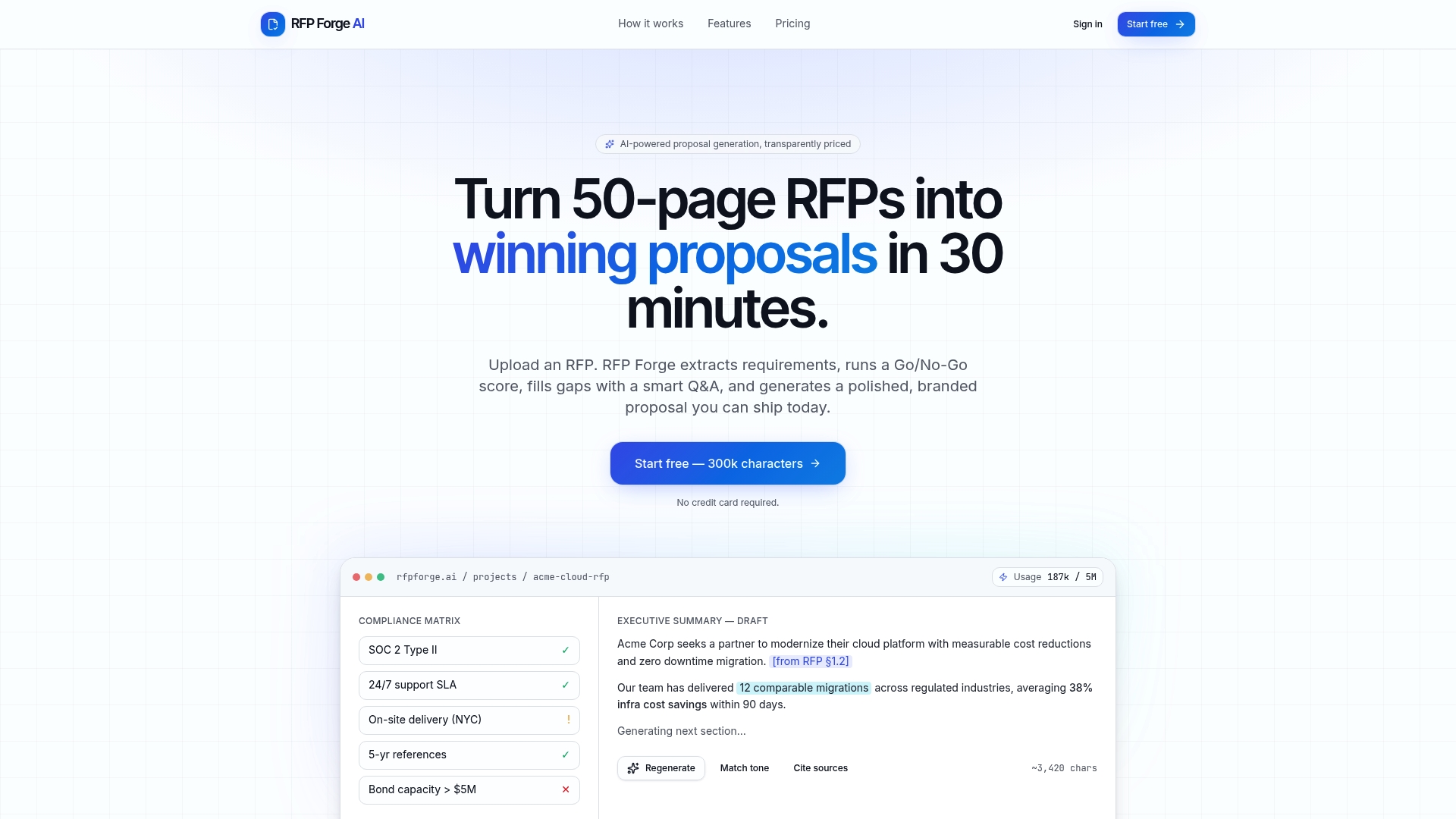
Here is what the platform does for your team:
- RFP parsing: Automatically extracts every requirement ID, scoring criterion, and submission instruction from the source document
- Compliance matrix automation: Generates a pre-populated matrix you can validate and refine, rather than build from scratch
- Executive summary generation: Drafts a structured summary using your inputs and knowledge base, ready for SME review
- Branded export: Delivers a formatted, client-ready document in your organization's style
- Win-rate analytics: Tracks proposal outcomes so your team can identify which approaches and section structures correlate with wins
For teams in regulated industries, Rfpforgeai reports an average 38% cost reduction in infrastructure migration proposals through tighter requirements tracing. The platform is built for business development teams, consultants, and agencies who submit proposals regularly and cannot afford to spend a week on every response.
Start your first proposal on Rfpforgeai and see how far a 30-minute draft gets you before your next submission deadline.
Useful sources and further reading
A short list of authoritative references used to build this guide, with notes on what each offers:
-
Technical Proposal — Project Management Formula: Practitioner-focused guidance on discovery, scope definition, budget structure, and risk mitigation. Strong on the practical mechanics of writing proposals for client engagements.
-
Chapter 13: Proposals — The Practical Guide to Technical Writing for Engineers and Computer Scientists: Open-access academic text covering proposal structure, milestone planning, and the persuasive function of technical documents. Useful for students and early-career professionals building foundational skills.
-
7.2 Proposals — Technical Writing Essentials: Concise open-access chapter on proposal types, audience analysis, and section organization. Good starting point for understanding solicited versus unsolicited proposals.
-
Technical Proposal for Project Example — examples.com: Editable sample proposal template with standard section structure. Useful as a starting-point document to adapt for specific RFPs.
-
Technical Proposal Template — docs-professionals.com: A structured template covering parties, scope, timeline, budget, and terms. Includes a disclaimer reminding users to customize for project-specific requirements.
-
Rfpforgeai: The platform's landing page explains RFP parsing, compliance matrix automation, executive summary generation, and win-rate analytics. Relevant for teams evaluating AI-assisted proposal tools.