
The most effective executive summary answers three questions in a concise word count suitable for board-level reads: what you're proposing, why it fits, and what you need from the reader. Paste this template directly into your next RFP response:
[Company Name] proposes [solution] to address [client's stated problem], delivering [primary benefit] within [timeframe]. Our approach meets [RFP requirement reference] through [key differentiator]. Based on [evidence/metric], we project [expected outcome]. We ask the evaluation committee to [specific ask, e.g., advance us to the oral presentation stage].

Keep the final version concise for board-level reads, or trim to a single brief paragraph when the RFP form limits the summary field. Rfpforgeai can generate and populate this template automatically once it extracts requirements from your RFP document.
Table of Contents
- What does an executive summary actually do in a proposal?
- What core elements does every executive summary need?
- Five annotated executive summary examples you can copy
- Reusable templates and sentence starters for programmatic generation
- How to generate executive summaries at scale with AI prompts
- How to tailor executive summaries for RFPs and regulated industries
- Common mistakes and how to fix them before submission
- How Rfpforgeai automates executive summary generation
- Key Takeaways
- The case for disciplined templates over free-form generation
- Your team can generate compliant summaries in under 30 minutes
- Useful sources and further reading
What does an executive summary actually do in a proposal?
An executive summary is a standalone decision document, not a teaser. Busy evaluators often read only this section, so it must carry the full argument without requiring the reader to flip to page 12 for context.
In RFP contexts, that job expands: the summary must also signal compliance, demonstrate fit, and surface any risks the evaluator needs to flag before scoring. Three format signals help:
- Length: 250–500 words for board and evaluation packs; one tight paragraph for inline RFP fields.
- Structure: Short paragraphs or three to five bullets, never dense prose blocks.
- Appendices: Push supporting data (pricing tables, CVs, compliance matrices) to appendices and reference them by section number.
What core elements does every executive summary need?
Five structured parts cover every proposal context. Map each one to your RFP's evaluation criteria before you write.
| Element | What it covers | Sample phrasing |
|---|---|---|
| Headline recommendation | One sentence stating your proposed solution | "We propose a managed cloud migration over a period intended to optimize operations…" |
| Context / why it matters | The client's problem and its business impact | "Current infrastructure costs exceed budget by a significant margin…" |
| Key evidence / metrics | Two to three data points that prove fit | "Our team has completed numerous similar migrations with demonstrated success…" |
| Recommended action / ask | What you need the reader to do next | "We request selection for the oral presentation…" |
| Risks and tradeoffs | One sentence on the primary risk and mitigation | "Timeline risk is mitigated by a phased rollout…" |
Lead with the headline recommendation. Evaluators score fit first, so your strongest claim belongs in sentence one, not buried in paragraph three.
Five annotated executive summary examples you can copy
These sample executive summaries cover the most common proposal contexts. Each annotation shows which core element a sentence serves and where to inject variable data for automation.
-
RFP response / solution fit "[Company] proposes a 36-month infrastructure modernization program for [Agency], reducing operating costs by an estimated 38% through automated provisioning and consolidated vendor contracts. [Ref: RFP Section 3.2 — Cost Efficiency]. Primary risk: legacy system dependencies; mitigation: parallel-run period in months 1–3." Annotation: sentence 1 = headline + metric; sentence 2 = requirement trace; sentence 3 = risk element. Swap
[Agency]and the percentage for each new RFP. -
Investor pitch "[Company] is seeking $2M in Series A funding to scale its AI-assisted compliance platform to 500 enterprise clients by Q4 2027. Revenue grew 140% year-over-year; current ARR stands at $1.2M. Funds will accelerate product development and expand the U.S. sales team." Annotation: purpose + ask in sentence 1; evidence in sentence 2; action plan in sentence 3.
-
Project status update "The Orion CRM migration is 78% complete and on budget at $1.1M of the $1.4M approved. Two open risks — data mapping for legacy accounts and UAT sign-off — are tracked in the project register. Sponsor decision required on scope change request #14 by March 14." Annotation: status + metric; risk disclosure; specific ask with a deadline.
-
Managed services proposal "[Company] proposes a 24/7 NOC service covering [Client]'s 340-node network, with a guaranteed 99.9% uptime SLA and a four-hour response commitment. Monthly reporting and a dedicated account manager are included at the proposed rate of $[X]/month." Annotation: solution + scope; SLA as evidence; commercial ask implied by rate disclosure.
-
Technical compliance response "This response addresses all 47 mandatory requirements in RFP-2026-IT-009. Section 4 of our proposal maps each requirement to a named deliverable and an acceptance criterion. One exception is noted in Appendix C with a compliant alternative." Annotation: compliance signal up front; traceability reference; risk/exception disclosed.
Reusable templates and sentence starters for programmatic generation
Short template (75–100 words, single RFP field):
[Company] proposes [solution] to [client], addressing [primary requirement] from [RFP reference]. Our approach delivers [benefit] within [timeframe], supported by [evidence]. [Risk sentence, optional]. We ask [specific ask].
Long template (250–400 words, decision pack):
Use the five-element structure from Section 3. Open with the headline recommendation (1–2 sentences), follow with context (2–3 sentences), then evidence (3–5 bullets or a short paragraph), then action/ask (1–2 sentences), and close with the risk statement (1 sentence).
Modular sentence starters for automation pipelines:
- Purpose: "This proposal responds to [RFP_title] issued by [issuing_agency] on [issue_date]…"
- Evidence: "[Company] has delivered [n] comparable engagements, achieving [metric] on average…"
- Ask: "We request [next_step] by [deadline]…"
- Risk: "The primary risk, [primary_risk], is mitigated by [mitigation_owner]'s [mitigation_action]…"
Mark required placeholders (e.g., [RFP_title], [issuing_agency]) as mandatory fields in your generation pipeline. Set fallback text for optional fields: if [metric] is empty, the sentence defaults to "achieving measurable results on comparable engagements."
How to generate executive summaries at scale with AI prompts
A repeatable workflow prevents quality drift when you're running batch generation across multiple RFPs.
- Extract requirements. Feed the RFP into Rfpforgeai or your extraction tool. Output: a prioritized list of mandatory vs. optional requirements.
- Map priorities. Rank requirements by evaluator weight (usually stated in the RFP scoring rubric). Flag the top three for the summary.
- Generate draft. Use the prompt below.
- Inject metrics. Pull verified figures from your knowledge base. Never let the model invent percentages.
- Run quality check. Score against the checklist in Section 8.
- Finalize. Human reviewer approves before submission.
Prompt A — summary generation from RFP requirements: "You are a proposal writer. Using the following prioritized requirements [paste list], write a 300-word executive summary in the format: headline recommendation, context, three evidence bullets, ask, one-sentence risk statement. Use [company_name] and [solution_name] as placeholders."
Prompt B — compression from a longer document: "Compress the following [X]-word proposal section into a 250-word executive summary. Preserve the top three metrics, the compliance reference, and the ask. Remove all background history."
Prompt C — risk-aware rewrite: "Rewrite the following executive summary to add a one-sentence risk disclosure and a named mitigation owner. Keep the total under 400 words."
Quality checklist for automated outputs:
- All mandatory RFP requirements are referenced by section number.
- At least one verified metric appears (no invented figures).
- A clear ask is present in the final paragraph.
- Risk is disclosed with a mitigation owner named.
- Tone matches the client's stated preferences (formal/technical vs. collaborative).
Pro Tip: Sample one in every five AI-generated summaries for peer review. Errors cluster in batches when input data is incomplete, so catching one bad output usually reveals a systemic gap in your knowledge base.
How to tailor executive summaries for RFPs and regulated industries
RFP evaluators score against a rubric, so your summary must trace back to their requirements, not just describe your solution.
| RFP requirement phrase | Summary translation | Traceability note |
|---|---|---|
| "Demonstrate prior experience with federal agencies" | "We have supported 12 federal agencies under GSA Schedule [X]…" | Ref: RFP Section 3.2 |
| "Describe your approach to data security" | "All data is processed in SOC 2 Type II certified environments…" | — |
| "Provide evidence of cost savings" | "Clients in regulated industries have achieved a 38% cost reduction…" | Ref: RFP Section 3.2 |
| "Identify key risks and mitigations" | "Primary risk: staff transition; mitigation: 90-day parallel support…" | — |
For regulated industries (federal, healthcare, financial services), add a one-line compliance callout near the top of the summary: "This proposal is fully compliant with [regulation/standard] as detailed in the compliance matrix at Appendix B." Evaluators in these sectors are trained to look for it.
Common mistakes and how to fix them before submission
The two most damaging errors are over-detailing and a missing ask. Both are fixable in under five minutes with a structured edit.
| Error | Quick fix |
|---|---|
| Too much detail | Cut to the top three metrics; move the rest to appendices |
| Vague benefits | Replace "improved efficiency" with a specific percentage or time saving |
| Missing ask | Add one sentence: "We request [next step] by [date]" |
| No risk disclosure | Add one sentence naming the primary risk and its mitigation owner |
| Wrong length | Trim to 250–500 words; remove background history paragraphs |
| Tone mismatch | Run a tone-alignment check against the RFP's own language register |
Peer-review sampling for automated batches: Review 100% of high-value RFPs (above your defined threshold). For mid-tier batches, sample one in five. For low-value or repeat-template responses, sample one in ten. Document every error found and trace it back to the input data gap that caused it.
- Flag summaries where the AI left a placeholder unfilled.
- Reject any summary that lacks a traceable requirement reference.
- Escalate any summary that claims a metric not in the knowledge base.
How Rfpforgeai automates executive summary generation
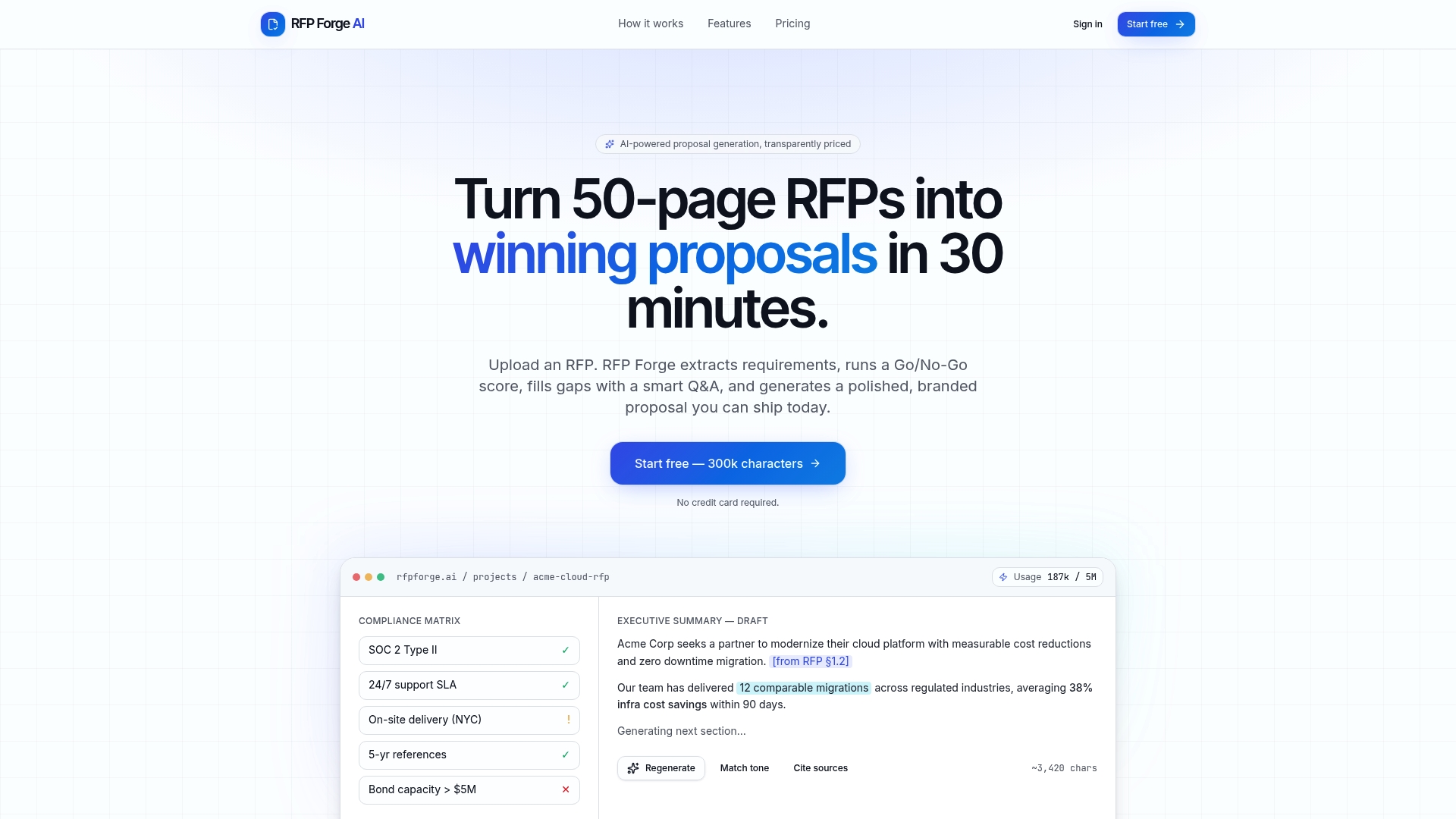
Rfpforgeai extracts requirements from your RFP document, scores fit against your capability profile, and generates a draft executive summary in the five-element structure described above. Key capabilities relevant to summary generation:
- Requirement extraction: Identifies mandatory vs. optional requirements and ranks them by evaluator weight.
- Fit scoring: Produces a Go/No-Go score so you invest time only in winnable bids.
- Summary generation: Outputs a 250–400 word draft pre-mapped to RFP sections.
- Tone presets: Matches formal, technical, or collaborative registers to the client's stated preferences.
- Branded export: Delivers a formatted document ready for submission.
Clients in regulated industries using Rfpforgeai's infrastructure migration workflows have reported a 38% cost reduction, a result that appears in the executive summary as a verified, citable metric rather than a vague claim. That distinction matters to evaluators who score on evidence quality. You can generate a proposal draft in under 30 minutes to see how the summary output maps to your next live RFP.
Key Takeaways
A well-structured executive summary, kept to 250–500 words and built on the five core elements, is the single highest-leverage document in any RFP response.
| Point | Details |
|---|---|
| Lead with the verdict | Open with your headline recommendation, not background context. |
| Hit the word count | Keep summaries to 250–500 words; trim to one paragraph for inline RFP fields. |
| Trace every claim | Reference the RFP section number for each requirement you address. |
| Automate with guardrails | Use AI generation with verified metrics only; sample one in five outputs for peer review. |
| Rfpforgeai for scale | Rfpforgeai extracts requirements, scores fit, and generates compliant summaries in under 30 minutes. |
The case for disciplined templates over free-form generation
Most BD teams underestimate how much quality variance creeps in when writers draft executive summaries from scratch under deadline pressure. The problem is not skill. It's the absence of a repeatable structure that forces the right questions: Is the ask explicit? Is a risk disclosed? Does every claim trace back to an RFP requirement?
Template discipline solves the consistency problem. But automation without accurate input data creates a different one: a summary that sounds confident while misrepresenting your actual fit. That's worse than a weak summary, because evaluators who catch the gap will score you down on credibility, not just accuracy.
Keep one human reviewer in any production pipeline for high-value RFPs. Their job is not to rewrite the AI output. It's to verify that every metric is sourced, every requirement reference is correct, and the ask is specific. That single checkpoint is what separates a scalable proposal operation from a liability.
Your team can generate compliant summaries in under 30 minutes
Proposal teams that respond to multiple RFPs per month spend hours on executive summaries that could be generated, reviewed, and finalized in a fraction of the time. Rfpforgeai cuts that cycle by automating requirement extraction, fit scoring, and draft summary generation in a single workflow.
BD teams and consultants on any plan tier can run a sample generation against a live RFP to see the output quality before committing. If you manage commercial proposals across multiple clients or verticals, the knowledge base reuse feature alone recovers significant time per bid. Start a free trial at rfpforgeai.com and run your first automated executive summary today.
Useful sources and further reading
- Diligent: Executive summary guide with template — Authoritative guidance on the five-part structure and board-level reading patterns; the source for length and standalone-document standards used throughout this article.
- The Executive Summary: Template and examples — Practitioner-focused resource with fillable templates, the 250–500 word guideline, and before/after compression examples.
- Asana: Executive summary examples and template — Four-part framework with sample phrasing teams can adapt directly to proposal contexts.
- Monday.com: Business executive summary template guide — Category-based templates covering investor pitch, project update, and grant proposal scenarios; useful for modular automation.
- Best quoting software for proposal teams — Partner resource covering commercial proposal tooling relevant to teams that pair executive summaries with pricing documents.