
A capture plan template is a structured, living document that guides your pursuit of a specific contract opportunity from initial identification through proposal submission. It is not a one-time checklist. It is the strategic backbone that keeps your capture team aligned, your intelligence organized, and your win themes sharp long before the RFP drops.
At its core, a solid capture plan template covers:
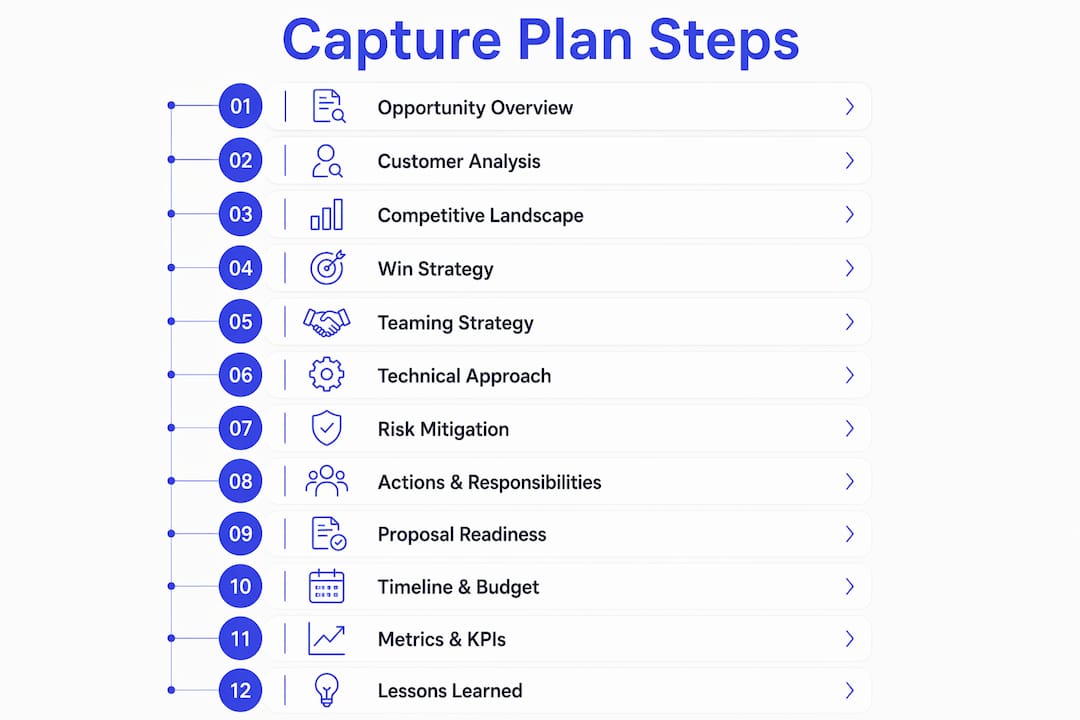
- Opportunity overview: contract scope, period of performance, set-aside status, and anticipated RFP timeline
- Customer analysis: decision-maker identification, agency pain points, and mission alignment
- Competitive landscape: incumbent strengths, competitor positioning, and your differentiators
- Win strategy and win themes: the core messages that explain why your team wins this contract
- Teaming and partnership strategy: who you need, what roles they fill, and how you collaborate
- Risk management: capture-phase risks and how you plan to address them
Most comprehensive capture plan templates also include solution approach and risk mitigation strategies to ensure every key component—opportunity overview, customer and competitive analysis, win strategy, teaming, and resource allocation—is addressed and kept current throughout the pursuit.
The real value of a capture plan is what it prevents. Capture managers consistently find that a well-built plan means proposal teams write to a predefined strategy rather than invent one under deadline pressure. That shift alone reduces last-minute proposal heroics and improves the quality of what you submit. Think of the template as your proposal team's handoff package, not just your BD team's internal roadmap.
Table of Contents
- What every capture plan template must include
- Why a one-page capture plan can sharpen your win rate
- How to keep your capture plan working throughout the pursuit
- How AI tools are changing capture plan execution
- Rfpforgeai turns your capture plan into a winning proposal faster
- Key Takeaways
What every capture plan template must include
A capture plan template earns its value by covering every dimension of the pursuit, not just the obvious ones. Here is what each section should contain and why it matters for US federal contracting.
Opportunity overview
This section anchors the entire plan. Document the contract vehicle, estimated value, period of performance, NAICS code, set-aside status (8(a), SDVOSB, WOSB, unrestricted), and the anticipated RFP release date. Pull from SAM.gov, agency forecasts, and any pre-solicitation notices. If you cannot fill in most of these fields, you may be starting capture too late. Effective capture begins months before RFP publication, not after.
Customer analysis
Identify the key decision-makers and influencers: the Contracting Officer, the Contracting Officer's Representative, and the program office stakeholders who will evaluate your proposal. Document their priorities, known pain points, and how your solution aligns with their mission. This is where voice-of-customer intelligence from industry days, capability briefings, and RFI responses belongs.
Competitive landscape
Name the incumbent, assess their performance record, and identify their likely bid strategy. Map two or three additional competitors and note their strengths and weaknesses relative to yours. The goal is not just knowing who you are up against but understanding where you can credibly outperform them. A rigorous capture plan forces this analysis early, before you have committed significant resources.
Win strategy and win themes
Your win strategy is the overarching logic for why you win. Win themes are the specific, customer-validated messages that support it. Each theme should connect a customer pain point to a specific discriminator you bring. Vague themes like "we have experience" do not move evaluators. Specific ones do: "We reduced system downtime by 40% on a comparable DHS program, and we will apply that same architecture here."

Teaming and partnership strategy
Document your teaming decisions: who is the prime, who are the subs, what capabilities each partner brings, and what percentage of work they will perform. Note any teaming agreements in progress and flag any gaps you still need to fill. Teaming decisions made late in the capture cycle often create compliance problems in the proposal.
Solution or technical approach
Sketch your proposed solution at a high level. This does not need to be proposal-ready prose, but it should be specific enough that your proposal team can build from it. Identify the key technical discriminators and how they map to the customer's stated requirements.
Risk management and mitigation
Capture risks are different from proposal risks. They include things like a competitor with a strong incumbent advantage, a teaming partner who may not be available, or an agency relationship gap you have not yet closed. Document each risk, assign a likelihood and impact rating, and note your mitigation plan.
Capture actions and responsibilities
This is the operational core of your plan. List every major capture activity, who owns it, and when it is due. Customer meetings, RFI responses, competitive intelligence updates, teaming calls, solution reviews — all of it goes here. Without clear ownership, capture plans become wish lists.
Proposal readiness measures
Define what "ready to propose" looks like for your team. This includes having validated win themes, a complete competitive assessment, a signed teaming agreement, a draft solution concept, and a staffing plan. These readiness criteria become your gate review checklist.
Timeline and milestones
Map your capture activities against the anticipated RFP timeline. Work backward from the expected RFP release date to identify when each major milestone must be complete. Include go/no-go decision points, customer engagement windows, and internal review gates.
Budget and resource allocation
Capture costs money. Assign a pursuit budget that covers business development labor, travel for customer engagement, proposal preparation, and any outside support. Track actual spend against the budget at each milestone review. Underfunded pursuits tend to produce underprepared proposals.
Metrics and KPIs
Track win probability at each gate review, milestone completion rates, and the ratio of capture investment to contract value. These metrics tell you whether your capture process is working across your pipeline, not just on a single pursuit. Over time, they reveal which opportunity types and customer agencies your team wins most consistently.
Lessons learned and continuous improvement
Build a structured debrief into every capture cycle, win or lose. Document what intelligence proved accurate, which win themes resonated with evaluators, and where the capture process broke down. Feed those findings back into your template and your BD pipeline process.
Pro Tip: Follow the "populate, validate, update, and implement" cycle for every section. Populate each field with your best current intelligence, validate it through customer engagement and competitive research, update it as new information arrives, and implement the resulting strategy in your proposal. A section left blank is a gap in your strategy, not a placeholder.
Why a one-page capture plan can sharpen your win rate
Longer is not always better. A one-page capture plan forces the discipline that multi-page documents often obscure. When you can fit your entire pursuit strategy on a single page, you have actually done the hard thinking. When you cannot, you usually have not.
One-page capture plans increase focus and alignment by distilling the pursuit strategy into seven essential elements: opportunity summary, customer profile, competitive assessment, win themes, teaming needs, action timeline, and go/no-go review. These distilled elements cover the core areas identified as essential for effective capture planning.
The one-page format works especially well in two situations. First, for small businesses pursuing their first few federal contracts, it removes the intimidation factor of a 20-page capture document and gets the team moving. Second, in the early stages of any capture effort, when intelligence is still thin, a one-page plan keeps the team focused on what they know and honest about what they still need to learn.
The common misconception is that a thorough capture plan must be long. In practice, a bloated capture document often signals that the team has not yet made hard strategic choices. The one-page format forces those choices. You cannot hedge on your win themes when you only have room for two or three.
Pro Tip: Treat your one-page plan as a living snapshot, not a finished product. Review and update it after every significant customer interaction, competitive intelligence update, or RFI response. A one-page plan that is two weeks old without an update is already losing accuracy.
How to keep your capture plan working throughout the pursuit
A capture plan that sits in a shared drive untouched for three weeks is not a strategy document. It is a historical artifact. The difference between capture teams that win consistently and those that scramble at proposal time usually comes down to how they maintain and use the plan.
Here is what that looks like in practice:
- Update after every intelligence event. New RFI responses, agency feedback, a competitor announcement, a teaming partner dropping out — any of these should trigger an update as soon as possible. If a capture plan goes untouched for two weeks, it is likely already outdated.
- Schedule gate reviews at fixed milestones. Do not wait for the RFP to decide whether to bid. Build go/no-go decision points into the plan at 90 days out, 60 days out, and at RFP release. Each gate review should assess win probability, resource availability, and competitive position against predefined criteria.
- Structure the capture-to-proposal handoff. The handoff package should include validated customer pain points, incumbent intelligence, confirmed teaming roles, and draft win themes. A structured handoff lets the proposal team start writing to a strategy, not building one from scratch.
- Assign clear ownership for every action item. Every task in the capture plan needs a name next to it, not a team or a department. Shared ownership is no ownership.
- Avoid pursuit momentum. This is the trap of continuing to invest in a bid because you have already invested in it, not because your win probability justifies it. Gate reviews exist to catch this. If your competitive position has not improved since the last review, that is a signal worth acting on.
For version control and team collaboration, platforms that support real-time document sharing and commenting keep everyone working from the same current version. This matters especially when your capture team spans multiple time zones or includes teaming partners.
Pro Tip: Build a lessons-learned session into every post-award debrief, whether you win or lose. Ask the agency for a debrief, compare their feedback to your capture plan assumptions, and document the gaps. Those gaps are your improvement roadmap for the next pursuit.
How AI tools are changing capture plan execution
The most time-consuming parts of capture planning have always been the manual ones: extracting requirements from lengthy solicitation documents, tracking compliance across dozens of sections, and generating first-draft proposal content under tight deadlines. AI is changing the economics of all three.
AI-powered tools now automate extraction of bid requirements, compliance tracking, gap analysis, and proposal content generation. What used to take a capture manager several days of careful document review can now be completed in a fraction of the time, with fewer errors and a cleaner compliance matrix as the output. That shift has real consequences for how you staff and schedule your capture efforts.
For capture planning specifically, AI assists in several concrete ways:
- Requirements extraction: AI parses RFP documents and pulls every stated and implied requirement into a structured list, which you can map directly to your solution and compliance matrix.
- Gap analysis: By comparing your current capabilities and past performance against extracted requirements, AI flags where your proposal has coverage gaps before you start writing.
- Compliance tracking: AI monitors every section of your draft proposal against the solicitation's instructions and evaluation criteria, flagging missing elements in real time.
- Proposal content generation: AI generates first-draft sections for executive summaries, technical approaches, and management plans based on your capture plan inputs and past proposal content stored in a knowledge base.
The practical AI use cases in government contracting go beyond speed. When your capture plan is well-populated, AI can validate whether your win themes are reflected consistently across proposal sections, something that is easy to miss in a manual review of a 200-page document.
The important caveat: AI handles the mechanical and analytical work. Your capture team still owns the strategy. Customer relationships, competitive intelligence, and win theme development require human judgment that no tool replaces. The right model is AI for execution speed and compliance rigor, humans for strategic direction and customer insight.
Rfpforgeai turns your capture plan into a winning proposal faster
You have built a solid capture plan. Your win themes are validated, your competitive assessment is current, and your teaming is locked. The next challenge is turning all of that intelligence into a compliant, compelling proposal before the deadline.
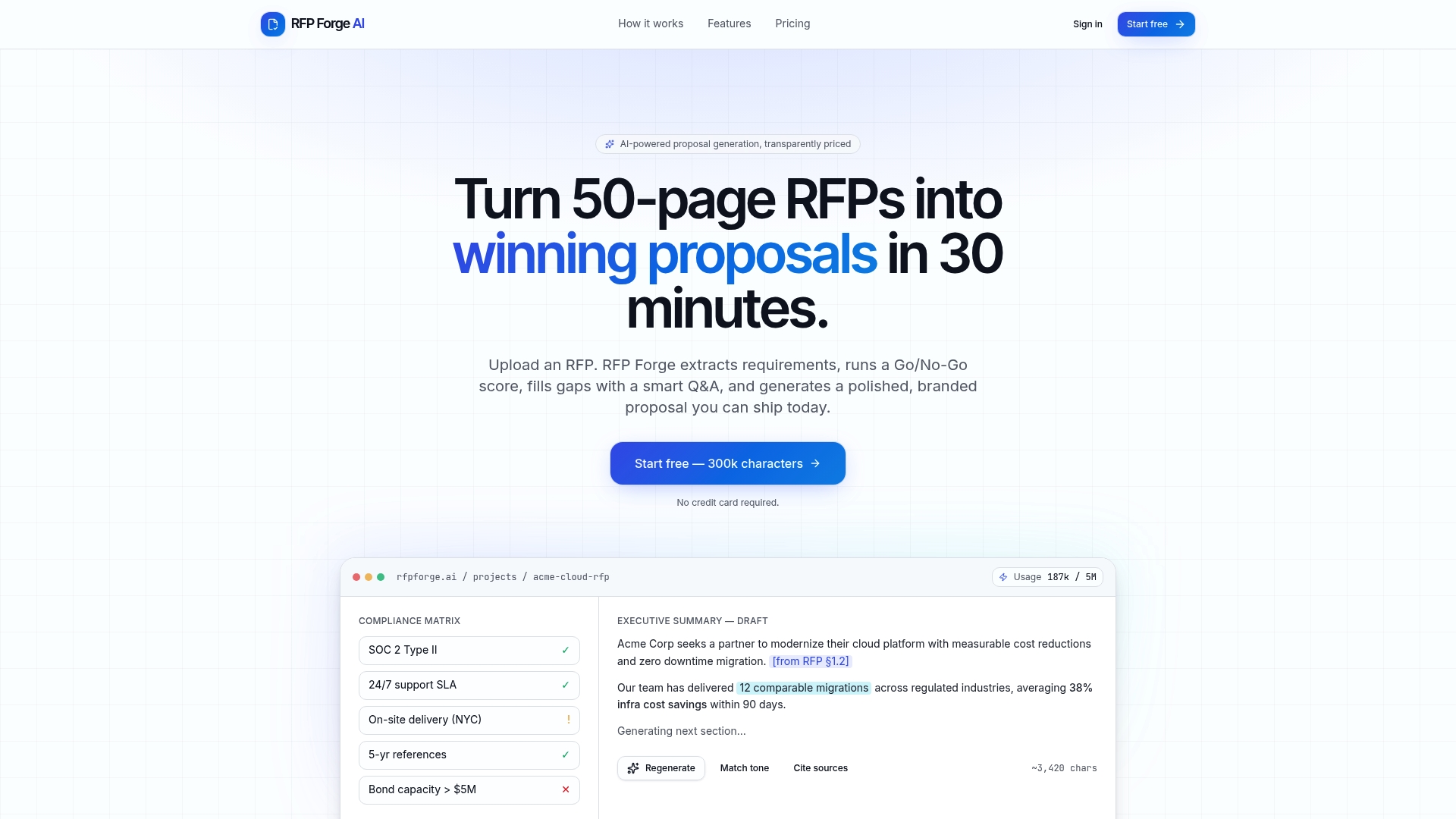
Rfpforgeai is built for exactly that transition. The platform takes your RFP document and, in about 30 minutes, extracts every requirement, builds a compliance matrix, and generates structured first-draft sections for your executive summary, technical approach, pricing narrative, and timeline. Your capture plan inputs feed directly into the Q&A system, so the AI fills gaps using your actual strategy, not generic content. Win themes you defined during capture show up consistently across every section, and the compliance tracker flags any requirement that is not yet addressed.
For BD teams managing multiple pursuits simultaneously, the knowledge base feature means your past proposals, past performance write-ups, and approved boilerplate are always available for reuse. You are not starting from scratch on every bid. Start building faster proposals with Rfpforgeai and put your capture plan to work the moment the RFP drops.
Key Takeaways
A well-maintained capture plan template is the single most reliable way to reduce proposal scramble and improve your probability of win across your federal contracting pipeline.
| Point | Details |
|---|---|
| Start capture early | Effective capture begins months before RFP release, not after the solicitation drops. |
| Keep the plan current | A capture plan untouched for two weeks is likely already outdated; update after every intelligence event. |
| Use the one-page format | Capturing the essential elements on one page forces strategic clarity and keeps the team aligned. |
| Structure the handoff | Transfer validated win themes, customer pain points, and teaming roles to the proposal team before writing begins. |
| Rfpforgeai accelerates execution | Rfpforgeai extracts requirements, builds compliance matrices, and generates first-draft proposal sections from your capture plan inputs in about 30 minutes. |