
The top Proposify alternatives for compliance-driven business development teams fall into four categories: AI-driven RFP automation (for regulated, high-volume RFP response), all-in-one document platforms (for end-to-end proposal-to-payment workflows), interactive web proposals (for visual-first buyer experiences), and RFP-response enterprise platforms (for centralized content libraries and SME workflows). Choose Rfpforgeai when your bottleneck is RFP analysis, compliance matrixing, or converting a 200-page solicitation into a polished proposal in under 30 minutes.
Key shortlist picks and why:
- AI-driven RFP automation (Rfpforgeai): Extracts requirements, scores Go/No-Go fit, builds a compliance matrix, and generates proposal sections automatically. Best for regulated industries and high-volume RFP response.
- All-in-one document platforms (PandaDoc): Templates, e-signature, and integrated payment collection at signature in one flow. Best for sales teams sending standardized proposals at volume.
- Interactive web proposals (Qwilr, GetAccept): Web-based, non-linear buyer experiences with section-level engagement analytics that change how you follow up. Best for agencies and complex multi-stakeholder deals.
- RFP-response enterprise platforms (RFPIO, Loopio, RFP360): Centralized answer libraries, SME assignment workflows, and compliance tracking. Best for enterprise procurement and government contracting.
- Budget web-page tools (Better Proposals): Clean, fast, affordable. Best for freelancers and small agencies that need professional output without a large monthly spend.
SOC 2 Type II certification is the baseline security signal to require from any vendor on this list. Editor fatigue — the accumulation of formatting bugs, pasting issues from Word, and UI settings that flip unexpectedly — is the most common trigger for switching away from Proposify, according to AMW Group's analysis.
Table of Contents
- How do these Proposify alternatives compare on core capabilities?
- Tool-by-tool profiles: what each category actually does
- How to choose the right Proposify alternative for your team
- Migration and onboarding checklist before you switch
- Pricing models, hidden costs, and negotiation tips
- Security and compliance checklist for regulated industries
- Final recommendation: which category to pick and when to choose Rfpforgeai
- Key Takeaways
- What most teams get wrong when switching proposal tools
- Rfpforgeai turns RFP pain into proposal wins faster
- Useful sources and what to verify on vendor pages
How do these Proposify alternatives compare on core capabilities?
| Category | Best For | RFP Automation & AI | Compliance & Audit | Time-to-Send | Buyer Engagement Analytics | End-to-End Flow | Pricing Shape |
|---|---|---|---|---|---|---|---|
| AI-driven RFP automation | Regulated, RFP-heavy BD teams | ✅ Requirements extraction, compliance matrix, Q&A gap-fill | ✅ Versioned audit trail, compliance matrix | Fast (AI-assisted drafting) | Win-rate analytics | Proposal generation + export | Per-org / tiered |
| All-in-one document platforms | High-volume sales teams | Basic AI assist | Basic approval workflow | Fast (template-driven) | Open/view tracking | Proposal → sign → pay | Per-seat |
| Interactive web proposals | Agencies, complex deals | Minimal | Minimal | Moderate (design-heavy) | ✅ Section-level, time-on-section | Proposal → sign (payment varies) | Per-seat |
| RFP-response enterprise platforms | Enterprise procurement | ✅ Answer library, SME routing | ✅ Compliance workflows, versioning | Moderate (SME coordination) | Basic | RFP response → export | Per-seat, enterprise |
| Budget web-page tools | Freelancers, small agencies | None | None | Very fast | Basic open/view | Proposal → sign → pay | Per-seat, low cost |
The distinction between a proposal tool and an RFP response platform is critical for regulated buyers. A proposal tool handles design and e-signature. An RFP response platform handles compliance workflows, versioned audit trails, and centralized answer libraries. Conflating the two creates audit risk.
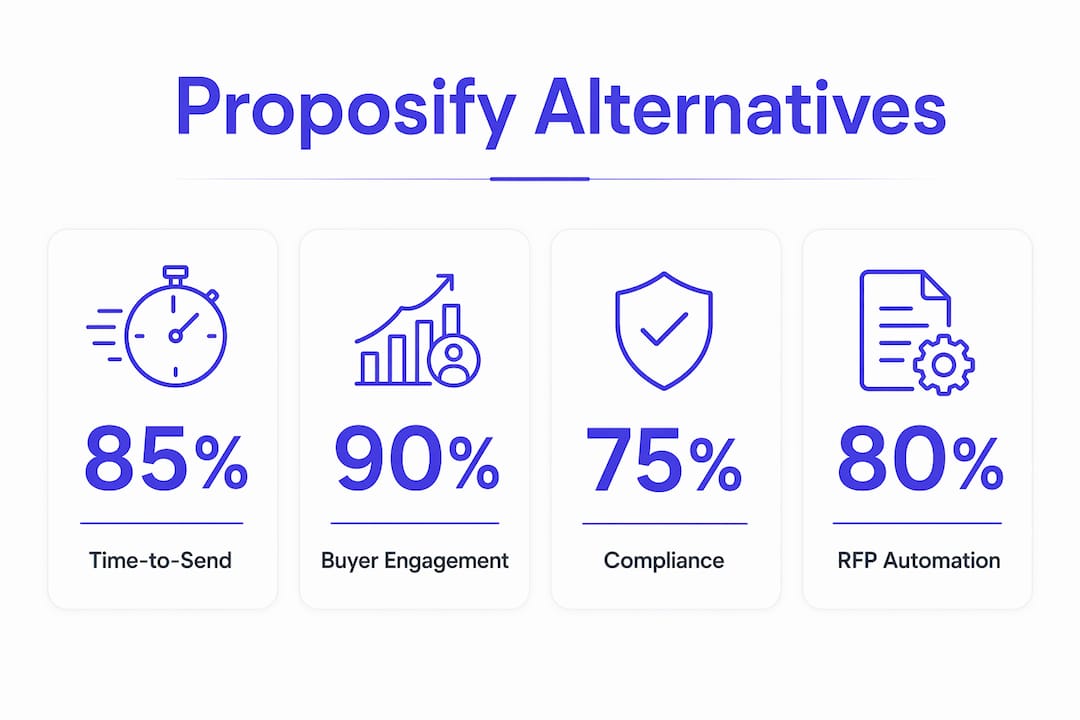
Evaluate time-to-send and buyer engagement analytics as your primary pilot KPIs — they predict platform ROI more reliably than design features alone.
Tool-by-tool profiles: what each category actually does

AI-driven RFP automation (Rfpforgeai)
Rfpforgeai reads the RFP, extracts every requirement, scores your fit, and fills gaps through an interactive Q&A before generating the executive summary, approach, pricing, timeline, and compliance sections. The compliance matrix is built automatically, not assembled manually. Template migration is managed, not a blank-editor rebuild.
- ✅ AI requirement extraction and Go/No-Go scoring
- ✅ Compliance matrix and versioned audit trail
- ✅ Managed template migration and knowledge base reuse
- ✅ Win-rate analytics and tone customization
- ✅ SOC 2 security posture
- ⚠️ Optimized for RFP-driven workflows; less suited for purely visual, design-first proposals
Best for: BD teams in regulated industries, government contractors, and any team responding to formal solicitations at volume.
All-in-one document platforms (PandaDoc)
PandaDoc covers the full proposal lifecycle: template creation, CRM integration (Salesforce, HubSpot), e-signature, and payment collection at signature. Teams switching from Proposify typically do so for a larger template library and more mature document automation.
- ✅ End-to-end proposal → sign → pay in one flow
- ✅ Strong CRM integrations
- ⚠️ Per-seat pricing inflates cost as reviewer seats grow
- ⚠️ Compliance tracking is basic; not built for formal RFP response
Best for: Sales teams sending high volumes of standardized proposals who need payment collection without a separate tool.
Interactive web proposals (Qwilr, GetAccept)
Qwilr's interactive pricing tables let buyers configure scope directly in the proposal, cutting negotiation rounds. GetAccept adds a personalized video that plays on open, which measurably increases initial engagement in relationship-driven markets. Both deliver section-level analytics that tell you which part of the pricing drove the response.
- ✅ Non-linear buyer navigation; section-level engagement data
- ✅ Interactive pricing (Qwilr); video engagement (GetAccept)
- ⚠️ Migration from Proposify requires rebuilding templates in a web format
- ⚠️ Compliance and audit features are minimal
Best for: Agencies with modular service offerings and sales teams where buyer experience is the primary differentiator.
RFP-response enterprise platforms (RFPIO, Loopio, RFP360)
Enterprise RFP platforms are architecturally different from proposal tools. They include centralized answer libraries, SME assignment workflows, and compliance matrices that no traditional proposal editor replicates. RFPIO, Loopio, and RFP360 all target procurement-heavy organizations responding to formal government or enterprise RFPs.
- ✅ Centralized content library with AI-assisted answer drafting
- ✅ SME routing and compliance workflow management
- ⚠️ Enterprise pricing; significant onboarding investment
- ⚠️ Not designed for sales proposals or buyer-facing visual experiences
Best for: Large organizations with dedicated RFP response teams and high compliance requirements.
Budget web-page tools (Better Proposals)
Better Proposals delivers clean, modern web proposals at a price point well below mid-market tools. E-signature and payment are included. The ceiling is lower: smaller template library, basic analytics, limited customization.
- ✅ Fast setup, affordable per-seat pricing
- ✅ E-signature and payment included
- ⚠️ Not suitable for compliance-heavy or regulated deals
- ⚠️ Analytics stop at open/view; no section-level data
Migration reality: Teams strongly prefer vendors that offer managed template migration over blank-editor rebuilds. Ask every vendor whether migration is included in onboarding or billed separately — and get the deliverables in writing.
Pro Tip: During your pilot, paste your most complex existing template directly into the new editor. Formatting breakage on import is the single most reliable predictor of long-term editor frustration, per AMW Group's analysis of switching triggers.
How to choose the right Proposify alternative for your team
Pick the category that fixes your actual bottleneck. If your team spends hours manually extracting requirements from RFPs, AI-driven automation is the answer. If proposals stall because buyers can't navigate a static document, interactive web proposals solve that. If compliance audit risk keeps you up at night, you need an RFP response platform or Rfpforgeai, not a prettier template editor.
Decision framework:
- Time-to-send: How long does it take from receiving an RFP to sending a compliant draft? If it's more than a day, AI extraction is your fix.
- Buyer engagement analytics: Do you need section-level data to know which pricing drove the response? Prioritize interactive web proposals or Rfpforgeai's win-rate analytics.
- Compliance and audit: Does your industry require versioned audit trails and a compliance matrix? Eliminate any tool that can't produce one.
- Migration effort: Will you rebuild templates manually or does the vendor manage migration? Factor this into your total cost of ownership.
- Integrations: Confirm CRM sync (Salesforce, HubSpot), SSO, and storage integrations before committing.
Vendor questions to ask in every demo:
- Does managed template migration come with onboarding, or is it a paid add-on?
- What is your SOC 2 Type II certification status, and can you share the report?
- How are reviewer seats billed — do they count against the per-seat limit?
- What does data export look like at contract termination?
7–14 day pilot KPIs: time-to-send on a real RFP, section-level engagement rate on a live proposal, and successful CRM sync on at least two records.
Pro Tip: For regulated industries, weight compliance and migration criteria at 2x in your pilot scoring. A tool that looks fast but can't produce a compliance matrix or export your data cleanly will cost you more in rework than it saves in authoring speed.
Migration and onboarding checklist before you switch
A mid-market migration typically runs four weeks: one week for discovery and inventory, one week for pilot, one week for migration and QA, and one week for launch and change management.
- Inventory all templates — catalog every active template, variable field, and pricing table. Identify which are compliance-critical.
- Map your content library — list reusable sections, boilerplate language, and approved compliance language that must transfer.
- Verify CRM sync — test a live Salesforce or HubSpot record push before migration begins.
- Confirm SSO and user provisioning — validate that your identity provider works with the new platform before you deprovision the old one.
- Export compliance artifacts — pull all signed proposals, audit logs, and versioned documents from Proposify before canceling.
- Assign migration owners — one person owns content migration, one validates compliance artifacts, one runs the pilot with a real deal.
- Run QA on three test scenarios — a simple proposal, a complex multi-section RFP response, and a compliance-heavy regulated deal.
Editor bugs on import — formatting breakage from Word, fields that don't map — are the most common migration failure point. Test your exact problem scenarios during the trial, not after you've signed a contract.
Pricing models, hidden costs, and negotiation tips
| Pricing Shape | Favors | Watch For |
|---|---|---|
| Per-seat | Vendors | Reviewer seats, approver seats billed separately |
| Per-org / flat | Buyers | Volume caps on documents sent per month |
| Per-document | Low-volume users | Costs spike fast at scale |
| Usage-based tiered | Growing teams | AI credit limits, per-recipient signing fees |
Per-seat pricing and document-send caps are the two most common hidden cost drivers. A platform priced at $35/seat looks affordable for a three-person team; add five reviewer seats and a 50-document monthly cap and the true cost of ownership doubles.
Hidden costs to negotiate out:
- Per-signer or per-recipient fees on e-signature
- Migration fees (push for managed migration included in onboarding)
- Premium integration fees for Salesforce or HubSpot connectors
- Per-document AI credit charges above your plan quota
- Data export fees at contract termination
Negotiation tactics: Request a pilot-to-contract conversion clause so your pilot data and templates carry over. Require uptime SLAs (99.9% minimum) and a written data export clause before signing. For annual contracts, ask for migration to be included as a line item in the onboarding scope.
TCO scenarios (high-level):
- Small team (3 seats, 20 proposals/month): Budget tools or per-org flat pricing win on cost.
- Scaling mid-market (10 seats, 80 proposals/month): Per-org pricing with included migration avoids the per-seat trap.
- Enterprise RFP-heavy buyer (20+ seats, formal solicitations): AI-driven platforms with compliance matrixing justify the higher per-org cost through time savings and audit risk reduction.
Security and compliance checklist for regulated industries
Require at minimum: SOC 2 Type II certification and documented data-residency options. For healthcare-adjacent deals, confirm HIPAA Business Associate Agreement availability.
Vendor questions to ask:
- Can you provide your most recent SOC 2 Type II report?
- Where is data stored, and can we specify U.S.-only residency?
- Does the platform maintain a versioned audit trail for every proposal revision?
- What is your penetration test cadence, and can you share a summary?
- How are signed documents and compliance artifacts exported at contract end?
Documents to request: SOC 2 Type II report, penetration test executive summary, data processing addendum, and written data export and termination procedures.
For regulated industries, the gap between a proposal tool and an RFP response platform is an audit risk, not just a feature gap. A tool without versioned audit trails and a compliance matrix cannot satisfy procurement compliance requirements in federal, healthcare, or financial services deals.
Compliance signal to watch: Vendors that publish their SOC 2 report on request without friction are signaling mature security operations. Vendors that deflect or offer only a one-page summary are a yellow flag.
Final recommendation: which category to pick and when to choose Rfpforgeai
Match your scenario to the right category:
- High-volume formal RFP response (regulated industries, government contracting): AI-driven RFP automation. Rfpforgeai is the direct answer here.
- Sales teams needing end-to-end document workflows: All-in-one document platforms (PandaDoc). Fast, template-driven, payment-at-signature.
- Visual-first, multi-stakeholder deals: Interactive web proposals (Qwilr, GetAccept). Section-level analytics change your follow-up game.
- Enterprise procurement with SME workflows: RFP-response enterprise platforms (RFPIO, Loopio, RFP360). Architecturally built for compliance at scale.
- Freelancers and small agencies: Budget web-page tools (Better Proposals). Fast, affordable, no compliance overhead needed.
Rfpforgeai is the right choice when your team receives formal RFPs, needs a compliance matrix generated automatically, and cannot afford to spend days manually extracting requirements before writing a single word. The managed template migration removes the biggest switching cost. The AI requirement extraction and Go/No-Go scoring mean your team focuses on the narrative, not the checklist. Run a 7–14 day pilot using the checklist above, with a real RFP from your pipeline as the test case.
Key Takeaways
The single most important decision when evaluating Proposify alternatives is matching the tool category to your actual bottleneck — authoring speed, compliance, buyer engagement, or end-to-end workflow.
| Point | Details |
|---|---|
| Match category to bottleneck | Pick AI-driven RFP automation for compliance, interactive web proposals for buyer analytics, or document platforms for volume. |
| Run a 7–14 day pilot | Use a real RFP from your pipeline; measure time-to-send, CRM sync, and compliance matrix output. |
| Validate migration upfront | Request managed migration in writing; test your most complex template on day one of the trial. |
| Require SOC 2 Type II | Ask for the full report, data-residency options, and a written data export clause before signing. |
| Rfpforgeai for RFP-heavy teams | AI requirement extraction, automatic compliance matrix, and managed migration make it the strongest fit for regulated BD teams. |
What most teams get wrong when switching proposal tools
The conventional wisdom says to pick the tool with the best template library or the cleanest UI. That is the wrong filter. Templates can be migrated. UI preferences change. What cannot be easily fixed after you sign a contract is a missing compliance matrix, a per-seat pricing model that doubles your cost as the team grows, or a vendor that charges a migration fee after you've already canceled your old subscription.
The teams that switch successfully are the ones that define their bottleneck before they open a single demo. If your bottleneck is time-to-send on formal RFPs, no amount of beautiful design will fix it. If your bottleneck is buyer engagement on complex deals, a faster authoring tool won't move your close rate. Get specific about the problem first. The right category becomes obvious from there.
One practical tip that rarely appears in vendor comparison guides: during your pilot, run the exact scenario that caused the most pain in your current tool. If it was a 150-page government RFP that took three days to parse, upload that document on day one of the trial. If it was a compliance matrix that had to be built manually, check whether the new platform generates it automatically. Pilots that test ideal scenarios instead of problem scenarios produce false confidence.
Rfpforgeai turns RFP pain into proposal wins faster
Compliance-heavy BD teams switching from Proposify consistently hit the same wall: a tool that handles design well but leaves the hard work — requirement extraction, compliance matrixing, gap analysis — entirely manual. Rfpforgeai was built specifically for that gap.
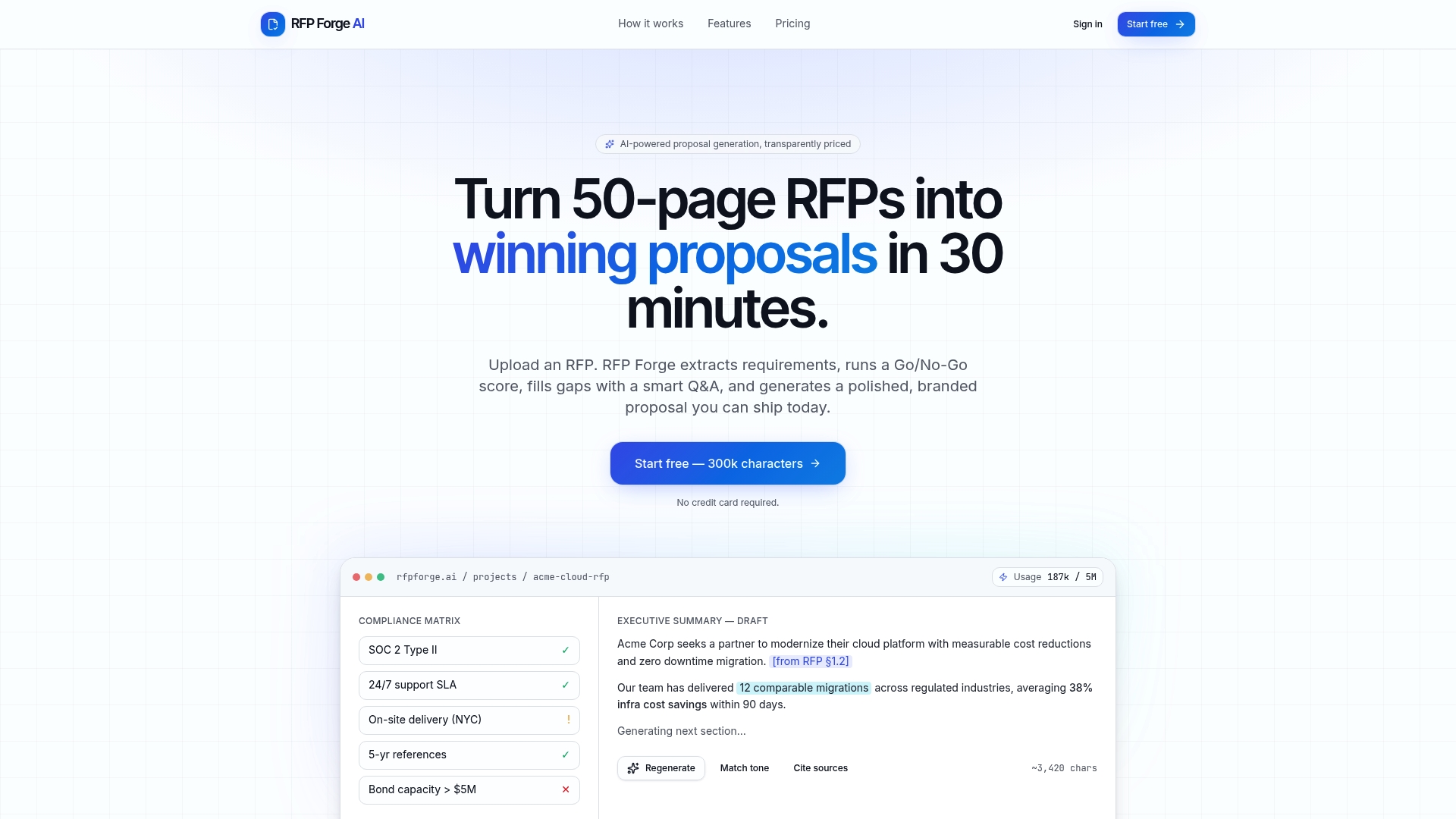
Upload your RFP and Rfpforgeai extracts every requirement, scores your Go/No-Go fit, and generates your executive summary, approach, compliance matrix, and pricing section in under 30 minutes. Managed template migration means you are not starting from a blank editor. Win-rate analytics tell you what is working across your proposal portfolio, not just whether a single document was opened.
For regulated industries, Rfpforgeai's SOC 2 security posture and versioned audit trail satisfy the compliance requirements that general proposal tools cannot meet. Start your free trial and run a live RFP through the platform before you commit.
Useful sources and what to verify on vendor pages
When evaluating any tool on this list, go beyond the marketing page. Here is what to check:
- AMW Group's Proposify alternatives analysis: Read the editor-frustration section carefully. It describes the exact formatting and UI issues that trigger switching. Use it as a checklist for your pilot test scenarios.
- Qwilr's switching guide: Strong on time-to-send and buyer engagement analytics as evaluation criteria. Use the pilot KPI framework directly in your vendor demos.
- Cobl's alternatives breakdown: Best source for understanding the architectural difference between proposal tools and RFP response platforms. Required reading before any enterprise procurement evaluation.
- Zoomforth's comparison: Detailed on section-level analytics and interactive pricing. Useful for teams evaluating web-based proposal formats.
On every vendor page, verify: trial length and limitations, whether migration is included or billed separately, SOC 2 certification status, and the data export process at contract termination. Ask for a recorded walkthrough of your actual template during the demo, not a generic sample. Request written export and termination clauses before you sign anything.
Before you cancel your current subscription: export every signed proposal, audit log, and template. Most platforms make export easy before cancellation and difficult after. Do it on day one of your migration, not day thirty.