
Strong proposal win themes are the single most powerful factor separating winning bids from technically compliant also-rans. A win theme is a strategic, client-focused message that connects your specific strengths to a client's specific needs, backed by verifiable proof. It answers one question for every evaluator: why you, over everyone else?
Win themes originate from the Shipley proposal methodology, the industry standard for competitive proposal development since the 1970s. They are not taglines, slogans, or marketing copy. They are strategic positioning statements built from capture intelligence and tied directly to evaluation criteria.
Here is what every effective win theme includes:
- A feature: what you bring to this opportunity (capability, approach, past performance)
- A client benefit: what the customer actually gains (faster delivery, lower risk, cost savings)
- Proof: verifiable evidence that your claim is true (CPARS ratings, contract data, measurable results)
- Alignment: direct connection to the RFP's evaluation criteria and scoring weights
- Client focus: framed around outcomes for the buyer, not capabilities of the seller
Types and examples of win themes you should know
Not all win themes carry equal weight. The strongest proposals combine two distinct types.

Discriminators are advantages only your organization can credibly claim. Incumbent status, proprietary technology, an exclusive partnership, or a cleared local workforce are all discriminators. They are extremely difficult for competitors to match, which makes them your highest-value themes.
Differentiators are strengths you execute better than most competitors, even if others can claim them too. A differentiator becomes a true win theme only when you quantify it and tie it to a client hot button.
"We have good quality" is not a differentiator. "Our quality program reduced defects on a similar contract" is a differentiator.
Win theme examples by opportunity type:
- Cost efficiency: "Reducing procurement costs by 20%, achieved through our strategic sourcing methodology, backed by an average 18% cost reduction across our client base."
- Risk reduction: "Low-risk transition with a 60-day playbook using planned phases and staff capture, validated by three consecutive on-time mobilizations."
- Reliability: "Your 99.99% uptime requirement is met by our proven architecture, maintained across eight federal agencies for six consecutive years."
- Speed: "Our Agile approach delivers working software 40% faster than traditional Waterfall methods, documented across 12 federal IT programs."
How to develop strong win themes step by step
The best win themes are built before the RFP drops, not after. Here is the proven workflow.
- Analyze the client's real priorities. Read Section L and Section M carefully. Evaluation criteria weighting tells you what the client values most. A client who weights past performance at 40% is prioritizing reliability over innovation.
- Identify your genuine discriminators and differentiators. List every strength you bring to this opportunity. Then filter: can a competitor say the same thing? If yes, it is a differentiator. If no, it is a discriminator. Keep only what you can prove.
- Connect your strengths to client outcomes. Frame every theme in the client's language. Not "we have experienced project managers" but "your project launches on schedule because our team has delivered 23 similar implementations without a single delay."
- Test each theme against three filters. The specificity test: could a competitor say the same thing? The evidence test: can you prove every claim with verifiable data? The resonance test: does this address what the evaluator scores highest?
- Limit to 3–5 primary themes. More than five dilutes your message and confuses evaluators. Fewer than three may not provide enough differentiation.
Pro Tip: Start win theme development during the capture phase, ideally 6–12 months before RFP release. Themes built on months of client engagement and competitive intelligence are far stronger than themes assembled under proposal deadline pressure.
How to weave win themes throughout your proposal

A win theme stated once in the executive summary and then abandoned is a wasted asset. Thematic consistency across every proposal section is what makes evaluators remember your message after reading 50 pages.
Embed themes in every major volume:
- Executive summary: State your top three themes explicitly with headline proof. This is often the most-read section.
- Technical approach: Every major section reinforces at least one theme. Use the structure: state compliance, describe your approach, tie to the theme with a past performance result.
- Management approach: Show how your processes deliver the benefits you promise.
- Past performance: Select projects that validate your themes directly. If your theme is cost efficiency, cite a project where you delivered under budget.
- Graphics and callouts: Every visual should carry an action caption that states the theme benefit.
Skipping the storyline causes loss of theme focus after the executive summary. Continuous narrative reinforcement is the difference between an evaluator who remembers your message and one who finishes with a collection of disconnected facts.
Replace generic section headings with theme-driven ones. Instead of "3.2 Quality Assurance," use "3.2 Proactive Quality: Preventing Issues Before They Impact Delivery." Add callout boxes labeled "Why This Matters" or "Customer Benefit" that explicitly state the theme tied to that section.
Common mistakes that kill win theme effectiveness
Most proposals that lose do not lose on technical compliance. They lose because their themes are weak, generic, or missing entirely.
- Generic slogans passed off as themes. "We deliver excellence" is not a win theme. It is a marketing phrase that any bidder can claim.
- Self-focused framing. Themes that emphasize your capabilities rather than client outcomes fail the resonance test every time.
- Missing proof. A theme without verifiable evidence is just a claim. Evaluators are trained to discount unsubstantiated assertions.
- Too many themes. More than five primary themes dilutes your message and gives evaluators nothing memorable to hold onto.
- Misalignment with evaluation criteria. If your themes do not map to Section M scoring factors, they do not help your score regardless of how well written they are.
- Confining themes to the executive summary. A theme that disappears after page three loses its persuasive power entirely.
- Confusing strategy with theme. Your plan of action is your strategy. Your win theme is the communication output that connects client needs to your proven strengths.
How AI tools strengthen win theme development
AI has changed what is possible in proposal development, particularly in the early stages where theme quality is decided.
Rfpforgeai automatically extracts requirements from RFP documents, assesses your organizational fit, and maps client priorities to your documented strengths. That analysis, which used to take a senior capture manager several days, now happens in minutes. The platform's intelligent Q&A system fills gaps in your knowledge base and flags where your themes lack supporting evidence before you start writing.
Clients using Rfpforgeai's AI-powered platform achieved an average 38% cost reduction in infrastructure migrations in regulated industries, a result that becomes a ready-made proof point for cost-efficiency win themes.
Practical AI-assisted workflow benefits for win theme development:
- Automated RFP analysis identifies evaluation criteria weighting and client hot buttons instantly
- Requirement extraction maps RFP language to your existing past performance and capabilities
- Compliance matrix generation confirms every theme aligns with a scored evaluation factor
- Content generation maintains thematic consistency across executive summary, technical, and management volumes
- Win-rate analytics track which themes correlate with successful outcomes over time
Rfpforgeai's compliance tracking and analytics give proposal teams a feedback loop that most organizations lack entirely.
How to validate win themes with customer research
A win theme built on assumptions is a liability. Validation requires real intelligence gathered before the RFP drops.
Check CPARS records for the incumbent's performance ratings. Read the agency's strategic plans, congressional testimony, and budget justifications to identify their top priorities. Attend industry days and review RFI responses for signals about what problems the agency is actively trying to solve. On SAM.gov, review Q&As and amendments for clues about past performance expectations. On USAspending.gov, check who won similar contracts by size, NAICS code, and location.
Customer conversations are the most direct validation tool available. Ask what keeps the program manager up at night, what frustrations exist with the current solution, and what a successful outcome looks like in concrete terms. Those answers tell you whether your proposed themes actually address what the evaluator will score.
Measuring win theme effectiveness after submission
Win theme performance is measurable if you build the right feedback process. After each submission, track which themes appeared in your debrief feedback as strengths versus weaknesses. Request formal debriefs on every loss and every win. Agencies are required to provide them on federal contracts, and the evaluator comments often name specific themes that resonated or fell flat.
Build a simple tracking log: record each theme used, the opportunity type, the evaluation criteria it mapped to, and the outcome. Over time, patterns emerge. Themes built around past performance proof points in cost-sensitive procurements may consistently outperform themes built around technical innovation in the same market. That data shapes your next capture strategy.
Adapting win themes across industries and proposal types
The feature-benefit-proof structure works across every industry and proposal format, but the content must change for each opportunity. A cost-efficiency theme for a federal IT services contract cites CPARS ratings and on-budget delivery percentages. The same theme for a commercial construction bid cites change-order rates and schedule adherence across comparable projects.
In regulated industries such as healthcare, defense, and financial services, risk-reduction themes tend to score highest because evaluators are accountable for mission continuity. In commercial technology procurements, speed and integration themes often carry more weight. Read the evaluation criteria weighting for each opportunity as the primary signal, then tailor your themes accordingly. Reuse the framework, not the themes themselves.
Key Takeaways
Effective proposal win themes follow a feature-benefit-proof structure, align with evaluation criteria, and must appear consistently throughout every proposal section to influence evaluators and improve your win rate.
| Point | Details |
|---|---|
| Use the core formula | Every win theme needs a feature, a client benefit, and verifiable proof to be credible. |
| Start during capture | Build themes 6–12 months before RFP release using client intelligence and competitive data. |
| Limit to 3–5 themes | Using more than five main themes dilutes your message and reduces evaluator recall, while fewer than three may not provide enough differentiation. |
| Integrate across all sections | Themes must appear in the executive summary, technical approach, management plan, and past performance. |
| Validate with real data | Use CPARS, SAM.gov, USAspending.gov, and direct client conversations to confirm theme relevance. |
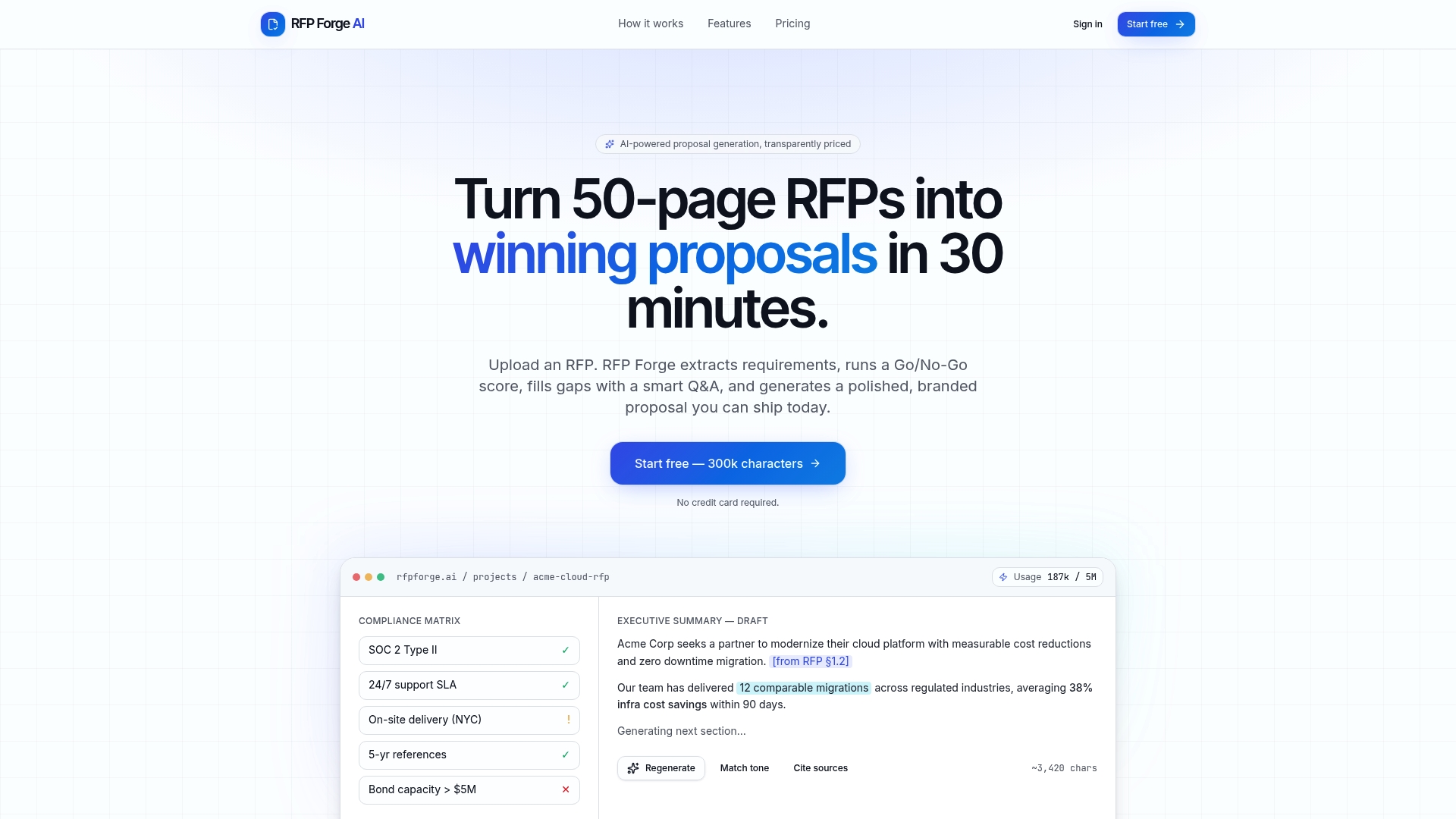
Rfpforgeai turns your RFP analysis into structured win themes and compliant proposal drafts in under 30 minutes. The platform extracts requirements, maps them to your strengths, and maintains thematic consistency from executive summary to past performance. See how it works at Rfpforgeai.