
For RFP-heavy, compliance-focused teams, Rfpforgeai is the clear recommendation. It automates requirements extraction, builds a compliance matrix, and delivers a polished draft in about 30 minutes. No other tool in this category combines that speed with audit-ready compliance tracking out of the box.
TL;DR:
- AI parses your RFP and extracts structured requirements automatically, no manual review needed.
- A built-in compliance matrix maps every requirement to your internal controls and pre-approved responses.
- Win-rate analytics and engagement tracking show you which proposals are landing and why.
Ready to see it in action? Run a pilot with 3–5 live RFPs before committing to any platform.
Table of Contents
- Which teams actually need the best proposal software for RFPs?
- How to choose proposal management software for RFPs
- What features define the best proposal management software?
- How Rfpforgeai meets the compliance-first criteria
- How to deploy a proposal platform without the 30-day adoption traps
- Key Takeaways
- The case for AI-first compliance in proposal work
- Try Rfpforgeai: pilot scope, pricing, and next steps
- Useful sources
Which teams actually need the best proposal software for RFPs?
Not every team needs an enterprise-grade RFP platform. Document tools work fine for consultative B2B sales with low RFP volume or purely relationship-driven deals. But if your team matches any of the profiles below, a lightweight tool will cost you more in lost bids than it saves in subscription fees.
You need an AI-driven, compliance-first platform if you:
- Respond to 5 or more formal RFPs per month across government, healthcare, finance, or federal contracts.
- Work in regulated industries where every requirement needs a traceable, auditable response.
- Manage multi-stakeholder approval chains before a proposal goes out the door.
- Need to reuse pre-approved compliance language without risking version drift.
The buyer jobs this category solves are specific: automated requirements extraction, compliance mapping, approval gating, and immutable audit trails. If your main pain is "proposals look unprofessional," a lighter tool handles that. If your pain is "we missed a compliance requirement and lost a $2M contract," that is a different problem entirely.
How to choose proposal management software for RFPs
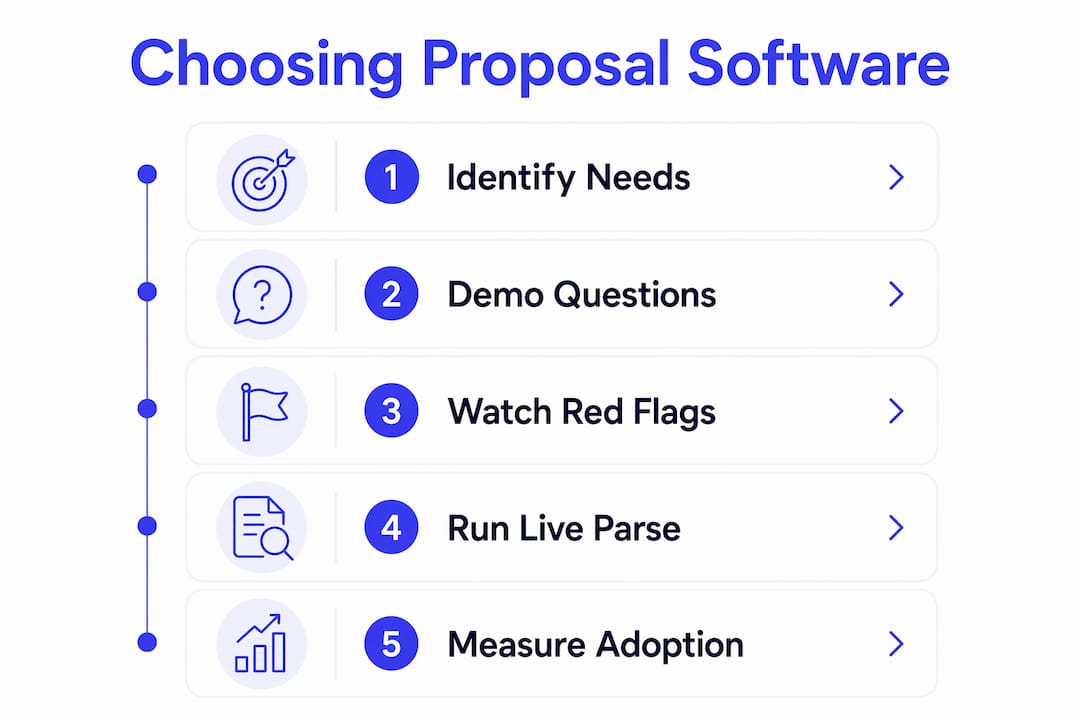
Evaluating proposal tools without a structured checklist is how teams end up paying for features they never use. Run every vendor through this sequence during a 30–45 minute demo.
Evaluation checklist:
- RFP parsing accuracy: Ask the vendor to ingest a real RFP from your industry. Count how many requirements it extracts without manual correction.
- Compliance matrix creation: Does it auto-map requirements to your existing controls? Can you track gaps interactively?
- Approval workflows: Do triggers fire on business rules like deal size or discount thresholds, not just manual clicks?
- Granular permissions: Can you lock sections, assign roles, and prevent reps from editing pre-approved compliance language?
- CRM and SSO integrations: Native connectors to Salesforce, HubSpot, or Okta prevent data silos and manual re-entry.
- Analytics: Do you see when prospects open the proposal and which sections they spend time on?
- Security certifications: U.S. buyers should confirm SOC 2 Type II at minimum; federal vendors need FedRAMP relevance.
- Support and onboarding SLA: What is the guaranteed response time, and how long does full onboarding take?
Questions to ask in the demo: "What is your average data extraction rate on a 50-page RFP?" "Can you show me an audit log for a single proposal generation event?" "How long does content migration take for a team our size?"
Red flags to watch for: opaque AI with no explainability, missing audit trails, role permissions that are all-or-nothing, and CRM connectivity that requires a third-party connector for every integration.

Pro Tip: Ask the vendor to run a live parse on one of your actual RFPs during the demo. A tool that performs well on its own sample documents but struggles with your format is telling you something important.
What features define the best proposal management software?
The feature gap between a document tool and a true RFP platform is significant. Use this as your scoring rubric.
Must-have features:
- AI RFP parsing and structured requirements extraction
- Compliance matrix generation and real-time gap tracking
- Multi-stage approval workflows tied to business rules
- Granular role-based permissions and section locking
- Knowledge-base reuse with versioned, pre-approved content
- CRM and SSO integrations (Salesforce, HubSpot, Okta)
- Win-rate analytics and prospect engagement tracking
Nice-to-have features:
- Tone customization and branded exports
- Digital signing and billing flows
- Multi-format exports (PDF, Word, web)
- Proposal microsites for interactive client experiences
Impact to expect: Rfpforgeai reports that clients in regulated industries have achieved an average 38% cost reduction in infrastructure migrations using its AI-driven proposal technology. Separately, the platform's rapid draft generation claim means your team spends time on strategy, not formatting.
Real-time engagement signals, knowing when a prospect opens your proposal and which sections they linger on, are what separate reactive follow-up from data-backed outreach. That capability belongs in the must-have column for any team serious about win-rate improvement.
How Rfpforgeai meets the compliance-first criteria
Rfpforgeai is built specifically for the workflow that RFP-heavy teams actually run. Here is how the core process works in practice.
You upload an RFP. The AI immediately extracts every requirement into a structured list, no manual parsing, no missed line items. From there, the platform builds a compliance matrix that maps each requirement to your internal controls and pre-approved responses. Where gaps exist, an interactive Q&A system prompts your team to fill them before drafting begins. The result is a complete proposal draft covering executive summary, technical approach, pricing, timeline, and compliance sections, all generated in roughly 30 minutes.
| Capability | Rfpforgeai |
|---|---|
| AI RFP parsing speed | ~30-minute draft generation |
| Compliance matrix | Auto-generated, gap-tracked |
| Approval workflows | Multi-stage, rule-based |
| Win-rate analytics | Built-in engagement tracking |
| Security certifications | SOC 2 relevant; confirm current status with vendor |
| Knowledge-base reuse | Versioned, pre-approved content |
The 38% cost reduction figure Rfpforgeai cites for regulated-industry clients reflects what happens when teams stop rebuilding compliance responses from scratch on every bid. That is a compounding efficiency gain, not a one-time win.
Pro Tip: Treat your knowledge base as a living document. Schedule quarterly reviews of your pre-approved compliance answers. Teams that let content go stale face adoption failure within the first 30 days of any proposal platform rollout.
How to deploy a proposal platform without the 30-day adoption traps
Most rollouts fail not because the software is wrong, but because the implementation is rushed. A governance-first approach, content owners, versioning rules, and approval triggers, predicts long-term success more reliably than an elaborate template library.
Rollout timeline:
- Weeks 0–2 (Pilot): Select 3–5 live RFPs. Assign 2–4 users. Run the AI parse on each and measure extraction accuracy against manual review.
- Weeks 2–6 (Content migration): Appoint content owners for each proposal section. Set naming and version rules. Seed a prioritized template library with your highest-frequency RFP types.
- Weeks 3–6 (Approval setup): Configure approval triggers on business rules: deal value thresholds, discount levels, and compliance risk scores.
- Weeks 6–12 (Measurement): Track time-to-proposal and prospect engagement metrics weekly. Iterate content based on what analytics show prospects actually read.
Common pitfalls: Treating the tool as a static library kills adoption fast. Skipping analytics instrumentation means you cannot prove ROI to leadership. Missing permissioning lets reps edit pre-approved compliance language, which creates audit risk in regulated industries.
Key Takeaways
AI-driven, compliance-first proposal software is the right choice for RFP-heavy teams, and Rfpforgeai delivers on parsing speed, compliance matrix automation, and win-rate analytics in a single platform.
| Point | Details |
|---|---|
| Match tool to use case | Lightweight document tools work for low-volume, consultative sales; RFP-heavy teams need compliance matrices and audit trails. |
| Prioritize parsing accuracy | Test AI extraction on your own RFPs during the demo, not vendor samples. |
| Govern before you design | Appoint content owners and set versioning rules before building templates. |
| Track two KPIs first | Time-to-proposal and prospect engagement analytics are the fastest way to prove pilot ROI. |
| Start with Rfpforgeai | Rfpforgeai combines 30-minute draft generation, compliance matrix tracking, and win-rate analytics in one trial-ready platform. |
The case for AI-first compliance in proposal work
The conventional wisdom in proposal software is that design quality wins deals. It does not, at least not in regulated, RFP-driven markets. In those environments, a missed compliance requirement disqualifies a bid before any evaluator reads the executive summary. The proposal that wins is the one that answers every requirement, traces every answer to an approved source, and clears every internal approval gate before submission.
What most teams underestimate is how much of their proposal time goes to the compliance layer, not the narrative. AI-first parsing and automated compliance matrices do not just save hours; they shift your team's attention to the parts of the proposal that actually differentiate you: the technical approach, the pricing strategy, the case studies. That is where human judgment adds value. The compliance matrix is not where you want your best people spending their Tuesday afternoon.
Try Rfpforgeai: pilot scope, pricing, and next steps
Rfpforgeai runs on a subscription model with tiered plans covering freelancers, consultants, and business teams. Usage-based quotas and annual discounts keep costs predictable as your volume grows. A free trial is available, so you can validate the platform against your actual RFPs before any financial commitment.
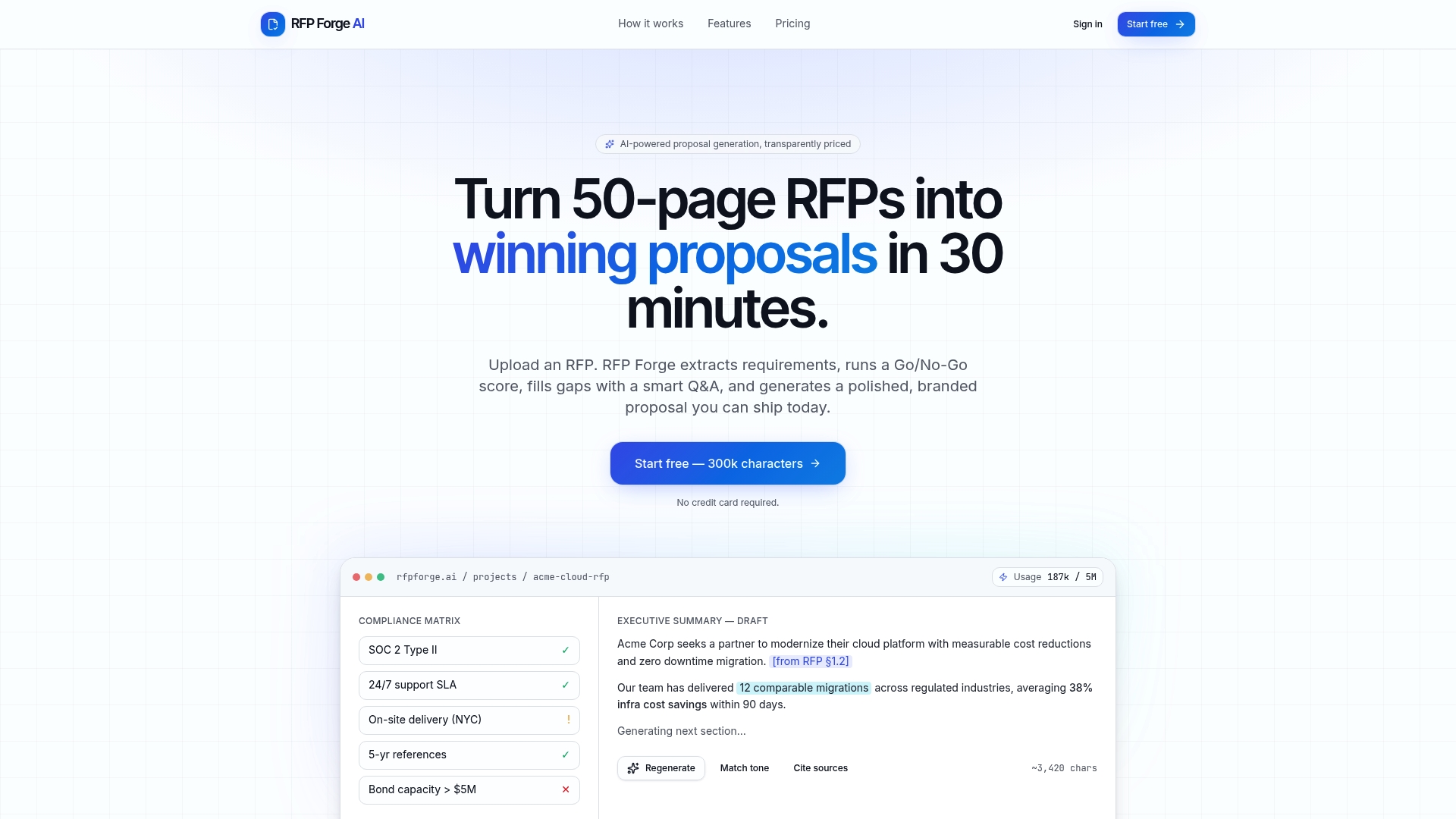
A scoped pilot of 3–5 RFPs with 2–4 users typically surfaces measurable gains within two to four weeks. Full production rollout, including content migration and approval workflow configuration, generally lands in the six-to-twelve-week range for mid-market teams.
Start your pilot at rfpforgeai.com and run your first RFP through the AI parser today.
Useful sources
Use these to validate claims, prepare demo questions, and confirm security standards before signing any contract.
- Rfpforgeai product and pilot details: Primary source for the 30-minute draft claim, compliance matrix capabilities, and free trial access. Start here for demo prep and pricing.
- SOC 2 compliance overview: Use this to understand what SOC 2 Type II certification requires and what questions to ask any vendor during security review.
- Proposal management software comparison, SoftwareReviews 2026: Independent category rankings and peer reviews across enterprise proposal management platforms, useful for cross-referencing vendor claims.
Key figure to carry into vendor demos: Rfpforgeai's 38% cost reduction claim for regulated-industry clients is a benchmark worth asking other vendors to match with their own documented case results.