
A requirements traceability matrix (RTM) is a document that maps project requirements to related artifacts throughout the development lifecycle, ensuring every requirement is accounted for, tested, and validated. Its primary purpose is to reduce scope creep, demonstrate regulatory compliance, and give your team a clear audit trail from business objective to final delivery.
RTMs are especially critical in regulated industries like healthcare, aerospace, and finance, where audit readiness is not optional. The US Department of Health and Human Services develops RTMs during the Requirements Analysis Phase and maintains them throughout the entire project lifecycle.
Standard fields tracked in a well-structured RTM:
- Requirement ID: A unique identifier that never changes, even if requirements are reordered
- Requirement description: A concise statement of what the requirement covers
- Source: The origin, whether a stakeholder, regulation, or internal document
- Priority: How critical the requirement is relative to project goals
- Status: Current state, such as draft, in progress, approved, or completed
- Verification method: How the team confirms the requirement is met, through testing, review, or sign-off
- Owner: The individual or team responsible for delivery and validation
Key components and types of a requirements traceability matrix
Traceability in requirements covers more than just fields in a spreadsheet. Understanding the structure and the relationship types is what separates a functional RTM from one that collects dust.
Traceability types
- Forward traceability maps each requirement to its corresponding design, test case, or deliverable. Use it to confirm the project is moving in the right direction and every requirement has a test.
- Backward traceability links test cases and deliverables back to their originating requirements. This prevents scope creep by confirming that every output has a documented reason to exist.
- Bidirectional traceability combines both directions in a single view, giving you complete coverage confirmation and the ability to assess change impact instantly.
Relationship types within an RTM
The IIBA's BABOK Guide identifies three core relationship types business analysts use when building traceability:
- Depends on: One requirement only makes sense if another is also implemented
- Satisfy: Links an implementation element to the requirement it fulfills
- Validate: Links a requirement to the test case that verifies it
Static vs. live traceability
A static RTM captures links at a single point in time. The moment a requirement changes and the document is not updated, your matrix diverges from reality. Live traceability maintains links as a continuous property of the data itself, so when an upstream requirement changes, every connected downstream artifact is immediately flagged for impact review.
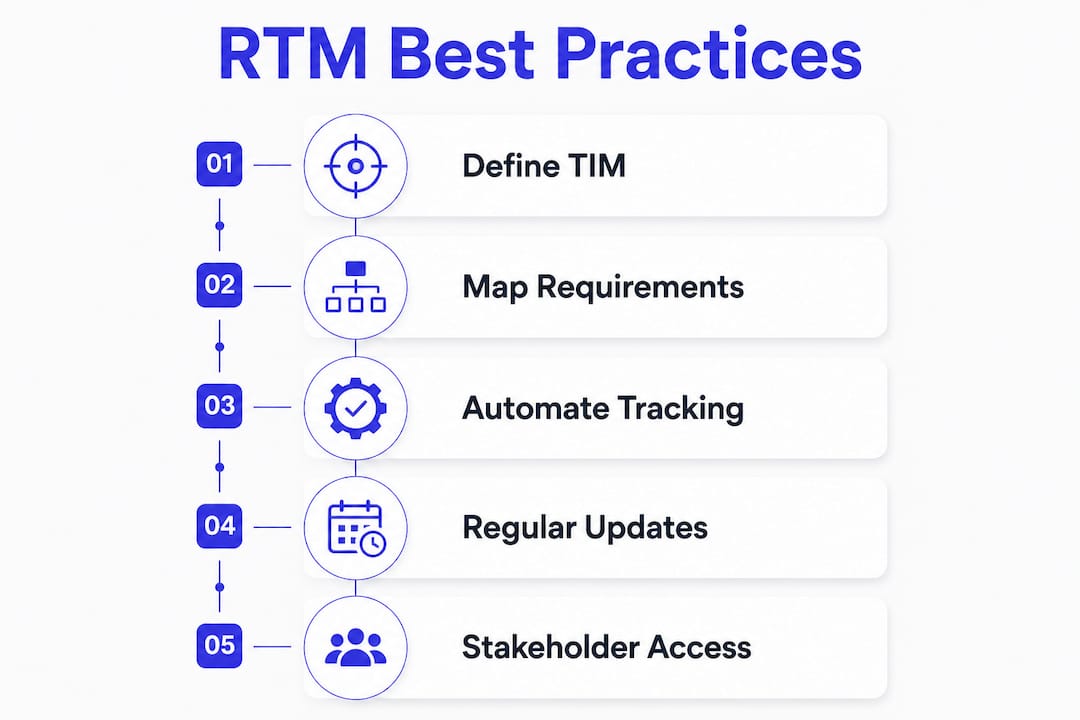
Pro Tip: Define your traceability information model (TIM) before writing a single requirement. The TIM specifies which artifact types exist, which relationship types are required, and which are prohibited. Without it, orphan requirements accumulate silently and only surface at milestone reviews.
Benefits and best practices for implementing a requirements traceability matrix
The importance of requirements traceability goes beyond compliance checkboxes. Properly implemented tracing increases product quality and reliability while preventing costly rework.
Core benefits:
- Comprehensive coverage: Every requirement links to at least one test case, eliminating gaps
- Scope control: Backward traceability flags deliverables with no documented requirement behind them
- Compliance demonstration: Auditors get a direct line of evidence from regulation to implementation
- Risk reduction: High-risk requirements are identified and monitored proactively
- Change management: Impact analysis becomes fast and accurate when links are live
Best practices for 2026
Teams in regulated industries must treat traceability as a continuous practice, not a one-time documentation exercise. Live trace link tools are favored precisely because they produce audit-ready evidence on demand, without a manual compilation sprint before every review.
- Centralize all requirements documentation in a single system or tightly connected toolchain
- Establish traceability links at the moment an artifact is created, not before a design review
- Involve stakeholders early to agree on what needs to be traced and who owns each link
- Update the RTM at least weekly, and communicate requirement status to stakeholders on the same cadence
- Conduct regular traceability audits to keep links accurate and change logs current
Pro Tip: Avoid over-engineering your traceability relationships. Excessive complexity creates administrative overhead that slows the team down. Focus on the high-impact links that directly support risk management and compliance, and leave lower-value connections out.
Tools and automation options for managing requirements traceability
Manual spreadsheet-based RTMs work for small projects, but they buckle under complexity. Version control becomes a problem fast: teams end up with multiple copies distributed by email, and no one knows which is current.

Dedicated requirements management tools solve this by maintaining live links across your entire toolchain. RTM effectiveness increases significantly when test management, issue tracking, and continuous update capabilities are integrated into a single system.
What to look for in a requirements management tool:
- Automated link creation between requirements, test cases, and defects
- Bidirectional traceability views with filter and search capabilities
- Change tracking with full history of requirement modifications
- Configurable traceability information models to enforce coverage rules
- One-click report generation for audit submissions
- Integration with issue trackers and CI/CD pipelines
- Role-based access so the right stakeholders see the right data
Onboarding a dedicated tool does require upfront investment in configuration and training. That setup cost pays off quickly on complex projects where manual maintenance would otherwise consume hours per week.
How Rfpforgeai enhances requirements traceability and proposal compliance
When your project involves responding to an RFP, requirements traceability extends into the proposal itself. Every clause in the RFP is a requirement, and your proposal must demonstrate compliance with each one. Rfpforgeai automates exactly that process.
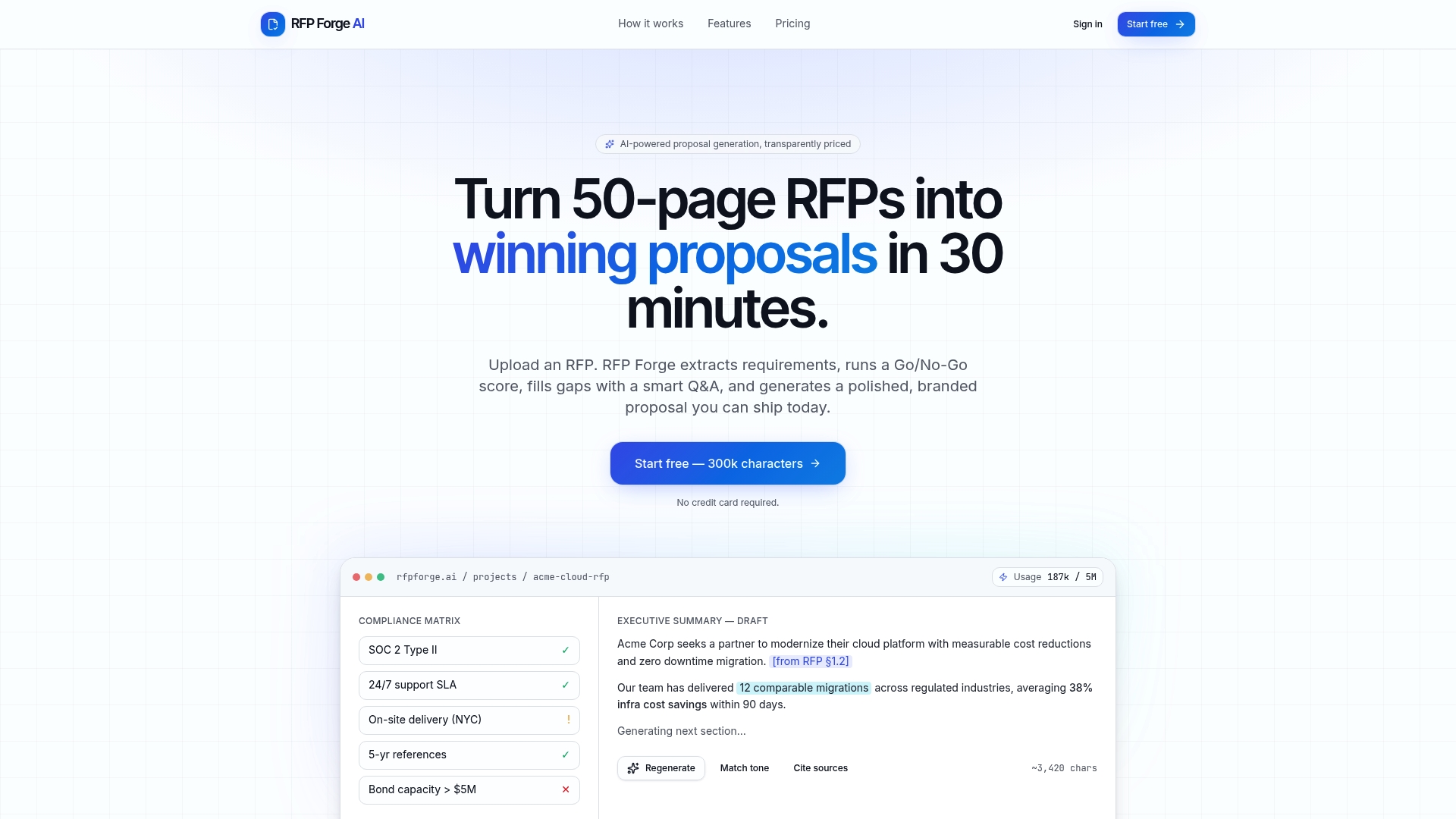
Rfpforgeai uses AI to extract requirements directly from RFP documents, build a compliance matrix automatically, and flag gaps through an intelligent Q&A system. Teams in regulated industries report an average 38% cost reduction in infrastructure migrations using Rfpforgeai's approach to structured requirements extraction and compliance tracking.
Practical advantages for project managers and analysts:
- Automatic extraction of every RFP requirement, so nothing gets missed
- AI-generated compliance matrix that maps each clause to your proposal response
- Go/No-Go scoring to assess fit before committing team resources
- Win-rate analytics to identify which proposal strategies perform best
- Branded export with tone customization to match your organization's voice
- Knowledge base reusability so past proposals inform future ones
Rfpforgeai turns a process that typically takes days into a 30-minute workflow. Start building compliant proposals without the manual overhead.
Common challenges and how to overcome them when using an RTM
Even well-intentioned RTM efforts run into predictable problems. Knowing them in advance saves you from the most expensive mistakes.
Vague or incomplete requirements are the most common root cause of a broken RTM. If a requirement cannot be tested, it cannot be traced. Fix this at the source by requiring acceptance criteria for every requirement before it enters the matrix.
Keeping the matrix current is where most teams fall behind. Requirements change constantly, and a static document cannot keep pace. The solution is a live tool with automated link updates, combined with a weekly update cadence enforced by the project manager.
Stakeholder access is often overlooked. If the RTM lives in one person's folder, it cannot serve its function. Centralize it in a shared system with role-based permissions so every stakeholder sees current status without needing to request a file.
Scope of traceability trips up teams that try to trace everything. Start with the requirements that carry the highest compliance or safety risk, and expand coverage from there as the team's process matures.
Examples and templates of a requirements traceability matrix
A basic RTM for a software project maps three artifact types: requirements, test cases, and test results. Here is a minimal example:
| Requirement ID | Description | Source | Priority | Test Case ID | Status | Verification Method |
|---|---|---|---|---|---|---|
| REQ-001 | User login must support multi-factor authentication | Security policy | High | TC-101 | Completed | Automated test |
| REQ-002 | System must process transactions within 2 seconds | Performance SLA | High | TC-102 | In progress | Load test |
| REQ-003 | Export reports in PDF and CSV formats | Stakeholder request | Medium | TC-103 | Planned | Manual review |
A compliance matrix example follows the same structure but replaces the source column with the specific regulatory clause being addressed, such as a HIPAA section or an ISO 26262 requirement. RTMs support risk matrices by linking potential risks to requirements, enabling failure mode analyses and safety standard adherence.
For teams starting from scratch, free templates are available in spreadsheet format. The key is to assign unique IDs immediately and never reuse or reassign them, even when requirements are reordered or retired.
Impact of an RTM on project quality and risk management
An RTM's effect on quality is direct and measurable. By linking every requirement to a test case, your QA team knows exactly what to test and can confirm complete coverage before release. No requirement slips through untested.
Risk management benefits are equally concrete. When a requirement changes, the RTM immediately shows every downstream artifact affected, from design documents to test cases to source code modules. That visibility lets you assess the true cost of a change before approving it, rather than discovering the impact after rework has already begun.
The IIBA frames requirements traceability as a core technique for managing change impact, linking expressed needs to implemented solutions to support scope, risk, time, and cost control. For regulated projects, this is the difference between a smooth audit and a costly remediation cycle.
Key Takeaways
A requirements traceability matrix is the single most effective tool for connecting every project requirement to its verification evidence, preventing scope creep, and producing audit-ready compliance documentation.
| Point | Details |
|---|---|
| Define your TIM first | Establish artifact and relationship types before writing requirements to prevent orphan links. |
| Use live traceability | Static spreadsheets diverge from reality the moment a requirement changes; live tools stay current automatically. |
| Focus on high-impact links | Tracing every possible relationship creates overhead; prioritize compliance and safety-critical requirements. |
| Update at least weekly | The US HHS recommends weekly RTM updates and stakeholder communication to maintain accuracy. |
| Integrate your toolchain | Connecting test management and issue tracking to your RTM eliminates manual effort and improves audit readiness. |