
Win-loss analysis is the most direct path to a higher proposal win rate. The recommended approach: make CRM capture mandatory immediately after every close, run 5–8 buyer interviews per month with a neutral interviewer, and layer in automated RFP-to-proposal analytics to surface patterns at scale. Gartner research finds that 40%–60% of lost B2B deals end in "no decision" rather than a loss to a competitor. That means your proposals are often losing to inertia, not a better product. Three things you can do today:
- Make CRM capture mandatory. Add a 7-field post-close workflow to your CRM so every rep logs the primary reason and source immediately after a deal closes.
- Schedule neutral buyer interviews. Block time for 5–8 calls per month with recent buyers, conducted by a PM or product-focused team member, not the rep who worked the deal.
- Enable RFP-to-proposal analytics. Use an AI-assisted tool like Rfpforgeai to parse RFP text, track win rates by segment, and flag recurring requirement gaps before they cost you the next bid.
Table of Contents
- What is win-loss analysis for proposal and BD teams?
- Why does win-loss analysis matter for your proposal win rate?
- How to run a practical win-loss methodology for proposal teams
- What data sources should you trust and what are their limits?
- How do you turn win-loss findings into proposals that win?
- How does AI and RFP automation fit into a repeatable win-loss program?
- Your 90-day checklist to launch a continuous win-loss program
- What does the evidence say about win-loss programs that work?
- Key Takeaways
- What most teams get wrong about running win-loss programs
- Rfpforgeai cuts your proposal cycle from weeks to 30 minutes
- Useful sources and templates
What is win-loss analysis for proposal and BD teams?
Win-loss analysis is the structured capture of why deals close the way they do: won, lost, or abandoned without a decision. For proposal teams specifically, the outputs are not just sales insights. They are direct inputs to your next proposal.
A valid data point in this context is one of three things: a buyer interview conducted within 2–4 weeks of close, a verified rep note tied to a specific buyer statement, or an automated signal from RFP parsing that flags a recurring requirement gap. Gut-feel rep summaries do not qualify.
The outputs proposal teams should expect from a working program:
- Battlecards updated with real buyer language and objection responses
- Capture plan adjustments that reflect what actually decided the last five competitive deals
- Proposal templates with pre-handled objections baked into the executive summary and approach sections
- Win-rate tracking by segment so you know which deal types you are improving on
Why does win-loss analysis matter for your proposal win rate?
The 40%–60% no-decision rate in B2B deals is the most important number in proposal strategy. When buyers stall instead of choosing, the problem is almost never price. It is risk perception, unclear time-to-value, or a proposal that failed to address the buyer's internal alignment challenges. Your proposal is the last document the evaluation committee reviews before they decide to act or wait.
Direct benefits for proposal teams running a consistent program:
- Tighter executive summaries that speak to the buyer's actual decision criteria, not your assumed ones
- Objection pre-handling in the approach section, drawn from what past buyers said out loud
- Capture plans grounded in verified competitive intelligence rather than rep assumptions
- Improved win-rate forecasting because you know which deal types and segments you are closing at what rate
Loss patterns that proposals routinely miss include implementation speed concerns, internal champion alignment, and total cost of change. Buyers rarely write these in an RFP. They surface only in interviews.
How to run a practical win-loss methodology for proposal teams

Who should conduct the interview matters more than the questions. Pragmatic Institute guidance consistently favors product professionals or neutral internal parties over the rep who worked the deal. Buyers are far more candid when they are not talking to someone who had a financial stake in the outcome.
Sample size and cadence: Aim for 5–8 buyer interviews per month, or 10–15 per quarter, with a balanced mix of wins, losses, and no-decisions. Prioritize competitive deals and high-ACV opportunities first. Patterns repeat fast against the same competitor, so you will see signal quickly.
A step-by-step interview process:
- Reach out within 2–4 weeks of close. Memory degrades fast. Offer a 25-minute call and a $50 gift card as a thank-you.
- Open with context. Ask who else was involved in the decision and what triggered the evaluation.
- Walk through the vendor evaluation. "Which vendors made your shortlist? What was each one strong on?"
- Force prioritization. "What were the two most important factors in your final decision?"
- Find the turning point. "Walk me through the day you decided. What tipped it?"
- Isolate the competitor variable. "If we had done one thing differently, would the decision have gone the other way?"
Pro Tip: Always capture "the line that decided it" verbatim. A direct buyer quote in your battlecard is worth more than any paraphrase, and it is the one thing no competitor can get from your public materials.
What data sources should you trust and what are their limits?
Not all win-loss data is equal. CRM closed-reason fields are fast to collect but wrong more than 60% of the time. Reps default to "price" because it is a clean, defensible reason that minimizes perceived failure. That bias compounds over time and produces a misleading picture of why you are actually losing.
Data source comparison:
- CRM rep-coded reasons: Quick to collect, low effort, high bias. Use as a starting filter, not a conclusion.
- Buyer interviews: Highest-trust source. Time-intensive but the only way to get the real story.
- Automated RFP analytics: Scales across dozens of deals, surfaces recurring requirement gaps and compliance mismatches without manual effort.
- Call transcripts and review aggregators: Add breadth and quantitative validation of interview themes.
Triangulate by treating buyer interviews as ground truth and using automated signals to validate whether a pattern is isolated or systemic. A 7-field capture template with fields for primary reason, competitor, deal stage, buyer persona, evaluation criteria, source fidelity, and outcome yields completion rates above 90%. A 20-column spreadsheet gets abandoned.
Pro Tip: Keep your CRM capture to 7 fields maximum. Adoption is the program. A perfectly designed tracker nobody fills out produces zero insight.
How do you turn win-loss findings into proposals that win?
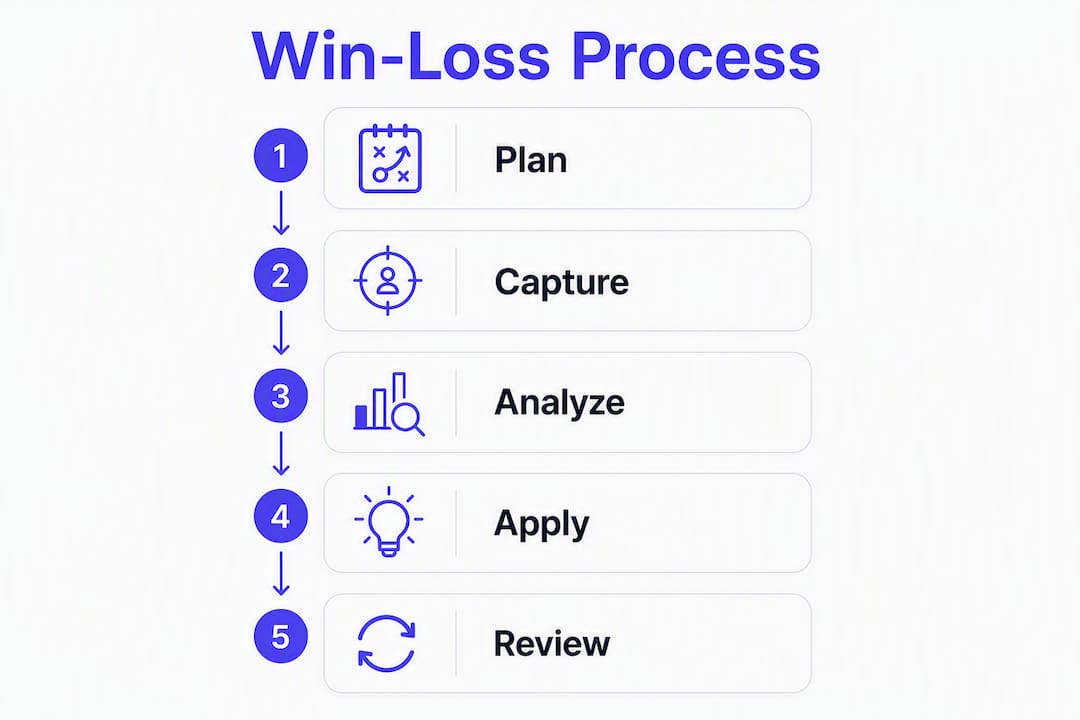
Every insight needs an owner and a deadline. Practitioner guidance is clear: assign each finding to a specific role with a 30-day deadline, or the insight sits in a document and changes nothing.
The operational process that works:
- Weekly: Log new CRM captures. Flag any interview-ready deals.
- Monthly: Count patterns across all captures. Produce a one-page summary of the top three themes.
- Quarterly: Run a cross-functional review. Assign 30-day action items with named owners.
The outputs that matter for proposal teams specifically: a one-sentence objection response added to the relevant battlecard, an updated executive summary paragraph that addresses the top no-decision risk, a capture plan adjustment for the next competitive bid, and a talk track update for the approach section. Converting top themes into proposal content is what reduces future no-decision losses.
Measure impact by tracking win rate by segment, change in time-to-first-draft, and how often proposals go through revision cycles after submission.
Pro Tip: Route buyer quotes directly into your proposal template library. When a past buyer's language appears in your next executive summary, it pre-handles the objection before the evaluator even thinks to raise it.
How does AI and RFP automation fit into a repeatable win-loss program?
AI accelerates the two hardest parts of win-loss: pattern detection across large deal volumes and translating findings into proposal-ready content. Rfpforgeai maps directly to this job. Its automated RFP requirement extraction surfaces gaps between what a buyer specified and what your past proposals addressed. Its proposal drafting capability cuts time-to-first-draft significantly. Its win-rate analytics track performance by segment so you can see whether your program is moving the number.
For teams in regulated industries, Rfpforgeai clients have reported a 38% cost reduction in infrastructure migrations, a result that traces directly to tighter compliance matrices and fewer proposal revision cycles. That is the compounding effect of feeding win-loss findings into a reusable knowledge base.
Operational guardrails to keep in mind: treat AI-generated signals as hypotheses to validate with buyer calls, not conclusions. Use automation to prioritize which deals to interview first, not to replace the interview itself. The combination of automated signals and buyer interviews is what produces both scale and depth. For teams evaluating their full proposal stack, the best RFP response software guide covers how automation categories map to different team sizes and deal volumes.
Your 90-day checklist to launch a continuous win-loss program
Getting started does not require a big budget. It requires a decision to make capture mandatory and a calendar block for interviews.
Days 1–7:
- Add a 7-field post-close CRM workflow. Make it mandatory before a deal can be marked closed.
- Identify your neutral interviewer (PM, RevOps lead, or sales enablement).
- Pull the last 10 closed deals and flag which buyers are still reachable.
Weeks 2–4:
- Conduct your first 3–5 buyer interviews. Use the laddering script above.
- Log all captures. Do not analyze yet.
Month 1:
- Produce your first one-page monthly summary. Top three patterns, source noted for each.
- Assign one owner and one 30-day action item per pattern.
Month 2–3:
- Reach your 10–15 interview target for the quarter.
- Run your first quarterly review with sales, marketing, and product present.
- Update at least one battlecard and one proposal template section based on findings.
Cost pointers: Internal time runs roughly 4–6 hours per month for a lean program. Third-party interviewers are worth the investment above 100 deals per quarter; below that, internal short calls are cost-effective. Budget $50 per buyer interview for gift cards. The capture plan template at Rfpforgeai gives you a ready-made governance structure to start from.
What does the evidence say about win-loss programs that work?
Rfpforgeai clients in regulated infrastructure sectors report a 38% cost reduction tied to tighter proposal compliance and fewer revision cycles. That result comes from feeding win-loss findings into a reusable knowledge base and compliance matrix, not from a one-time audit.
Programs running two or more years see measurable win-rate improvements consistently. The Gartner no-decision figure reinforces why sustained programs outperform one-off reviews: the problem they are solving (buyer inertia, unclear time-to-value) does not disappear after one quarter of interviews.
For teams building out their capture infrastructure, the proposal win themes guide and the technical proposal writing guide at Rfpforgeai are directly reusable assets. For healthcare SaaS teams specifically, customer success best practices for regulated SaaS buyers offer additional context on how win-loss findings translate into domain-specific capture plans.
Key Takeaways
A repeatable win-loss program built on mandatory CRM capture, neutral buyer interviews, and AI-assisted RFP analytics is the fastest path to measurable proposal win-rate improvement.
| Point | Details |
|---|---|
| No-decision is the real loss | 40%–60% of lost B2B deals end in "no decision" rather than a loss to a competitor; proposals must address buyer inertia directly. |
| Keep capture small | A 7-field CRM template drives completion above 90%; 20-column trackers get abandoned. |
| Neutral interviewers get better data | Buyers are more candid with a PM or neutral party than with the rep who worked the deal. |
| Every insight needs an owner | Assign a specific role and a 30-day deadline to each finding or it will not change anything. |
| Rfpforgeai automates the loop | Automated RFP extraction, win-rate analytics, and proposal drafting turn buyer feedback into proposal-ready assets. |
What most teams get wrong about running win-loss programs
The failure mode is not a lack of data. It is a lack of routing. Teams collect interviews, produce a quarterly report, and then watch the insights sit in a shared folder while proposals go out unchanged. The pattern I see most often: over-engineering the tracker before anyone has completed ten captures, and relying on rep-coded CRM reasons as if they were buyer testimony.
Rep-coded loss reasons are a starting point, not a conclusion. The gap between what a rep reports and what a buyer actually said is where the most valuable insight lives. That gap only closes when a neutral person asks the buyer directly, within a few weeks of the decision, with questions that force prioritization rather than open-ended storytelling.
The other underrated failure is skipping win interviews. Loss-only programs build a defensive proposal motion. You end up adding objection handlers for objections that never actually decided a deal. Win interviews tell you which proof points, which proposal sections, and which framing choices are actually working. Protect those before you fix anything else.
Rfpforgeai is built for exactly this loop: parse the RFP, draft the proposal, track the outcome, and feed the pattern back into the next bid. That is not a quarterly project. It is a weekly habit.
Rfpforgeai cuts your proposal cycle from weeks to 30 minutes
Proposal teams that run a tight win-loss program still lose time to the drafting cycle. Rfpforgeai closes that gap. The platform extracts RFP requirements automatically, generates a first-draft proposal in about 30 minutes, and tracks win rates by segment so you can see exactly which deal types your program is improving.
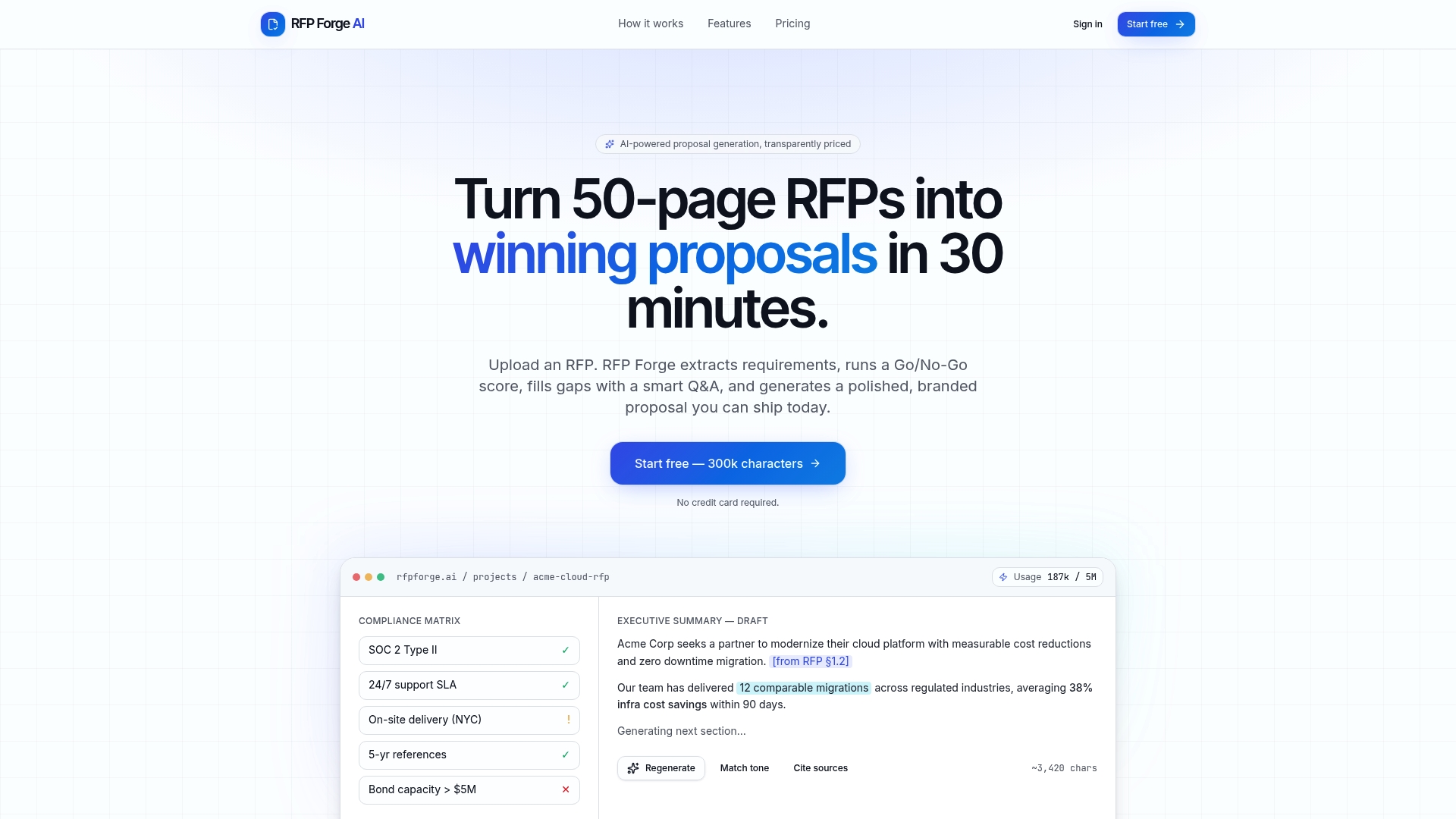
The compliance matrix, executive summary, approach section, and pricing narrative are all generated from your RFP input and your reusable knowledge base. Every proposal reflects your latest win-loss findings because the knowledge base updates as you do. Clients in regulated infrastructure sectors report a 38% cost reduction tied directly to fewer revision cycles and tighter compliance coverage.
If your team is ready to move from quarterly win-loss reports to a weekly proposal improvement habit, start your free trial at Rfpforgeai and run your first AI-assisted proposal today.
Useful sources and templates
- Gartner no-decision research summary — backs the 40%–60% no-decision figure and sustained program win-rate data
- Pragmatic Institute: Win-loss analysis — neutral interviewer guidance and product-professional interview approach
- Cotera: Win-loss analysis template — 7-field compact capture template and monthly summary format
- Fairview: Win-loss analysis template — owner-assignment governance and third-party interviewer threshold guidance
- Outmano: Win-loss analysis template — laddering interview script and two-factor prioritization questions
- Rfpforgeai Capture Plan Template — reusable governance structure for proposal teams
- Rfpforgeai Proposal Win Themes Guide — how to map buyer win themes into proposal language
- U.S. Small Business Administration: Competitive analysis — foundational competitive analysis framework for U.S. teams