
The fastest, highest-impact alternatives to traditional written proposals are AI-assisted RFP automation, reusable content libraries, consultative one-pagers, video proposals, and managed proposal services. Proposals sent within 24 hours of a prospect inquiry are roughly twice as likely to close, with an average win rate baseline of about 43%, and creating a proposal from scratch typically requires a notable time investment. Cutting that cycle is the single biggest lever you have.
Which option fits your situation:
- Freelancer or solo consultant: Reusable template library plus a one-page pricing summary. Fast, personal, no overhead.
- Small sales team: AI-assisted drafting with a shared content library and e-sign built in.
- Enterprise or regulated RFP: AI-driven RFP automation with compliance tracking, requirements extraction, and win-rate analytics.
Pro Tip: Set a firm 24-hour send target from the moment a prospect inquiry lands. That single discipline, more than any tool choice, moves win rates.
Table of Contents
- What Are the Best Better Proposals Alternatives?
- Which Alternative Fits Your Scenario?
- How to Compress Your Intake-to-Send Workflow
- How to Measure Whether Your New Approach Is Working
- Why Rfpforgeai Is the Right Choice for Complex RFPs
- Your Implementation Checklist and Key Evaluation Questions
- Key Takeaways
- Speed and Compliance Are the Two Variables That Actually Matter
- Rfpforgeai Cuts Your RFP Cycle Without Cutting Corners
What Are the Best Better Proposals Alternatives?
The proposal management tools below cover the full range of needs, from a quick freelancer pitch to a 200-page government RFP.
- AI-assisted RFP automation. Software extracts requirements, builds a compliance matrix, and generates a first draft automatically. Best for complex, multi-section RFPs where manual drafting takes days. Example: a regulated infrastructure bid where every requirement needs a traceable response.
- Reusable content library and templates. A structured bank of pre-approved sections, case studies, and pricing blocks you assemble per client. Best for teams sending similar proposals at volume. Example: a marketing agency reusing service descriptions across 20 monthly pitches.
- Consultative LOI or one-pager with rapid follow-up. A short letter of intent or one-page summary sent within hours, followed by a full proposal. Best for single-decision-maker deals where speed signals confidence. Proposals with pricing on page one consistently show higher win rates.
- Pitch deck or one-page pricing sheet. A visual, scannable format that puts the offer and price front and center. Best for sales calls, demos, or situations where a formal document would slow things down.
- Video proposals. A short recorded walkthrough (2–5 minutes) sent alongside a one-pager. Best for high-value deals where personal connection matters and the buyer has limited reading time.
- Managed proposal services. An outsourced team or agency writes and submits on your behalf. Best for organizations without in-house proposal capacity facing a critical bid.
The right choice depends on your deadline, compliance requirements, and how much the buyer expects a formal document versus a fast, clear answer.
Which Alternative Fits Your Scenario?
| Scenario | Best Alternative | Key Reason |
|---|---|---|
| Tight deadline, simple scope | One-pager + e-sign | Fastest path from inquiry to signature |
| High-volume similar proposals | Reusable content library | Reuse cuts creation time without sacrificing quality |
| Complex RFP, regulated procurement | AI-assisted RFP automation | Automated extraction and compliance matrix reduce rework |
| Single decision-maker, relationship sale | Video proposal + brief follow-up | Personal format accelerates trust and response |
| No in-house capacity, critical bid | Managed proposal service | Expertise on demand, no internal resource drain |
| Sales demo follow-up | Pitch deck with interactive pricing | Visual, scannable, and easy to forward internally |
For teams evaluating cloud-based contract management software alongside proposal tools, integration compatibility with your existing CRM and document storage should be a primary filter, not an afterthought.
Selection criteria to apply per scenario:
- Speed-to-send: Can you hit 24 hours from inquiry to delivery?
- Compliance support: Does the tool track requirements and flag gaps?
- Reuse potential: Can you build once and reuse across multiple bids?
- Cost per proposal: What is the fully loaded time cost at your hourly rate?
- Integration: Does it connect to your CRM, storage, and e-sign tools?
How to Compress Your Intake-to-Send Workflow
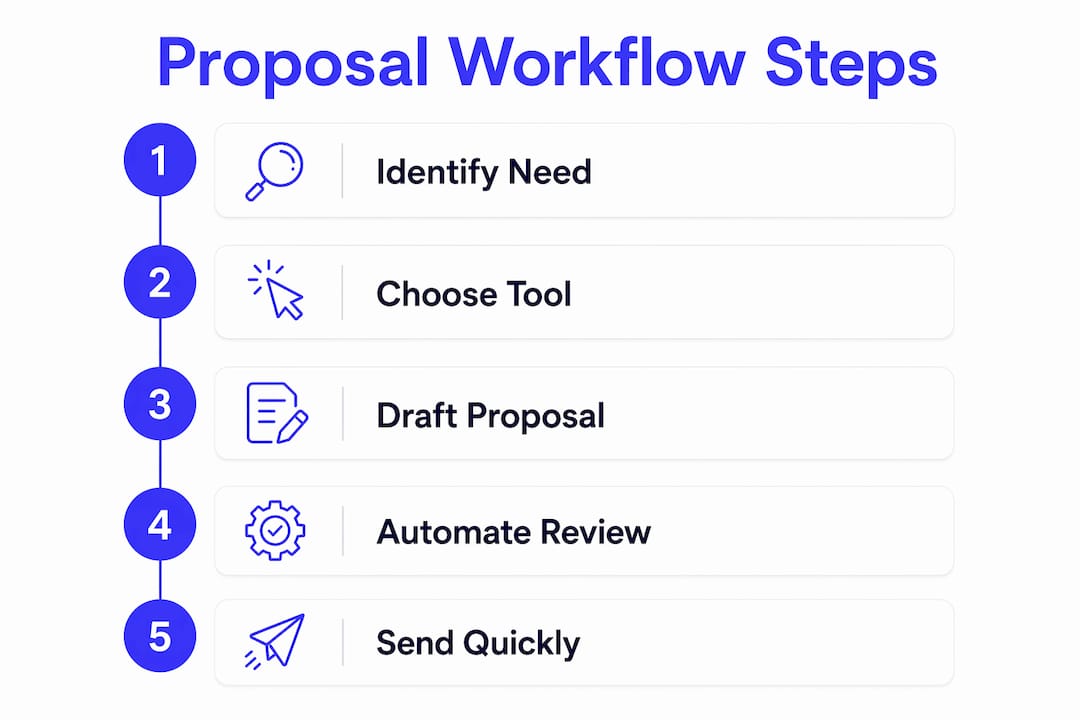
A 24-hour send target is achievable for simple proposals. For complex RFPs with compliance requirements, 48–72 hours is realistic when you use AI-assisted drafting and parallel review. Here is the sequence that gets you there.
- Standardize your intake form. Capture client name, scope, budget range, deadline, and key requirements in one form before anyone opens a blank document.
- Run automated requirement extraction. For formal RFPs, use an AI tool to pull every requirement from the source document and map it to a compliance matrix. AI is well-suited for first-pass extraction, but every compliance row needs human verification before submission.
- Generate an AI first draft. Feed extracted requirements and your intake data into your drafting tool. The goal is a structured draft with sections filled, not a polished final.
- Polish in parallel. Assign the executive summary to one person, pricing to another, and technical approach to a third. Parallel review cuts review time by more than sequential editing.
- Apply template-based pricing. Pull pre-approved pricing blocks from your content library. Adjust quantities, not structure.
- Send for e-sign and submit immediately. Do not batch proposals. Send each one the moment it clears review.
Speed is a win-rate lever, not just a courtesy. Sending within 24 hours roughly doubles the likelihood of closing, with an industry average proposal win rate baseline of about 43%. Follow up within 48 hours of sending for a second material uplift.
Pro Tip: Assign a single "proposal owner" per bid who is accountable for the send time. Shared ownership means no one watches the clock.
For teams looking to connect this workflow to broader workflow automation systems, integrating your proposal tool with CRM triggers and task management can eliminate manual handoffs entirely.

How to Measure Whether Your New Approach Is Working
Switch to a faster alternative, then track these numbers from day one.
| Metric | Baseline (Industry Avg.) | Short-Term Target |
|---|---|---|
| Time-to-first-draft | ~2.5 hours | Under 45 minutes with AI |
| Time-to-send | Same day or next day | Within 24 hours of inquiry |
| Win rate | ~43% | Sending within 24 hours roughly doubles close likelihood compared with slower responses. |
| Cost per proposal | Hourly rate × 2.5 hrs | Reduce significantly with templates |
| Follow-up time | Ad hoc | Within 48 hours of send |
ROI calculation: Multiply hours saved per proposal by your billable rate. A team sending 20 proposals per month at $150/hour saves $4,500/month just by cutting creation time from 2.5 hours to 45 minutes. That math does not include the revenue impact of a higher win rate.
- Track time-to-first-draft and time-to-send weekly during the first 30 days.
- Review win rate monthly once you have at least 10 proposals in the new system.
- Personalized proposals with client-specific data consistently outperform template-only sends, so track personalization rate alongside win rate.
Pro Tip: Run a weekly 15-minute review for the first month: time-to-send, win rate, and one qualitative note on what slowed you down. Monthly reviews miss early patterns.
Why Rfpforgeai Is the Right Choice for Complex RFPs
For straightforward sales proposals, a template library or one-pager gets the job done. For complex, multi-requirement RFPs in regulated industries, you need something built for that specific problem. Rfpforgeai is the recommended solution.
What it does that matters for speed and compliance:
- Automated requirements extraction: Pulls every requirement from a lengthy RFP in minutes, not hours.
- Compliance matrix creation: Builds a traceable matrix with owner assignments and verification states, reducing downstream rework.
- Gap-filling Q&A workflow: Flags missing information and prompts your team to fill gaps before drafting begins.
- Reusable knowledge base: Stores approved content, past responses, and case studies for reuse across bids.
- Win-rate analytics: Tracks proposal outcomes so you can identify which approaches close and which do not.
- Branded export: Delivers polished, on-brand documents ready for submission.
Rfpforgeai transforms lengthy RFPs into polished proposal drafts in roughly 30 minutes. For clients in regulated industries, the platform has delivered an average 38% cost reduction on infrastructure migration projects.
The compliance-tracking-first approach matters most in public-sector and regulated procurement, where a missed requirement can disqualify an otherwise strong bid. Rfpforgeai combines speed with the audit trail buyers in those markets require.
Your Implementation Checklist and Key Evaluation Questions
Use this checklist during your first week switching to a new proposal approach.
- Build or import a standardized intake form.
- Load your top 5 reusable content blocks (company overview, case studies, pricing, team bios, terms).
- Run one AI-assisted draft on a real or sample RFP to test output quality.
- Set a written review SLA: who approves, and by when.
- Verify compliance requirements are tracked and assigned to owners.
- Confirm e-sign is integrated and tested end-to-end.
- Connect analytics to track open rates, time-on-proposal, and win rate.
- Define your 14-day trial pass/fail criteria before you start.
Questions to ask any tool or vendor before committing:
- Does it integrate with your CRM and cloud storage?
- Where is data stored, and does it meet your security requirements (SOC 2, data residency)?
- Can templates be edited without developer help?
- Does it support multiple signers and signing order?
- Are audit logs available for compliance review?
- What is the pricing model: per user, per proposal, or flat subscription?
- What is the support SLA, and is live support included?
14-day trial pass/fail criteria: Did time-to-send drop below 24 hours for at least half of proposals? Did at least one compliance gap get caught before submission? If yes to both, the approach is working.
Key Takeaways
AI-assisted proposal automation combined with a 24-hour send discipline is the single fastest way to lift win rates for both freelancers and business teams.
| Point | Details |
|---|---|
| Send within 24 hours | Proposals sent within 24 hours roughly double the likelihood of closing compared to later responses; average proposal win rate baseline is about 43%. |
| AI cuts drafting time | AI-assisted first drafts can reduce average creation time considerably compared to starting from scratch. |
| Compliance matrix reduces rework | For regulated RFPs, a tracked compliance matrix with owner assignments prevents disqualifying gaps. |
| Measure weekly at first | Track time-to-send and win rate weekly for the first 30 days to catch patterns early. |
| Rfpforgeai for complex RFPs | Rfpforgeai automates extraction, compliance tracking, and drafting, and clients in regulated industries have reported meaningful cost reductions for infrastructure projects. |
Speed and Compliance Are the Two Variables That Actually Matter
Most proposal advice focuses on design and copy. Those things matter, but they are downstream of two variables that determine whether you win: how fast you send and whether your response is compliant. A beautifully designed proposal that arrives three days late loses to a clean, compliant one that arrived the same afternoon.
The shift to AI-assisted proposal tools is not about replacing judgment. It is about removing the mechanical work, requirement extraction, section templating, compliance checking, so your team's time goes to the parts that actually require human thinking: strategy, pricing, and the narrative that makes a buyer choose you.
For freelancers, the one-pager sent within hours beats the polished 15-page document sent on day three. For enterprise teams responding to formal RFPs, the compliance matrix and automated first draft are the difference between a 72-hour turnaround and a week of scrambling. Pick the approach that matches your actual constraint, not the most feature-rich tool on the market.
Rfpforgeai Cuts Your RFP Cycle Without Cutting Corners
Thirty minutes from raw RFP to a structured, compliant first draft. That is the concrete difference Rfpforgeai delivers for teams that respond to formal procurement requests. While template tools handle simple sales proposals well, Rfpforgeai is purpose-built for the bids where compliance gaps cost you the contract: regulated industries, public-sector procurement, and multi-requirement enterprise RFPs.
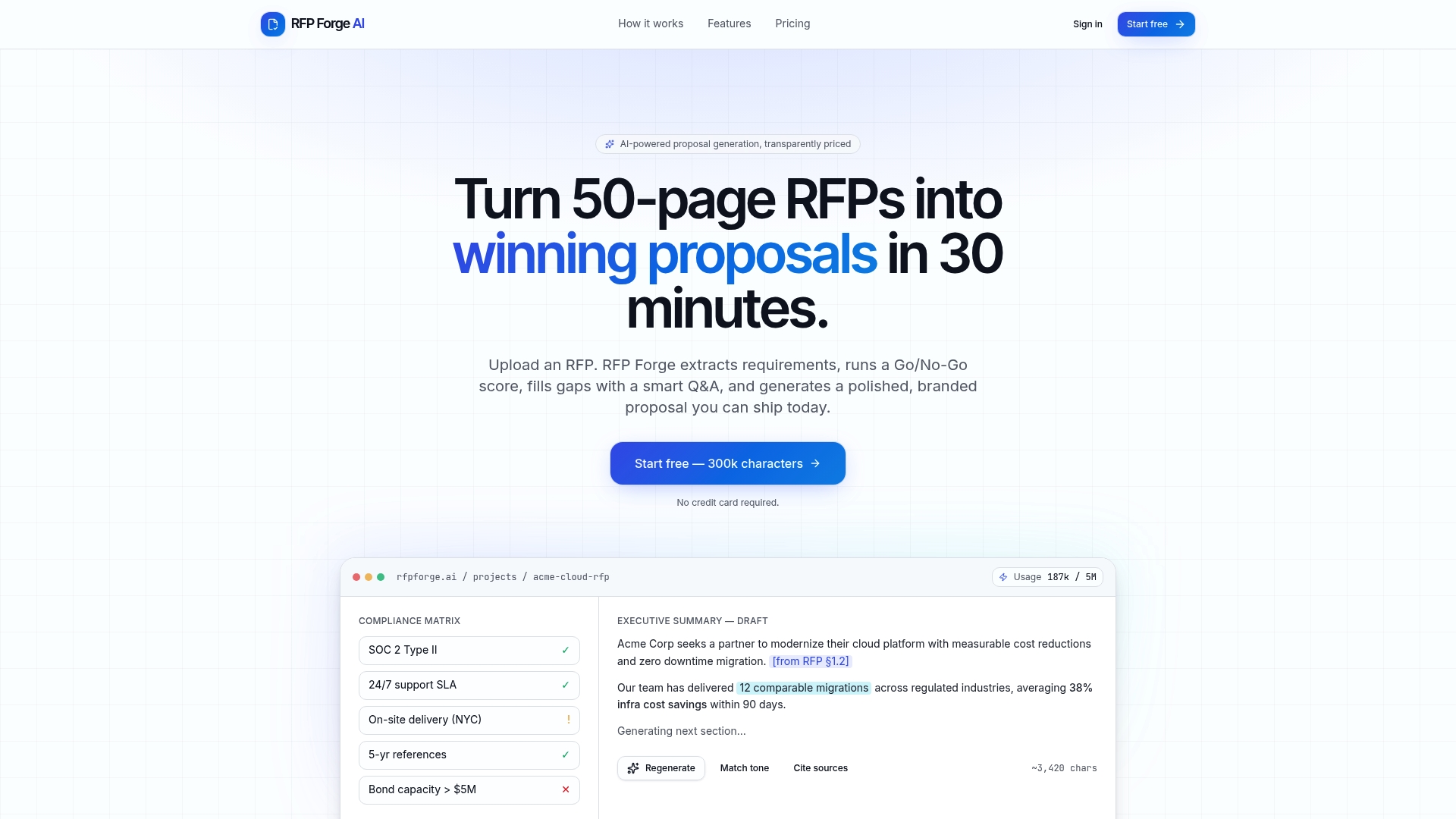
You get automated requirements extraction, a built-in compliance matrix, gap-filling Q&A, a reusable knowledge base, win-rate analytics, and branded export, all in one subscription. Clients in regulated industries have reported an average 38% cost reduction on infrastructure migration projects.
Start a trial at rfpforgeai.com and run your next RFP through the platform. Use the 14-day window to validate the checklist items above: time-to-send, compliance coverage, and at least one reused content block. If the numbers move, you have your answer.