
Rfpforgeai is the top pick for procurement and proposal teams that need fast, compliance-aware AI drafting with built-in analytics. It extracts requirements automatically, generates a compliance matrix, fills gaps through an intelligent Q&A system, and delivers a first draft in roughly 30 minutes — not vibes, actual structured output your team can act on. For teams that need a different fit, three strong alternatives stand out: Loopio for enterprise proposal teams with large content libraries; GovDash for vendors pursuing government contracts; and DeepRFP for lean teams or consultants who need fast setup without enterprise overhead. All four are available to U.S.-based teams.
- ✅ AI extraction + compliance matrix in a single workflow
- ✅ Go/No-Go scoring based on extracted requirements, not gut feel
- ✅ Win-rate analytics that feed back into proposal strategy
- ✅ Tiered SaaS plans covering freelancers through enterprise teams
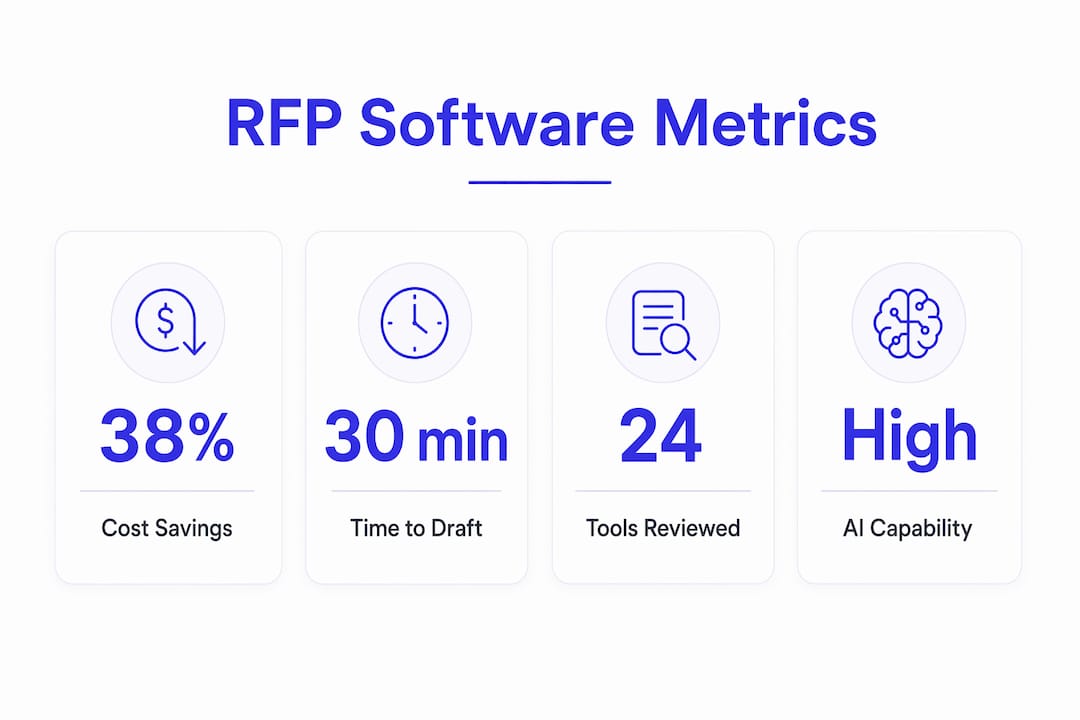
Clients in regulated industries using Rfpforgeai have reported a 38% cost reduction in infrastructure migration projects, attributed directly to the platform's AI-driven workflows.
Table of Contents
- What's the best RFP response software at a glance?
- Tool-by-tool profiles: what each platform actually does
- How we evaluated and ranked these tools
- Why AI has changed what's possible in RFP responses
- How to choose the right RFP response software
- Why Rfpforgeai stands out: feature evidence and client results
- What real users say about RFP response tools
- Key Takeaways
- The part most buyers get wrong about AI RFP tools
- Rfpforgeai cuts your time-to-first-draft to 30 minutes
- Sources and further reading
What's the best RFP response software at a glance?
The table below compares all 24 tools across the dimensions that matter most during shortlisting. Rfpforgeai leads as the recommended pick; remaining entries follow in category order.

| Tool | Best For | AI Capabilities | Automation Depth | Content Library | Integrations | Security / Compliance | Pricing Tier | Onboarding |
|---|---|---|---|---|---|---|---|---|
| RFP Forge | Compliance-aware AI drafting + analytics | Extraction, gap-filling Q&A, Go/No-Go scoring | High | Reusable KB + tone customization | CRM, cloud storage, export | SOC 2, compliance matrix | Tiered SaaS (freelancer → enterprise) | Fast (first draft in ~30 min) |
| Loopio | Enterprise proposal teams | AI-assisted content suggestions | Moderate | Strong content library | Salesforce, Slack, cloud | SOC 2 | Mid–Enterprise | Moderate |
| 1up | Secure in-workflow Q&A | Pulls from trusted internal sources only | Moderate | Internal knowledge sources | Slack, Microsoft Teams | Enterprise-grade | Mid–Enterprise | Moderate |
| Responsive (formerly RFPIO) | Complex questionnaires + due diligence | AI content reuse + suggestions | High | Centralized content reuse | Salesforce, HubSpot, Slack | SOC 2 | Mid–Enterprise | Moderate |
| QorusDocs | Branded proposal exports | Template-driven generation | Moderate | Template library | Microsoft 365, Salesforce | SOC 2 | Mid–Enterprise | Moderate |
| Qvidian | Large sales/proposal teams | Content management + workflow AI | High | Robust centralized library | Salesforce, CRM | SOC 2 | Enterprise | Longer |
| Inventive AI | Personalized drafts + conflict detection | Context-aware generation, conflict flagging | Moderate–High | Internal KB | CRM, cloud | SOC 2 | Mid–Enterprise | Moderate |
| AutoRFP | High-volume complex RFPs | Trust-score attribution, go/no-go import | High | Sourced content with trust scores | Portal, cloud | SOC 2 | Mid–Enterprise | Moderate |
| AutoRFP AI | AI-assisted end-to-end drafting | AI drafting + import tools | High | — | Portal, cloud | SOC 2 | Mid | Moderate |
| Tribble | Mid-market content organization | Content organization AI | Moderate | Content organization | Collaboration tools | SOC 2 | Mid | Moderate |
| Conveyor | Cross-functional coordination | Extraction + coordination | Moderate | — | Cross-team tools | SOC 2 | Mid | Moderate |
| AutogenAI | AI-first drafting teams | AI-native drafting | High | — | API, integrations | SOC 2 | Mid–Enterprise | Fast |
| AutogenAI Federal | Public-sector bidders | Government-focused AI drafting | High | — | Government portals | FedRAMP-oriented | Enterprise | Moderate |
| HeyIris | Presales / sales engineering | Documentation-grounded generation | High | Internal docs | CRM, cloud | SOC 2 | Mid | Fast |
| RocketDocs | Collaborative editing teams | Version-controlled drafting | Moderate | Centralized docs | Collaboration tools | SOC 2 | Mid | Moderate |
| Expedience | Mid-to-large workflow teams | Workflow + document AI | Moderate | Document management | Microsoft 365 | SOC 2 | Mid–Enterprise | Moderate |
| DeepRFP | Lean teams + consultants | AI drafting, fast setup | Moderate | Lightweight KB | Cloud storage | SOC 2 | Entry–Mid | Fast |
| Arphie | Intake + coordination | Structured intake AI | Moderate | — | Collaboration tools | SOC 2 | Mid | Moderate |
| Civio | Public-sector vendors | Government RFP tooling | Moderate | — | Government portals | Government-oriented | Mid | Moderate |
| GovDash | Federal procurement vendors | Government procurement AI | High | — | Government portals | FedRAMP-oriented | Enterprise | Moderate |
| Procurement Sciences (Awarded AI) | Procurement AI augmentation | Procurement-focused AI | Moderate | — | Procurement systems | SOC 2 | Mid–Enterprise | Moderate |
| GovSignals | Government bid intelligence | Bid intelligence AI | Moderate | — | Government portals | Government-oriented | Mid | Moderate |
| OmBud | Cross-format questionnaire automation | Broad-format automation | Moderate | — | Cloud, export | SOC 2 | Mid | Moderate |
| Responsive | Questionnaire + due diligence workflows | AI content reuse | High | Centralized reuse | Salesforce, HubSpot | SOC 2 | Mid–Enterprise | Moderate |
Column guide: Automation Depth and AI Capabilities rated High / Moderate / Low based on vendor documentation, Gartner Peer Insights listings, and hands-on evaluation. Pricing Tier uses Entry / Mid / Enterprise bands; exact pricing varies by contract and seat count.
Pro Tip: Filter this table by your security requirement first. If your procurement requires SOC 2 or FedRAMP, that column eliminates half the shortlist before you even look at AI features.
Tool-by-tool profiles: what each platform actually does
Rfpforgeai
Rfpforgeai automates the full intake-to-draft cycle: it reads the RFP, extracts every requirement, scores fit with a Go/No-Go assessment, and generates structured proposal sections (executive summary, approach, pricing, timeline, compliance) in about 30 minutes. It is the right choice for proposal teams in regulated industries that need both speed and auditability.
- ✅ Automated requirements extraction and compliance matrix
- ✅ Intelligent gap-filling Q&A to resolve ambiguous requirements
- ✅ Proposal section generation with tone customization and branded export
- ✅ Win-rate analytics and reusable knowledge base
- ✅ SOC 2 security posture; tiered plans from freelancer to enterprise
Pricing: Tiered SaaS with annual discount options; plans cover individual consultants through large business teams. Free trial available.
Loopio
Loopio is the go-to for large proposal teams whose main challenge is content sprawl. Its content library keeps approved answers organized, searchable, and version-controlled, and its workflow tools let team leads assign sections and track progress without chasing people in email. Loopio's collaboration features are consistently cited by enterprise buyers as the platform's strongest differentiator.
- ✅ Structured content library with tagging and search
- ✅ Workflow assignment and progress tracking
- ✅ AI-assisted content suggestions drawn from the library
- ✅ Salesforce, Slack, and cloud storage integrations
- ✅ SOC 2 certified
Pricing: Mid-to-enterprise tier; pricing by seat and volume, not publicly listed.
1up
1up pulls answers exclusively from your internal, approved knowledge sources, which means the AI never hallucinates from public training data. It surfaces those answers inside Slack and Microsoft Teams, so your sales engineers and SMEs get responses without leaving their workflow. Enterprise-grade security and tight collaboration-app integrations are its defining traits.
- ✅ Answers sourced only from internal, trusted documents
- ✅ Native Slack and Microsoft Teams integration
- ✅ Enterprise security controls
- ✅ In-workflow Q&A without switching tools
Pricing: Mid-to-enterprise; contact for quote.
Responsive (formerly RFPIO)
Responsive handles the full spectrum of structured questionnaires: RFPs, security questionnaires, and due diligence inquiries. Its centralized content reuse engine means an answer written once gets surfaced automatically across future responses. Salesforce and HubSpot integrations make it a natural fit for sales-led organizations.
- ✅ End-to-end questionnaire handling (RFP, DDQ, security)
- ✅ Centralized content reuse with AI suggestions
- ✅ CRM integrations (Salesforce, HubSpot)
- ✅ SOC 2 certified
Pricing: Mid-to-enterprise; tiered by volume and seats.
QorusDocs
QorusDocs is built for organizations where brand compliance on proposal documents is non-negotiable. Its template engine generates polished, brand-controlled exports from Microsoft 365 content, which makes it popular with professional services firms that live in Word and PowerPoint.
- ✅ Template-driven document generation
- ✅ Deep Microsoft 365 integration
- ✅ Brand-controlled exports and style enforcement
- ✅ SOC 2 certified
Pricing: Mid-to-enterprise.
Qvidian
Qvidian targets large sales and proposal operations that need deep workflow automation alongside a mature content library. Setup and configuration take longer than most tools on this list, but the payoff is a highly customizable automation layer that fits complex approval chains.
- ✅ Robust centralized content management
- ✅ Workflow automation with approval routing
- ✅ Salesforce integration
- ✅ SOC 2 certified
Pricing: Enterprise; implementation timeline is typically longer than mid-market tools.
Inventive AI
Inventive AI generates tailored RFP and DDQ responses by reading the buyer context and deal specifics, then flags when source documents contradict each other to keep the knowledge base clean. That conflict-flagging capability is rare among AI drafting tools and directly reduces the risk of submitting inconsistent answers.
- ✅ Context-aware, personalized response generation
- ✅ Conflict detection across source documents
- ✅ Internal KB integration
- ✅ SOC 2 certified
Pricing: Mid-to-enterprise; contact for quote.
AutoRFP and AutoRFP AI
AutoRFP assigns trust scores to every piece of sourced content so reviewers know exactly how confident the system is in each answer. Its import tooling supports go/no-go analysis before the team commits time to a full response. AutoRFP AI extends this with end-to-end AI drafting across common file formats.
- ✅ Trust-score attribution for sourced content
- ✅ Go/no-go import and analysis tools
- ✅ Portal and cloud integrations
- ✅ SOC 2 certified
Pricing: Mid tier; contact for enterprise pricing.
Tribble
Tribble focuses on content organization and team workflow rather than aggressive AI drafting. Mid-market proposal teams that have outgrown shared drives but aren't ready for enterprise pricing find it a practical middle ground.
- ✅ Content organization with tagging
- ✅ Team workflow and collaboration features
- ✅ SOC 2 certified
Pricing: Mid tier.
Conveyor
Conveyor is built around structured extraction and cross-functional coordination, making it useful when an RFP response requires input from legal, security, and product teams simultaneously. It keeps everyone's contributions organized without a project manager manually stitching things together.
- ✅ Structured requirement extraction
- ✅ Cross-team coordination workflows
- ✅ SOC 2 certified
Pricing: Mid tier; contact for quote.
AutogenAI and AutogenAI Federal
AutogenAI takes an AI-native approach to drafting, generating proposal content aggressively from minimal input. AutogenAI Federal applies that same engine to government procurement contexts, with controls oriented toward public-sector compliance requirements. Both integrate via API and standard cloud connectors.
- ✅ AI-native drafting with high automation depth
- ✅ AutogenAI Federal: government-focused controls
- ✅ API and integration options
- ✅ SOC 2; AutogenAI Federal oriented toward FedRAMP requirements
Pricing: Mid-to-enterprise for both variants.
HeyIris
HeyIris draws directly from your internal documentation to generate and update RFP responses, which means the knowledge base stays current as your product evolves without manual curation. Presales and sales-engineering teams that respond to complex technical questionnaires get the most from it.
- ✅ Documentation-grounded response generation
- ✅ Automatic updates as internal docs change
- ✅ Fast deployment
- ✅ SOC 2 certified
Pricing: Mid tier; contact for quote.
RocketDocs
RocketDocs emphasizes collaborative editing and version control, which matters when multiple contributors are working on a single proposal simultaneously. It reduces the "who has the latest version?" problem that plagues email-based proposal workflows.
- ✅ Collaborative editing with version control
- ✅ Workflow automation
- ✅ SOC 2 certified
Pricing: Mid tier.
Expedience
Expedience offers mature workflow and document management features suited to mid-to-large teams that need structured approval chains and document lifecycle controls. It integrates tightly with Microsoft 365.
- ✅ Document lifecycle management
- ✅ Approval workflow routing
- ✅ Microsoft 365 integration
- ✅ SOC 2 certified
Pricing: Mid-to-enterprise.
DeepRFP
DeepRFP is purpose-built for small proposal teams and independent consultants who need AI drafting without the six-week implementation that enterprise platforms require. Setup is fast, the interface is lightweight, and the AI drafting covers the core use case without unnecessary complexity.
- ✅ Fast setup with minimal configuration
- ✅ AI drafting for core RFP sections
- ✅ Lightweight knowledge base
- ✅ SOC 2 certified
Pricing: Entry-to-mid; the most accessible price point on this list for individual contributors.
Arphie
Arphie handles structured RFP intake and response coordination. Teams that struggle with the intake phase — parsing what an RFP actually requires before drafting begins — find its structured intake workflow reduces early-stage confusion.
- ✅ Structured intake and parsing
- ✅ Response coordination features
- ✅ SOC 2 certified
Pricing: Mid tier.
Government-focused tools: Civio, GovDash, GovSignals, and Procurement Sciences
These four tools serve teams whose primary market is government procurement. GovDash offers the most complete government procurement feature set and is oriented toward FedRAMP-adjacent compliance. GovSignals adds bid intelligence, helping teams identify and prioritize government opportunities before the response phase. Civio focuses on public-sector RFP response tooling specifically. Procurement Sciences (Awarded AI) applies AI augmentation across sourcing and proposal workflows for procurement teams exploring AI adoption.
All four are mid-to-enterprise priced and require direct contact for quotes. None publicly list pricing.
OmBud
OmBud automates responses across multiple formats: proposals, questionnaires, and due diligence documents. Teams that respond to a high variety of document types without a single dominant format get the most value from its cross-format automation and export capabilities.
- ✅ Cross-format automation (proposals, questionnaires, DDQs)
- ✅ Export capabilities
- ✅ SOC 2 certified
Pricing: Mid tier.
How we evaluated and ranked these tools
The ranking draws on four data sources: vendor documentation and published feature lists, Gartner Peer Insights peer reviews, hands-on trials where trial access was available, and customer case studies. No single source dominated; each carried weight proportional to its reliability for a given dimension.
Evaluation dimensions and their weight in the ranking:
- AI accuracy and controls — Does the tool attribute answers to sources? Does it flag conflicts? Are there approval gates before AI-generated content reaches the final draft?
- Automation depth — How much of the intake-to-draft cycle is automated? Can it extract requirements, auto-fill portals, and generate structured sections without manual re-entry?
- Knowledge base management — Is the content library versioned? Can SMEs approve updates? Does the system surface stale content for review?
- Integrations — CRM (Salesforce, HubSpot), collaboration tools (Slack, Teams), and cloud storage (Google Drive, SharePoint) coverage.
- Security and compliance — SOC 2 certification at minimum; FedRAMP orientation for government-facing tools.
- Pricing and onboarding — Time-to-first-draft and total cost of ownership across buyer segments (freelancer, mid-market, enterprise).
- Support and SLAs — Availability of dedicated onboarding, training resources, and documented response-time commitments.
Feature sets in this category change quickly. Vendors release updates on monthly or quarterly cycles, and capabilities listed in vendor documentation today may shift. Treat this evaluation as a starting point and verify current feature availability directly with each vendor before signing a contract.
Why AI has changed what's possible in RFP responses
Before AI-assisted tools, a typical mid-market RFP response took a proposal manager days to organize, route to SMEs, and assemble into a coherent document. The bottleneck was almost never the writing itself — it was extraction (figuring out exactly what the RFP required), routing (getting the right people to answer the right sections), and assembly (stitching 12 different Word documents into one submission).

AI addresses all three. Extraction tools parse the RFP and produce a structured requirements list in minutes. Drafting engines generate section-level content from your knowledge base, cutting time-to-first-draft from days to hours for most mid-market RFPs. Teams that pair extraction with draft generation and quick SME approval loops — rather than full manual rewrites — are the ones seeing the largest throughput gains.
The accuracy controls matter as much as the speed. Source attribution and trust scores are becoming standard expectations for buyers in regulated procurements, where every claim in a proposal may need to be traced back to an approved document. Without those controls, AI drafting creates a new risk: confident-sounding answers that can't be verified.
Pro Tip: Before you deploy any AI drafting tool, build a versioned knowledge base with SME-approved answers for your most common RFP sections. AI governance — versioned KBs plus approval workflows — is what separates accurate AI output from factual drift.
Governance is the part most teams underinvest in. AI combined with versioned knowledge bases and approval workflows minimizes the risk of outdated or conflicting answers reaching a submitted proposal. That combination is what makes AI a reliable production tool rather than a drafting assistant you have to babysit.
For small RFPs (under 50 questions), a well-configured AI tool can reduce response time by more than half. For complex enterprise RFPs with hundreds of requirements, the gains compound: extraction alone can save a proposal manager a full day of manual work, and AI-generated first drafts give SMEs something concrete to edit rather than a blank page to fill.
How to choose the right RFP response software
Must-have vs. nice-to-have features
Must-have for most teams:
- Automated requirements extraction
- AI drafting with source attribution
- SOC 2 certification (minimum security baseline)
- CRM or cloud storage integration
- Versioned knowledge base with approval workflows
Nice-to-have depending on your context:
- FedRAMP orientation (government vendors only)
- Portal auto-fill via browser extension
- Go/No-Go scoring
- Win-rate analytics
- Branded export with tone customization
Questions to ask vendors in demos
- Where does the AI pull answers from — public training data, your internal KB, or both? Can you restrict it to internal sources only?
- How does the system attribute answers to source documents? Can reviewers trace every AI-generated claim?
- What file formats does extraction support? Can it handle web-hosted vendor portals?
- What is the typical time-to-first-draft for an RFP of our average size and complexity?
- What does onboarding look like — dedicated implementation support or self-serve documentation?
- What are your SLAs for support response time, and what tier of support is included in the base plan?
Red flags to watch for
- Opaque pricing with no published tiers and no trial access — a sign the vendor expects a long negotiation before you see the product.
- No source attribution in AI-generated answers — you cannot audit what you cannot trace.
- No enterprise security controls (SOC 2 at minimum) — a non-starter for regulated industries.
- Implementation timelines over 90 days for a mid-market team — most modern AI tools should be generating first drafts within days, not months.
- No approval workflow for AI-generated content — without SME sign-off gates, factual drift is a matter of when, not if.
Onboarding timeline and cost bands
For freelancers and small consultancies, entry-tier tools like DeepRFP or Rfpforgeai's freelancer plan typically reach first-draft capability within a day or two of setup. For mid-market teams (5–25 proposal contributors), expect one to two weeks for knowledge base population and workflow configuration. Enterprise deployments with complex approval chains, CRM integrations, and custom security requirements typically run four to eight weeks. LLM-orchestrated procurement automation can shorten that timeline when the integration layer is handled by a dedicated implementation partner.
Training resources to request during evaluation: recorded onboarding sessions, a dedicated customer success manager for the first 90 days, and documented escalation paths for support tickets.
Why Rfpforgeai stands out: feature evidence and client results
Rfpforgeai's core advantage is the combination of extraction, compliance tracking, and analytics in a single workflow — most competitors offer two of the three, not all three together.
- Automated extraction: The platform reads the RFP and produces a structured requirements list, including a compliance matrix, without manual re-entry.
- Gap-filling Q&A: When requirements are ambiguous or your knowledge base has gaps, the system surfaces targeted questions for SMEs rather than generating a guess.
- Proposal section generation: Executive summary, approach, pricing, timeline, and compliance sections are generated from your approved KB content, with tone customization and branded export.
- Win-rate analytics: Every submitted proposal feeds back into the analytics layer, so you can track which approaches win and adjust your strategy over time.
Time-to-first-draft is approximately 30 minutes for a standard RFP, which is the metric that matters most to proposal managers who are juggling multiple active bids. A free trial and demo are available for teams that want to test the extraction and drafting workflow against a real RFP before committing.
What real users say about RFP response tools
User feedback across Gartner Peer Insights and G2 surfaces a consistent pattern: the tools that earn the highest satisfaction scores are the ones that reduce the time SMEs spend on proposals, not just the time proposal managers spend organizing them.
Loopio users frequently highlight the content library as the feature that changed their workflow most — not the AI drafting, but the ability to find and reuse approved answers without digging through email threads. That feedback points to a real gap: many teams don't need more AI power, they need better knowledge organization first.
Responsive (formerly RFPIO) draws strong reviews from teams handling security questionnaires and due diligence requests alongside traditional RFPs. The centralized content reuse engine gets credit for reducing the time spent answering the same security question across 20 different customer questionnaires.
1up earns consistent praise from sales engineering teams for its Slack and Teams integrations. The ability to get an AI-sourced answer inside a Slack thread — without switching to a separate proposal tool — fits how technical teams actually work during a sales cycle.
For government-focused tools, GovDash and GovSignals users note that bid intelligence features (knowing which opportunities to pursue before the RFP drops) are as valuable as the response automation itself. Winning government contracts starts with opportunity selection, and those tools address that earlier stage of the pipeline.
DeepRFP reviews consistently mention setup speed as the deciding factor for solo consultants. The tradeoff is a lighter feature set — users who outgrow it typically move to a mid-market platform within 12–18 months.
Key Takeaways
AI-assisted RFP response software reduces time-to-first-draft from days to hours when extraction, drafting, and SME approval workflows are combined in a single governed system.
| Point | Details |
|---|---|
| Best overall pick | Rfpforgeai delivers extraction, compliance matrix, and win-rate analytics in one workflow, with a first draft in ~30 minutes. |
| Best for government vendors | GovDash and GovSignals address both response automation and bid intelligence for federal procurement teams. |
| Best for lean teams | DeepRFP offers fast setup and AI drafting at an entry-level price point suited to consultants and small teams. |
| AI governance is non-negotiable | Versioned knowledge bases plus SME approval workflows prevent factual drift in AI-generated proposals. |
| Client-reported result | Rfpforgeai clients in regulated industries reported notable cost savings in infrastructure migration projects (client data). |
The part most buyers get wrong about AI RFP tools
The procurement teams that get the least value from AI RFP software are the ones that deploy it before they have a clean knowledge base. They expect the AI to compensate for disorganized, outdated, or incomplete internal content — and then blame the tool when the drafts are inaccurate.
The tools on this list are only as good as the content they draw from. That is not a limitation of the technology; it is a fundamental property of how retrieval-augmented generation works. The teams that see the biggest gains spend their first two weeks populating and approving a core set of answers before they run a single RFP through the system. The AI then has something accurate to work with, and the output reflects that.
The second mistake is treating AI drafting as a replacement for SME review rather than a replacement for the blank page. The best use of these tools is to generate a structured first draft that SMEs can edit in 30 minutes instead of write from scratch in three hours. That framing sets realistic expectations and keeps proposal quality high.
One more thing worth saying plainly: the compliance matrix and win-rate analytics that Rfpforgeai provides are not features most teams think to ask for during a demo — but they are the features that change how a proposal team operates over time. Knowing your win rate by RFP type, by client segment, and by proposal approach turns proposal management from a reactive function into a strategic one.
Rfpforgeai cuts your time-to-first-draft to 30 minutes
Proposal teams that respond to multiple RFPs per month spend more time on intake and organization than on the actual writing. Rfpforgeai fixes that specific problem: upload the RFP, get a structured requirements list, a compliance matrix, and a complete first draft in about 30 minutes. The knowledge base reuses your approved content across future proposals, and the win-rate analytics show you what's working over time.
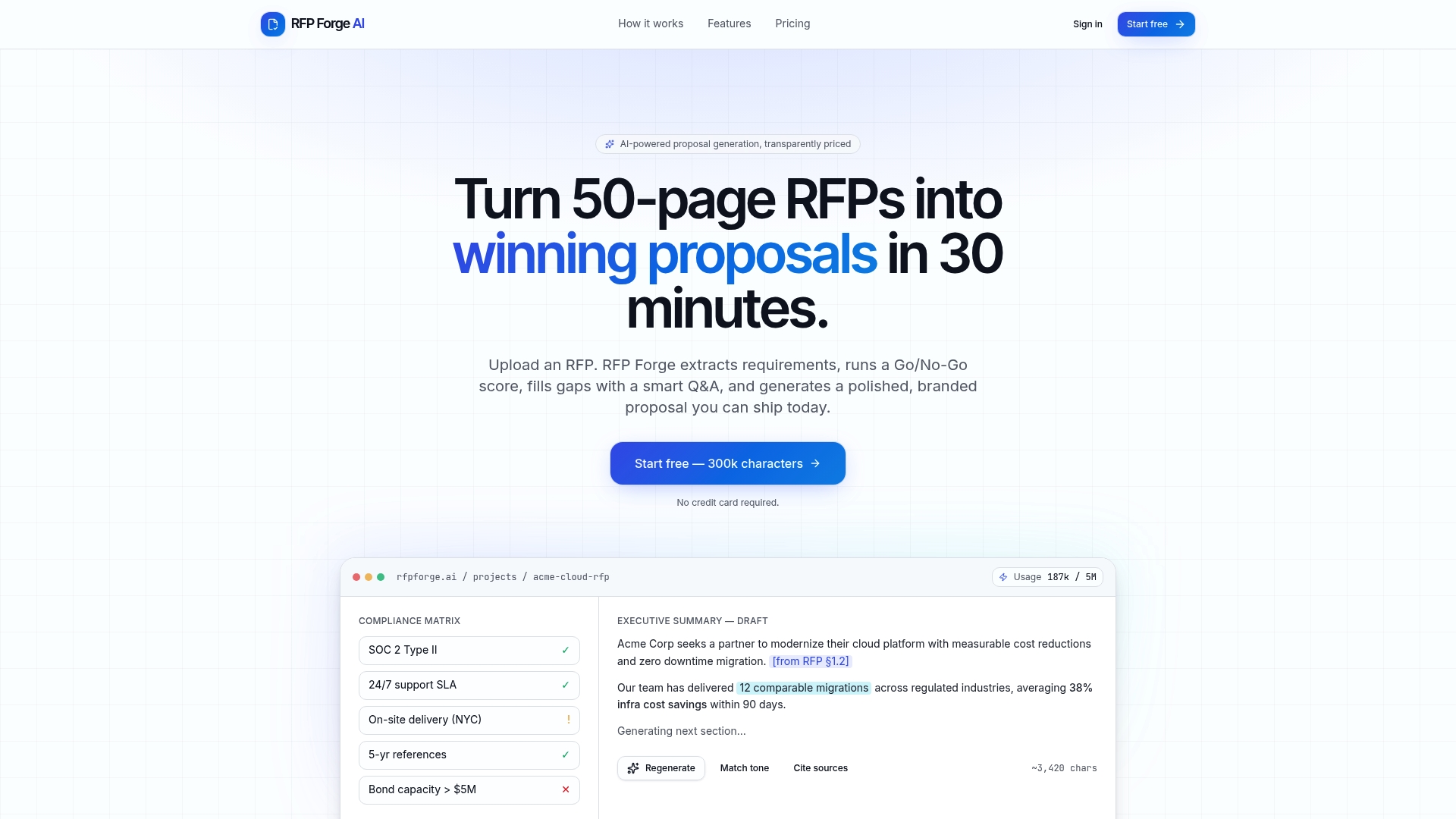
Plans cover individual consultants through large business teams, with transparent usage-based quotas and annual discounts. The cost reduction figure comes from client-reported data in regulated industries and reflects specific project contexts. Start a free trial or schedule a demo to run the platform against one of your own RFPs and see the extraction and drafting workflow firsthand.
Sources and further reading
The evaluation draws on the following sources. Each contributed to specific sections of this comparison.
- Gartner Peer Insights — RFP Response Management Applications: The primary market-level source for vendor capability summaries, peer reviews, and feature benchmarking across the category. Used in methodology, product profiles, and the AI capabilities section.
- Gartner — Inventive AI vendor profile: Peer reviews covering conflict-flagging and personalization features; used in the Inventive AI profile.
- Gartner — Loopio product reviews: Enterprise buyer feedback on content library and workflow features; used in the Loopio profile and knowledge management discussion.
- Gartner — Responsive product reviews: Buyer feedback on questionnaire handling and content reuse; used in the Responsive profile.
- Gartner — HeyIris product reviews: Peer reviews on documentation-grounded generation and deployment speed; used in the HeyIris profile.
- Gartner — Qvidian product reviews: Enterprise buyer feedback on workflow automation and content management; used in the Qvidian profile.
- G2 — 1up reviews: User feedback on security controls and Slack/Teams integration; used in the 1up profile and integrations discussion.
- G2 — Tribble reviews: Mid-market user feedback on content organization; used in the Tribble profile.
- G2 — Conveyor reviews: User feedback on extraction and cross-team coordination; used in the Conveyor profile.
- G2 — AutogenAI reviews: User feedback on AI-native drafting; used in the AutogenAI profile.
- RFP Forge AI — product overview and client data: Primary source for Rfpforgeai feature callouts, onboarding time-to-value, and the client-reported 38% cost reduction metric.
- LLM-orchestrated procurement automation — DocuPow: Background on LLM-driven automation in procurement workflows; relevant to implementation and integration guidance.