
Start by mapping Section M evaluation factors to a compliance matrix and assigning an owner for every requirement, then build your proposal shell so it mirrors Section L before you write a single narrative page. That order matters more than talent, more than templates, and more than how many hours your team logs. A technically brilliant proposal that misses a Section L formatting rule or skips a required signature can get thrown out before an evaluator reads a word of it.
Here's what to do in the first 24 to 72 hours after a solicitation drops:
- Read Section M first, cold, before anything else. Know exactly how the agency scores proposals and what weight each factor carries.
- Read Section L second and extract every submission instruction: page limits, font size, file naming, volume structure, and delivery method.
- Log every deadline into a shared calendar, including the Q&A cutoff, amendment windows, and the final submission time (note the time zone).
- Build a shall-statement tracker that captures every "shall," "must," and "will" in the solicitation, tied to a source paragraph.
- Assign a named owner to each proposal volume (technical, management, past performance, price) before drafting begins.
Before you write anything else, confirm these non-negotiables, because any one of them can disqualify an otherwise winning proposal:
- Active SAM.gov registration with no lapses
- All required forms and representations completed and signed
- Compliance with page limits, font, and margin rules exactly as written
- Pricing submitted in the format Section B demands, not your own template
Key Takeaways
Compliance mapped to Section M, tracked in a matrix, and locked 48 to 72 hours before deadline is what separates proposals that get scored from proposals that get eliminated before evaluation begins.
| Point | Details |
|---|---|
| Read Section M first | Know the evaluation weighting before you outline or draft a single page. |
| Build a compliance matrix early | Track every shall-statement with a source, owner, and status from day one. |
| Mirror Section L exactly | Match volume structure, page limits, and file naming to the solicitation's own instructions. |
| Run a final compliance pass | Lock the matrix and check formatting 48 to 72 hours before the deadline, not the morning of. |
| Use automation to accelerate, not replace | Rfpforgeai extracts requirements and builds a compliant shell in minutes, but human review of Section L and Section M still governs the final submission. |
Table of Contents
- What Is a Government RFP Response?
- How Do Government RFPs Differ From Commercial Proposals?
- What Is the Government RFP Lifecycle?
- What Are the Key Sections of a Government Solicitation?
- How Do You Structure Your Proposal Response?
- How Do You Build a Compliance Matrix?
- How Do You Write a Technical Approach That Scores Well?
- How Do You Prepare a Compliant Cost or Price Proposal?
- How Do You Present Past Performance and Management Approach?
- What Mistakes Get Proposals Disqualified?
- How Should You Schedule and Manage a Proposal Team?
- Where Do Automation and AI Fit in RFP Response Work?
- What Do Experienced Capture Teams Do Differently?
- How Rfpforgeai Compresses Compliance Work Without Cutting Corners
- Where Should You Go for Authoritative Procurement Guidance?
- Frequently Asked Questions
- Sources
What Is a Government RFP Response?
A government RFP response is a formal, compliant proposal submitted in reply to a solicitation that invites vendors to propose a complete technical, management, and pricing approach to a defined requirement. The solicitation itself usually contains a Statement of Work (SOW), Performance Work Statement (PWS), or Statement of Objectives (SOO), plus Section L (instructions for submission) and Section M (evaluation factors). Understanding this structure early is the difference between writing to what the agency actually wants and guessing.
The RFP sits at one end of a spectrum of procurement instruments. Government buyers use different vehicles depending on how well-defined the requirement is, and confusing them wastes real effort.
- RFI (Request for Information): Market research only. No formal proposal is required, and there's no contract award attached. Agencies use it to gauge industry capability before writing a solicitation.
- RFQ (Request for Quotation): Typically used for simpler, well-defined purchases where price is the dominant factor. Responses are usually shorter and less narrative-heavy.
- RFP (Request for Proposal): The most complex instrument. It asks for a full technical approach, management plan, past performance, and pricing, evaluated against published criteria in Section M.
GSA's guidance on responding to a solicitation is explicit that offerors should read the entire solicitation, identify the evaluation factors, and register for amendment notifications before drafting anything. That advice sounds obvious. Most teams skip straight to writing the technical narrative anyway, and it shows in how many proposals miss the mark on scoring criteria they never actually read closely.
How Do Government RFPs Differ From Commercial Proposals?
Government RFPs are rule-bound in a way commercial sales proposals never are. A commercial buyer might forgive a formatting slip or a missing attachment. A federal contracting officer often cannot, because the evaluation process is built on documented, defensible criteria that have to survive a protest.
That distinction changes how you write and assemble everything.
- Mandatory forms and certifications (reps and certs, wage determinations, small business subcontracting plans) are not optional attachments. Missing one can remove you from consideration.
- Volume structure is prescribed, not negotiable. If Section L says technical, past performance, and price go in three separate files with specific naming conventions, that's what evaluators expect to open.
- Page limits, font size, and margins are enforced literally. Evaluators are often instructed not to read past the page limit at all.
- Pricing is submitted as its own volume, evaluated separately from technical merit under FAR-based source selection procedures.
- Losing offerors have formal debriefing and protest rights, which means agencies document scoring decisions carefully and expect proposals to match the solicitation's exact language.
Industry guidance consistently points to compliance failures, not weak technical content, as the most common reason proposals get eliminated. A proposal that scores well on technical merit but violates a Section L instruction often never reaches the scoring table at all.
Pro Tip: Print Section L and Section M separately and keep them open side by side while you outline. Most compliance failures happen because writers work from memory instead of the actual text.
What Is the Government RFP Lifecycle?
Understanding the lifecycle helps you know where you are, what's expected of you, and how much time you realistically have left. The stages run in roughly this order:
- Market research and capture. Agencies post sources-sought notices and RFIs, often months before a formal RFP. Vendors who engage here can shape requirements and build relationships that matter later.
- Solicitation release. The RFP posts, usually on SAM.gov, with a defined response deadline and full instructions.
- Questions and amendments. Vendors submit clarifying questions by a stated deadline; the agency issues amendments that can shift requirements or timelines. Sam is the authoritative source for tracking these changes.
- Bid/no-bid decision. Your team evaluates fit, competition, and capacity before committing resources.
- Proposal development. Writing, pricing, and compliance work happen in parallel, gated by internal reviews.
- Compliance review and color team. Internal reviewers check the draft against Section L and Section M before submission.
- Submission. The proposal is delivered exactly as instructed, ideally with time to spare.
- Evaluation. The agency scores proposals against Section M factors, sometimes including oral presentations or clarification requests.
- Debrief, award, or protest. Winners get notified; losers can request a debriefing and, in some cases, file a protest through the Government Accountability Office.
Most straightforward RFPs run on a 30 to 60 day response window from release to submission, though complex, multi-volume procurements can stretch well past that. Small business guidance notes that complex federal proposals commonly require hundreds of hours of combined effort across writing, pricing, and review, which is exactly why the bid/no-bid gate matters so much.
What Are the Key Sections of a Government Solicitation?
Every solicitation is built from a handful of recurring parts, and knowing what each one demands keeps your proposal from wandering off-topic.
- SOW, PWS, or SOO: Defines the actual work. A SOW is prescriptive about how the work gets done; a PWS focuses on performance outcomes; a SOO gives you room to propose your own approach. Which one you're responding to should shape how much you emphasize methodology versus outcomes.
- Section L (Instructions, Conditions, and Notices to Offerors): Tells you exactly how to format, organize, and submit your proposal. This section is the rulebook for assembly.
- Section M (Evaluation Factors for Award): Tells you how the agency will score what you submit, including relative weighting of technical, past performance, management, and price.
- Section B (Supplies or Services and Prices): Defines the pricing structure the agency expects, often down to specific line items and contract line item numbers (CLINs).
- Administrative and certification requirements: Reps and certs, SAM.gov registration status, wage determinations under the Service Contract Act where applicable, and any required small business plans.
| Solicitation Section | What It Contains | What You Must Deliver |
|---|---|---|
| SOW/PWS/SOO | Description of the work or desired outcomes | A technical approach that directly addresses the stated scope |
| Section L | Submission instructions, format, and deadlines | A proposal assembled exactly to spec, by volume and file |
| Section M | Evaluation factors and their relative weight | Content that maps directly to each scored sub-factor |
| Section B | Pricing structure and line items | A cost/price volume in the required format |
| Reps and certs | Legal and administrative certifications | Signed, current documentation, including active SAM.gov status |
CAR 1352.215-70 spells out that proposals need to be clearly written, indexed, and organized into the volumes the solicitation demands, and that taking exceptions to stated terms can work against you. Treat that as a warning, not a formality.
How Do You Structure Your Proposal Response?
The winning pattern is simple to state and hard to execute under deadline pressure: build your proposal shell to mirror Section M, not your own instinct for how to tell the story.
Most government proposals break into four volumes:
- Administrative/certifications volume: Reps and certs, SAM.gov proof, required forms.
- Technical volume: Your approach to the SOW/PWS/SOO, organized by the sub-factors listed in Section M.
- Management/past performance volume: Org structure, key personnel, quality control, and relevant project history.
- Price volume: Submitted separately, often reviewed by a different evaluation team than the technical volume.
Cross-referencing every Section M sub-factor to a specific proposal section and a named owner is what keeps evaluators from hunting for your answer.
| Section M Sub-Factor | Proposal Location | Owner |
|---|---|---|
| Technical approach | Volume II | Technical lead |
| Management approach | Volume III | Proposal manager |
| Past performance | Volume III | Capture lead |
| Price reasonableness | Volume IV | Pricing lead |
File naming and indexing sound like housekeeping, but they change how fast an evaluator can find your answer. Use the solicitation's own volume numbers in your file names ("Vol_II_Technical_CompanyName.pdf"), include a table of contents that mirrors Section L's requested order, and number pages consistently across volumes. Evaluators scoring dozens of proposals under time pressure reward clarity, even unconsciously.
How Do You Build a Compliance Matrix?
A compliance matrix is the single document that keeps a government RFP response from falling apart under its own complexity. It converts every "shall," "must," and "will" in the solicitation into a trackable row with an owner and a status.
Your matrix needs these fields at minimum:
| Field | Purpose |
|---|---|
| Requirement text | The exact shall-statement, copied verbatim from the RFP |
| Source paragraph | Where in the solicitation it appears (SOW, Section L, etc.) |
| Proposal volume/section | Where the response lives |
| Page reference | Draft page number once written |
| Owner | Named individual accountable for that content |
| Status | Not started / drafted / reviewed / compliant |
| Evidence link | Link to the actual draft language or supporting data |
Building and maintaining it follows a repeatable sequence:
- Extract every shall-statement from the SOW/PWS/SOO, Section L, and Section M into the matrix.
- Assign each row an owner during your kickoff meeting, not after drafting starts.
- Update status as each section moves through drafting and review.
- Run the matrix through your color-team review, checking every row against the actual draft language, not against memory.
- Lock the matrix 48 to 72 hours before submission and run a final line-by-line pass against the finished proposal.
Pro Tip: Assign one person, and only one, with the authority to sign off on final compliance. When two people think they're responsible for the compliance check, neither one actually does it thoroughly.
A requirements traceability matrix built this way isn't just a checklist. It's your best defense in a debrief if a competitor protests and the agency has to show its scoring was grounded in what was actually submitted.
How Do You Write a Technical Approach That Scores Well?
Evaluators don't reward eloquence. They reward proposals that make it easy to award points, which means every paragraph in your technical volume should follow a claim, evidence, proof structure: state what you'll do, show the evidence you can do it, and prove the outcome with a measurable result.
A sample paragraph built on that formula:
"[Company] will reduce onboarding time for new system users by implementing a phased training rollout validated on three prior federal contracts. On the [prior agency] task order, this approach cut average time-to-proficiency from six weeks to three, verified through the customer's own performance metrics. We will apply the same phased model here, with acceptance criteria tied to [Section M sub-factor] and monthly reporting against the government's quality assurance surveillance plan."
Use heading templates that borrow the solicitation's own language. If Section M lists "Technical Approach to Data Migration" as a sub-factor, your heading should say exactly that, not a creative variation. Evaluators are often scoring against a checklist, and a heading mismatch costs you seconds they don't have to spend hunting for your answer.
Every technical section should include:
- A measurable outcome or metric, not a vague promise of quality
- Explicit acceptance criteria tied back to the SOW
- A named risk and a specific mitigation step
- A deliverable schedule that a program manager could actually track
For deeper templates on this structure, technical proposal writing guidance walks through additional paragraph patterns for common sub-factors like staffing, quality control, and transition planning.
How Do You Prepare a Compliant Cost or Price Proposal?
Your price volume gets evaluated by a different lens than your technical narrative, and pricing mistakes are among the easiest ways to trigger clarification requests or outright rejection. Section B tells you the exact structure the agency wants, and deviating from it, even with a "better" format, creates friction you don't need.
Before submission, confirm your price volume covers:
- The exact format and line-item structure Section B specifies, including CLIN-level breakdowns
- Direct labor categories and hours that tie back to your technical staffing plan
- Escalation assumptions for multi-year contracts, stated explicitly rather than buried in a footnote
- Indirect rates that are current, defensible, and consistent with your accounting system
- Supporting spreadsheets in the format requested, not a reformatted version of your internal cost model
How price gets weighed depends on the source selection method. FAR 15.204-5 explains the difference between best-value tradeoff, where technical merit can outweigh a higher price, and Lowest Price Technically Acceptable (LPTA), where price becomes the deciding factor once technical acceptability is confirmed. Read Section M carefully to know which posture you're pricing against before you build your rate strategy.
| Cost Element | Example Structure |
|---|---|
| Direct labor | Hours by labor category × loaded rate |
| Other direct costs | Travel, materials, equipment tied to the SOW |
| Subcontractor costs | Pass-through costs with applied fee, if allowed |
| Indirect rates | Overhead, G&A, and fringe applied per your accounting practice |
Cost realism matters even in best-value procurements. A price that looks too low relative to your proposed labor hours can trigger a cost realism analysis that raises more questions than it answers.
How Do You Present Past Performance and Management Approach?
Past performance is where evaluators judge risk, not just capability. A well-built past performance card should include the scope of the work, measurable outcomes, the period of performance, a customer point of contact, and an explicit line connecting that project's relevance to the current solicitation.
- Lead with relevance, not chronology. The most recent project isn't always the strongest match.
- Include a customer point of contact who can actually confirm the performance narrative if the agency calls.
- If you lack direct government experience, use relevant commercial work, teaming arrangements, or subcontractor references, but be transparent about which entity performed which part of the work.
- Quantify outcomes wherever possible: cost savings, schedule adherence, defect rates, customer satisfaction scores.
Your management volume should carry equal weight in how carefully it's built. Evaluators are looking for evidence you can actually execute, not just describe intent.
- An org chart showing clear lines of authority and communication
- Resumes for key personnel that map directly to the roles the SOW requires
- A subcontracting plan if required by the solicitation's size and type
- Quality control metrics and a surveillance approach that shows how you'll catch problems before the customer does
What Mistakes Get Proposals Disqualified?
Most disqualifications aren't dramatic. They're small, avoidable errors that get missed because nobody owned the final check.
- Missing or outdated forms, including reps and certs that weren't updated for the current solicitation
- Page count or font violations that exceed what Section L allows
- Unsigned certifications or missing authorized signatures
- Pricing submitted in the wrong format or missing required backup spreadsheets
- Late submission, including missing a portal cutoff by minutes
- Expired SAM.gov registration discovered too late to fix before the deadline
Taking exceptions to solicitation terms deserves special caution. An evaluator reading a stated exception or deviation often reads it as a signal you can't or won't perform to the government's actual terms, and proposal preparation guidance treats unstated compliance as the baseline expectation, not an optional courtesy.
Practitioner analysis across government proposal guides converges on one consistent point: most proposals fail at the compliance gate, long before an evaluator gets to judge technical quality. That's a solvable problem, not a talent gap.
Run your final compliance pass 48 to 72 hours before the deadline, with enough buffer to fix what you find. Submit at least 24 hours early when the portal allows it. SAM.gov and agency submission portals do go down, and "the system was slow" is not a defense an evaluator has to accept.
How Should You Schedule and Manage a Proposal Team?
A realistic internal schedule protects you from the two things that kill proposal quality most reliably: rushed writing and last-minute compliance surprises.
A sample high-level schedule for a 45-day response window:
- Days 1 to 3: Kickoff, bid/no-bid confirmation, compliance matrix built from the raw solicitation
- Days 4 to 10: Outline development mapped to Section M, proposal shell built to Section L format
- Days 11 to 25: First draft across all volumes
- Days 26 to 30: Color team review (an internal, structured critique against Section M)
- Days 31 to 38: Revisions incorporating color team findings
- Days 39 to 42: Pricing lock and final cost realism check
- Days 43 to 44: Final compliance pass, signatures, formatting check
- Day 45: Submission, ideally a full day ahead of the deadline
| Role | Primary Responsibility |
|---|---|
| Capture lead | Pre-RFP agency engagement, bid/no-bid recommendation |
| Proposal manager | Schedule ownership, volume coordination, outline enforcement |
| Technical writer(s) | Drafting claim-evidence-proof content by sub-factor |
| Pricing lead | Cost volume compliance and realism |
| Compliance owner | Matrix maintenance and final sign-off authority |
| Reviewer(s) | Color team critique against Section M |
Build in time buffers deliberately. A portal outage the morning of a deadline is not a rare event, and a schedule with zero slack turns a minor technical glitch into a missed submission.
Where Do Automation and AI Fit in RFP Response Work?
Automation earns its place in the parts of the process that are mechanical and repetitive: extracting shall-statements, mapping them to Section M sub-factors, and generating a first-pass proposal shell that already matches the solicitation's required structure.
Realistic use cases include:
- Automatically extracting requirements and shall-statements from lengthy SOWs and Section L instructions
- Mapping extracted requirements to a compliance matrix without manual copy-paste
- Generating a proposal shell pre-organized around Section L's volume structure and Section M's sub-factors
- Drafting tailored capability statements pulled from a reusable knowledge base
- Running automated compliance checks against page limits and required sections before human review
Practitioner workflows describe extracting shall-statements and Section M weights first, then generating a proposal shell and tailored language, as a way to compress the time to a first compliant draft from days to hours. That kind of head start matters most on short-turnaround solicitations where the writing team never has enough runway.
None of that replaces the human parts of the job. A tool can extract a shall-statement, but it can't decide whether your technical approach actually answers the sub-factor with the evidence an evaluator wants to see. It can't sign a certification. And it can't replace someone reading Section L and Section M with the same care GSA recommends before a single word gets drafted. Treat automation as the engine that clears the mechanical work off your desk, so your best writers spend their hours on the narrative and pricing judgment calls that actually win.
What Do Experienced Capture Teams Do Differently?
The best proposal teams I've studied treat capture as a discipline that starts long before a solicitation posts, not a scramble that begins the day it does. Waiting for the RFP to drop and then trying to learn the customer's priorities from scratch puts you at a structural disadvantage against an incumbent or a competitor who's been asking questions at industry days for months.
Bid/no-bid decisions deserve the same rigor. A team that says yes to every opportunity spreads its best writers thin across too many pursuits, and that's how a strong technical team produces a mediocre proposal on the one bid that actually mattered. Saying no early, based on honest fit and win-probability criteria, is what protects your ability to say yes fully to the opportunities you can actually win.
The habit that separates repeat winners from one-off winners is what they do after the decision comes back, win or lose. Requesting a formal debrief, whether you won or lost, and feeding those findings back into your win themes and templates is how a proposal shop actually gets better over time instead of just getting busier. Debriefs are one of the only places an agency will tell you, in specific terms, why your technical approach scored where it did.
How Rfpforgeai Compresses Compliance Work Without Cutting Corners
Every step in this playbook, from extracting shall-statements to mapping Section M sub-factors to a proposal shell, is manual work most bid teams still do in spreadsheets and copy-paste. Rfpforgeai turns that same workflow into a 30-minute process: it reads the solicitation, auto-extracts requirements, and builds your compliance matrix and proposal shell already aligned to Section L and Section M, so your writers start on narrative and pricing instead of formatting and cross-referencing.
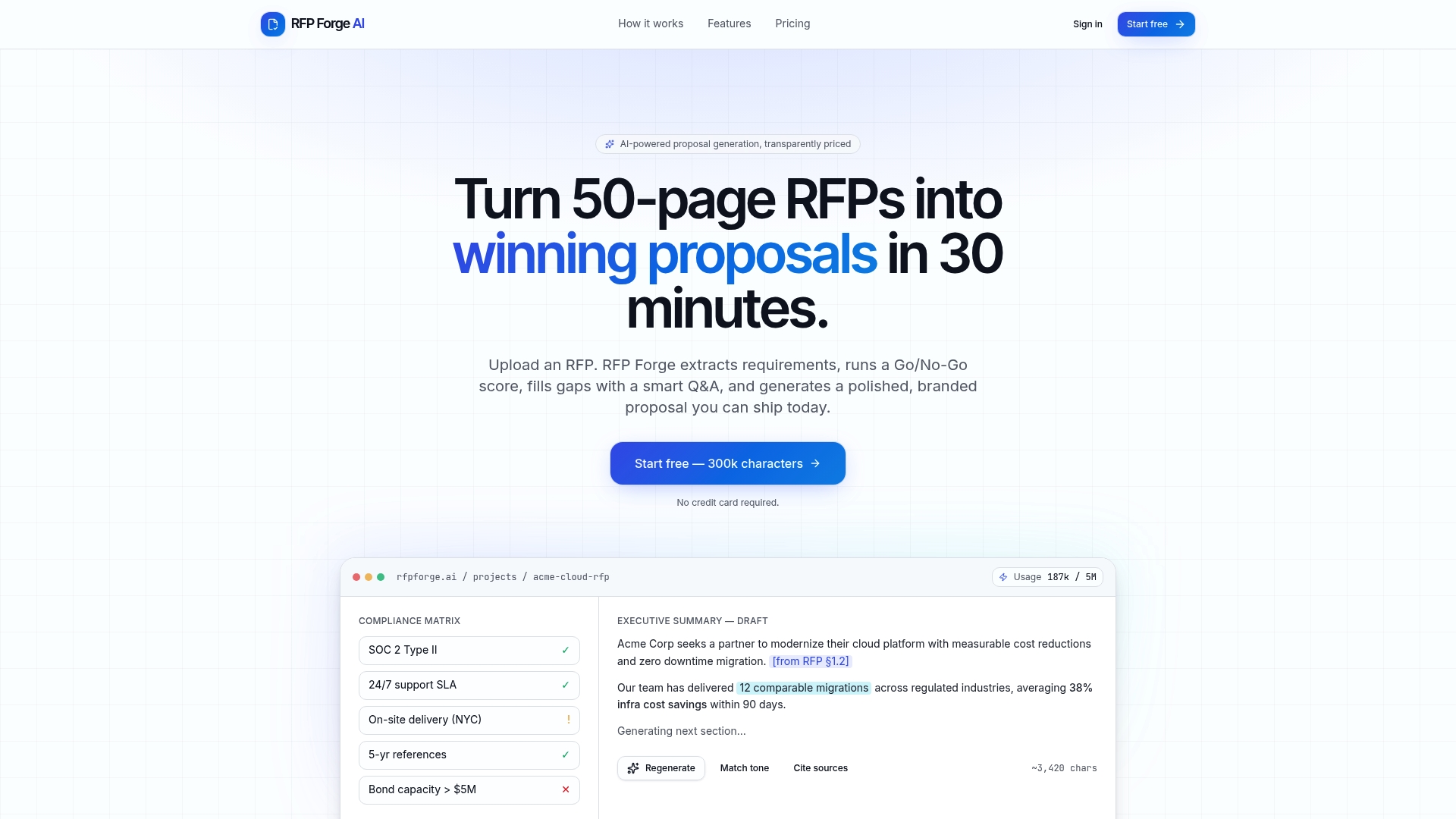
The platform's interactive Q&A system fills gaps in your knowledge base automatically, generating tailored capability statements and draft sections (executive summary, technical approach, pricing, timeline) that reflect your company's voice rather than a generic template. Built-in win-rate analytics let you see which sections and strategies actually correlate with awards across your pipeline, so your next bid/no-bid decision is grounded in your own data. For data security questions that come up when evaluating any AI platform for sensitive procurement work, Patterns Process Finder AI's security practices illustrate the kind of data-handling standards worth expecting from any vendor in this space.
If your team is still building compliance matrices by hand at 11 p.m. before a deadline, try Rfpforgeai on your next solicitation and see how much of that work it clears before your writers even open the SOW.
Where Should You Go for Authoritative Procurement Guidance?
- GSA's guide to responding to a solicitation: Consult this first when a new solicitation lands, for a clear walkthrough of reading order and submission mechanics.
- Acquisition and FAR 15.204-5: Reference these when you need to understand how source selection and evaluation methodology actually work under federal regulation.
- Sam: Check this continuously throughout a live pursuit for solicitation notices, amendments, and to confirm your own entity registration is current.
- GAO's bid protest resources: Turn to this after an award decision if you believe the evaluation process didn't follow its own stated criteria.
Frequently Asked Questions
What is the difference between a government RFP and an RFQ? An RFP asks for a full technical, management, and pricing proposal evaluated against published criteria in Section M. An RFQ is typically used for simpler, well-defined purchases where price plays a dominant role and the response is far shorter.
How long does it typically take to respond to a government RFP? Most straightforward solicitations give vendors 30 to 60 days from release to submission. Complex, multi-volume procurements with technical evaluations or oral presentations often require considerably more time and coordination.
What is a compliance matrix and why does it matter so much? A compliance matrix is a tracked document that converts every solicitation requirement into a row with a source, a proposal location, an owner, and a status. It's the primary tool for making sure nothing in Section L or the SOW gets missed before submission.
Can AI tools actually replace human proposal writers on government RFP response work? No. AI can extract requirements, build a compliance matrix, and generate a proposal shell quickly, but it cannot replace human judgment on technical strategy, cannot sign required certifications, and cannot substitute for a person actually reading Section L and Section M carefully before submission.
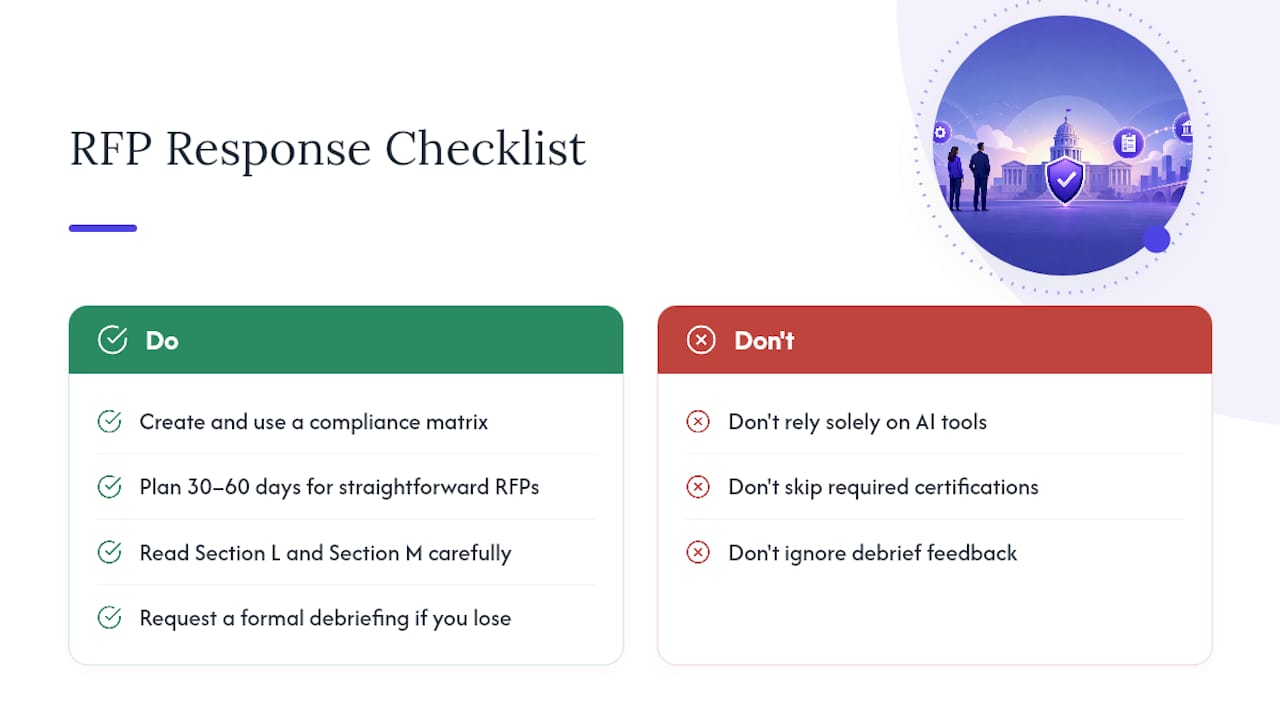
What happens if I lose a government contract bid? You have the right to request a formal debriefing from the contracting officer, and in cases where you believe the evaluation process was flawed, you can file a bid protest through the Government Accountability Office. Debriefs are also one of the best sources of specific feedback for improving your next proposal.
Sources
- Respond to a solicitation | GSA
- 1352.215-70 Proposal preparation (CAR)
- Acquisition
- Acquisition
- GAO — Bid protests