
For most mid-market and enterprise proposal teams, Rfpforgeai is the recommended starting point for AI-first, compliance-driven RFP response. If your team needs deep enterprise workflow integration and has dedicated admin resources, Responsive (formerly RFPIO) belongs on your shortlist. If you prioritize fast onboarding and high-touch vendor support, Loopio is worth a close look.
One-line verdicts:
- Rfpforgeai: Best for teams that need fast, auditable AI-assisted drafts, built-in compliance matrices, and win-rate analytics. The platform transforms lengthy RFPs into polished proposals in approximately 30 minutes.
- Responsive (formerly RFPIO): Best for large enterprise teams with complex CRM/workflow integration requirements and dedicated proposal ops staff.
- Loopio: Best for small-to-mid proposal teams that want quick onboarding, straightforward content reuse, and strong vendor support.
Pro Tip: Before you schedule demos, map your top three procurement pain points (governance, speed, or integration) to the platform that addresses them most directly. That single exercise will cut your evaluation time in half.
All three platforms carry SOC 2 compliance signals, and G2 aggregated scores place Loopio at 4.7/5 (638 reviews) and Responsive at 4.5/5 (1,143 reviews) as surfaced on G2 compare. Rfpforgeai's AI-first architecture is purpose-built for the compliance and auditability requirements that regulated buyers increasingly demand in 2026.
Table of Contents
- How do Loopio, Responsive, and Rfpforgeai compare side by side?
- What does Loopio do well, and where does it fall short?
- Where does Responsive (formerly RFPIO) add the most enterprise value?
- What makes Rfpforgeai the right fit for compliance-driven teams?
- How do you choose between Loopio, Responsive, and Rfpforgeai?
- What should you budget beyond the license fee?
- What integrations and security certifications should you verify?
- Which platform should you shortlist for your specific scenario?
- Rfpforgeai in practice: measured impact and how to validate it
- Key Takeaways
- The case for governance-first AI in enterprise RFP programs
- Rfpforgeai delivers auditable AI proposals in 30 minutes
- Useful sources and references
How do Loopio, Responsive, and Rfpforgeai compare side by side?
The table below covers the dimensions procurement and proposal ops teams care about most.
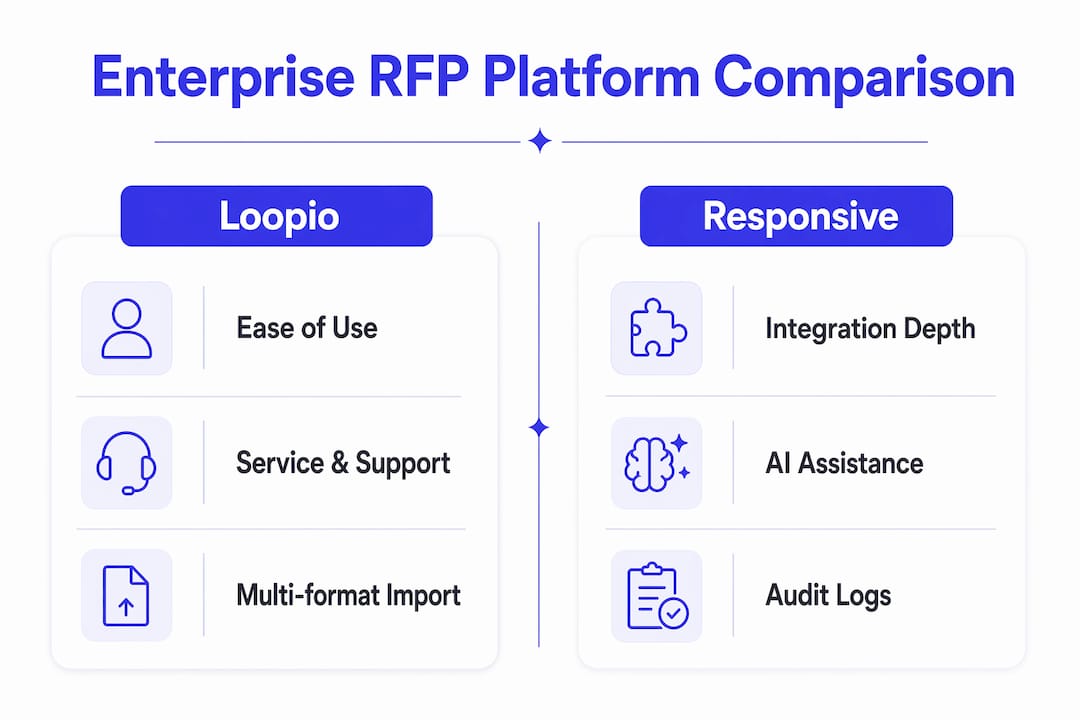
| Dimension | Rfpforgeai | Loopio | Responsive (formerly RFPIO) |
|---|---|---|---|
| Best for / ideal team | Mid-market to enterprise needing fast, auditable AI drafts | Small-to-mid teams prioritizing ease of use and support | Large enterprise with complex workflows and integration needs |
| Pricing model | Tiered SaaS subscription; transparent usage-based quotas | Custom quote; no public pricing | Custom quote; no public pricing |
| Ease of use / onboarding | Fast setup; AI-guided Q&A reduces manual configuration | Highest ease-of-use scores on G2; short onboarding | Steeper configuration; longer onboarding for complex deployments |
| AI capabilities | Automated extraction, Q&A gap-filling, compliance matrix, Go/No-Go scoring | Basic AI suggestions; limited hallucination controls | Advanced GenAI, answer automation; validate citation controls in PoC |
| Governance & compliance | Built-in compliance matrix, audit trails, traceable edits | Basic approval workflows; limited audit depth | Approval workflows; validate audit log depth for regulated use |
| Integrations & API | Core integrations; growing ecosystem | Standard CRM and cloud storage connectors | Broad integration depth; Salesforce, Slack, Microsoft 365, and more |
| Content library reuse | Knowledge base with reusable sections and tone customization | Governed answer library with tagging and search | Large-scale answer library; strong for high-volume programs |
| Support & customer success | Dedicated support; SLA-backed tiers | Top-rated support on G2; strong mid-market CS | Enterprise CS available; setup complexity can delay time-to-value |
| Security certifications | SOC 2 compliance signals; encryption in transit and at rest | SOC 2; standard enterprise security controls | SOC 2; ISO signals; enterprise-grade security stack |
| Deployment & scalability | Cloud SaaS; scales with team growth and usage tiers | Cloud SaaS; scales well for mid-market | Cloud SaaS; multi-region options; built for high-volume enterprise |
| G2 rating | — | 4.7★ (638 reviews) | 4.5★ (1,143 reviews) |
Key differentiators at a glance:
- Rfpforgeai is the only platform with a built-in compliance matrix and win-rate analytics designed for auditable AI outputs from day one.
- Loopio leads on ease of use and support quality, making it a fast path to value for lean teams.
- Responsive wins on raw integration breadth and enterprise workflow depth, but demands more admin lift to configure.
Neither Loopio nor Responsive publishes standard pricing; both require custom quotes for enterprise terms, which means TCO comparisons require direct vendor engagement.
What does Loopio do well, and where does it fall short?
Loopio's core product is a governed answer library. You tag, search, and reuse pre-approved content blocks across RFPs, security questionnaires, and DDQs. The import/export workflow handles common formats, and the interface is clean enough that most proposal writers are productive within days, not weeks.
Strengths:
- ✅ Consistently highly rated for ease of use and setup speed on G2
- ✅ Support quality is a recurring theme in user reviews; teams with limited admin bandwidth appreciate the responsiveness
- ✅ Shorter onboarding curve compared to Responsive, especially for smaller teams
- ✅ Solid content tagging and search for mid-market RFP volumes
Weaknesses:
- ❌ Limited enterprise workflow breadth; complex multi-format RFPs can expose gaps
- ❌ AI hallucination controls are not a documented strength; validate this in any PoC
- ❌ Audit trail depth may not satisfy regulated-industry compliance requirements without customization
Who it fits: Loopio is the right call for a proposal team of 5–25 people that needs to get up and running fast, values a vendor that picks up the phone, and handles a manageable RFP volume without heavy CRM integration requirements.
"Loopio stands out for shorter onboarding and higher support satisfaction — that matters for teams with limited admin bandwidth." — based on aggregated review themes on G2
Pro Tip: During your Loopio demo, ask specifically how the platform handles multi-format RFP imports (Word, Excel, PDF) and what the audit trail looks like for a compliance review. Those two questions will surface limitations faster than any feature walkthrough.
Red flags to watch: If your RFPs include complex conditional logic, multi-section compliance matrices, or require a full approval chain with timestamped logs, push hard on those scenarios in the trial. Loopio's strengths are real, but its enterprise governance depth is where buyers in regulated industries most often hit a ceiling.
Where does Responsive (formerly RFPIO) add the most enterprise value?
Responsive is built for scale. Its document-centric architecture handles high-volume RFP programs, and its integration catalog covers Salesforce, Slack, Microsoft 365, Google Workspace, and a range of procurement and content management tools. For a large enterprise team running dozens of concurrent proposals, that breadth matters.
Strengths:
- ✅ Deep integration ecosystem; enterprise workflow tooling is a consistent differentiator in user reviews
- ✅ Advanced GenAI features including answer suggestion automation and AI-assisted drafting
- ✅ Built for high-volume programs with large answer libraries and multi-team collaboration
- ✅ Strong enterprise security stack with SOC 2 and ISO signals
Weaknesses:
- ❌ Steeper configuration and admin overhead; onboarding timelines can stretch for complex deployments
- ❌ GenAI hallucination controls and citation features need explicit validation during PoC; they are not guaranteed out of the box
- ❌ Cost and complexity can be disproportionate for mid-market teams without dedicated proposal ops staff
Who it fits: Responsive is the right choice when you have a dedicated proposal operations function, a complex CRM integration requirement, and a high enough RFP volume to justify the configuration investment. Gartner Peer Insights rates Responsive at 4.2/5 (55 ratings) among Loopio alternatives, with reviewers noting it is "light in use" but needing improvement in AI capabilities.
"Responsive (formerly RFPIO) is repeatedly selected by large enterprises for integration depth and advanced AI assistance, but buyers should validate hallucination controls and citation features during PoCs." — as summarized on G2

Pro Tip: Ask Responsive's sales team for a live demo of citation controls and audit logs before signing. GenAI features that cannot show you exactly where an answer came from are a compliance liability in regulated industries.
The platform's Gartner reviewers note that Loopio scores higher on service and support and on evaluation and contracting experience, which is worth factoring into your vendor relationship expectations.
What makes Rfpforgeai the right fit for compliance-driven teams?
Rfpforgeai takes a different architectural approach. Instead of starting with a content library and adding AI on top, the platform is built AI-first: it automatically extracts requirements from an uploaded RFP, scores fit with a Go/No-Go assessment, and then runs an intelligent Q&A process to fill gaps before generating draft proposal sections.
Core capabilities:
- ✅ Automated RFP requirements extraction and fit scoring
- ✅ Interactive Q&A gap-filling that surfaces missing information before drafting begins
- ✅ Compliance matrix creation with traceable, auditable outputs
- ✅ Branded export with executive summary, approach, pricing, timeline, and compliance sections
- ✅ Win-rate analytics to track proposal performance and iterate on strategy
- ✅ Knowledge base with reusable sections and tone customization
Strengths: The 30-minute draft claim is not a marketing approximation. The platform's extraction and Q&A pipeline is designed to compress the time between receiving an RFP and having a reviewable first draft. For regulated industries, the compliance matrix and audit trail are built into the workflow, not bolted on afterward.
Trade-offs: Rfpforgeai's integration ecosystem is growing but not yet as broad as Responsive's. If your team has a hard requirement for a specific CRM connector or a legacy procurement system integration on day one, verify availability before committing.
Who it fits: Mid-market to enterprise teams that need AI-assisted first drafts, strong compliance and audit controls, and measurable win-rate improvements. Particularly strong for teams in regulated industries where auditability of AI outputs is a procurement requirement.
Pro Tip: Run a PoC with a real, recent RFP from your pipeline. Measure time from upload to reviewable draft, compliance coverage percentage, and reviewer edit time. Those three metrics will give you a defensible ROI case for your procurement committee.
Significant average cost reductions in infrastructure migrations for clients in regulated industries, as reported by Rfpforgeai based on client outcomes.
How do you choose between Loopio, Responsive, and Rfpforgeai?
Start with your top constraint. Governance and compliance requirements should drive the decision for regulated buyers. Speed to value and admin overhead drive it for lean teams. Integration depth drives it for large enterprises with existing tech stacks.
Selection criteria ranked by enterprise priority:
- Compliance and governance: Does the platform produce auditable outputs with approval workflows and timestamped logs?
- AI controls: Can you see exactly where AI-generated content came from? Are hallucination controls documented?
- Integration requirements: Which CRM, SSO, and cloud storage connectors are non-negotiable on day one?
- Admin overhead: Does your team have dedicated proposal ops staff, or does someone wear multiple hats?
- Content reuse strategy: How mature is your existing answer library, and how much migration work is realistic?
- TCO: License cost is one line item. Implementation, training, content migration, and ongoing admin are the others.
Twelve demo questions to ask every vendor:
- Show me a full audit trail for a completed proposal, including every edit and approval.
- How does the AI cite its sources when generating a draft answer?
- What happens when the AI cannot find a confident answer? Does it flag the gap or fill it silently?
- Walk me through SSO setup (SAML/SCIM) and how long it typically takes.
- What are the API rate limits, and how do you handle burst usage during peak RFP season?
- Where is our data stored, and can we specify a U.S.-only data residency?
- What is your support SLA for a P1 issue during a live proposal deadline?
- How do you handle multi-format RFP imports (Word, Excel, PDF, web forms)?
- What does your onboarding timeline look like for a team of our size?
- Can you provide a reference customer in our vertical who has completed a security questionnaire PoC?
- What does your pricing look like for our expected annual RFP volume, and what triggers a tier upgrade?
- How do you handle content library migrations from our current platform?
Red flags during trials:
- AI generates answers with no source citation or confidence indicator
- Audit logs are incomplete or require a support ticket to access
- Onboarding timeline exceeds 90 days for a standard deployment
- Pricing changes significantly between the demo quote and the contract
How to weight by buyer profile:
- Compliance-first: Prioritize audit trails, compliance matrix depth, and AI citation controls. Rfpforgeai and Responsive both warrant PoCs; push hard on governance in both.
- Speed-first: Prioritize onboarding time and time-to-first-draft. Rfpforgeai's 30-minute draft pipeline and Loopio's ease-of-use scores are the benchmarks.
- Integration-first: Prioritize Responsive's connector catalog, then verify each required integration is production-ready, not just listed.
What should you budget beyond the license fee?
Neither Loopio nor Responsive publishes standard pricing; both require custom quotes for enterprise terms. Rfpforgeai offers tiered SaaS plans with transparent usage-based quotas, which makes initial budgeting more predictable.
TCO line items beyond the license:
- Implementation and configuration: Custom workflow setup, SSO integration, and content library structure can add weeks of professional services time.
- Content migration: Moving an existing answer library from another platform requires mapping, cleaning, and re-tagging content. Budget this as a project, not a task.
- Admin staffing: Responsive in particular requires ongoing admin attention. A platform that needs a half-FTE to maintain is a real cost.
- Integration development: Custom API connectors or CRM integrations not covered by native connectors require developer time. Understanding data mapping patterns between your RFP platform and CRM is worth scoping before you sign.
- Training and change management: Plan for at least one structured training cycle per team, plus documentation updates.
| Scenario | License cost shape | Biggest additional cost | Time to value |
|---|---|---|---|
| Lean mid-market (5–25 users) | Low-to-mid tier | Content migration + onboarding | 2–4 weeks |
| Mid-market (5–25 users) | Mid tier | Admin staffing + SSO setup | 4–8 weeks |
| Enterprise (25+ users) | Enterprise license | Integration development + change management | 8 weeks |
The enterprise scenario is where TCO diverges most sharply between platforms. Responsive's integration depth is valuable, but the configuration investment is real. Rfpforgeai's tiered model and AI-first setup reduce the configuration burden, which compresses time to value for most mid-market teams.
What integrations and security certifications should you verify?
Common integrations to confirm before signing:
- CRM: Salesforce, HubSpot, or Microsoft Dynamics connectivity
- SSO: SAML 2.0 and SCIM provisioning for enterprise identity management
- Cloud storage: SharePoint, Google Drive, Box, or Dropbox for document management
- Collaboration: Slack or Microsoft Teams notifications for approval workflows
- Pricing engines: CPQ or ERP connectors if your proposals include dynamic pricing
Security and compliance checklist:
- ✅ SOC 2 Type II certification (request the report, not just the badge)
- ✅ Encryption in transit (TLS 1.2+) and at rest (AES-256)
- ✅ U.S. data residency option for regulated industries
- ✅ Role-based access controls and permission scoping
- ✅ Audit logs with timestamps for every content edit and approval action
- ✅ Vendor security questionnaire support (G2 lists this as a feature category for both Loopio and Responsive)
Scale considerations:
- Confirm API rate limits match your peak RFP season volume.
- Ask about multi-region deployment options if your team spans U.S. and international offices.
- Test content library search performance at scale; degradation at 10,000+ entries is a known issue with some platforms.
- Verify enterprise admin tooling: bulk user management, content archiving, and reporting dashboards.
Pro Tip: Send each vendor your own security questionnaire as part of the PoC. How quickly and completely they respond tells you more about their security maturity than any certification badge. Platforms built for proposal teams should be able to answer their own security questionnaire fast.
Understanding how your RFP platform will connect to your CRM and analytics stack is also worth scoping early. Teams that have mapped their integration architecture before the PoC consistently close procurement cycles faster.

Which platform should you shortlist for your specific scenario?
- Compliance-first enterprise: Shortlist Rfpforgeai and Responsive. Run parallel PoCs focused on audit trail depth and AI citation controls. Rfpforgeai's built-in compliance matrix gives it an edge for regulated industries.
- High-volume proposal program: Responsive is built for this. Validate integration depth and admin overhead before committing.
- Lean mid-market team: Rfpforgeai for AI-first speed and auditability; Loopio if support quality and minimal admin overhead are the top priorities.
- Tight budget with predictable pricing: Rfpforgeai's transparent tiered model is the clearest starting point. Both Loopio and Responsive require custom quotes.
- Fast PoC with a real RFP: Rfpforgeai's 30-minute draft pipeline is designed for exactly this. Upload a real RFP, measure time to draft, and review compliance coverage.
When to run a two-vendor PoC: If your requirements span both deep integrations (Responsive's strength) and fast, auditable AI drafts (Rfpforgeai's strength), run both in parallel on the same RFP. The output quality and time comparison will make the decision for you.
Next steps:
- Request a PoC from your top-two shortlisted vendors using a real, recent RFP from your pipeline.
- Ask each vendor for their SOC 2 Type II report and a reference customer in your vertical.
- Benchmark time to first reviewable draft, compliance coverage, and reviewer edit time across both PoCs.
Rfpforgeai in practice: measured impact and how to validate it
Rfpforgeai's two headline metrics are the 30-minute draft generation claim and a reported 38% average cost reduction in infrastructure migrations for clients in regulated industries. Both figures come from the brand's own client outcome reporting and should be validated in your PoC against your specific RFP types and team size.
How to measure your PoC: Track three metrics: (1) time from RFP upload to first reviewable draft, (2) compliance coverage percentage against the RFP's stated requirements, and (3) reviewer edit time compared to your current baseline. Those three numbers give you a defensible ROI case.
Methodology note: Rfpforgeai's platform generates auditable outputs by design. The compliance matrix creation and traceable edit history are built into the workflow, which means PoC measurement is straightforward: every requirement is mapped, every AI-generated section is traceable, and every reviewer edit is logged. For regulated industries, that auditability is the core value proposition, not a feature add-on.
| Metric | Rfpforgeai claim | How to validate in your PoC |
|---|---|---|
| Draft generation speed | ~30 minutes per RFP | Time from upload to first reviewable draft on a real RFP |
| Cost reduction (regulated clients) | 38% average in infrastructure migrations | Compare implementation and review hours before and after |
| Compliance coverage | Built-in matrix against RFP requirements | Audit matrix completeness against your RFP's stated requirements |
Key Takeaways
For enterprise and mid-market proposal teams, the right RFP platform comes down to three factors: compliance and governance depth, AI citation controls, and integration requirements. Rfpforgeai leads on auditable AI drafts and compliance matrix creation; Responsive leads on integration breadth for large enterprises; Loopio leads on ease of use and support quality for lean teams.
| Point | Details |
|---|---|
| Rfpforgeai for compliance-first teams | Built-in compliance matrix and auditable AI outputs make it the strongest choice for regulated industries. |
| Loopio for ease and support | Rated 4.7/5 on G2 (638 reviews) with top marks for onboarding speed and vendor support quality. |
| Responsive for enterprise integrations | Rated 4.5/5 on G2 (1,143 reviews). Best fit for large teams with complex CRM and workflow integration requirements and dedicated admin staff. |
| Budget beyond the license | Implementation, content migration, and admin staffing often exceed the license cost in year one. |
| Rfpforgeai PoC approach | Upload a real RFP, measure time to draft and compliance coverage, and compare reviewer edit time to your baseline. |
The case for governance-first AI in enterprise RFP programs
The debate in enterprise proposal teams right now is not whether to use AI. It is whether the AI your platform uses can be trusted in a compliance audit. That is a different question, and most platforms are not answering it directly.
Responsive's GenAI features are genuinely capable, but "advanced AI assistance" and "auditable AI assistance" are not the same thing. When a regulated buyer asks where a specific claim in a proposal came from, "the AI suggested it" is not an acceptable answer. Citation controls and traceable outputs are governance requirements, not nice-to-haves.
Loopio's strength is real: a team that gets up and running in two weeks and actually uses the platform consistently will outperform a team that spent six months configuring a more powerful tool they half-understand. Ease of use is a legitimate procurement criterion, not a consolation prize.
What the 2026 procurement cycle is revealing is that the platforms winning enterprise deals are the ones that can satisfy both the proposal team and the compliance officer in the same demo. That means AI speed plus audit trails, not one or the other. Rfpforgeai's architecture was built for that combination. The PoC is where you verify it holds up against your actual RFPs.
Rfpforgeai delivers auditable AI proposals in 30 minutes
If your team is spending days on first drafts that still need heavy compliance review, Rfpforgeai is worth a direct look. The platform extracts requirements, fills gaps through an intelligent Q&A process, and generates a branded, compliance-mapped proposal draft in approximately 30 minutes. For regulated industries, every output is traceable and auditable from day one.
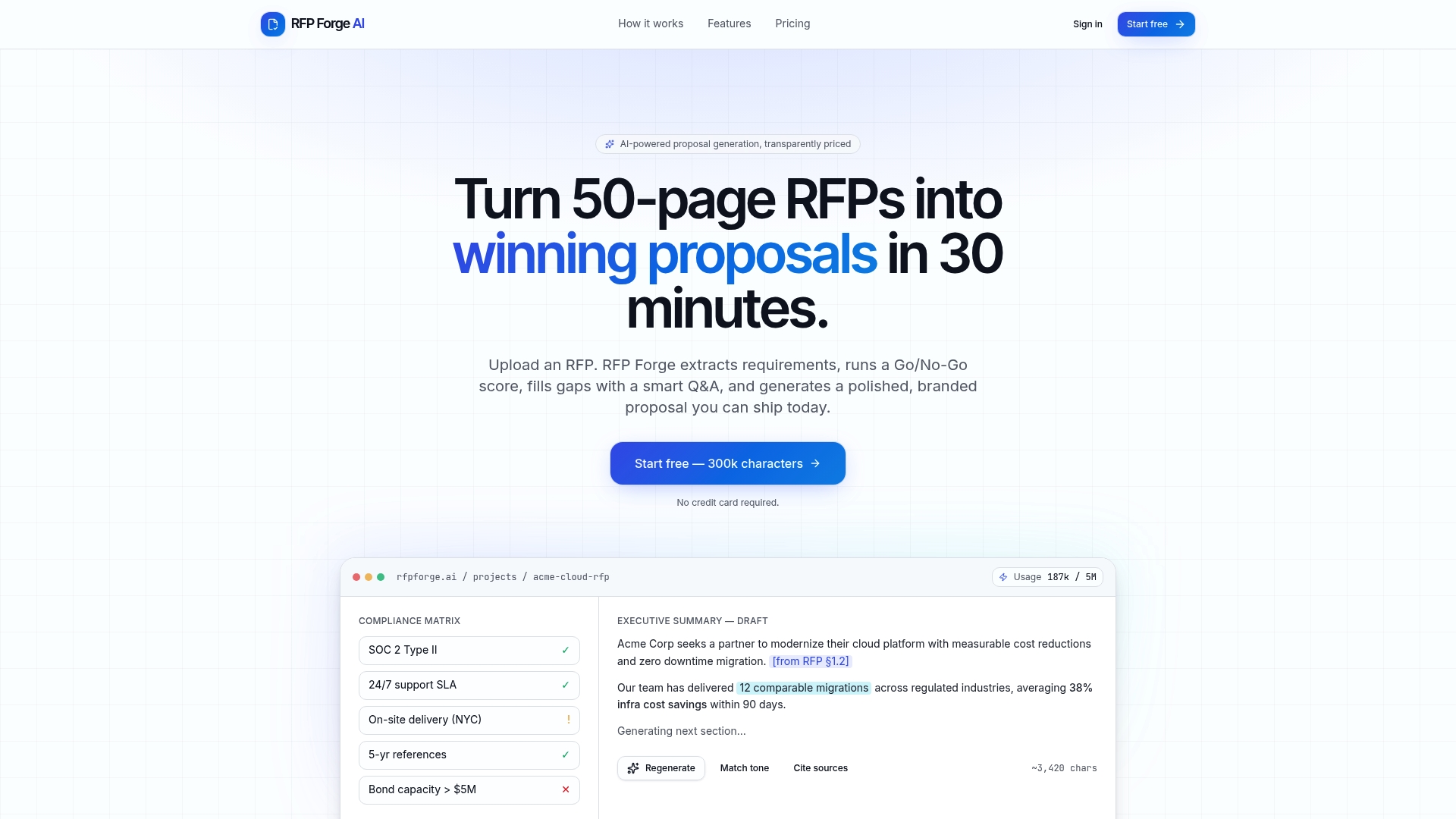
The PoC process is straightforward: upload a real RFP from your current pipeline, review the compliance matrix and draft sections, and measure the time and quality against your current baseline. No lengthy configuration required before you see results.
Start your PoC at Rfpforgeai or contact the team directly for enterprise pricing and a reference customer in your vertical.
Useful sources and references
The following sources were used in this comparison and are worth reviewing directly during your procurement process.
- G2: Loopio vs. Responsive comparison: Side-by-side feature breakdowns, pricing availability notes, and aggregated review themes. The primary source for G2 ratings (Loopio 4.7/5, Responsive 4.5/5) and feature category comparisons used throughout this article.
- G2: Loopio product reviews: Full review set with ease-of-use and support quality breakdowns. Useful for validating mid-market adoption patterns and onboarding experience claims.
- G2: Responsive (formerly RFPIO) product reviews: Enterprise feature coverage, integration depth evidence, and user feedback on configuration complexity.
- Gartner Peer Insights: Loopio alternatives: Verified enterprise buyer reviews comparing Loopio and Responsive. Responsive rated 4.2/5 (55 ratings) on this platform, with notes on AI improvement needs and service and support comparisons.
- Rfpforgeai product page: Primary source for Rfpforgeai's capabilities, client outcome metrics (38% cost reduction claim, 30-minute draft generation), and PoC trial access.