
A FAR compliance matrix is a single-source tracker that maps every solicitation and contract clause to where your proposal or contract documentation satisfies it. Your fastest next step: open the Smart Matrix on Acquisition.gov, pull your solicitation's Section L and M, and create one row for every "shall" statement you find.
Three resources to open right now:
- Acquisition.gov Smart Matrix — the official FAR clause table with effective dates, prescription references, and export-ready formatting
- WARU Provision & Clause Matrix — a widely used academic/vendor matrix updated around the 1st and 15th of each month, with explicit RFO/DFARS-change and commercial-item indicator columns
- Rfpforgeai — an AI-driven platform that shreds solicitations, extracts "shall" statements automatically, and generates a compliance matrix and proposal shell in minutes
Your fastest win: extract every "shall/must/will" statement from Section L and M, drop each into a spreadsheet row, and assign an owner before your kickoff meeting ends.
Key Takeaways
A FAR compliance matrix built from the Smart Matrix, WARU, and a structured column schema gives your team an auditable record from proposal submission through contract closeout.
| Point | Details |
|---|---|
| Start with official sources | Open the Acquisition.gov Smart Matrix and WARU matrix before building any compliance matrix row. |
| Extract shalls from Section L and M | FAR 15.203 makes Section L and M the primary sources for proposal instructions and evaluation factors. |
| Use the full column schema | Include effective date, flowdown flag, owner, and RFO change marker — the two most neglected columns in practice. |
| Version and update after every mod | Increment version numbers, log changes, and refresh flowdown rows the same day a contract modification is issued. |
| Rfpforgeai automates the shred | Rfpforgeai extracts requirements, maps clauses, and exports a versioned compliance matrix in minutes, with human QC built into the workflow. |
Table of Contents
- What a FAR compliance matrix is and why it matters
- Where to get authoritative FAR compliance matrices and tools
- Essential columns every usable FAR compliance matrix must include
- How to build a FAR compliance matrix from an RFP
- How to keep your matrix accurate after award
- A ready-to-use compliance matrix template
- How automation accelerates matrix creation and what to watch for
- What actually makes a compliance matrix stick in practice
- Rfpforgeai cuts matrix build time from hours to minutes
- Sources
What a FAR compliance matrix is and why it matters
The term "compliance matrix" covers two distinct tools that proposal teams often conflate. A proposal compliance matrix maps the Government's instructions (Section L) and evaluation factors (Section M) to specific volumes, pages, and narrative evidence in your submission. A contract compliance matrix tracks active clauses, flowdowns, reporting deadlines, and deliverables across the full performance period. Both are versions of the same core concept: a structured record that proves every requirement has an owner and a documented response.
FAR 15.203 requires that RFPs include the Government's requirements, anticipated terms and conditions, information required in proposals, and evaluation factors. That structure makes Section L and M the primary extraction points for any proposal matrix.
Common use cases across the contract lifecycle:
- Pre-award go/no-go and capture: check whether your team meets mandatory qualifications and certifications before investing bid resources
- Proposal compliance check: confirm every Section L instruction has a mapped response before submission
- Color-team review: give Red and Gold teams a row-by-row checklist instead of a narrative hunt
- Contract intake: ingest awarded clauses, CLINs, and ACRNs into a performance matrix on Day 1
- Audit readiness: produce a timestamped export showing clause coverage and evidence locations
- Modification tracking: log changes to scope, period of performance, or funding and update affected clause rows immediately
Ownership shifts as the contract moves through phases. During proposal development, the proposal manager typically owns the matrix and assigns rows to volume leads, pricing, and legal. Post-award, the contracts manager or program manager takes over, with subcontract managers responsible for flowdown rows. That handoff is where matrices most often break down — the proposal team's version rarely survives intact into contract administration.
Balancing compliance with winning content is a real tension. PropLibrary notes that strict checklist compliance without judgment about what the customer values can actually reduce proposal quality. Section M weights should drive how much effort you invest in each row, not just whether the box is checked.
Where to get authoritative FAR compliance matrices and tools
Three tiers of resources exist: official government sources, academic/vendor matrices, and commercial toolkits. Each serves a different need.
Acquisition.gov Smart Matrix
The Smart Matrix is the canonical official source. It lists FAR Part 52 provisions and clauses with their prescribed use, effective dates, and prescription references. The table structure supports filtering by contract type, commercial-item applicability, and clause number. You can export rows to CSV for import into Excel or a proposal tool. Always check the "last updated" date on the page before relying on a downloaded copy — FAR rule changes can shift prescriptions without obvious notice.
WARU Provision and Clause Matrix
The WARU matrix adds two columns the Smart Matrix lacks: an RFO/DFARS-change marker and a commercial-item flag. WARU updates around the 1st and 15th of each month and added those columns as of March 9, 2026. When FAR renumbering occurs, the change-log column lets you spot affected rows immediately rather than doing a manual diff. For teams tracking DFARS supplements, WARU's explicit change markers reduce the manual review time that FAR reorganizations typically create.
Wolters Kluwer FAR Matrix Tool
The Wolters Kluwer FAR Matrix Tool is a paid commercial toolkit built on FAR Part 52.301. It adds threshold indicators, direct clause links, and a curated interface designed for legal and compliance professionals. It is a vendor resource, not an official source, so treat it as a supplement to the Smart Matrix rather than a replacement.
What to check in any matrix download
Before using any matrix file, confirm these four fields are present and populated:
- Last updated / effective date — stale matrices are the single most common source of missed clause changes
- Change log or RFO marker column — tells you which rows changed since your last review
- Export format — CSV and Excel are import-ready; PDF-only matrices require manual re-entry
- Prescription reference — the FAR subpart that mandates the clause, so you can verify applicability for your contract type
Essential columns every usable FAR compliance matrix must include
A matrix without the right columns is just a list. The schema below gives you a data dictionary you can use to evaluate any template or build your own.
| Column | Format / Example |
|---|---|
| Clause identifier | FAR Part 52 |
| Provision vs. clause | "Provision" (pre-award) or "Clause" (post-award) |
| Effective date | effective date |
| Prescription / FAR location | FAR prescription reference |
| Applicability rule | Commercial items, fixed-price |
| Commercial-item flag | Yes / No |
| RFO/DFARS change marker | RFO 2026-01 |
| Source in solicitation | Section I, page reference |
| Exact "shall" statement text | Full verbatim text from solicitation |
| Mapped proposal volume/section | Proposal volume and section |
| Compliance evidence / document location | Technical Approach, p. 22 |
| Owner | Jane Smith, Contracts |
| Due / delivery date | effective date |
| Flowdown required | Yes — Subcontractor A |
| Reporting obligation / form | required reporting form, periodic |
| Retention / recordkeeping note | post-closeout retention per FAR |
The TechnoMile compliance checklist confirms that a lifecycle matrix must cover CLIN/ACRN mapping, cybersecurity obligations (DFARS 252.204-7012), wage determinations, and subcontracting plan tracking — all of which need their own rows.
Pro Tip: The two most neglected columns in practice are "Effective date/change marker" and "Flowdown required." Fix the first by pulling the Smart Matrix export date every time you open a new solicitation. Fix the second by adding a subcontract manager as a named owner on every flowdown row at contract intake — before performance starts, not after a DCAA inquiry.
How to build a FAR compliance matrix from an RFP
This workflow is repeatable under time pressure. Run it in order.
-
Triage the solicitation. Confirm the contract type (fixed-price, cost-reimbursement, T&M), the applicable supplements (DFARS, agency-specific FAR supplements), and any page limits, format requirements, and submission deadlines from Section L.
-
Extract every "shall/must/will" statement. Read Section L (instructions to offerors), Section M (evaluation factors), and the Statement of Work or Performance Work Statement. Paste each discrete requirement into a new matrix row. Tag the Section M weight or evaluation factor next to each row where stated.
-
Attach applicable FAR/DFARS provisions. Use the Smart Matrix to confirm which clauses are prescribed for your contract type. Cross-check with the WARU matrix for any RFO/DFARS changes that affect your clause list. Add the clause identifier, effective date, and prescription reference to each row.
-
Map rows to proposal volumes and sections. Assign each row a specific volume, section heading, and page range in your proposal outline. A sample mapping row looks like this: FAR 52.215-1 → Vol. 1, Section 2.3 (Technical Approach) → Narrative on p. 18 → Owner: Tech Lead → Due: 5 days before submission.
-
Assign owners and deadlines. Every row needs a named person, not a team label. Set internal deadlines at least 48 hours before the submission deadline to allow for a compliance pass.
-
Run a pre-submission responsiveness check. Filter for empty "compliance evidence" cells. Reconcile page counts against Section L limits. Flag any row where the owner field is blank. Stamp the file with a version number and date, and get sign-off from the proposal manager and legal reviewer before final submission.
For mapping compliance evidence to narrative sections like the executive summary, the executive summary examples guide shows how to tie Section M factors directly to your opening narrative.
How to keep your matrix accurate after award
A matrix that stops at submission is a liability, not an asset. The governance model below keeps it auditable through closeout.
-
Establish a versioning convention on Day 1. Use a filename like
ContractName_ComplianceMatrix_v1.0_YYYYMMDD.xlsx. Increment the minor version (v1.1, v1.2) for routine updates and the major version (v2.0) for contract modifications that change scope or clauses. -
Complete a full contract intake within five business days of award. Ingest all awarded clauses, CLINs, and ACRNs. Assign owners to every post-award row, including flowdown clauses for each subcontractor.
-
Run a monthly lookahead review during performance. Check upcoming reporting deadlines, deliverable due dates, and any open "change marker" rows flagged from WARU or Smart Matrix updates.
-
Refresh immediately after FAR/DFARS updates or contract modifications. When a modification changes scope, adds a clause, or adjusts funding, update affected rows the same day. Log the modification number in the change-log column.
-
Review at each option exercise. Option periods often reset period-of-performance dates and can trigger new wage determinations or updated cybersecurity requirements. Treat each option exercise as a mini contract intake.
Pro Tip: Tie matrix changes to CLIN/ACRN funding updates. When a modification adjusts funding on a CLIN, check the Limitation of Funds clause row (FAR 52.232-22) and the corresponding invoicing rows at the same time. Missing that link is how teams inadvertently exceed funded amounts.
A unified compliance checklist approach that consolidates FAR, DFARS, GSA Schedule, DCAA, and OFCCP obligations into one matrix reduces the administrative friction of tracking multiple oversight regimes separately.
A ready-to-use compliance matrix template
The CSV header below is import-ready for Excel, Google Sheets, or any proposal tool that accepts delimited files. Copy the header row, then add one row per requirement.
CSV header line:
Clause_ID,Provision_or_Clause,Effective_Date,Prescription_FAR_Ref,Applicability_Rule,Commercial_Item_Flag,RFO_DFARS_Change_Marker,Source_in_Solicitation,Shall_Statement_Text,Mapped_Proposal_Volume_Section,Compliance_Evidence_Location,Owner,Due_Date,Flowdown_Required,Reporting_Obligation_Form,Retention_Note
The two sample rows below show a proposal-responsiveness row and a post-award clause monitoring row.
| Clause_ID | Provision_or_Clause | Effective_Date | Prescription | Applicability | Commercial_Flag | RFO_Change | Source | Shall_Statement | Proposal_Section | Evidence_Location | Owner | Due_Date | Flowdown | Reporting | Retention |
|---|---|---|---|---|---|---|---|---|---|---|---|---|---|---|---|
| FAR 52.215-1 | Provision | effective date | FAR prescription reference | Negotiated; non-commercial | No | None | Sec. L, p. 3 | "Offerors shall submit a technical volume not to exceed 30 pages." | Vol. 1, Sec. 1.0 | Technical Volume cover page | Proposal Mgr | effective date | No | None | 3 yrs post-award |
| DFARS 252.204-7012 | Clause | effective date | DFARS clause | all DoD contracts over threshold | No | RFO identifier | Sec. I, p. 22 | "The Contractor shall report cyber incidents promptly." | N/A (post-award) | Incident Response Plan, Sec. 4 | ISSO | Ongoing | Yes — all subs | required form equivalent | 3 yrs post-incident |
The requirements traceability matrix guide covers import formatting and traceability schema best practices if you need to extend this template for larger programs.
How automation accelerates matrix creation and what to watch for
Automated solicitation shredding has changed the time math on proposal compliance. A workflow that once took a senior proposal manager four to six hours can now produce an initial matrix in under two hours, according to Fed-Spend's 2026 RFP playbook. That speed advantage compounds across a busy pipeline.
Concrete automation benefits for FAR compliance matrices:
- Consistent "shall" extraction — NLP parsing catches statements human readers skip when fatigued
- Clause library lookup — auto-match extracted clauses against the Smart Matrix or a curated library
- Structured export — generate a pre-formatted CSV or Excel matrix directly from the solicitation parse
- Owner assignment rules — route rows to the right team member based on clause type or section tag
- Update alerts — flag rows when a new WARU or Smart Matrix update touches a clause already in your file
Common pitfalls that automation does not eliminate:
- Imperfect NLP extraction — ambiguous "shall" language (conditional clauses, nested requirements) requires human review
- Mapping errors — an extracted clause may match the wrong FAR citation when solicitation text paraphrases the standard language
- Missed flowdowns — automated tools often miss subcontractor applicability unless flowdown rules are explicitly configured
- Stale effective dates — if the clause library is not updated after each FAR rule change, the matrix inherits outdated prescriptions
Safe adoption practices for AI-assisted matrix generation include human-in-the-loop QC checkpoints at extraction, mapping, and final export stages. Color-team reviewers and legal sign-off remain required even when automation handles the initial shred. For teams evaluating AI compliance governance frameworks, the same audit-trail and oversight principles that apply to regulated AI systems apply here: document what the tool extracted, what a human verified, and when.
The best proposal writing software guide covers which platform features matter most for regulated contracting, including clause libraries and audit trails.
What actually makes a compliance matrix stick in practice
Most proposal teams build a matrix for the proposal and abandon it at award. That is the wrong model, and it creates real audit exposure. The matrix earns its value post-award, when a DCAA auditor or a CO asks for evidence that a specific clause obligation was tracked and met.
The minimum viable matrix for a competitive bid has three things: every Section L instruction mapped to a proposal section, every Section M factor tagged with its evaluation weight, and a named owner on every row. That is not a long list. A 30-page RFP might produce 40 to 60 rows. You can build that in a morning if you have the right template and a shredded solicitation.
Where teams lose time is in the sign-off process. Legal wants to review every clause interpretation. Contracts wants to flag flowdowns. The proposal manager wants to keep the bid moving. The fix is a tiered review: proposal manager signs off on mapping and evidence, legal reviews only the rows flagged as "interpretation required," and contracts reviews only the flowdown rows. That structure cuts review cycles from days to hours.
Section M weights should drive your effort allocation, not just your compliance check. Compliance is the floor, not the ceiling.
Rfpforgeai cuts matrix build time from hours to minutes
Building a FAR compliance matrix manually is slow, and a missed "shall" in a federal proposal can cost you the award. Rfpforgeai gives proposal teams a faster path: the platform automatically shreds your solicitation, extracts every requirement, and generates a structured compliance matrix with clause citations, mapped proposal sections, and owner assignments — ready to export as CSV or Excel.
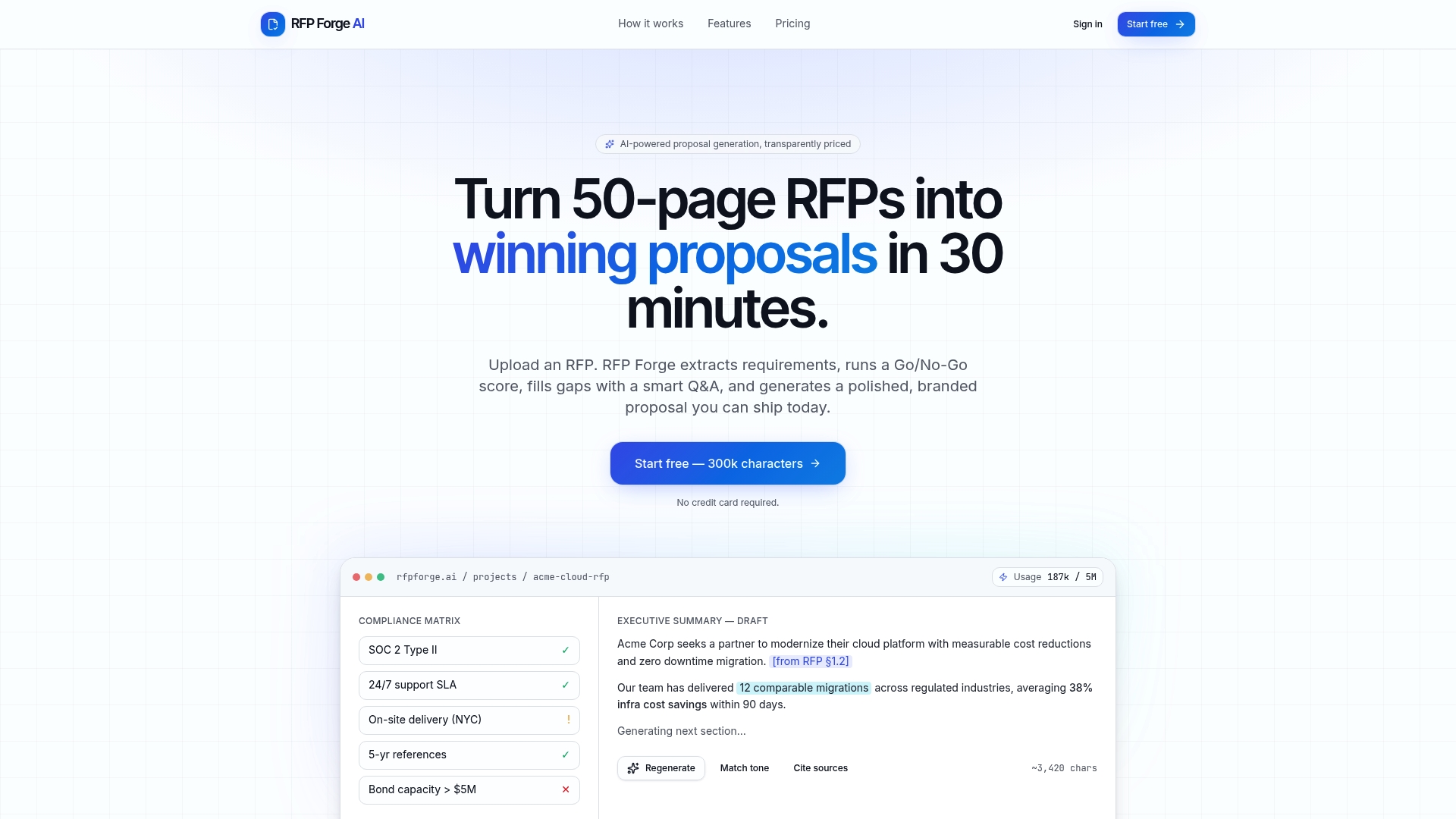
The platform's clause library maps against FAR and DFARS prescriptions, flags flowdown requirements, and produces versioned, audit-ready exports your contracts team can use through closeout. You get a compliance matrix and a proposal shell in the same workflow, not two separate tools. Teams in regulated industries report significant reductions in proposal prep time, with the platform's AI handling the extraction work that used to consume a senior proposal manager's full day.
Start your free trial at Rfpforgeai and turn your next solicitation into a compliant, submission-ready proposal draft in under 30 minutes.
Sources
Open these resources before you build or update your next compliance matrix. Check the last-updated date on every download before relying on it.
Official .gov sources:
- Smart Matrix
- WARU Provision and Clause Matrix
- Government Contract Compliance Checklist: A Complete CLM Checklist for Federal Contractors | TechnoMile
Vendor and academic resources:
Practical checklists and guides:
Always verify the publication or last-updated date on any vendor resource before using it as the basis for clause applicability decisions. Official .gov sources take precedence when a vendor matrix and the Smart Matrix conflict.
This article is general information, not a substitute for advice from a qualified lawyer. Consult a qualified legal professional about your own circumstances before acting on anything here.