
Color team reviews are staged, scored internal checkpoints that test a proposal for compliance and persuasive strength before it reaches an evaluator. The single most important thing you can do right now: schedule your Red Team five to seven days before submission and distribute Section L and Section M to every reviewer before that session.
TL;DR:
- Pink Team at an early draft stage catches compliance gaps when fixes are still cheap.
- Red Team simulates Source Selection Evaluation Board (SSEB) scoring against the solicitation's evaluation criteria.
- Gold Team is executive sign-off, not another edit pass.
Pro Tip: If you only have time for one review, make it the Red Team — but run it with a scored rubric mapped to Section M, not as a freeform critique session.
Table of Contents
- What are color team reviews and why do they raise win probability?
- What each color stage checks and what you should deliver
- When to run each review and who should attend
- How to run a Red Team that actually simulates evaluator scoring
- Reusable agendas, checklists, and a post-review action log
- Why color teams sometimes fail and how to fix it
- How to fold color teams into your proposal lifecycle and tooling
- How to measure review effectiveness and close the loop
- How AI can speed your color team preparation without replacing judgment
- Key Takeaways
- The gap between color team theory and what actually works
- Rfpforgeai cuts color team prep time from hours to minutes
What are color team reviews and why do they raise win probability?
Color team reviews are a structured, multi-stage mock evaluation process borrowed from federal procurement and popularized by the Shipley Associates methodology. Each "color" represents a distinct checkpoint with its own purpose, deliverables, and acceptance criteria. The Pink, Red, and Gold sequence maps directly to three questions every evaluator will ask: Is this proposal compliant? Is it persuasive? Is it ready to submit?

The method originated in Department of Defense (DoD) source selection, where agencies use formal evaluation panels to score proposals against published criteria. Proposal teams adapted the same logic internally: if you can simulate how an evaluator will score your draft, you can fix weaknesses before they cost you points.
The core benefits are concrete:
- Compliance prevention. Reviewers catch missing attachments, page-limit violations, and unaddressed requirements before submission.
- Evaluator perspective. Scoring against Section M forces reviewers to think like the SSEB, not like the authors.
- Risk reduction. Identified gaps become tracked action items with owners and deadlines, not verbal notes that get lost.
- Win theme validation. Red Teams confirm that discriminators are visible and tied to evaluation factors, not buried in technical prose.
Full color-team sequencing makes the most sense for large federal bids, complex grants, and high-value commercial RFPs where the cost of losing outweighs the cost of running three reviews. For smaller pursuits, a compressed combined Pink/Red review with two or three unbiased reviewers preserves the method's rigor without the overhead.
What each color stage checks and what you should deliver
Color team evaluations follow a predictable sequence, but each stage has a distinct job. Treating them as interchangeable is one of the fastest ways to waste reviewer time.

Pink Team
Purpose: Catch compliance gaps and confirm strategic direction while the proposal is still roughly 50% complete. Fixes at this stage cost a fraction of what they cost after a full Red Team rework.
Bring to the review: Draft outline, compliance matrix, win themes, and any completed sections.
What reviewers check: Does the outline address every Section L instruction? Are win themes tied to evaluation factors? Are there obvious gaps in technical approach or past performance?
Acceptance criteria: Every Section L requirement is mapped; win themes are documented; no fatal compliance gaps remain unresolved.
Red Team
Purpose: Simulate SSEB scoring against Section M. A Red Team that replicates evaluator scoring identifies weaknesses tied to evaluation factors and increases win probability by forcing the team to see the proposal through the evaluator's eyes.
Bring to the review: Complete draft (or near-complete), Section L/M, scoring rubric, and blank Proposal Deficiency Report (PDR) forms.
Expected outputs: Scored findings by evaluation factor, completed PDRs with named owners, and a prioritized rewrite list.
Acceptance criteria: Every Section M factor has a score; every finding below threshold has a PDR with an assigned owner and deadline.
Gold Team
Purpose: Executive sign-off. This is a risk and commitments review, not another edit pass. Leadership confirms that pricing is defensible, teaming commitments are solid, and no new compliance issues were introduced during rewrites.
Bring to the review: Final draft, compliance matrix (updated post-Red Team), pricing summary, and any outstanding PDRs.
Acceptance criteria: All high-severity PDRs closed; executive signatures obtained; version locked for production.
Blue, Green, and White-Glove Variants
| Color | When to add it | Primary focus |
|---|---|---|
| Blue | Concept/pre-RFP stage | Strategy alignment, early win themes |
| Green | Cost volume or pricing review | Price-to-win, cost realism, fee structure |
| White-Glove | Final production pass (24–48 hrs out) | Page counts, cross-references, missing forms |
Pro Tip: White-glove checks are the easiest to automate. Use a compliance tool to flag broken cross-references, missing attachments, and page-count violations before the final print run.
When to run each review and who should attend
Timing and reviewer selection are where most color team programs break down. A Red Team run two days before submission cannot generate findings the team has time to fix. Reviewer selection that pulls in proposal writers produces feedback that reads like in-line edits, not scored evaluations.
Sample timing blueprint
| Color | Proposal completion | Days before submission | Primary purpose |
|---|---|---|---|
| Pink | ~50% | 15–20 days | Compliance and direction |
| Red | — | five to seven days | Mock evaluation, scoring |
| Gold | — | one to two days | Executive sign-off |
| White-Glove | Production-ready | — | Final production check |
Reviewer selection checklist
- No proposal writers as reviewers. Writers cannot objectively score their own work. Assign them as note-takers or PDR owners, not evaluators.
- Include at least one subject-matter expert (SME) per major technical volume to validate approach credibility.
- Bring in evaluator-experienced reviewers when available. Former contracting officers or agency program managers add significant signal to Red Team scoring.
- Assign a capture lead to confirm win themes and competitive positioning are intact after rewrites.
- Include a production coordinator for Gold and White-Glove reviews to manage version control and submission logistics.
For smaller teams, two or three unbiased reviewers can cover discrete evaluation factors rather than replicating a full panel. This preserves rigor without requiring a large staff.
Logistics notes: Distribute the draft and Section L/M at least 48 hours before the Red Team session. Reviewers who arrive without having read the solicitation cannot score against it. Lock the version being reviewed so writers cannot push changes during the session.
How to run a Red Team that actually simulates evaluator scoring
The Red Team is the highest-stakes review in the sequence. Its value depends entirely on whether reviewers score against the sponsor's criteria or simply react to the prose. A Red Team adds value only when reviewers score against the sponsor's criteria and provide written, prioritized findings mapped to RFP factors.
Designing the scorecard
Map every Section M evaluation factor to a row in your scorecard. For each factor, include:
- Factor name and weight (as stated in Section M)
- Score field (see scale options below)
- Evidence field: "What specific text supports this score?"
- Gap field: "What is missing or weak?"
Scoring should force reviewers to justify ratings against explicit assessment criteria — understanding, soundness, and compliance — so leadership can see the rationale behind each score, not just a number.
Scoring scale options
| Scale type | Example | Best for |
|---|---|---|
| Color-coded | Red / Yellow / Green / Blue | Federal bids; mirrors DoD evaluation language |
| Numerical | 1–5 or 1–10 | Commercial bids; easier to average across factors |
| Adjectival | Unacceptable / Marginal / Acceptable / Good / Outstanding | FAR Part 15 alignment |
Color-coded scoring is recommended because it visually aligns with DoD scoring language and makes systemic weaknesses easier to read at a glance. A dashboard showing three Red factors and two Yellow factors communicates risk to leadership faster than a spreadsheet of numbers.
Writing actionable findings with PDRs
Proposal Deficiency Reports (PDRs) turn subjective critique into trackable rewrite tasks. Each PDR should include:
- Finding ID (sequential)
- RFP factor and section reference
- Severity (Critical / Major / Minor)
- Finding description (what is missing or weak)
- Recommended action (what the writer should do, not how to write it)
- Assigned owner and deadline
The facilitator's role
The facilitator's job is to keep reviewers scoring, not rewriting. Enforce three rules: no in-line edits during the session, every finding must reference a Section M factor, and every score must have written justification. Run a 15-minute debrief at the end to prioritize findings by severity and assign owners before anyone leaves the room.
Pro Tip: Use a color-coded scoring visualization when briefing leadership on Red Team results. Red and Yellow factors on a single slide communicate urgency faster than a written summary.
Reusable agendas, checklists, and a post-review action log
Red Team agenda (60–90 minutes)
- Pre-read confirmation (5 min): Confirm all reviewers have read Section L/M and the distributed draft.
- Scoring session (40–50 min): Reviewers score independently against the Section M rubric. No group discussion during scoring.
- Debrief (20 min): Facilitator collects scores, surfaces outliers, and leads group discussion on Critical and Major findings.
- Assignment meeting (10–15 min): Every Critical and Major PDR gets a named owner and a deadline before the session closes.
Pink Team agenda (45 minutes): Open with compliance matrix walkthrough (15 min), then review outline against Section L (20 min), close with win theme alignment check (10 min).
Gold Team agenda (30–45 minutes): Review updated compliance matrix (10 min), confirm all Critical PDRs are closed (10 min), executive sign-off on pricing and commitments (15–25 min).
Reviewer checklist (questions to focus feedback)
- Does every Section L instruction have a corresponding response?
- Is the win theme visible in the first paragraph of each major section?
- Does the technical approach address the evaluation criteria in Section M, not just the statement of work?
- Are discriminators specific and supported by evidence, or are they generic claims?
- Are past performance examples tied to the same scope, size, and complexity as this requirement?
- Are all required forms, certifications, and attachments present?
Post-review action log template
| Finding ID | RFP factor | Severity | Owner | Deadline | Status |
|---|---|---|---|---|---|
| — | Technical Approach (M.1) | Critical | J. Smith | Day +2 | Open |
| — | Past Performance (M.3) | Major | A. Lee | Day +3 | In Progress |
| — | Management Plan (M.2) | Minor | T. Nguyen | Day +4 | Closed |
Re-review all Critical findings within 24 hours of the assigned deadline. Do not wait until the Gold Team to verify that Critical PDRs are resolved.
Why color teams sometimes fail and how to fix it
Color team feedback fails when the process is treated as a formality rather than a scored evaluation. These are the patterns that kill review value.
Common anti-patterns and corrections:
- Writers as reviewers. Writers defend their choices instead of scoring objectively. Fix: enforce the no-writers rule and assign them as PDR owners instead.
- Feedback delivered as rewrites. Reviewers who rewrite draft text during the session consume time and undermine writer ownership. Fix: the facilitator stops in-line edits immediately and redirects to the PDR form.
- Red Team run too late. Running the review too late leaves no time to act on substantive findings. Fix: gate the Red Team at five to seven days before submission as a non-negotiable schedule milestone.
- Missing Section M alignment. Reviewers who haven't read the solicitation score based on writing quality, not evaluation criteria. Fix: require Section L/M pre-read as a condition of participation.
- Inconsistent scoring. Without a shared rubric, scores reflect personal preference. Fix: anchor every score to the rubric's explicit criteria before the session starts.
- Pink Team skipped. Compliance gaps discovered at Red Team cost far more to fix than those caught at Pink. Fix: treat Pink as mandatory, even if it runs as a 45-minute virtual session.
When schedules compress, combine Pink and Red into a single session rather than skipping one entirely. Assign two reviewers to compliance and two to evaluator scoring, then debrief together.
Pro Tip: Limit each reviewer to a maximum of two PDRs per evaluation factor. More than that usually signals the draft needs a structural rewrite, not incremental fixes — and that conversation belongs in the debrief, not in 20 separate PDR forms.
How to fold color teams into your proposal lifecycle and tooling
Color team reviews only deliver consistent value when they are built into the capture plan as hard gate dates, not scheduled reactively when the draft is nearly done.
Integration checklist:
- Add Pink, Red, Gold, and White-Glove dates to the capture plan at kickoff.
- Define gate maturity criteria for each review (what "ready to review" means in terms of completion percentage and required deliverables).
- Schedule reviewer training or a 30-minute orientation for any reviewer new to the PDR process.
- Establish a version-control protocol: one locked draft per review, no live edits during the session.
- Require a closure gate: no submission without confirmed Gold Team sign-off.
Tooling capabilities to prioritize
| Capability | Why it matters for color teams |
|---|---|
| Automated compliance extraction | Reduces pre-read time; surfaces missing requirements before Pink |
| Scorecard / scoring fields | Standardizes Red Team ratings across reviewers |
| Version control | Prevents reviewers from scoring different drafts |
| PDR / action-tracking dashboard | Tracks finding status from Red Team through Gold |
| Compliance matrix generation | Gives Pink and Gold reviewers a structured reference |
For teams evaluating proposal software features that support review gates, prioritize compliance extraction and action-tracking dashboards over formatting features. A tool that auto-generates a compliance matrix from the RFP cuts Pink Team pre-read time significantly. Platforms with built-in RFP evaluation criteria mapping help reviewers stay anchored to Section M during scoring.
How to measure review effectiveness and close the loop
Running color team reviews without tracking outcomes is the equivalent of scoring a proposal and never reading the results. These KPIs give you a quantifiable picture of review impact.
KPIs to track:
- Percentage of Critical and Major PDRs closed before submission. This is the primary measure of review execution quality.
- Average days between Red Team and submission. Tracks whether teams are scheduling reviews with enough runway.
- Rework hours by severity. Quantifies the cost of findings caught late versus early.
- Evaluator-aligned score delta. If you track simulated Red Team scores across pursuits, compare them to actual award/debrief feedback to calibrate your rubric over time.
Closure workflow
- Assign all PDRs with owners and deadlines at the Red Team debrief.
- Re-review Critical findings within 24 hours of their deadline.
- Facilitator confirms closure in the action log before the Gold Team.
- Gold Team verifies the compliance matrix reflects all post-Red Team changes.
- Version lock after Gold Team sign-off; no further edits without executive approval.
One-page dashboard fields
| Field | What to track |
|---|---|
| Total PDRs by severity | Critical / Major / Minor counts |
| PDR closure rate | % closed before submission |
| Days Red Team to submission | Actual vs. target (five to seven days) |
| Sections with Critical findings | Identifies recurring weak areas |
| Simulated vs. actual score | Track over time for rubric calibration |
Feed lessons learned into a review-knowledge repository after each pursuit. Document which evaluation factors generated the most Critical findings, which reviewer profiles added the most signal, and which pre-read materials were most useful. Over time, this repository becomes your most reliable source of proposal improvement data.
How AI can speed your color team preparation without replacing judgment
AI and automation add the most value in the preparation and tracking phases of color team reviews, not in the scoring itself. Human evaluator judgment cannot be replaced by a language model, but the administrative work surrounding reviews can be cut significantly.
Specific capabilities that deliver value:
- Requirements extraction. AI tools can parse a 200-page RFP and surface every Section L instruction and Section M factor in minutes, giving Pink Team reviewers a structured starting point rather than a manual read.
- Automated compliance matrices. A pre-built matrix showing which requirements are addressed, partially addressed, or missing reduces Pink Team pre-read time and gives Gold Team reviewers a clean reference.
- Gap highlighting. AI can flag sections where the draft does not reference a required evaluation factor, surfacing likely Red Team findings before the session starts.
- PDR drafting assistance. Some platforms can suggest a finding description based on a flagged gap, which the reviewer then edits and approves. This speeds the PDR-writing step without removing reviewer judgment.
- Action-tracking and verification. Automated dashboards that update PDR status as owners mark findings resolved reduce the facilitator's administrative load and make closure gates easier to enforce.
Where human judgment must stay primary: AI requirement extraction produces false positives. A tool may flag a sentence as non-compliant when it actually addresses the requirement in different language. Reviewers need training to verify AI outputs rather than accept them. Similarly, AI-suggested PDR text should be treated as a draft, not a finding. The reviewer's job is to confirm the gap is real and that the recommended action is appropriate for the proposal's strategy.
Pro Tip: Run AI-generated compliance matrices through a manual spot-check before distributing them to reviewers. One false positive that sends the team chasing a non-issue costs more time than the automation saved.
Key Takeaways
Structured color team reviews, anchored to Section M scoring and closed-loop PDR tracking, are the most reliable method for improving proposal quality before submission.
| Point | Details |
|---|---|
| Schedule reviews early | Pink at 50% completion, Red at five to seven days out, Gold at one to two days out. |
| Score against Section M | Every Red Team finding must map to an evaluation factor, not general writing quality. |
| Use PDRs for accountability | Assign every Critical and Major finding to a named owner with a deadline before the session ends. |
| Track closure as your primary KPI | Percentage of Critical PDRs closed before submission is the clearest measure of review execution. |
| Rfpforgeai accelerates preparation | Automated compliance matrices and action-tracking dashboards cut pre-read time and keep PDR closure on schedule. |
The gap between color team theory and what actually works
Color team reviews are one of the most widely recommended practices in proposal management and one of the most consistently misapplied. The theory is clean: run staged reviews, score against evaluation criteria, fix what's weak. The reality is messier.
The most common failure isn't skipping a color stage. It's running the right stage at the wrong time with the wrong people. A Red Team held three days before submission with two proposal writers as reviewers is not a Red Team. It is a pressure-release valve that generates comments no one has time to act on. The Shipley methodology and federal procurement practice both emphasize that the review's value is proportional to the runway it creates for fixes.
There's also a subtler problem: teams that run technically correct color reviews but never close the loop. PDRs get written, owners get assigned, and then the Gold Team happens without anyone verifying that Critical findings were actually resolved. The action log becomes a record of intent, not a record of execution. Tracking closure rate as a hard KPI changes that dynamic. When leadership can see that 85% of Critical PDRs were closed before submission, the review process has a measurable output, not just a procedural one.
The other thing most guides understate: the Pink Team is where the real leverage is. Catching compliance gaps at roughly 50% completion costs a fraction of what a late Red Team rework costs in writer hours and schedule pressure. Teams that skip Pink because they're behind schedule are making a trade that almost always costs more than it saves.
If you want to improve your win rate through better reviews, start with two changes: enforce the no-writers-as-reviewers rule, and treat the Red Team schedule date as a hard gate, not a target. Everything else in the process improves once those two constraints are in place.
Rfpforgeai cuts color team prep time from hours to minutes
Preparing for a Red Team used to mean manually building a compliance matrix, distributing a 150-page draft, and hoping reviewers had time to read Section M before the session. Rfpforgeai changes that equation directly.
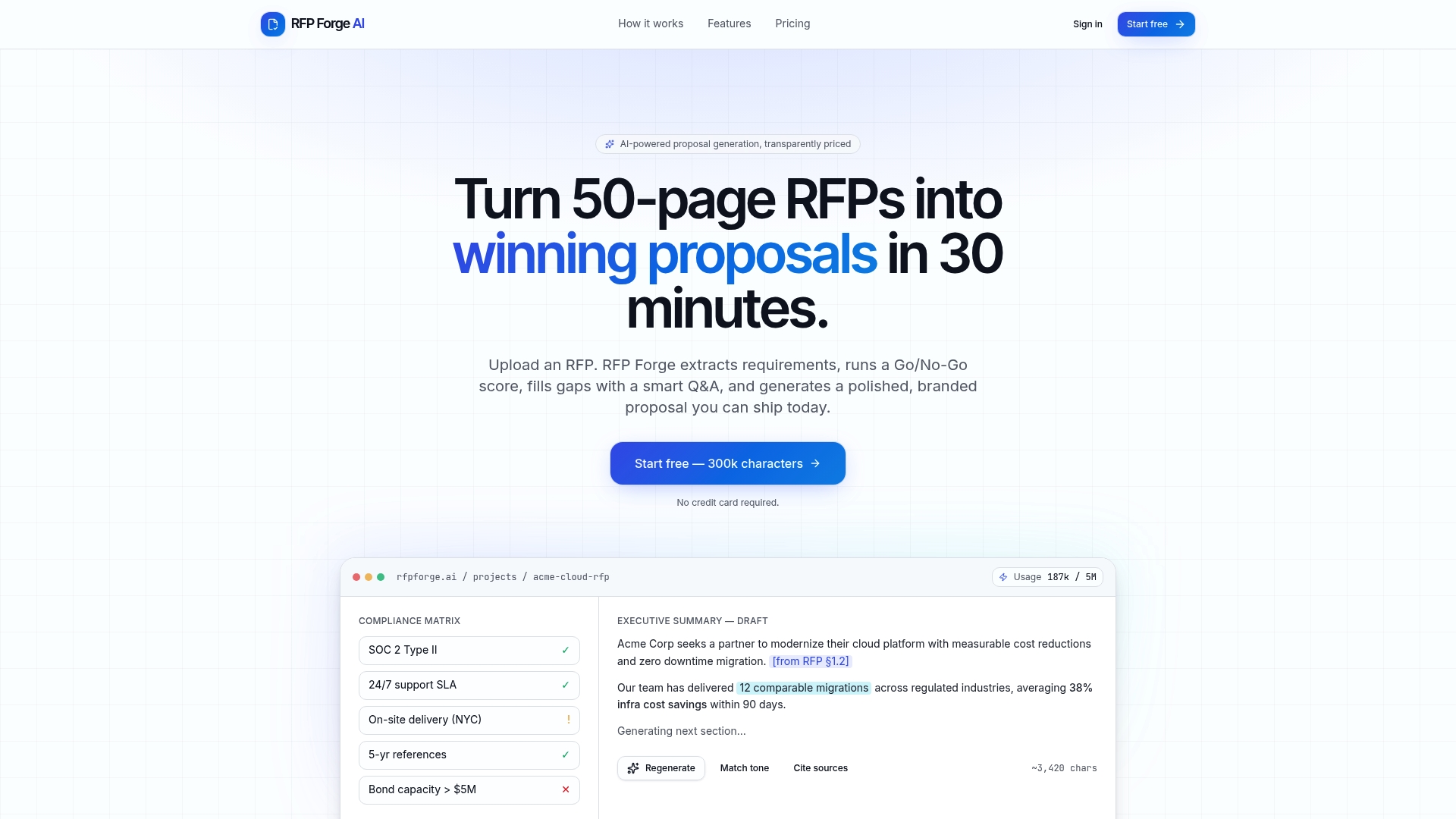
The platform extracts every Section L instruction and Section M evaluation factor from your RFP automatically, generates a compliance matrix your Pink and Gold teams can use as a structured reference, and flags gaps in your draft before reviewers ever open the document. PDR tracking and action dashboards keep closure rates visible from Red Team through Gold Team sign-off, so nothing falls through the cracks under deadline pressure.
For teams running their first structured color review or scaling an existing process, the fastest entry point is Rfpforgeai's compliance matrix and requirements extraction features. They cut pre-read time, surface missing requirements early, and give your reviewers a scored starting point instead of a blank page.
Start your first AI-assisted review and see how much faster your next Red Team runs.