
What are RFP evaluation criteria and why do they matter?
RFP evaluation criteria are the predetermined standards your team uses to score and compare vendor proposals objectively. They tell vendors exactly what you value, and they give evaluators a consistent framework so every proposal gets judged on the same terms.
Under FAR 15.304, every competitive source selection must evaluate cost or price plus at least one non-cost quality factor, such as past performance or technical excellence. That regulatory floor exists for a reason: price alone is a poor predictor of contract success. The non-cost factors are where you separate a vendor who can win from one who can actually deliver.
Well-designed proposal evaluation criteria do three things at once:
- Guide evaluators by giving them measurable standards rather than gut feelings
- Inform vendors so they can tailor proposals to your actual priorities
- Protect your organization by creating a documented, defensible selection record
Clearly defined criteria also reduce irrelevant submissions. When vendors understand what you value, they self-select more accurately, which means fewer proposals to read and better responses from the ones you do receive.
Common RFP evaluation criteria categories and how weighting works
Weighting is how you translate organizational priorities into numbers. A procurement for a mission-critical IT system should not weight price the same as a procurement for office supplies. The distribution below illustrates a typical professional services or technology acquisition with varying weights assigned to key criteria such as technical approach, pricing, and past performance, emphasizing the importance of reflecting organizational priorities in weighting decisions. |

George Washington University's procurement office uses a similar weighted scoring model with 30% for organizational qualifications, 20% each for staff qualifications, references, and pricing, and 15% for approach. Your numbers will differ, but the logic is the same: the criterion that most directly predicts contract success gets the highest weight.
One practical note: if one criterion carries more than 50% of the total weight, document your justification carefully. A heavily skewed framework can expose your organization to protest risk and may inadvertently favor incumbents.
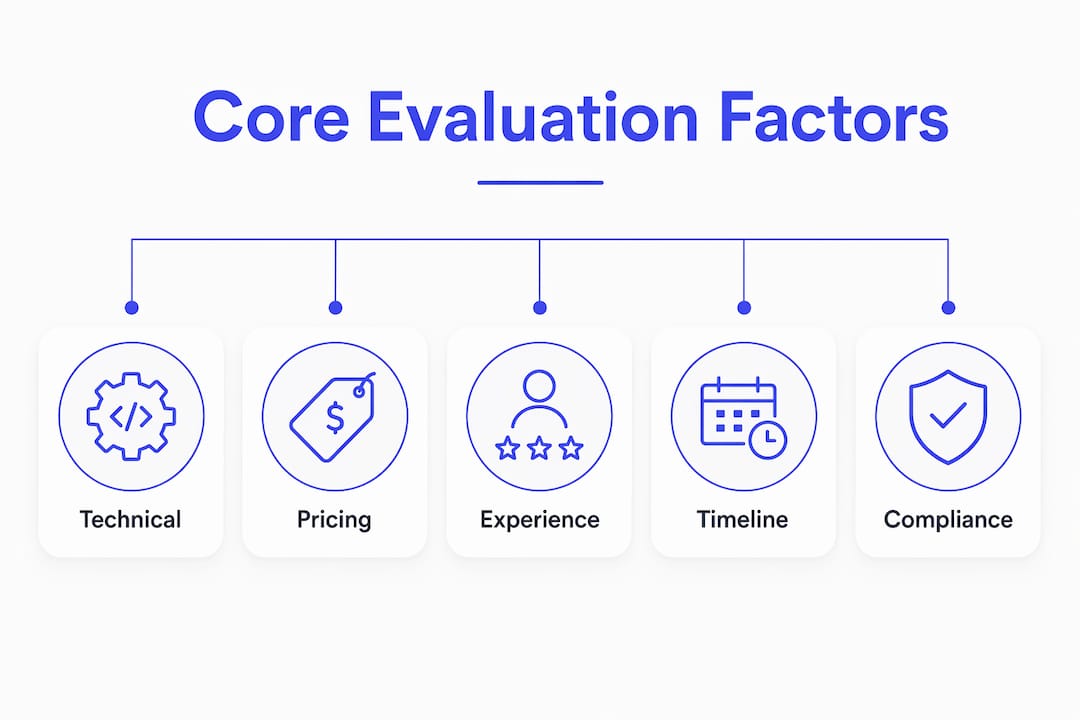
A closer look at the five core proposal evaluation factors
Technical requirements and approach
This criterion assesses whether the vendor actually understands the work. Look for a clear methodology, realistic assumptions, and evidence that the proposed approach fits your operating environment. Innovation matters here too, but only when it is grounded in feasibility. A proposal that promises a novel solution with no implementation detail scores lower than one with a proven, well-explained plan.
Pricing and cost structure
Cost evaluation goes beyond the bottom line. Per U.S. Department of Energy acquisition guidance, life-cycle costs such as software conversion, retraining, and ongoing maintenance must be identified in the solicitation to be considered fairly. If you only evaluate the initial contract price, you may select the cheapest proposal upfront and pay far more over the contract term.

Vendor experience and past performance
FAR 15.305 requires evaluators to consider the currency, relevance, and context of past performance data. A contract completed five years ago in a different industry tells you less than one completed last year in your sector. Ask vendors to identify similar contracts and describe any problems encountered along with corrective actions taken.
Implementation timeline
Evaluate whether the proposed schedule is realistic given the scope, and whether the vendor has built in contingency. A timeline that assumes perfect conditions is a risk indicator, not a strength.
Compliance, security, and risk
- Does the vendor meet mandatory regulatory requirements (HIPAA, FedRAMP, SOC 2, or sector-specific standards)?
- What is their data security posture and breach notification process?
- Have they identified project risks and proposed specific mitigation strategies?
- For federal contracts, does their small business subcontracting plan meet statutory goals?
Pass/fail versus scored criteria: understanding the difference
Many procurement teams blur the line between requirements and evaluation criteria. Requirements are pass/fail: a vendor either meets the minimum threshold or they do not. Evaluation criteria are scored on a gradated scale to distinguish the good proposals from the great ones. Confusing the two means you lose the ability to meaningfully differentiate among qualified vendors.
Per the Hawaii State Procurement Office, requirements capture binary eligibility (for example, "must support 10,000 concurrent users") while evaluation criteria measure quality and approach on a spectrum.
Common scoring methods, applied consistently:
- Numerical weights: Assign point values (1–5 or 1–10) to each criterion, then multiply by the criterion weight. Produces a total score that is easy to compare across proposals.
- Adjectival ratings: Labels such as Outstanding, Good, Acceptable, Marginal, and Unacceptable, each mapped to a defined standard. Useful when evaluators need narrative flexibility.
- Color coding: Blue/Green/Yellow/Red ratings, often used in federal source selections. Intuitive for committee review.
- Ordinal rankings: Rank proposals from best to worst on each criterion. Simpler but loses granularity on how far apart proposals actually are.
FAR 15.305 explicitly allows any combination of these methods, provided evaluators apply them consistently and document the rationale. The rating method itself does not need to be disclosed in the solicitation, but the factors and their relative importance must be.
Sample scoring matrix:
| Criterion | Weight | Vendor A score (1–5) | Weighted score |
|---|---|---|---|
| Technical approach | — | — | — |
| Pricing | 20% | — | — |
| Past performance | 20% | 5 | — |
| Key personnel | 10% | — | — |
| Risk and compliance | 10% | — | — |
| Total | — | —.90 / 5.00 |
Your pre-RFP evaluation criteria checklist
Before you release the RFP, run through this checklist. Gaps at this stage become disputes after proposals arrive.
Alignment and scope
- Each criterion connects directly to a specific outcome goal or scope element
- Criteria flow logically from the statement of work and performance objectives
- No criterion exists solely for administrative convenience
Fairness and clarity
- Criteria do not favor incumbent vendors or create artificially restrictive thresholds
- Each criterion is described in plain language that a vendor can act on
- Evaluators have a shared understanding of what a top score looks like before proposals arrive
Weighting rationale
- Weights reflect actual project priorities, not default percentages from a prior procurement
- No single criterion is weighted so heavily that it predetermines the outcome
- The solicitation states whether non-cost factors are more, less, or approximately equal in importance to price
Vendor communication
- The RFP clearly states all factors, subfactors, and their relative importance
- Vendors know what information to submit for each criterion
- Life-cycle cost elements (maintenance, retraining, conversion) are explicitly listed if they will be evaluated
Evaluator instructions
- Scoring standards are documented before the evaluation begins
- Each evaluator receives written guidance on applying the rating scale
- The process for resolving scoring disagreements is defined
Pro Tip: Draft a sample "top-score" description for each criterion before you finalize the RFP. If your committee cannot agree on what a perfect response looks like, the criterion is not specific enough to use.
Best practices for designing fair and effective evaluation criteria
The single most common mistake in RFP scoring criteria design is treating weighting as an afterthought. NIGP's Global Best Practices for Request for Proposals are direct on this point: criteria weighting must align with project success metrics, not organizational habit. Copying weights from a previous procurement is a fast path to selecting the wrong vendor for this one.
Involve stakeholders early. The people who will live with the contract outcome, program managers, end users, legal, and finance, each see different risk dimensions. A procurement team that builds criteria in isolation often misses the technical nuances that matter most to the people doing the actual work.
Keep the factor list short. The Army's acquisition guidance is explicit: use the minimum number of factors needed to effectively assess proposals. Every additional criterion dilutes the discriminating power of the ones that actually matter and extends evaluation timelines.
Document everything. FAR 15.305 requires that source selection decisions include documented rationale for tradeoffs. That documentation protects you in a protest and creates institutional knowledge for future procurements.
Connecting criteria to outcomes is what separates a good evaluation framework from a generic one. The Harvard GovLab RFP guidebook puts it plainly: each evaluation factor should flow from your goals, metrics, and scope of work as a logical continuation, not a separate checklist bolted on at the end.
Common pitfalls to avoid in RFP evaluation criteria design
Overloading the criteria list. More criteria feels thorough but actually weakens the evaluation. When you have fifteen factors, each carrying 6–7% of the total weight, none of them meaningfully differentiates proposals. Trim to the factors that genuinely predict success.
Weighting price too heavily without justification. A framework that gives price 60% or more of the total weight will almost always select the lowest bidder, regardless of capability. That is a legitimate choice for commodity purchases, but a serious risk for complex services where execution quality drives outcomes.
Vague criterion descriptions. "Quality of proposal" is not a criterion. It gives evaluators no standard to apply and vendors no signal about what to write. Every criterion needs a description specific enough that two evaluators reading the same proposal would reach similar scores independently.
Ignoring life-cycle costs. Evaluating only the contract price and ignoring downstream costs like retraining, software conversion, and maintenance produces a skewed total cost picture. Those costs must be named in the solicitation to be considered fairly in the evaluation.
Building criteria that favor the incumbent. Requirements written around a current vendor's specific capabilities, certifications, or proprietary tools create a biased playing field. Review each criterion and ask whether a qualified new entrant could realistically compete.
Skipping evaluator calibration. Even a well-designed scoring rubric produces inconsistent results if evaluators interpret the scale differently. A short calibration session before scoring begins, using a sample proposal, closes most of that gap.
How to customize weighting based on your organization's priorities
Weighting is not a formula. It is a deliberate decision that should reflect what failure looks like for this specific contract. Start by asking: if one factor goes wrong, which one causes the most damage?
For a public safety technology deployment, compliance and security failures can be catastrophic. Weight those criteria higher, even if it means reducing the weight on price. For a short-term consulting engagement where the deliverable is a report, the qualifications of the specific named personnel may matter more than the firm's overall past performance.
A practical approach is to rank your criteria from most to least critical, then assign weights proportionally. If technical approach is twice as important as pricing for your project, the weights should reflect that ratio. Priority statements work too: "technical approach is more important than price, which is more important than past performance." That language gives the source selection authority flexibility to make tradeoff decisions without being locked into rigid point totals.
Revisit the weights after your market research. If the vendor pool is relatively homogeneous on technical capability but varies widely on price, shifting weight toward price makes sense. If the opposite is true, weight the differentiating factors more heavily.
How to handle subjective versus objective criteria
Objective criteria have clear, verifiable answers. A vendor either holds a FedRAMP authorization or they do not. Their proposed price is a number. Their delivery timeline is a date. These criteria are easy to score consistently.
Subjective criteria, like "quality of technical approach" or "clarity of project management plan," require judgment. The risk is that two evaluators score the same proposal differently based on personal preference rather than the stated standard. Three practices close that gap.
First, write behavioral anchors for each rating level. Instead of "Good technical approach," define what good looks like: "Proposal demonstrates a clear methodology with named milestones, identifies at least two project risks with specific mitigation strategies, and shows direct experience with comparable scope." That description is still qualitative, but it gives evaluators a shared target.
Second, use independent scoring before group discussion. Each evaluator scores proposals alone, then the committee compares scores. Significant divergence on a criterion signals either a poorly written standard or a proposal that is genuinely ambiguous. Both are worth resolving before finalizing scores.
Third, require narrative justification for scores above and below the midpoint. A score of 5 out of 5 with no written rationale is not defensible. A score of 5 with two sentences explaining what the proposal did exceptionally well is.
How to document and communicate evaluation criteria to vendors
Vendors write better proposals when they know exactly how they will be judged. The RFP should state every evaluation factor, its weight or relative importance, and a description of what a strong response includes. Withholding this information does not protect your organization. It just produces generic proposals that are harder to score.
The solicitation must clearly state the relative importance of price compared to all other factors combined. FAR 15.304 requires at minimum that the RFP indicate whether non-cost factors are significantly more important than, approximately equal to, or significantly less important than cost. That single statement shapes how vendors allocate their proposal writing effort.
For each criterion, include a brief description of what a top score looks like. You do not have to publish the full scoring rubric, but giving vendors a target improves response quality across the board. If a criterion has sub-components, list them and indicate how points are distributed within the category.
After the RFP is released, maintain a consistent record of all vendor questions and your responses. Answers that clarify evaluation standards should go to all vendors simultaneously. Any post-release change to the criteria or weights requires a formal amendment and sufficient time for vendors to revise their proposals.
Key Takeaways
Well-designed RFP evaluation criteria, grounded in FAR 15.304 requirements and weighted to reflect actual project priorities, are the single most reliable way to select the right vendor and defend that decision.
| Point | Details |
|---|---|
| Regulatory baseline | FAR 15.304 mandates cost/price evaluation plus at least one non-cost quality factor in every competitive source selection. |
| Weighted scoring | Assign percentage weights that reflect project priorities; no single criterion should predetermine the outcome. |
| Pass/fail vs. scored | Requirements set minimum eligibility; scored criteria on a gradated scale differentiate proposal quality. |
| Life-cycle costs | Name maintenance, retraining, and conversion costs in the solicitation or they cannot be fairly evaluated. |
| Document everything | FAR 15.305 requires documented rationale for all tradeoffs and source selection decisions. |