
Use this one-sentence rule to decide: issue an RFI when you need market intelligence, an RFQ when your specs are locked and price is the only variable, and an RFP when you need vendors to propose a full solution. The distinction between RFI, RFP, and RFQ is not semantic — picking the wrong document wastes weeks of internal effort and produces responses you cannot use.
Quick-match guide:
- Buying commodity items with fixed specs (office supplies, standard hardware, raw materials) → issue an RFQ
- Evaluating the market before you know what you need (new technology, unfamiliar vendor category) → issue an RFI
- Selecting a systems integrator, managed service, or complex solution → issue an RFP
Sequencing note: RFI → RFP → RFQ is the classic Source-to-Contract (S2C) path, but the RFI step is optional. Skip it when your requirements are already defined and your vendor shortlist is established.
Table of Contents
- What is an RFI and when should you use it?
- What is an RFQ and when should you use it?
- What is an RFP and when should you use it?
- RFI vs RFP vs RFQ: side-by-side comparison
- When to use each: practical scenarios and sequencing
- Decision checklist: how to pick RFI, RFP, or RFQ
- Common mistakes and best practices for issuing and responding
- Typical timelines and effort expectations for each request type
- How AI tools speed RFI, RFP, and RFQ creation
- Key Takeaways
- The mistake most procurement teams make before they even send a document
- Cut your RFP response time without cutting corners
- Useful sources and next-step references
What is an RFI and when should you use it?
An RFI (Request for Information) is a formal market-research tool. You send it before you have finalized requirements, when you need to understand what vendors can actually deliver. Federal procurement guidance from the GSA treats RFIs as non-binding market research, not a commitment to buy. No award follows an RFI directly.
Typical RFI contents:
- Brief company and project context (a few paragraphs)
- High-level goals and constraints
- Open-ended capability questions
- Request for case studies or reference clients
- Response format instructions and deadline
Example RFI questions your team can adapt:
- "Describe your experience delivering [service type] for organizations of our size and industry."
- "What implementation timeline is realistic for a deployment of this scope?"
- "Which compliance certifications does your platform currently hold (SOC 2, FedRAMP, ISO 27001)?"
- "How do you handle data residency requirements for U.S.-based clients?"
- "What integrations do you support with [named ERP or procurement system]?"
- "What is your standard SLA for Tier 1 support incidents?"
At enterprise scale, RFIs function as a structured pre-qualification step that feeds qualified candidates into later RFP or RFQ stages, preventing wasted sourcing cycles.
Pro Tip: Structure your RFI with standardized fields and mandatory data points. Free-form responses are nearly impossible to compare across ten vendors. A scoring grid built into the RFI template lets you rank respondents before you draft the RFP.

What is an RFQ and when should you use it?
An RFQ (Request for Quotation) is a price-centric solicitation. You use it when the specifications are fixed, the quantity is known, and your primary evaluation criterion is cost. There is no ambiguity about what you are buying — you just need the best price from a qualified supplier.
Typical RFQ contents:
- Itemized specifications with tolerances or technical standards
- Quantities and units of measure
- Delivery location, schedule, and Incoterms
- Payment terms
- Qualification requirements (insurance, certifications, past performance)
- Evaluation criteria weighted toward price
Example line-item format:
| Item | Unit | Qty | Specification | Delivery |
|---|---|---|---|---|
| Network switch | EA | — | PoE+, 10GbE uplink | March, Chicago DC |
| Rack-mount UPS | EA | 6 | 2U, SNMP card | March, Chicago DC |
RFQs work best when requirements are fixed and price comparison is the primary selection criterion; RFPs evaluate broader value beyond price. Sending an RFQ when requirements are still fuzzy forces vendors to make assumptions, and those assumptions will differ, making comparison impossible.

Pro Tip: Require a standardized response template with unit pricing broken out separately from any bundled fees. Automated comparison tools can then parse line items directly — no manual re-entry, no transcription errors.
What is an RFP and when should you use it?
An RFP (Request for Proposal) is a structured solicitation for comprehensive vendor proposals. You use it when approach, methodology, risk management, and long-term value matter as much as price. The vendor is not just quoting a price — they are proposing a solution, and you are evaluating whether their solution fits your problem.
Typical RFP contents:
- Executive summary and project background
- Scope of work (SOW) with detailed functional and technical requirements
- Timeline and key milestones
- Budget guidance or ceiling (optional but helpful)
- Evaluation criteria and weighting
- Submission instructions and mandatory terms
- Appendices: data security questionnaire, reference request form, pricing template
Example RFP outline:
- Section 1 — Executive Summary: Project context, objectives, and procurement timeline
- Section 2 — Scope of Work: Detailed requirements, deliverables, and acceptance criteria
- Section 3 — Vendor Qualifications: Experience, references, certifications
- Section 4 — Technical Approach: Methodology, tools, staffing plan
- Section 5 — Commercial Terms: Pricing structure, payment schedule, contract terms
- Section 6 — Evaluation Rubric: Criteria with percentage weights
Building a strong RFP evaluation rubric before you issue the document is one of the highest-leverage steps in the entire process.
Pro Tip: Publish your evaluation criteria and their weights in the RFP itself. Vendors write better proposals when they know what you are scoring. Your review team moves faster when subjectivity is replaced by a shared rubric.
RFI vs RFP vs RFQ: side-by-side comparison
| Dimension | RFI | RFP | RFQ |
|---|---|---|---|
| Primary purpose | Market discovery | Solicit full solutions | Collect price quotes |
| Procurement stage | Pre-solicitation / market research | Active sourcing, requirements defined | Late-stage, specs locked |
| Level of detail required | Low (high-level capabilities) | High (approach, methodology, pricing) | Medium-high (itemized specs and pricing) |
| Typical contents | Capability questions, case study requests | SOW, evaluation rubric, commercial terms | Line-item specs, delivery terms, price template |
| What buyers evaluate | Vendor capability and market fit | Value, approach, risk, and price | Price and basic qualifications |
| Typical timeline/effort | Low (1–3 weeks to draft and receive) | High (4 weeks end-to-end) | Medium (2–5 weeks end-to-end) |
| Best for | New categories, technology exploration | Complex services, integrations, strategic buys | Commodity goods, defined services, repeat buys |
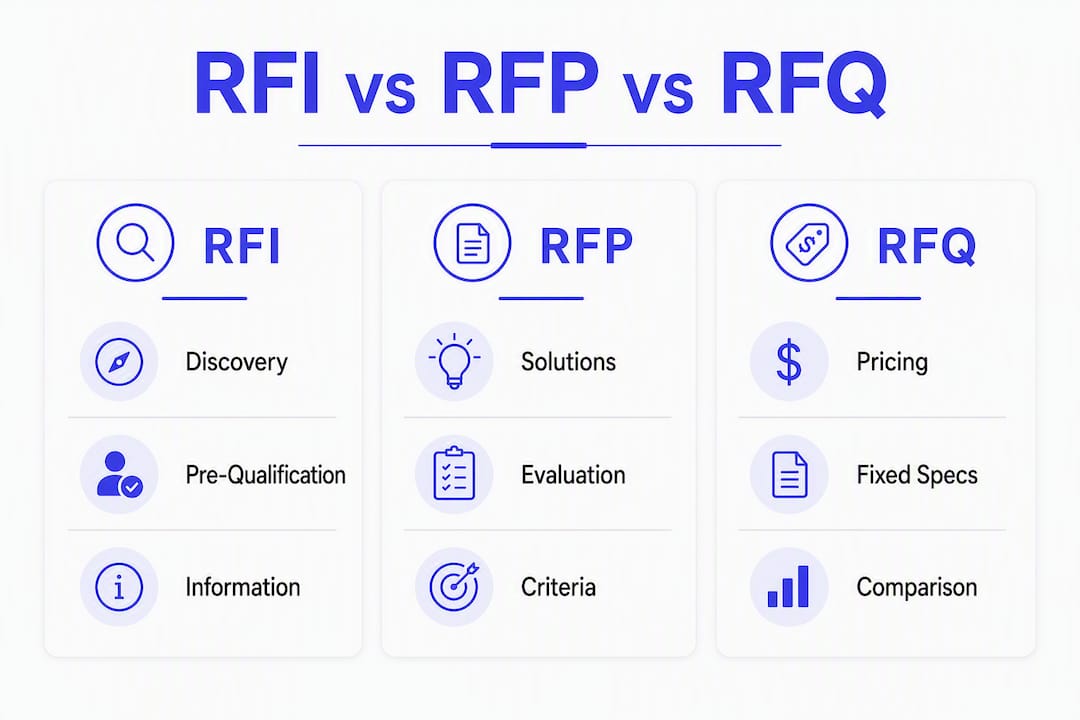
Reading the table: if price outweighs approach, favor an RFQ. If you cannot yet write a complete scope of work, start with an RFI. If you need vendors to solve a problem rather than fill an order, issue an RFP.
Three scenarios that illustrate the matrix:
- A hospital system exploring EHR vendors for the first time sends an RFI to 15 vendors, narrows to 6, then issues a full RFP to those 6.
- A manufacturer reordering the same industrial fasteners quarterly skips both RFI and RFP and issues an RFQ directly to its approved vendor list.
- A city government selecting a managed IT services provider issues an RFP with a weighted rubric covering security posture, SLA commitments, local workforce requirements, and total cost of ownership.
When to use each: practical scenarios and sequencing
The classic sequence is RFI → RFP → RFQ, but most procurement teams skip one or more steps depending on how well they understand the market and their own requirements.
Common project-to-document mappings:
- Enterprise software purchase (CRM, ERP, HRIS): RFI to shortlist vendors → RFP for full evaluation → RFQ or negotiated pricing for final terms
- Construction project (new facility, major renovation): RFI for contractor capabilities → RFP for design-build proposals → RFQ for specific subcontracted scopes
- Commodity procurement (office supplies, MRO, standard hardware): Skip RFI and RFP; go straight to RFQ
- Professional services (consulting, legal, audit): RFP directly when the firm's approach and team matter more than unit price
- Cloud infrastructure (IaaS, managed hosting): RFI to assess security and compliance posture → RFP for architecture and SLA proposals
When you can skip the RFI: Your team already knows the vendor landscape, requirements are internally defined, and stakeholders have signed off on scope. Skipping saves 2–4 weeks.
When you can skip directly from RFP to award (no RFQ): The RFP already includes a detailed pricing template, and commercial terms are negotiated post-award rather than pre-award.
Pro Tip: Before issuing any document, get written stakeholder alignment on scope, budget range, and must-have requirements. A sourcing process that stalls because finance and IT disagree on requirements after the RFP goes out costs far more time than the alignment meeting would have.
Decision checklist: how to pick RFI, RFP, or RFQ
Work through these yes/no questions in order. Your answers point directly to the right document.
-
Are your requirements fully defined and documented?
- No → Consider an RFI first to gather market input before writing specs.
- Yes → Continue to question 2.
-
Is price the only meaningful differentiator between qualified vendors?
- Yes → Issue an RFQ.
- No → Continue to question 3.
-
Does the purchase involve complex integration, custom methodology, or significant risk?
- Yes → Issue an RFP.
- No → Continue to question 4.
-
Do you have an approved vendor list with pre-qualified suppliers?
- Yes → Issue an RFQ directly to that list.
- No → Issue an RFP with a qualification section, or run an RFI first.
-
Are there regulatory, compliance, or multi-agency approval requirements?
- Yes → Build those requirements into an RFP with mandatory compliance sections; an RFQ alone will not capture the necessary detail.
Cross-functional reviewers to involve at each step:
- RFI stage: Procurement lead, subject-matter expert (IT, engineering, operations)
- RFP stage: Procurement, finance (budget sign-off), legal (contract terms), IT (security review), operations (delivery requirements)
- RFQ stage: Procurement, finance, and the requesting department to confirm specs
Mixing goals across document types — for example, asking for detailed methodology in an RFQ — reduces vendor response quality and increases your evaluation time.
Common mistakes and best practices for issuing and responding
Frequent mistakes that derail procurement cycles:
- Sending an RFP when an RFQ would do — vendors spend days writing proposals for a commodity buy
- Vague or incomplete specs in an RFQ, forcing vendors to make assumptions that make quotes incomparable
- Missing evaluation criteria in an RFP, leaving reviewers to score subjectively
- Unrealistic response windows (less than 10 business days for a complex RFP)
- Combining market research questions with pricing requests in a single document
Do-and-don't comparison:
| Situation | Do | Don't |
|---|---|---|
| RFI design | Use standardized fields; set a response length limit | Accept free-form essays with no structure |
| RFQ specs | Provide complete line-item specs with tolerances | Leave specs open to vendor interpretation |
| RFP evaluation | Publish criteria weights before responses arrive | Score after reading, based on gut feel |
| Response window | Allow 15–30 business days for complex RFPs | Set a 5-day deadline for a complex RFP |
| Vendor questions | Hold a structured Q&A period; share all Q&A with all vendors | Answer questions privately, creating information asymmetry |
Best practices for vendors responding:
- Answer every question in the order asked; do not reorganize the document
- Use the buyer's terminology, not your own product branding
- Flag any deviations from stated requirements explicitly rather than burying them
- Submit a compliance matrix that maps each requirement to your response section
Pro Tip: Build a reusable knowledge base of your best RFP responses, organized by requirement type. Teams that maintain this library cut first-draft time by a significant margin and produce more consistent answers across proposals. Proposal software with knowledge-base reuse makes this practical at scale.
Typical timelines and effort expectations for each request type
Realistic planning numbers vary by organization size and procurement complexity, but these ranges reflect common practice across U.S. procurement teams.
RFI:
- Drafting: a few days (internal)
- Vendor response window: about one or two weeks
- Evaluation: several days
- Total elapsed time: a few weeks
RFQ:
- Drafting: several days (spec documentation is the main effort)
- Vendor response window: about one to three weeks
- Evaluation and award: several days
- Total elapsed time: several weeks
RFP:
- Drafting: one to several weeks (cross-functional input required)
- Vendor response window: several weeks
- Evaluation, scoring, and shortlisting: a few weeks
- Negotiation and award: several weeks
- Total elapsed time: multiple weeks to a few months
Relative effort table:
| Document | Internal drafting effort | Vendor response effort | Evaluation effort |
|---|---|---|---|
| RFI | Low | Low | Low |
| RFQ | Medium | Low-Medium | Low |
| RFP | High | High | High |
Factors that extend timelines:
- Multi-region sourcing with different legal or compliance requirements
- Stakeholder review cycles that require multiple rounds of approval
- Complex technical requirements that generate high volumes of vendor questions
- Regulated industries (healthcare, defense, financial services) with mandatory review steps
For teams in regulated industries, specialized proposal software that handles compliance mapping can cut the drafting phase significantly.
How AI tools speed RFI, RFP, and RFQ creation
The biggest time sink in any procurement cycle is the blank page: drafting requirements, building compliance matrices, and formatting response templates from scratch. AI-powered tools address this directly.
Practical benefits of automation in the S2C cycle:
- Requirements extraction: AI reads incoming RFP documents and pulls every requirement into a structured list, eliminating manual parsing
- Compliance mapping: Automated compliance matrices track which requirements your response covers and flag gaps before submission
- Template reuse: A knowledge base of prior responses lets teams pull pre-approved content for recurring requirement types
- Faster first drafts: Sections like executive summaries, technical approaches, and pricing narratives can be generated from structured inputs rather than written from scratch
- Win-rate analytics: Tracking which proposal elements correlate with wins lets teams prioritize effort on what actually works
Rfpforgeai automates requirements extraction, compliance mapping, and knowledge-base reuse to speed proposal drafting and improve consistency across submissions. The platform's claims include turning a lengthy RFP into a polished proposal draft in 30 minutes, with an intelligent Q&A system that fills requirement gaps automatically.
Questions to ask when evaluating any automation tool:
- How accurately does it extract requirements from unstructured PDF or Word documents?
- Does it integrate with your existing procurement or CRM systems?
- What security and compliance controls does it hold (SOC 2, FedRAMP)?
- Can the knowledge base be organized by project type, industry, or requirement category?
- Does it provide analytics on response quality and win rates over time?
AI-first procurement teams highlight that reusable knowledge bases and automated extraction drastically reduce the "blank page" problem, compressing S2C cycles without sacrificing response quality.
Key Takeaways
RFI, RFP, and RFQ are distinct procurement tools: use the wrong one and you waste weeks; use the right one and your sourcing cycle runs on schedule.
| Point | Details |
|---|---|
| Match document to clarity | Use RFI when requirements are undefined, RFQ when specs are locked, RFP when approach and value matter. |
| Sequencing is flexible | The classic RFI → RFP → RFQ path is a guide, not a rule; skip steps when requirements are already clear. |
| Publish evaluation criteria | Including scoring weights in your RFP improves vendor response quality and speeds your review. |
| Timelines vary by type | RFIs close in 2–4 weeks; RFQs in 2–5 weeks; full RFP cycles typically run 6 weeks end-to-end. |
| Rfpforgeai accelerates RFP response | Rfpforgeai automates requirements extraction, compliance mapping, and knowledge-base reuse to cut proposal drafting time. |
The mistake most procurement teams make before they even send a document
Most sourcing failures I see trace back to the same root cause: the team chose a document type before they agreed on what they were actually trying to learn. They send an RFP when they needed an RFI, get back ten wildly different proposals, and spend three weeks trying to compare apples to aircraft carriers.
The fix is not a better template. It is a 30-minute pre-solicitation meeting where procurement, the requesting department, and finance answer three questions together: Do we know what we need? Do we know who can deliver it? Is price the deciding factor? Those three answers map directly to RFI, RFP, or RFQ. No meeting, no alignment, no usable responses.
The other habit worth building is a written Go/No-Go checkpoint before any document goes out. Not a formal approval process — just a one-page summary that confirms scope, budget range, and must-have requirements are agreed upon. Teams that skip this step routinely restart their sourcing process mid-cycle when a stakeholder surfaces a requirement that changes everything. That restart costs more time than the checkpoint ever would.
Cut your RFP response time without cutting corners
Drafting a compliant, compelling RFP response from scratch is the part of procurement that consumes the most time and produces the most inconsistency. Rfpforgeai is built specifically for that problem.
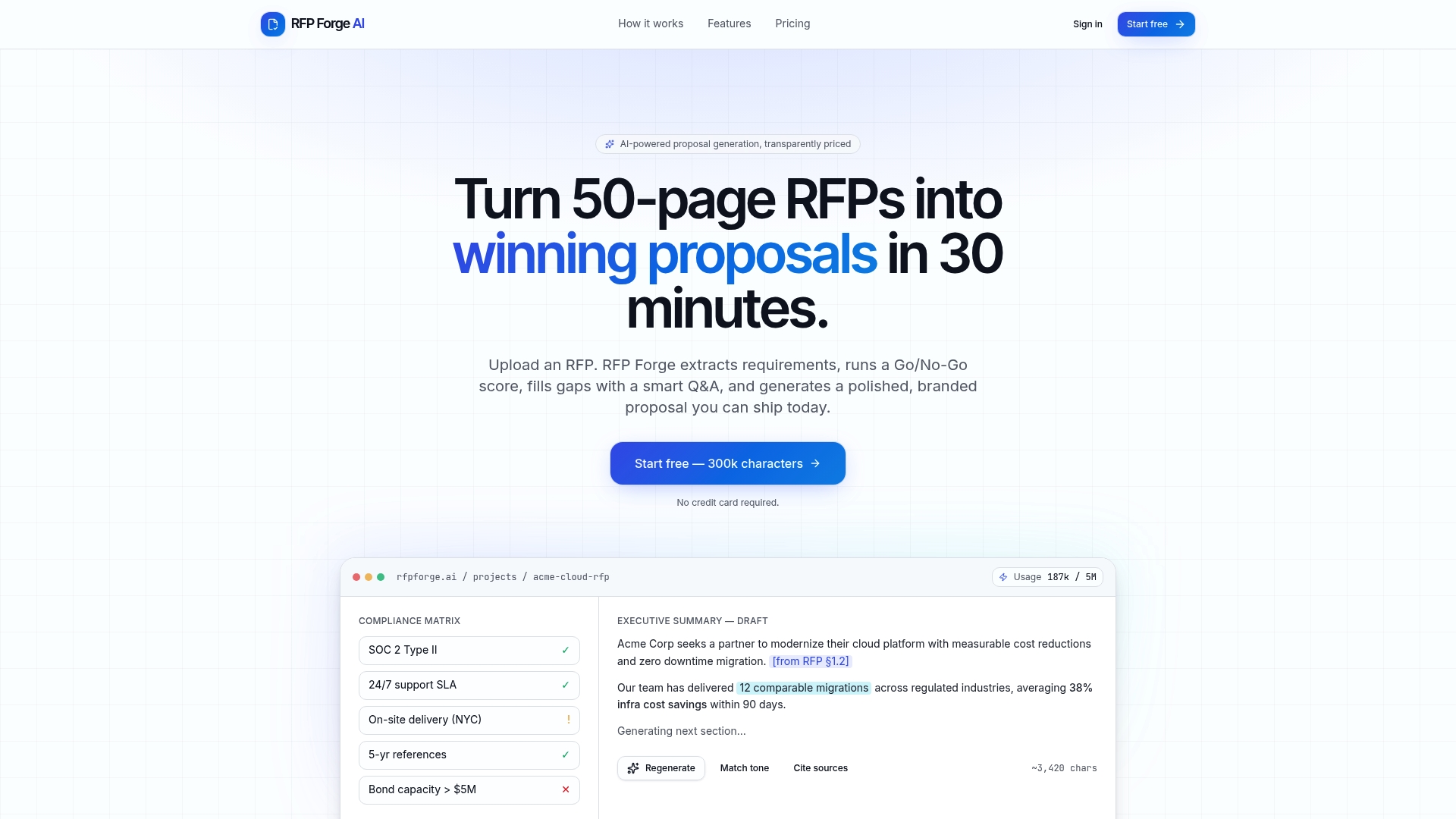
The platform reads your incoming RFP, extracts every requirement automatically, scores your fit with a Go/No-Go assessment, and generates draft sections — executive summary, technical approach, compliance matrix, pricing narrative — in minutes rather than days. A built-in knowledge base stores your best prior content so your team is never starting from zero. Win-rate analytics show which proposal elements actually move the needle.
If your team is managing multiple active RFPs or responding to complex government solicitations, try Rfpforgeai on your next proposal and measure the time saved against your current process.
Useful sources and next-step references
These are the most authoritative references for U.S. procurement professionals working with RFI, RFP, and RFQ processes.
- GSA — RFIs, RFQs, and RFPs (federal contracting terms): The GSA's official explanation of each document type and what vendors should expect when responding to federal solicitations.
- SAM.gov — Federal contract opportunities: The primary database for U.S. federal RFPs, RFQs, and RFIs; useful for benchmarking real-world document formats.
- Acquisition.gov — FAR policy and regulations: The Federal Acquisition Regulation (FAR) governs how federal agencies issue solicitations; essential reading for teams responding to government RFPs.
- SBA — Types of federal contracts: The Small Business Administration's guide to contract types, which maps directly to when each solicitation document is appropriate.
- Acquisition Gateway — Procurement forecast: Forward-looking view of upcoming federal procurement opportunities, useful for planning your RFI and RFP calendar.
- TechTarget — RFI vs. RFP vs. RFQ differences: Clear commercial-sector explainer covering purpose, timing, and use cases for each document type.