
For RFP-heavy business development and contract teams, Rfpforgeai is the strongest Qwilr alternative. Qwilr excels at web-based, design-first proposals, but it was never built for the volume and compliance demands of structured RFP workflows. When your team needs AI-driven requirement extraction, automated compliance matrices, and a reusable knowledge base, a purpose-built RFP platform closes the gap that Qwilr leaves open.
The decisive advantages of an RFP-first platform over Qwilr:
- Requirement extraction: AI pulls every mandatory requirement from a raw RFP document, so nothing gets missed in manual review.
- Compliance matrix automation: The platform builds and tracks a compliance matrix against extracted requirements, giving reviewers a clear audit trail.
- Knowledge-base reuse: Approved answers and proposal sections carry forward across responses, cutting authoring time on repeat topics.
- CRM integration depth: Bi-directional sync keeps requirement fields and compliance outcomes in your CRM record, not in a separate silo.
Qwilr still makes sense for small-volume, design-first proposals where a polished web experience matters more than structured compliance tracking.
Table of Contents
- What are the best Qwilr alternatives for RFP workflows?
- How do you choose the right Qwilr alternative for your workflow?
- Why RFP automation matters more than a better proposal template
- What does migration from Qwilr to an RFP-first platform actually look like?
- What should you budget for a Qwilr alternative?
- Which alternative should your team actually pick?
- What support options should you expect from these platforms?
- How do these tools handle mobile and offline use?
- How much branding control do these tools give you?
- How well do these platforms scale with your team?
- What integrations go beyond basic CRM connectivity?
- Key Takeaways
- The case for going RFP-first from the start
- Rfpforgeai turns RFP complexity into a 30-minute workflow
- Sources and further reading
What are the best Qwilr alternatives for RFP workflows?
Generic proposal builders often lack RFP-specific automation — requirement extraction, compliance matrices, and gap-filling — that high-volume RFP teams depend on. The table below maps the tools most commonly compared to Qwilr across the axes that matter for BD and contract teams.
| Tool | Best for | RFP automation | Proposal formats | E-sign & contract handoff | CRM integrations | Governance / approvals | Knowledge-base reuse | Analytics | Onboarding effort | Pricing model |
|---|---|---|---|---|---|---|---|---|---|---|
| Rfpforgeai | RFP-heavy BD & contract teams | ✓ AI extraction, compliance matrix, gap-filling Q&A | PDF, branded export | Via integrated workflow | HubSpot, Salesforce, and others | Approval workflows, audit trail | ✓ Full knowledge base | Win-rate analytics | Low (AI-guided) | Tiered subscription |
| PandaDoc | Mid-market sales teams | Partial (template automation) | PDF, Word, web | ✓ Native e-sign | HubSpot, Salesforce, Pipedrive | Approval workflows | Template library | Document analytics | Medium | Per-seat |
| Proposify | Agencies & sales teams | Partial (content library) | Web, PDF | ✓ Native e-sign | HubSpot, Salesforce | Role-based approvals | Content library | Proposal analytics | Medium | Per-seat |
| GetAccept | Digital sales rooms | Limited | Web, PDF | ✓ Native e-sign | HubSpot, Salesforce | Deal-room workflows | Limited | Engagement tracking | Medium | Per-seat |
| HummingDeck | Tracking-first teams | None | Existing PDFs/slides | Via third-party | Limited | None | None | Viewer analytics | Very low | Usage-based |
| Propal.io | Web-proposal-first teams | None | Web-first | ✓ E-sign | CRM via Zapier | Basic | Template reuse | Proposal analytics | Low | Flat/per-seat |
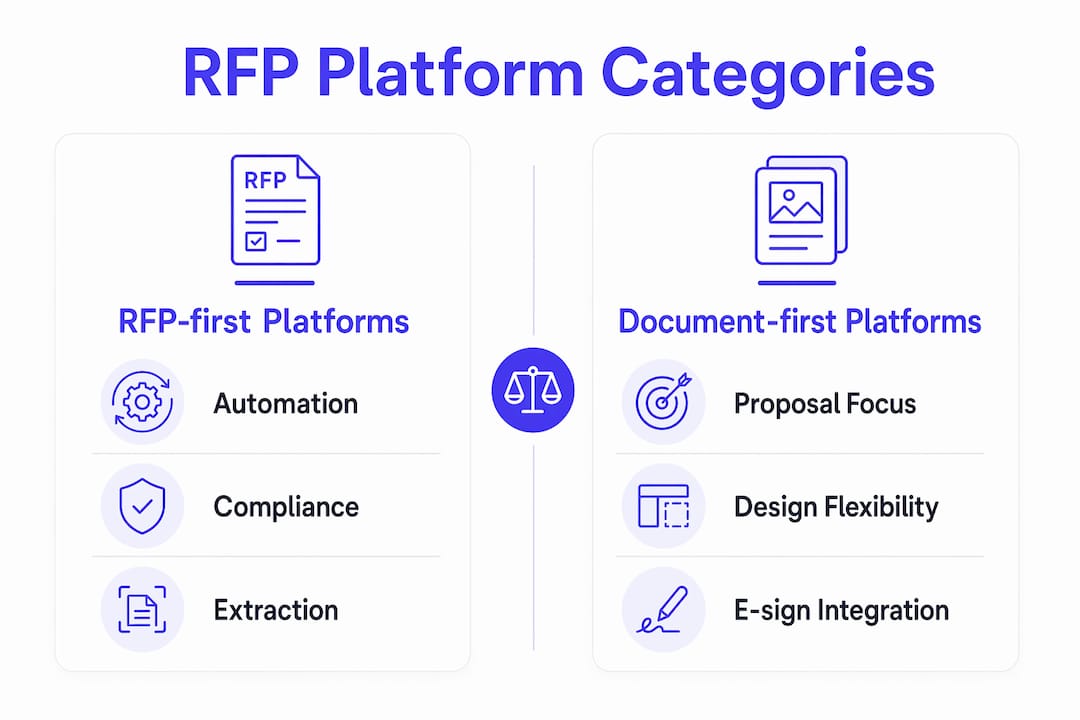
Market comparisons in 2026 consistently place tools in four categories: RFP-first automation platforms, document-first builders with strong e-sign, web-proposal-first builders, and tracking-only layers. Match your tool category to your workflow depth and CRM integration requirements before evaluating individual features.
How do you choose the right Qwilr alternative for your workflow?
Start with three questions before you open a demo:
- Where must the system sit? CRM-native (records saved directly in HubSpot or Salesforce) vs. a standalone tool that syncs via API. Without bi-directional sync, compliance evidence and requirement tracking fragment across systems.
- What output does procurement require? Web-only proposals create friction when buyers need PDFs for legal review. Choose a tool that supports both formats if procurement or legal are frequent stakeholders.
- How deep is your RFP automation need? Requirement extraction and compliance matrices are table stakes for regulated-sector RFPs. Generic builders skip both.
Questions to ask during vendor demos:
- Can the platform extract individual requirements from a raw RFP document automatically?
- Does it build a compliance matrix and track coverage against each requirement?
- How does the knowledge base work — can approved answers be reused across future responses?
- Is CRM sync bi-directional (fields write back to the CRM record, not just read from it)?
- What are the SLA commitments and support channels (email, chat, dedicated CSM)?
- What security certifications does the platform hold (SOC 2, ISO 27001)?
Red flags to watch for:
- Seat minimums that price out small BD teams before they can run a pilot.
- No export to standard document formats (PDF, Word) — a deal-breaker for procurement-heavy buyers.
- API access locked behind enterprise tiers, making CRM integration cost-prohibitive.
Pro Tip: Run a structured pilot before committing. Use three representative RFPs, measure pre/post response time, track compliance coverage against extracted requirements, and calculate your knowledge-base reuse ratio (reused answers vs. newly authored). That data validates the vendor's automation claims with your actual content.
Why RFP automation matters more than a better proposal template
The core gap is functional, not cosmetic. Generic proposal builders lack the requirement extraction and compliance tracking that structured RFP responses demand. When a team manually maps requirements from a 60-page RFP, they miss items, duplicate effort, and produce inconsistent compliance evidence across responses.
RFP-first platforms address this at three layers: AI extraction pulls every requirement from the source document, a compliance matrix maps each requirement to a response section, and a knowledge base surfaces previously approved answers so authors aren't starting from scratch. The result is faster responses with measurable compliance coverage.
Teams in regulated industries that adopted AI-driven RFP automation reported a significant reduction in infrastructure migration costs, according to client-reported outcomes published by Rfpforgeai. That figure reflects the compounded effect of shorter response cycles, fewer compliance gaps, and reduced rework after submission.
The technical path to that outcome: AI extraction feeds the compliance matrix, the matrix drives the knowledge-base query, and reusable answers fill the proposal sections. Authors review and refine rather than author from zero. For teams running 10+ RFP responses per quarter, that reuse ratio compounds quickly.
What does migration from Qwilr to an RFP-first platform actually look like?
Switching platforms is manageable when you stage it correctly. Most teams complete a full transition in 6–10 weeks.

| Phase | Activities | Typical duration |
|---|---|---|
| Pilot setup | Select 3 representative RFPs; configure AI extraction; map CRM fields | Week 1–2 |
| Template import | Migrate existing proposal templates; rebuild or adapt for new format | Week 2–3 |
| Knowledge-base seeding | Import approved answers, boilerplate sections, and compliance clauses | — |
| CRM integration | Validate bi-directional sync; confirm field mapping and SSO | — |
| Pilot responses | Run live RFP responses; measure time, compliance coverage, reuse ratio | — |
| Full rollout | Train remaining authors; archive Qwilr templates; decommission overlap | Week 8–10 |
Migration checklist:
- Export all active Qwilr templates before canceling the subscription.
- Map historical proposals to knowledge-base categories before import.
- Identify stakeholders who approve proposals and configure their roles in the new workflow.
- Validate CRM field mapping with a test record before going live.
- Keep active deals on Qwilr until their proposal cycle closes — don't migrate mid-deal.
Tracking-first tools offer the lowest migration risk if your team primarily needs viewer analytics without rebuilding templates. That's a valid short-term option while you plan a fuller transition.
What should you budget for a Qwilr alternative?
Pricing shapes vary by platform category. Expect per-seat models for document-first and web-proposal tools, flat-team pricing for mid-market platforms, and usage-based or custom enterprise pricing for RFP automation platforms.
| Pricing model | Typical for | Primary cost drivers |
|---|---|---|
| Per-seat | PandaDoc, Proposify, GetAccept | Seat count, feature tier |
| Flat-team | Propal.io, smaller builders | Team size band |
| Usage-based | HummingDeck, tracking tools | Document volume, viewer events |
| Tiered subscription | Rfpforgeai | Usage quotas, knowledge-base storage, integrations |
| Custom / enterprise | Large RFP platforms | API access, SSO, dedicated support, onboarding |
Industry comparisons in 2026 show category-level pricing differences are significant. Total cost of ownership extends beyond the subscription: factor in migration effort, author training, and integration services when comparing headline prices.
Negotiation levers worth asking about:
- Pilot credits that apply toward the first paid term.
- Onboarding discounts for annual commitments.
- Seat flexibility during a ramp period (add seats as the team grows into the platform).
Which alternative should your team actually pick?
The right choice depends on your primary workflow need:
- RFP-heavy BD and contract teams (10+ responses/quarter): Rfpforgeai. Requirement extraction, compliance matrices, and knowledge-base reuse are built in. Start with a pilot on three live RFPs.
- Mid-market sales teams that need strong e-sign and document control: PandaDoc. Solid CRM integrations and approval workflows at a predictable per-seat price.
- Agencies and sales teams focused on branded proposals: Proposify. Content library and role-based approvals work well for teams with consistent proposal structures.
- Teams that want engagement analytics without rebuilding templates: HummingDeck. Add a tracking layer to existing PDFs with minimal migration overhead.
What support options should you expect from these platforms?
Support quality varies significantly across this category. Rfpforgeai provides onboarding guidance and direct support channels suited to BD teams running active RFP cycles. PandaDoc and Proposify both offer tiered support with dedicated customer success managers available on higher plans. GetAccept includes live chat and email support across most tiers.
For enterprise contracts, ask specifically about SLA response times for critical issues, whether a dedicated CSM is included or costs extra, and what the escalation path looks like. Platforms that lock dedicated support behind top-tier plans can create real friction during a high-stakes RFP deadline.
How do these tools handle mobile and offline use?
Most platforms in this category are web-first, with mobile browser access rather than native apps. PandaDoc and Proposify offer mobile-responsive interfaces for reviewing and approving proposals on the go. Rfpforgeai's AI-driven workflow is optimized for desktop authoring sessions, where the requirement extraction and compliance matrix tools deliver the most value.
Offline capability is limited across the board. If your team needs to author or review proposals without a reliable connection, export to PDF or Word before going offline. Platforms with strong PDF export (Rfpforgeai, PandaDoc) handle this better than web-only builders.
How much branding control do these tools give you?
Rfpforgeai supports tone customization and branded export, so proposals carry your firm's visual identity and voice without manual reformatting. PandaDoc and Proposify both offer custom branding at the template level, including logo placement, color schemes, and font controls. Propal.io and Qwilr-style web builders emphasize design flexibility, which suits agencies that treat proposal aesthetics as a differentiator.
The practical limit for most BD teams: branding flexibility matters less than compliance accuracy. A perfectly branded proposal with a compliance gap loses. Prioritize platforms where branding is configurable but doesn't require a designer to maintain.
How well do these platforms scale with your team?
Rfpforgeai's tiered subscription model scales from freelancers and consultants up to full BD teams, with usage quotas and knowledge-base storage expanding at higher tiers. PandaDoc and Proposify both support multi-user collaboration with role-based permissions, making them practical for teams of 5–50 users. GetAccept handles deal-room collaboration well for distributed sales teams.
The collaboration features that matter most for RFP workflows: simultaneous section authoring, approval routing with version control, and comment threads tied to specific requirements. Platforms that treat proposals as static documents rather than collaborative workspaces slow down high-volume teams.
What integrations go beyond basic CRM connectivity?
CRM integration is the baseline. The platforms that pull ahead connect to the broader tool stack your BD team already uses. Rfpforgeai integrates with HubSpot and Salesforce for CRM sync, and supports document storage integrations for organized proposal archiving. PandaDoc connects to Stripe for payment collection, Slack for approval notifications, and Google Drive for document storage. Proposify integrates with Zapier, enabling connections to marketing automation tools like Marketo and HubSpot workflows.
For teams evaluating AI tool adoption patterns more broadly, the principle holds: integration depth determines whether a tool fits into your existing workflow or creates a parallel one. A proposal platform that doesn't write back to your CRM forces manual data entry, which defeats the efficiency gain.
Pro Tip: Before finalizing any platform, map your current tool stack (CRM, document storage, e-sign, analytics) and ask each vendor for a specific integration architecture diagram. "We integrate with HubSpot" can mean anything from a native bi-directional sync to a one-way Zapier trigger.
Key Takeaways
For RFP-heavy teams, the platform category matters more than any individual feature: RFP-first automation platforms close compliance and efficiency gaps that generic proposal builders cannot.
| Point | Details |
|---|---|
| Match tool to workflow depth | RFP-heavy teams need extraction and compliance matrices; design-first teams can use web builders. |
| CRM sync is the critical integration | Bi-directional sync keeps compliance evidence in your CRM record, not fragmented across tools. |
| Pilot before committing | Run three live RFPs, measure response time and compliance coverage, calculate knowledge-base reuse. |
| 38% cost reduction benchmark | Rfpforgeai clients in regulated industries reported this outcome from AI-driven RFP automation. |
| Rfpforgeai for RFP-first teams | Requirement extraction, compliance matrices, and branded export make it the recommended starting point. |
The case for going RFP-first from the start
The conventional wisdom in this category is that any good proposal tool will eventually handle RFPs well enough. That's wrong, and it costs teams real time and win rate. Generic builders were designed for sales proposals, not structured compliance responses. The gap shows up the moment you're working from a 50-page government or enterprise RFP with 80 numbered requirements.
What actually works: start with a platform built around requirement extraction and compliance tracking, then configure the proposal design layer to match your brand. The reverse approach, starting with a beautiful web builder and trying to bolt on compliance tracking, produces fragmented workflows and missed requirements. The AI-driven approach Rfpforgeai takes, extracting requirements first and generating proposal sections against them, is the right architecture for teams that respond to structured RFPs at volume.
The proof point worth testing: run one live RFP through a purpose-built platform and measure your compliance coverage rate against your last manual response. The gap is usually visible in the first pilot.
Rfpforgeai turns RFP complexity into a 30-minute workflow
Switching from Qwilr to a purpose-built RFP platform doesn't have to mean months of migration work. Rfpforgeai extracts requirements from your raw RFP, builds a compliance matrix automatically, fills gaps through an AI-powered Q&A system, and exports a fully branded proposal in standard formats — all in under 30 minutes. That's the concrete contrast with web-first builders: less manual mapping, fewer compliance gaps, and proposals your procurement buyers can actually submit.
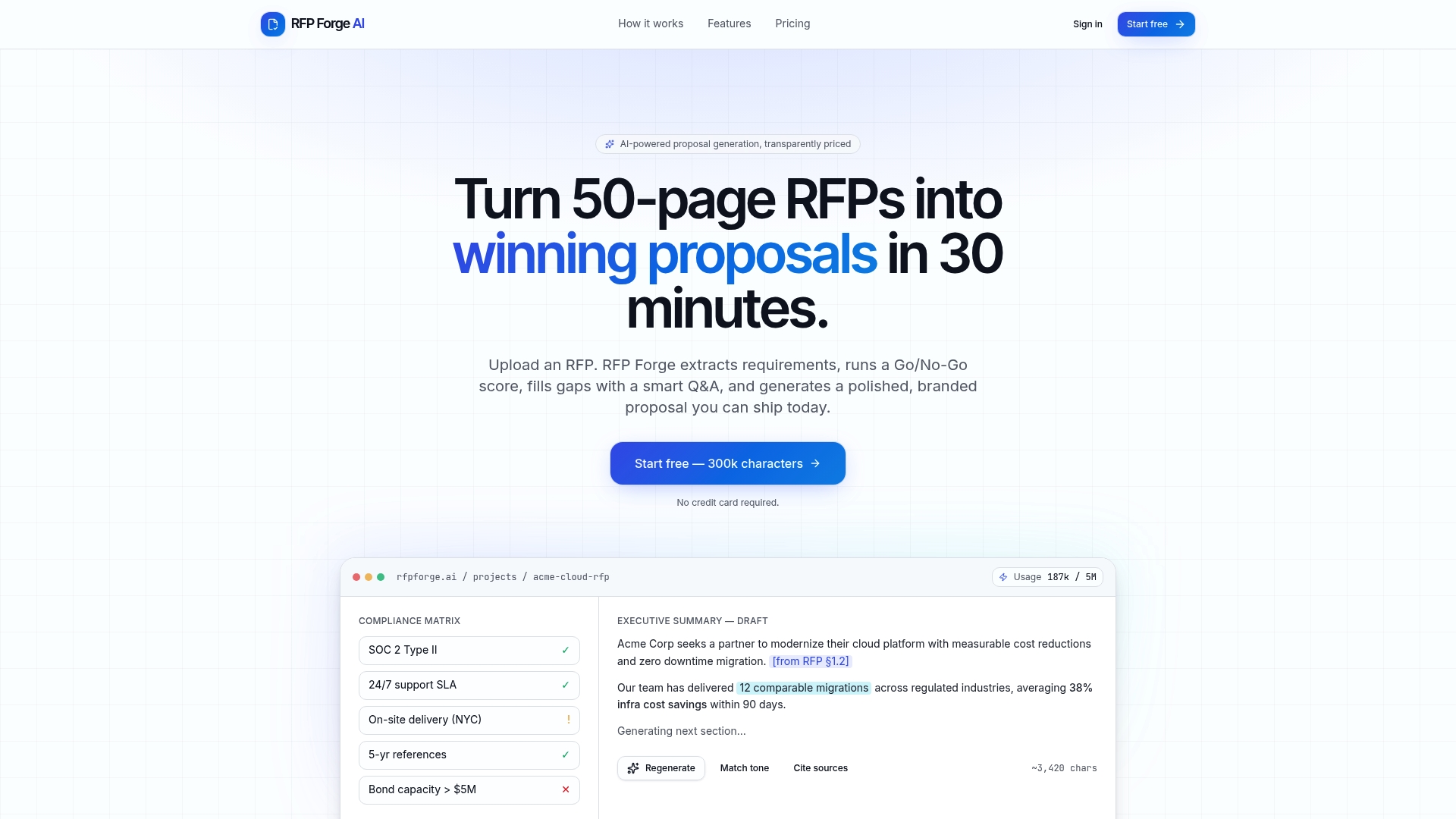
Rfpforgeai's tiered subscription covers freelancers, consultants, and full BD teams, with transparent usage quotas and no surprise seat minimums. Client-reported outcomes include a 38% reduction in infrastructure migration costs for regulated-industry teams. Free trial and demo options are available directly on the platform.
Start your pilot with three real RFPs and see the compliance coverage difference firsthand. Try Rfpforgeai today and run your first proposal in under 30 minutes.
Sources and further reading
- Rfpforgeai — AI-driven RFP analysis, compliance matrix generation, and trial details: Primary source for product features, ROI claims, and trial/demo access.
- 10 Best Qwilr Alternatives for Web-Based Proposals in 2026 — Propal.io: Market categorization of alternatives and guidance on matching tool type to team workflow.
- Best Qwilr Alternatives for HubSpot Teams (2026) — Portant: Analysis of CRM-native workflows and PDF/standard-document output as differentiation factors.
- Best Qwilr Alternatives in 2026: 8 Tools Compared — HummingDeck: Category-level pricing differences and tracking-first tool positioning.
- Qwilr Alternatives and Competitors — SaaSHub: Community-verified product comparisons and competitor listings for independent verification.
- AI Tools for Tech Job Seekers: 2026 Career Guide — Pluck Talent: Broader AI tool adoption patterns relevant to pilot design and workflow evaluation.