
Proposal compliance tracking is the process of systematically capturing every requirement in an RFP or solicitation, mapping each one to a specific response location, and verifying that your proposal addresses it completely before submission. Get this right, and you eliminate the most preventable reason proposals get disqualified. Start now with these four steps:
- Open the solicitation PDF (retrieve the authoritative version from Sam for federal bids)
- Search for every "shall," "must," and "will" statement and pull each one into a separate row
- Create a compliance matrix with one row per requirement, a unique ID, and a response-location field
- Assign a named owner to each row before your first review gate
For teams managing more than a handful of concurrent bids, Rfpforgeai automates the extraction and matrix-building steps so you can focus on writing the responses, not hunting for buried obligations.
Key Takeaways
A compliance matrix built on verbatim buyer language, named owners, and bidirectional traceability is the most direct way to eliminate preventable disqualifications and speed every review gate.
| Point | Details |
|---|---|
| Start with verbatim extraction | Copy buyer language exactly; paraphrasing creates gaps between what was required and what was answered. |
| Use bidirectional traceability | Forward tracing confirms coverage; backward tracing confirms no section is orphaned from a requirement. |
| Assign one owner per row | Shared ownership means no ownership; a single named person per requirement prevents items from falling through. |
| Automate when volume scales | Move from spreadsheets to a purpose-built tool when you manage more than three concurrent bids. |
| Rfpforgeai automates the matrix | Rfpforgeai extracts requirements, builds the compliance matrix, and tracks coverage in real time from a single upload. |
Table of Contents
- What is proposal compliance tracking, and why does it need a matrix?
- Why skipping compliance tracking costs you the bid
- What fields a winning compliance matrix must include
- How to build a compliance matrix from an RFP, step by step
- How to use the matrix during reviews and final QA
- Common failure modes that cause missed requirements
- A practical template you can copy into Excel or Sheets
- When should you automate compliance tracking?
- Operational tips to keep your matrix accurate throughout the bid
- The compliance tracking insight most teams learn too late
- Rfpforgeai turns your RFP into a compliance-ready proposal in 30 minutes
- Primary sources and further reading
- Sources
What is proposal compliance tracking, and why does it need a matrix?
Proposal compliance tracking is the discipline of recording, organizing, and verifying every obligation a buyer places on a bidder. The tool that makes it manageable is the compliance matrix, sometimes called a requirement coverage matrix. It is a structured document, usually a spreadsheet or a purpose-built tool, that links each buyer requirement to the exact section of your proposal that addresses it.
The compliance matrix shows up across three main contexts:
- Government solicitations with a Performance Work Statement (PWS) or Statement of Work (SOW), where FAR 15.304 requires evaluation to follow the solicitation's stated criteria
- Commercial RFPs with detailed scoring rubrics, where evaluators assign point values to each section
- Regulated-industry bids (healthcare, defense, financial services) where audit readiness and documented traceability are contractual requirements
The concept that makes a compliance matrix more than a checklist is traceability. Requirements coverage analysis distinguishes two directions: forward traceability traces a requirement forward to the response section or test case that satisfies it, and backward traceability starts from a response section and traces back to the requirement it was written to address. Both directions matter. Forward traceability confirms you have answered everything. Backward traceability confirms you have not written sections that answer nothing, which wastes page count and confuses evaluators.
For a deeper look at bidirectional traceability mechanics, the requirements traceability matrix best practices guide on the Rfpforgeai blog covers governance and maintenance in detail.
Why skipping compliance tracking costs you the bid
A missed requirement is not a minor oversight. On a federal solicitation, a single non-compliant response can trigger a "technically unacceptable" rating under the evaluation criteria, removing your proposal from competition entirely before price is even considered. On a scored commercial RFP, unanswered requirements translate directly to lost points.
Benefits of consistent compliance tracking:
- Reduced disqualification risk by confirming every mandatory requirement has a response
- Faster internal reviews because evaluators can navigate by requirement ID rather than reading the full document
- Clearer reviewer navigation, especially for evaluators who use the compliance matrix as a cross-reference tool
- Audit readiness, with documented evidence linking each requirement to its response
- Measurable coverage metrics that tell you exactly what percentage of requirements are addressed, in-progress, or at risk
Consequences of skipping it:
- Outright disqualification for missing a mandatory deliverable or format requirement
- Scoring penalties when a requirement is addressed but not clearly tied to the evaluation criterion
- Late-stage rework when a missed requirement surfaces during final review, forcing rewrites under deadline pressure
- Missed deadlines when no owner is assigned and a requirement falls through the cracks
The stakeholder impact is concrete. A capture manager needs coverage metrics to make a go/no-go call. A technical lead needs to know which requirements fall in their domain. A pricing lead needs to confirm that every deliverable with a cost implication is captured. A compliance reviewer needs a signed-off matrix to approve submission. None of them can do their job well without a maintained matrix.
What fields a winning compliance matrix must include
A requirements traceability matrix maps each requirement to its source, its response artifact, and its current status. The table below shows the columns a proposal compliance matrix needs, with a brief definition and a sample row drawn from a hypothetical IT services SOW.
| Field | Definition | Sample Value |
|---|---|---|
| Requirement ID | Unique alphanumeric identifier | REQ-XXX |
| Source doc & location | Document name, page, and section | SOW — |
| Buyer language (quote) | Verbatim text from the solicitation | "The contractor shall provide monthly status reports." |
| Requirement type | Shall / Must / Should / Will | Shall |
| Priority / weight | Evaluation weight or criticality tier | High |
| Response location | Proposal doc, section, and page | Vol. II — |
| Owner | Named team member responsible | J. Rivera |
| Status | Draft / In Review / Complete / At Risk | In Review |
| Evidence / proof | File name or citation confirming compliance | status-report-template.docx |
| Deadline / milestone | Internal due date for this response section | April 14 |
| Risk level / assumption | Red / Amber / Green plus any assumption | Amber — template pending approval |
| Notes / clarifications | Open questions or amendment references | Confirmed in Amendment 2 |
Every field earns its place. The buyer-language quote prevents paraphrasing errors. The evidence field creates an audit trail. The risk level flags items that need escalation before the review gate. Skipping any of these columns is where teams start losing track of requirements.
Pro Tip: Add a "Confirmed in Amendment" column or flag. Amendments frequently modify or add requirements after the original solicitation is posted, and a matrix that does not reflect the latest amendment version is effectively tracking the wrong document.
How to build a compliance matrix from an RFP, step by step
This workflow runs from document ingestion through final submission check. Each step names the responsible role and the acceptance check that confirms it is done correctly.
-
Ingestion (Proposal Manager) — Collect all solicitation documents: the base RFP, SOW/PWS, all amendments, and any Q&A responses. For federal bids, pull the authoritative package from Sam. Acceptance check: every document version is logged with its date and amendment number.
-
Extraction (Compliance Lead) — Read every section, table, attachment, and exhibit. Flag every "shall," "must," "will," and "should" statement. Do not paraphrase. Copy the verbatim buyer language into the matrix. Acceptance check: the extraction covers body text, tables, figures, and all attachments.
-
Normalization (Compliance Lead) — Assign a unique Requirement ID to each extracted item. Group related requirements by section but keep each obligation as a separate row. Acceptance check: no two rows share an ID; no single row contains more than one obligation.
-
Mapping (Proposal Manager + Section Leads) — Assign a response location to each requirement: the proposal volume, section, and page where the response will appear. For technical writing guidance on structuring those sections, the technical proposal writing guide is a useful reference. Acceptance check: every row has a response location, even if it is "TBD — assigned to Vol. III."
-
Ownership assignment (Proposal Manager) — Assign one named owner per requirement. One owner, not a team. Acceptance check: no row has a blank owner field or a shared ownership label like "Tech Team."
-
Status tracking (All owners) — Owners update their rows as writing progresses: Draft, In Review, Complete, or At Risk. Acceptance check: status fields are updated at each review gate, not just at submission.
-
Verification and sign-off (Compliance Reviewer) — Run forward and backward traceability checks. Confirm every requirement maps to a response and every response section maps back to at least one requirement. Acceptance check: zero open rows, zero unsigned-off requirements.
-
Submission check (Proposal Manager) — Export the final matrix and confirm the proposal document matches every response location recorded. Acceptance check: the matrix version matches the final proposal version number.
Pro Tip: Requirements buried in tables, figures, and amendment diffs are the most commonly missed. After your initial extraction pass, run a second pass using your PDF viewer's search function on the terms "contractor shall," "offeror must," and "required." Then open every amendment and diff it against the base document line by line. Amendments that add a single sentence to a paragraph are easy to miss in a full re-read.
How to use the matrix during reviews and final QA
The compliance matrix is not a document you build once and file. It is the primary navigation tool for every review gate from Pink Team through Gold Team.
Reviewer workflow using forward and backward traceability
A reviewer working forward starts at a requirement row, notes the response location, opens that section of the proposal, and confirms the response directly addresses the buyer's verbatim language. A reviewer working backward opens a proposal section and traces every paragraph back to the requirement it was written to satisfy. Any paragraph with no corresponding requirement row is either orphaned content or a missed extraction.
QA checklist for each requirement row
Before a reviewer signs off on a row, they should confirm:
- The buyer's verbatim language is quoted in the matrix, not paraphrased
- The response section directly addresses the requirement, not a related but different topic
- Evidence or proof is cited (a file, a template, a named deliverable)
- The owner has marked the row Complete, not just In Review
- Any amendment that modified this requirement is reflected in the current row
Role responsibilities at each review gate
| Role | Responsibility |
|---|---|
| Section writer | Updates status and evidence field when their section is drafted |
| Compliance reviewer | Runs forward/backward traceability check at each gate |
| Technical lead | Signs off on technical requirements in their domain |
| Pricing lead | Confirms all cost-bearing deliverables are captured |
| Final approver (Proposal Manager) | Clears all At Risk flags before submission |
FAR 15.304 ties evaluation directly to the solicitation's stated criteria, which means aligning your matrix language to the evaluation factors is not optional on federal bids. Reviewers who cross-reference the evaluation criteria column against the matrix catch scoring gaps that a simple completeness check misses.
Common failure modes that cause missed requirements
Most compliance failures are predictable. They repeat across bids and across teams. Here are the ones that show up most often, with a fix and a prevention step for each.
-
Paraphrasing buyer language. Teams rewrite requirements in their own words, then write responses to their version, not the buyer's. Fix: Replace every paraphrased row with the verbatim quote. Prevention: Make verbatim language a required field in your matrix template.
-
Ignoring tables and attachments. Requirements embedded in data tables, pricing sheets, or technical exhibits get skipped during extraction. Fix: Run a dedicated pass on every non-body element. Prevention: Add a checklist item to the ingestion step: "Tables and attachments reviewed: Y/N."
-
Failing to track amendments. The base solicitation is extracted, but Amendment 2 adds three new deliverables that never make it into the matrix. Fix: Re-extract from every amendment and diff against the existing matrix. Prevention: Treat each amendment as a new ingestion event with its own extraction pass.
-
Multiple owners for one requirement. When a requirement spans two sections, two people assume the other is handling it. Fix: Assign a single primary owner and note the contributing section lead in the Notes field. Prevention: Enforce the one-owner rule at the normalization step.
-
Stale status fields. Owners mark a row Complete at draft stage and never update it after revisions. Fix: Reset all Complete rows to In Review at each review gate and require re-sign-off. Prevention: Lock the status field so only the compliance lead can mark a row Complete.
The human factors behind these errors are consistent: time pressure compresses the extraction step, siloed teams do not share a single matrix version, and spreadsheet fatigue causes owners to stop updating fields as the deadline approaches. A matrix that is too large to maintain is worse than a smaller, accurate one, which is why keeping the RTM intentionally small and continuously updated is a principle worth enforcing from the start.
A practical template you can copy into Excel or Sheets
The template below uses four tabs to keep the matrix organized without making it unwieldy.
Recommended sheet tabs:
- Requirements — the main matrix with all fields from the table in the "What fields" section above
- Sources — a log of every solicitation document, version, and amendment with its retrieval date
- Evidence — a file index linking evidence artifacts to their requirement IDs
- Risk Register — a filtered view of all Amber and Red rows for escalation tracking
The sample rows below illustrate three different requirement types to show how the fields behave across categories.
| Req ID | Source & Location | Buyer Language | Type | Response Location | Owner | Status | Risk |
|---|---|---|---|---|---|---|---|
| REQ-XXX | SOW — | "The contractor shall deliver a Project Management Plan within 30 days of contract award." | Shall | Vol. II — | M. Chen | Complete | Green |
| REQ-XXX | RFP — | "Offerors must submit a past performance volume not to exceed 15 pages." | Must | Vol. IV — | T. Okafor | In Review | Amber |
| REQ-XXX | Amendment 3 — | "All deliverables shall use the Government-furnished template provided in Attachment J." | Shall | All deliverable sections | J. Rivera | Draft | Red |
Implementation notes: Version-control the matrix file with a date-stamped filename (e.g., compliance-matrix-v4-2026-04-14.xlsx) and add a Change Log tab that records who changed what and when. Before sharing with reviewers, export a read-only PDF so they cannot accidentally overwrite status fields. When you update for an amendment, add a row to the Change Log rather than deleting the old requirement row, so the audit trail stays intact.
When should you automate compliance tracking?
Spreadsheets work for small, infrequent bids. They break down fast when volume, complexity, or amendment frequency increases. The comparison below uses generic category labels because the decision is about capability fit, not brand preference.
| Dimension | Manual spreadsheet | Purpose-built compliance tool |
|---|---|---|
| Extraction speed | Hours of manual reading | Minutes with automated parsing |
| Amendment tracking | Manual diff and re-entry | Automated diff with change flags |
| Multi-user concurrency | Version conflicts, overwrite risk | Real-time collaborative editing |
| Traceability links | Manual hyperlinks, easily broken | Persistent bidirectional links |
| Audit trail | Change log maintained by discipline | Automatic version history |
| Coverage dashboard | Manual status counts | Live percentage-complete view |
Decision rule: Move to a purpose-built tool when any of these triggers apply:
- A moderate number of concurrent bids in progress at the same time
- A single solicitation with many distinct mandatory obligations
- Amendments arriving after the initial extraction is complete
- More than a few section owners updating the matrix at the same time
- A federal bid where FedRAMP-authorized data handling is required for the tools storing your procurement data
Automated extraction tools use techniques like two-pass verification and page-level citations to reduce missed obligations in long PWS/SOW documents. The key caveat: automated extraction speeds the work but still requires human-in-the-loop verification, because AI parsers can miss obligations stated in passive voice or embedded in complex table structures. Any tool you evaluate should preserve table structure and flag requirements found in amendments separately from the base document.
Rfpforgeai is built specifically for this workflow. It extracts requirements from uploaded RFP documents, builds a compliance matrix automatically, tracks coverage in real time, and uses an intelligent Q&A system to surface gaps before you write a single section. For teams in regulated industries evaluating proposal software, the best proposal writing software for regulated industries guide covers the security and audit-trail features to look for.
Pro Tip: When evaluating any automation tool for federal bids, check the FedRAMP marketplace before uploading sensitive solicitation data. A tool that is not FedRAMP-authorized may not meet your agency customer's data-handling requirements, which creates a compliance problem before the proposal is even written.
Operational tips to keep your matrix accurate throughout the bid
A compliance matrix that goes stale is worse than no matrix, because it creates false confidence. These governance practices keep it accurate from kickoff to submission.
Daily and weekly maintenance:
- Every owner updates their status field at the end of each writing day
- The compliance lead reviews all Amber and Red rows at the start of each week
- Any new amendment triggers an immediate ingestion event before other work continues
- The matrix version number increments with every substantive change
Version control rules:
- Date-stamp every saved version; never overwrite the previous version
- Only the compliance lead or proposal manager can change a row's status to Complete
- The Change Log tab records every modification with the editor's name and a timestamp
Role definitions:
- Matrix owner (Compliance Lead): maintains the master file, runs traceability checks, and clears the final submission gate
- Section owners: update their rows within 24 hours of completing a draft or revision
- Proposal Manager: reviews the coverage dashboard at each review gate and escalates Red items
- Final approver: signs off on the matrix as a condition of submission authorization
Onboarding new team members: Give every new contributor a 20-minute walkthrough of the matrix structure before they touch a row. The most common new-member error is updating the wrong version of the file. A shared, clearly named master file in a single location, with edit access controlled by the compliance lead, prevents most of these problems without requiring a formal training program.
The compliance tracking insight most teams learn too late
There is a pattern that shows up consistently in proposal post-mortems: teams that lose on compliance did not fail because they lacked a matrix. They failed because the matrix was treated as a one-time deliverable rather than a living document. The matrix was built at kickoff, partially filled, and then ignored as writing pressure mounted. By the time the final review arrived, the status fields were weeks out of date and the evidence column was mostly blank.
The teams that win on compliance treat the matrix as the single source of truth for the entire bid. Every review gate starts with the matrix, not the proposal document. Writers update their rows before they update their sections. The compliance lead has authority to halt a review if more than a handful of rows are unsigned. That discipline is not natural for most proposal teams, especially under deadline pressure. It has to be built into the process explicitly, with named owners and enforced checkpoints.
One pattern worth noting: teams that link their compliance matrix directly to their win-theme strategy, mapping each requirement to the discriminating strength it lets them demonstrate, tend to produce responses that are both compliant and compelling. Compliance and persuasion are not separate workstreams. A requirement row that has a win theme attached to it gets written differently than one that is treated as a box to check. The proposal win themes guide on the Rfpforgeai blog covers how to make that connection explicit.
Rfpforgeai turns your RFP into a compliance-ready proposal in 30 minutes
Proposal teams that manage multiple concurrent bids need more than a spreadsheet template. Rfpforgeai extracts every "shall/must" obligation from your uploaded RFP, builds a compliance matrix automatically, and tracks coverage in real time as your team writes. The platform's Q&A-driven gap-filling surfaces unanswered requirements before they become a scoring problem, and the coverage dashboard shows you exactly which sections are complete, in progress, or at risk.
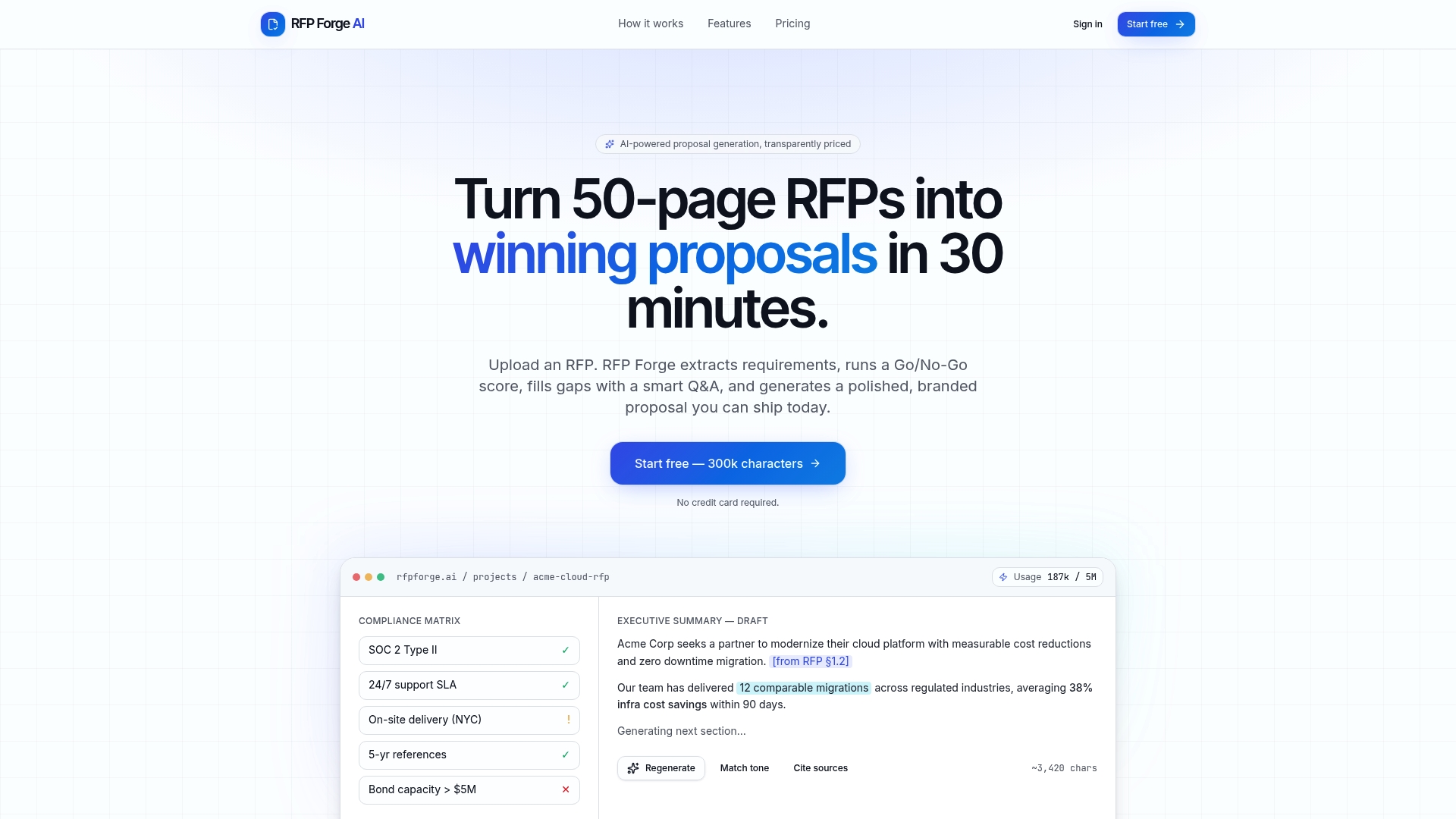
Every proposal export includes a compliance summary with traceability links, so your reviewers can navigate by requirement ID rather than reading the full document. For teams in regulated industries, Rfpforgeai's analytics track win rates across bids, giving you the data to improve your process over time. Upload your RFP and get a compliance matrix in minutes at Rfpforgeai.
Primary sources and further reading
Use these resources to verify extracted requirements, check amendment history, and access authoritative traceability guidance.
-
Sam — The federal portal for retrieving solicitation documents and their full amendment history. Always pull the authoritative PDF from SAM.gov before beginning extraction; a downloaded copy from another source may not reflect the latest amendment.
-
FAR 15.304 — Evaluation Factors and Significant Subfactors — The regulatory basis for proposal evaluation on federal solicitations. Use this to align your matrix's evaluation-weight column to the criteria the contracting officer will apply.
-
FedRAMP Marketplace — The authoritative list of cloud services authorized for federal data handling. Check this before selecting any automation tool that will store or process federal solicitation data.
-
Requirements Coverage Analysis — Visure Solutions — A detailed explanation of forward and backward traceability and how a traceability matrix links requirements to response artifacts.
-
Requirements Traceability Matrix Guide — Attract Group — Practical guidance on RTM structure, field definitions, and the principle of keeping the matrix small enough to maintain continuously.
Sources
- Requirements Coverage Analysis in Software Testing - Visure Solutions
- Acquisition
- Sam
- Requirements traceability matrix: a guide with an example and template | Attract Group
- Fedramp