
A proposal teaming strategy is the deliberate process of combining two or more companies' capabilities, past performance, and capacity into a single, compliant offer against a federal solicitation. Done right, it turns a "no-bid" into a competitive submission. For most mid-size and small-business primes, it's not optional. Your team is your proposal, and evaluators score the collective capability you present, not just the prime's résumé.
Start here, today, on your live pursuit:
- Score your candidates. Build a quick partner scorecard rating capability fit, past performance relevance, and compliance history.
- Verify registration status. Confirm SAM, UEI, and CAGE codes are active for every prospective teammate before you invest more time.
- Map primary and vital work. Decide upfront who performs the primary and vital portions of the effort, since this drives SBA scrutiny later.
- Draft exclusivity and LOI language. Get commitment in writing early, even in short form, before you build the compliance matrix.
- Loop in counsel. Have a lawyer review affiliation exposure under SBA rules before submission, not after.
Key Takeaways
A proposal teaming strategy succeeds when partner selection, signed commitments, and SBA affiliation review happen during capture, not during the final week before submission.
| Point | Details |
|---|---|
| Verify partners early | Confirm SAM, UEI, and CAGE status before investing time in any teaming conversation. |
| Sign before you build | Get exclusivity and workshare terms signed before the compliance matrix depends on them. |
| Watch affiliation risk | Document separate facilities, employees, and primary/vital work under 13 C.F.R. § 121.103. |
| Map every SOW element | Assign each requirement to prime or partner with a matching evidentiary artifact. |
| Automate the paperwork | Rfpforgeai centralizes requirements extraction and compliance tracking so teammate inputs stay aligned. |
Table of Contents
- What Is a Proposal Teaming Strategy and When Does It Pay Off?
- Prime-Sub, Formal CTA, JV, or Mentor-Protégé: Which Structure Fits?
- What Terms Belong in Every Teaming Agreement?
- How Do You Avoid Triggering SBA Affiliation Problems?
- How Do You Turn a Teaming Agreement Into Proposal Content?
- How Do You Vet and Negotiate With a Teaming Partner?
- Can Automation Handle the Coordination Load of Teaming?
- What Actually Separates Winning Teams From Failed Ones?
- How Rfpforgeai Keeps Your Teaming Artifacts Straight Under Deadline
- Where to Verify the Rules Before You Submit
- Frequently Asked Questions
- Sources
What Is a Proposal Teaming Strategy and When Does It Pay Off?
A teaming agreement is a written commitment between two companies to pursue a specific opportunity together, typically with one acting as prime and one as subcontractor. It's distinct from a subcontract, which governs actual performance after award, and from a joint venture, which creates a separate legal entity that bids and holds the contract itself. Teaming agreements set intent and structure before award; subcontracts and JV operating agreements govern what happens after.
The benefits show up directly in your evaluation score. Teaming fills capability gaps you can't build in time for the deadline. It imports past performance you don't have on your own, which matters enormously in technical and past-performance-heavy evaluations. It can satisfy socioeconomic goals when a small business or 8(a) firm rounds out your team. And it gives you pricing flexibility, letting you shift labor categories to whichever partner delivers them cheaper.
Teaming isn't free, though. Skip it when the requirement is small, single-discipline, and squarely inside your existing capability. Adding a partner to a small task order just to check a diversity box invites SBA affiliation risk for no evaluation upside.
Prime-Sub, Formal CTA, JV, or Mentor-Protégé: Which Structure Fits?
Four structures cover almost every teaming scenario in federal work, and picking the wrong one creates compliance headaches you don't discover until after award.
| Structure | Best used when | Key consequence |
|---|---|---|
| Prime-sub relationship (informal) | Small task orders, short timelines, one clear subcontractor role | Least legal overhead, weakest exclusivity protection |
| Contractor teaming arrangement (CTA), project-specific | Mid-size opportunities needing combined past performance | Requires a signed CTA per FAR and clear workshare terms |
| Joint venture (JV) entity | Large opportunities, especially set-asides requiring combined capacity | Creates a new legal entity; both firms share liability |
| Mentor-protégé JV | Small business paired with an experienced mentor for set-asides | SBA-approved arrangement exempts the JV from affiliation under specific conditions |
A few decision rules cut through the noise:
- Choose a CTA when you need combined past performance but don't want to stand up a new entity.
- Choose a JV when the opportunity size or set-aside type requires pooled bonding capacity or resources.
- Choose mentor-protégé when a small business needs SBA-sanctioned cover from affiliation while working alongside a larger, more experienced partner.
Each structure carries different workshare limits and staffing expectations, and GSA's industry FAQ on joint ventures walks through common formation questions worth reading before you commit to a JV route.
What Terms Belong in Every Teaming Agreement?
A teaming agreement that skips the wrong clause becomes unenforceable exactly when you need it most, usually the week before submission when a partner gets cold feet. Build your agreement around these elements:
- Identity of the solicitation. Name the specific RFP or RFI number so the agreement can't be stretched to cover unrelated pursuits.
- Exclusivity scope. State whether the partner is barred from teaming with competitors on this specific bid.
- Committed workshare. Spell out a percentage or task list, not a vague "to be determined."
- Proposal responsibilities. Assign who writes which volume and who reviews compliance.
- Pricing confidentiality. Protect rate information exchanged during proposal development.
- Intellectual property buckets. Separate background IP each party brings from foreground IP created jointly.
- Baseline subcontract terms. Attach draft terms so conversion after award doesn't restart negotiation from zero.
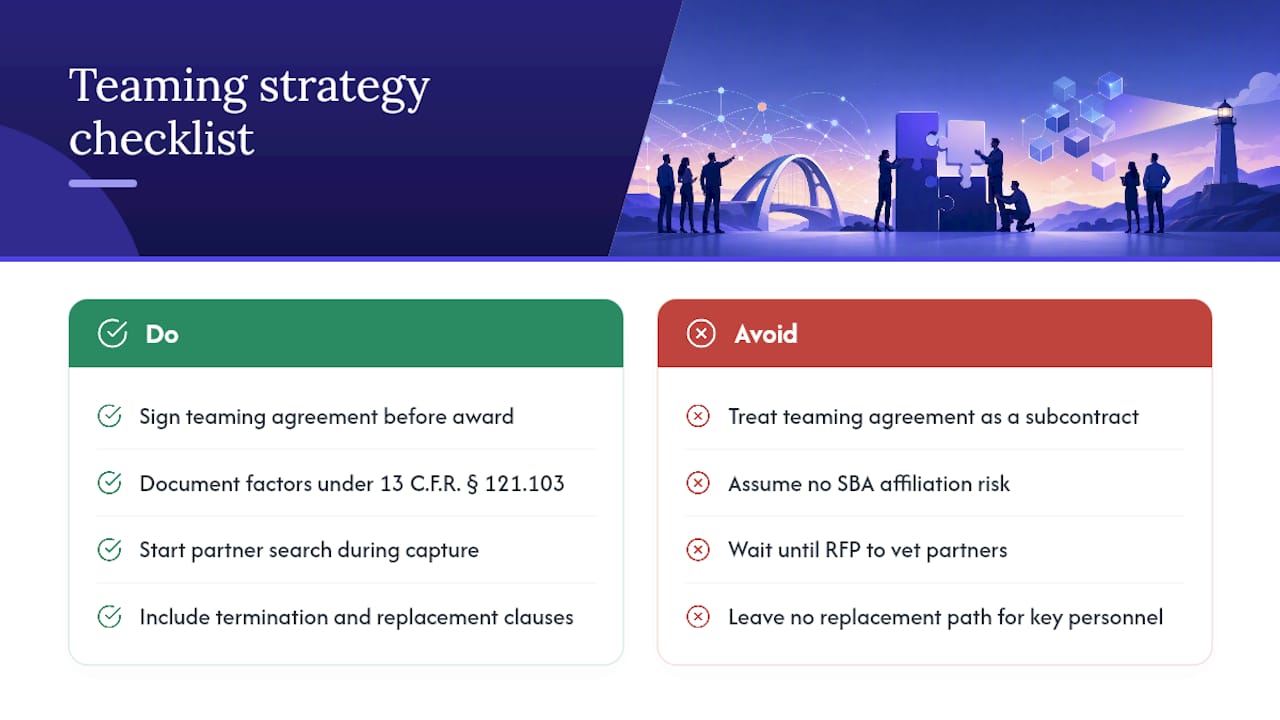
- Termination and cure provisions. Define what happens if a partner underperforms or the bid is pulled.
- Replacement of key personnel. Set a process if a named resume becomes unavailable before or after award.
- Flow-down clauses and payment terms. Confirm which prime contract clauses cascade down and on what payment schedule.
Pro Tip: Structure your commitment as two sentences, not one. The first states the binding commitment plainly ("Subcontractor commits to performing a defined portion of the total contract value"). The second isolates the assumption it depends on ("This commitment assumes award under the solicitation as issued, without material changes to scope"). Separating commitment from assumption keeps the clause enforceable even if the RFP shifts in amendment.
A teaming agreement is only as strong as the artifact trail behind it. Signed letters of intent, a baseline subcontract draft, and documented workshare percentages carry more weight in a protest or SBA size review than any amount of verbal goodwill between partners.
Sign the core agreement itself. Letters of commitment or intent can stay in LOI form if they're clearly referenced and dated, but the workshare and exclusivity terms need signatures before you submit.
How Do You Avoid Triggering SBA Affiliation Problems?
SBA evaluates affiliation under 13 C.F.R. § 121.103, looking at control, prior business relationships, profit-sharing arrangements, and whether the small business genuinely operates with separate facilities and employees. The core question examiners ask: does the small-business prime actually control the primary and vital elements of the work, or does the larger partner effectively run the show?
Work through this before submission:
- Document that facilities and employees are genuinely separate between prime and teammate, not shared office space or shared staff on paper only.
- Assign primary and vital work explicitly to the small-business prime and keep records showing that assignment held during performance.
- Preserve the small business's independent revenue and staffing outside this one pursuit, since heavy dependence on one partner invites scrutiny.
- Secure written LOIs and baseline subcontract language rather than relying on verbal understanding.
- Route the final teaming package through legal counsel before submission, specifically for an affiliation read.
Early counsel review isn't a formality. It's the step that catches an affiliation problem while it's still fixable, rather than after a competitor files a size protest.
DOE's own guidance flags this exact risk, warning offerors to review affiliation rules before proposal submission, not after award. Contracting officers face their own documentation duty here too. SBA guidance requires them to use Small Business Search for market research and document the rationale behind any set-aside determination, which means your team's structure gets examined from both sides. Misrepresenting your limitation-on-subcontracting compliance doesn't just risk a lost award. It can expose your company to False Claims Act liability if the misrepresentation is later discovered during performance.
How Do You Turn a Teaming Agreement Into Proposal Content?
A signed teaming agreement means nothing to evaluators unless it shows up clearly in the proposal itself. Map it deliberately.
Your technical approach should show integrated methodology, not two companies' sections stapled together. The management plan needs an organizational chart naming the teammate's key personnel by role. Past performance should present the teammate's relevant contracts with the same rigor as the prime's, including contract number, value, and a client point of contact where allowed. Staffing sections need signed or referenced letters of commitment attached as proposal exhibits.
| SOW element | Responsible party | Evidentiary artifact |
|---|---|---|
| Technical methodology | Prime (integrated with partner inputs) | Combined approach narrative |
| Specialized capability gap | Teammate | Letter of commitment, resumes |
| Relevant past contracts | Teammate | Past performance summary, references |
| Key personnel roles | Both | Signed LOIs, org chart |
| Pricing and labor rates | Both, separately negotiated | Baseline subcontract pricing schedule |
Attach the signed teaming agreement or a redacted version, letters of commitment for named personnel, and baseline subcontract terms as backup documentation. A requirements traceability matrix helps confirm every SOW line item has an owner and an evidentiary artifact before you submit, which is exactly the kind of gap evaluators catch during compliance review.
How Do You Vet and Negotiate With a Teaming Partner?
Due diligence protects your compliance posture as much as your win probability. Verify SAM, UEI, and CAGE status, then check past-performance relevance, financial stability, security clearance holdings, and insurance certifications before you go further.
Score candidates on capability fit, past performance relevance, compliance record, proposal responsiveness, and cultural fit, weighting capability fit and past performance highest since those drive evaluation scores directly.
Watch for these red flags:
- No active SAM registration or an expired CAGE code.
- Vague deliverable descriptions that never firm up during negotiation.
- Resistance to signing baseline subcontract terms before proposal submission.
- Past performance claims that don't match publicly available contract records.
A structured scoring matrix, outlined in guidance from federal teaming consultants, turns partner selection from a gut call into a repeatable process your capture team can run on every pursuit.
Can Automation Handle the Coordination Load of Teaming?
Coordinating multiple partners across a compressed proposal timeline creates exactly the kind of administrative drag that automation is built to absorb. Shared requirements extraction gets every partner working from the same compliance matrix instead of five different interpretations of the SOW. Joint past-performance libraries let teammates submit their own write-ups directly into a shared system rather than emailing Word documents back and forth.
- Use a unified compliance matrix so no partner section falls out of alignment with the RFP.
- Keep a single evidence pack (signed TA, LOIs, subcontract drafts, redlines, email record) tied to your proposal schedule in one access-controlled workspace.
- Version subcontract baselines so post-award conversion doesn't restart from scratch.
Pro Tip: Tie your evidence pack to the same Gantt chart driving your proposal schedule. When counsel asks for affiliation documentation six months later, you want it organized by milestone, not scattered across inboxes.
Automation speeds the mechanics. It doesn't replace legal counsel for affiliation determinations or contract interpretation questions.
What Actually Separates Winning Teams From Failed Ones?
The teaming agreements that hold up under pressure share a pattern: they get negotiated during capture, not during the seventy-two hours before submission. Waiting until the RFP drops to approach a partner means you're negotiating workshare and price simultaneously, under deadline pressure, with a partner who hasn't had time to vet the opportunity either.

Three things consistently separate teams that execute well. They start teaming conversations in capture, months ahead of the solicitation. They negotiate baseline subcontract language early, before proposal pressure distorts the conversation. And they document every commitment in writing, because a partner who says "we're in" verbally and never signs an LOI has given you nothing you can cite in a proposal.
The failure pattern is just as consistent. Teams overpromise workshare to a partner chasing revenue, then can't deliver on that promise once award happens and the small-business prime needs to retain primary and vital work for SBA compliance. Teams cite unsigned LOIs as if they were binding commitments, only to have the partner walk after the compliance matrix is built around their contribution. And teams skip a clear replacement path for key personnel, leaving the proposal exposed the moment one resume becomes unavailable.
How Rfpforgeai Keeps Your Teaming Artifacts Straight Under Deadline
Every teaming strategy above depends on paperwork staying organized while three or four companies race a submission clock, and that's where most teams lose hours they can't get back. Rfpforgeai cuts that administrative drag by turning a lengthy RFP into a shared compliance matrix in minutes, so every teammate works from the same requirements list instead of five conflicting interpretations.
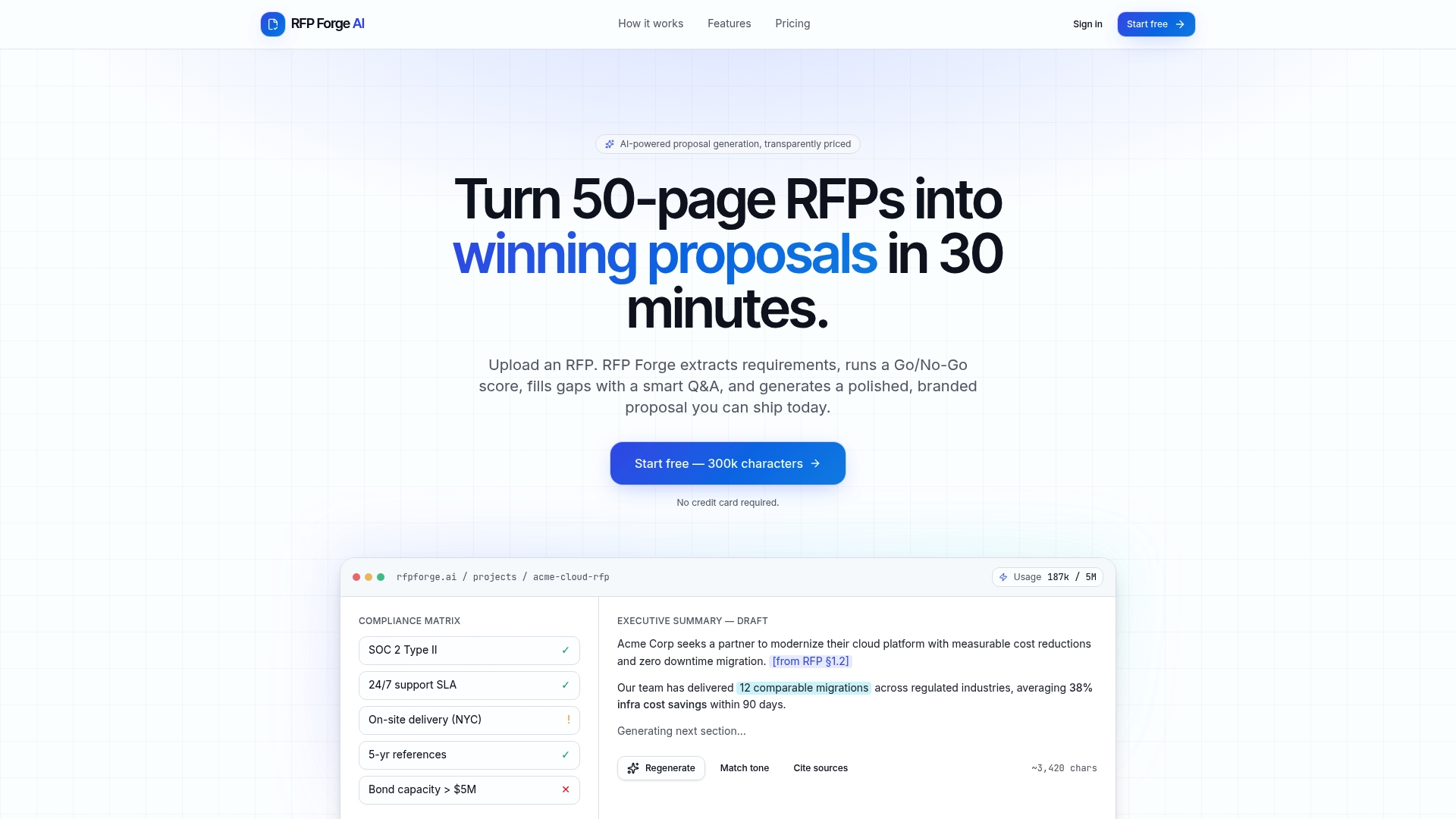
- Faster requirements extraction means your team spends less time reconciling who owns which SOW line and more time writing the technical narrative.
- A live compliance matrix keeps partner responsibilities visible to everyone, reducing the risk of a gap surfacing during final review.
- Consistent formatting across contributors helps evaluators read one integrated proposal instead of a patchwork of teammate sections.
If your next pursuit involves more than one company's name on the cover page, start your compliance matrix in Rfpforgeai as soon as the RFP drops and keep every partner's inputs in one workspace through submission.
Where to Verify the Rules Before You Submit
- DOE's teaming guidance: read this for a clear walk-through of how affiliation rules apply to teaming arrangements.
- SBA set-aside guidance: shows how contracting officials document set-aside determinations.
- FAR subpart 19.5: the governing rule for small business set-aside mechanics.
- FAR 19.502-3: covers partial set-aside requirements for divided acquisitions.
Confirm any affiliation-specific question with legal counsel before submission.
Frequently Asked Questions
Is a proposal teaming strategy the same thing as a subcontract? No. A teaming agreement sets intent and structure before award, while a subcontract governs actual performance and payment after the contract is won. Most teams sign both, in sequence.
Does teaming always create SBA affiliation risk? Not automatically, but it always warrants review. Affiliation depends on control, shared facilities or employees, and who performs the primary and vital work, so document those factors under 13 C.F.R. § 121.103 rather than assuming a clean structure.
When should I start looking for teaming partners? During capture, ideally months before the solicitation drops. Waiting until the RFP is public compresses partner vetting and workshare negotiation into a timeline too short to do either well.
What happens if a teaming partner backs out after we submit the proposal? Your teaming agreement's termination and replacement clauses govern this. Without a clear replacement path for key personnel or committed work, you risk a compliance gap discovered mid-performance.
Can a mentor-protégé joint venture avoid SBA affiliation entirely? An SBA-approved mentor-protégé JV receives an exemption from standard affiliation rules under specific conditions, but the arrangement still requires SBA approval and adherence to program requirements.
This article is general information, not a substitute for advice from a qualified lawyer. Consult a qualified legal professional about your own circumstances before acting on anything here.
Sources
- Impact of Teaming Arrangements on Small Business Status | Department of Energy
- Set-Aside Procurement guidance for contracting officials | SBA
- FAR subpart 19.5 — Set-Asides for Small Business
- FAR 19.502-3 — Partial set-asides of contracts other than multiple-award contracts
- Final JV industry FAQs | GSA