
Effective proposal risk management requires five things in every submission: identify your top risks by category, score each on probability and impact, assign a named owner, write a measurable mitigation with a cost or schedule trigger, and commit to a monitoring cadence. Reviewers across federal, state, and commercial procurement consistently use risk awareness as a proxy for readiness — a proposal that lists no risks signals naivety, while one that lists twenty signals an unfeasible project.
Start here: write one risk statement before you do anything else. It should name the risk, the owner, and the mitigation in a single sentence. Example: "Schedule risk (Owner: Project Manager) — if regulatory approval extends beyond 30 days, the team will activate a pre-approved two-week buffer and notify the sponsor." That sentence alone tells a reviewer your team has thought past the pitch.
- Identify risks by category (technical, schedule, budget, staffing, compliance, external)
- Score each on a 1–5 probability × 1–5 impact matrix
- Assign a named owner for every risk
- Write a mitigation with a measurable trigger (dollar threshold, calendar days, approval gate)
- Commit to a monitoring cadence (weekly in the first 90 days post-award, monthly thereafter)
Key Takeaways
Strong proposal risk management requires identifying 5–10 scored risks with named owners, measurable triggers, and contingency budgets that appear in both the risk register and the proposal's budget narrative.
| Point | Details |
|---|---|
| Start on Day 1 | Begin risk identification during proposal development — early risks are the cheapest to manage. |
| Score 5–10 risks | Use a 1–5 probability × impact matrix; fewer looks naive, more looks unmanageable. |
| Name every owner | Every risk needs a specific person, not "the team," or reviewers will discount the mitigation. |
| Budget your contingency | Contingency costs must appear in both the risk register and the budget narrative to be credible. |
| Rfpforgeai accelerates the process | The platform extracts requirements, detects assumptions, and generates templated risk register entries to cut drafting time. |
Table of Contents
- What does proposal risk management actually mean to a reviewer?
- When should you start risk management in the proposal lifecycle?
- How do you identify the right risks for your proposal?
- How do you assess and prioritize risks in a proposal?
- What fields should every proposal risk register include?
- What are your four response options and how do you write mitigations that hold up?
- How should you present risk management inside the proposal itself?
- How does risk management flow from proposal into execution?
- What are the most common proposal risk mistakes reviewers flag?
- Concrete examples you can copy into your proposal right now
- How Rfpforgeai speeds up proposal risk management
- Sources
What does proposal risk management actually mean to a reviewer?
Proposal risk management is the practice of identifying, assessing, and planning responses to risks before a project is awarded — not after. It differs from execution-only risk planning because it must be written for an external audience: reviewers who have limited context, limited time, and a specific question in mind: "Does this team know what could go wrong, and do they have a credible plan to handle it?"
The WSDOT Project Risk Management Guide frames risk management as resting on two pillars — identification and response — and recommends integrating both into schedule and cost estimates from the start. That integration is exactly what reviewers look for: not a standalone risk appendix bolted on at the end, but evidence that risk thinking shaped the budget, timeline, and staffing plan throughout the proposal.
When a reviewer scans your risk section, they are checking for five signals:
- Named risk owner — a specific person or role, not "the team"
- Quantified impact — cost, schedule days, or performance metric affected
- Timeline trigger — the condition that activates the mitigation
- Contingency — a fallback plan with a cost or time estimate
- Monitoring commitment — how often the risk register will be reviewed
Missing any one of these signals weakens the proposal's credibility on feasibility criteria.
When should you start risk management in the proposal lifecycle?
The answer is Day 1 of proposal development, not the week before submission. The New York DOT Risk Management for Project Development Guide is explicit: formal risk management should begin at the initial project proposal stage because risks identified early are the cheapest and most effective to manage. By the time a project is in execution, the cost of addressing an unmanaged risk is almost always higher than the cost of planning for it during the proposal.
In practical terms, your first week of proposal development should include three activities:
- Assumptions inventory — list every assumption your team is making about scope, data availability, staffing, regulatory timelines, and client readiness
- Top-5 risk brainstorm — run a 60-minute session with the proposal team to surface the five risks most likely to derail delivery
- Initial owner assignment — pair each risk with a named person before the session ends
The assumptions inventory is often skipped, and that is a mistake. Unvalidated assumptions are hidden risks. A team that assumes the client will provide clean data by Week 2, for example, has a schedule risk embedded in that assumption — and if it is not surfaced and owned, it will not appear in the proposal's risk section.
Pro Tip: Before submission, lock in at least one risk per major project phase (design, implementation, closeout). Reviewers who see phase-linked risks understand your team has mapped the full delivery arc, not just the kickoff.
How do you identify the right risks for your proposal?
The goal is a focused list, not an exhaustive one. Overlisting risks makes a project look unmanageable; underlisting makes the team look unprepared. Proposal guidance recommends aiming for 5–10 well-considered risks, scored and prioritized, rather than a generic laundry list.
Structured identification techniques
Use at least three of these methods during proposal kickoff:
- RFP/RFQ document review — read the solicitation for mandatory requirements, unusual constraints, and evaluation criteria that signal where the client sees risk
- Stakeholder interviews — ask subject-matter experts what kept similar projects from hitting schedule or budget
- Lessons-learned review — pull post-mortems from comparable past projects and extract recurring risk categories
- Assumptions review — treat every unvalidated assumption as a candidate risk, per the Velociteach guidance on assumptions and risk logging
- Dependency mapping — chart external dependencies (third-party vendors, regulatory bodies, client approvals) and flag each as a potential schedule or compliance risk
Common risk categories for proposals
- Technical/methodological — unproven technology, complex integration, data quality issues
- Schedule — regulatory approval delays, vendor lead times, key-personnel availability
- Budget — cost estimation uncertainty, inflation exposure, scope creep
- Staffing — key-person dependency, subcontractor performance, clearance requirements
- Compliance/regulatory — permit timelines, reporting requirements, audit readiness
- External dependencies — client data delivery, third-party APIs, supply chain lead times
- Stakeholder acceptance — change management resistance, end-user adoption risk
Pro Tip: Run a dedicated "assumptions and risks" agenda item at your proposal kickoff meeting. Ask the team: "What has to be true for this proposal to succeed?" Every answer is either a confirmed fact or a risk.
How do you assess and prioritize risks in a proposal?
Qualitative vs. quantitative scoring
Qualitative assessment — rating probability and impact on a descriptive scale (low/medium/high) — is fast and works well for most commercial and grant proposals where you have limited data and tight submission timelines. Quantitative assessment, which uses Monte Carlo simulation or expected monetary value calculations, is appropriate for large infrastructure bids, defense acquisitions, or any proposal where the client explicitly requires probabilistic cost or schedule analysis.
For most proposals, a simple 1–5 probability × 1–5 impact matrix gives you enough resolution to prioritize without overwhelming the reviewer. Score each risk on:
- Probability (1 = rare, 5 = near-certain)
- Cost impact (1 = negligible, 5 = project-threatening)
- Schedule impact (1 = less than one week, 5 = more than one month)
- Performance impact (1 = minor quality reduction, 5 = deliverable failure)
Multiply probability by the highest impact score to get a priority number. Risks scoring 15 or above are red (high priority), 8–14 are amber (medium), and 1–7 are green (low). This red/amber/green framing translates directly into reviewer-friendly language without requiring the reviewer to interpret raw numbers.
Pro Tip: Tie every threshold to a concrete trigger. "Red" should mean something specific: a cost variance exceeding $25,000, a schedule slip of more than 10 calendar days, or a required approval not received by a named milestone date. Vague thresholds give reviewers nothing to hold you accountable to — and that is exactly what undermines credibility.
A two-risk scoring example:
- Regulatory approval delay: Probability 4, Schedule impact 4, Cost impact 3 → Priority score 16 → Red
- Staff turnover on a non-critical role: Probability 2, Schedule impact 2, Cost impact 2 → Priority score 4 → Green
What fields should every proposal risk register include?
The risk register is the living document that connects your proposal's risk narrative to the execution plan. DoD RIO guidance prescribes assigning owners and updating the register at each project milestone, with the PM ultimately responsible for tracking and mitigation. For a proposal, you need two versions: a reviewer-facing summary (main body or appendix) and an internal living document that the team will maintain post-award.
Essential fields for the reviewer-facing register
| Field | Purpose |
|---|---|
| Risk ID | Unique reference (R-01, R-02) for cross-referencing in the proposal body |
| Short title | 5–8 words the reviewer can scan in seconds |
| Description | One sentence: what could happen, under what condition |
| Assumption link | Which assumption, if wrong, triggers this risk |
| Probability (1–5) | Likelihood score |
| Impact: Cost/Schedule/Performance | Separate scores for each dimension |
| Priority score | Probability × highest impact |
| Owner | Named person or role |
| Mitigation summary | One sentence: what the team will do |
| Contingency | Fallback cost or time reserve |
| Trigger/monitoring date | When the mitigation activates and when the risk is next reviewed |
| Status | Open / In mitigation / Closed |
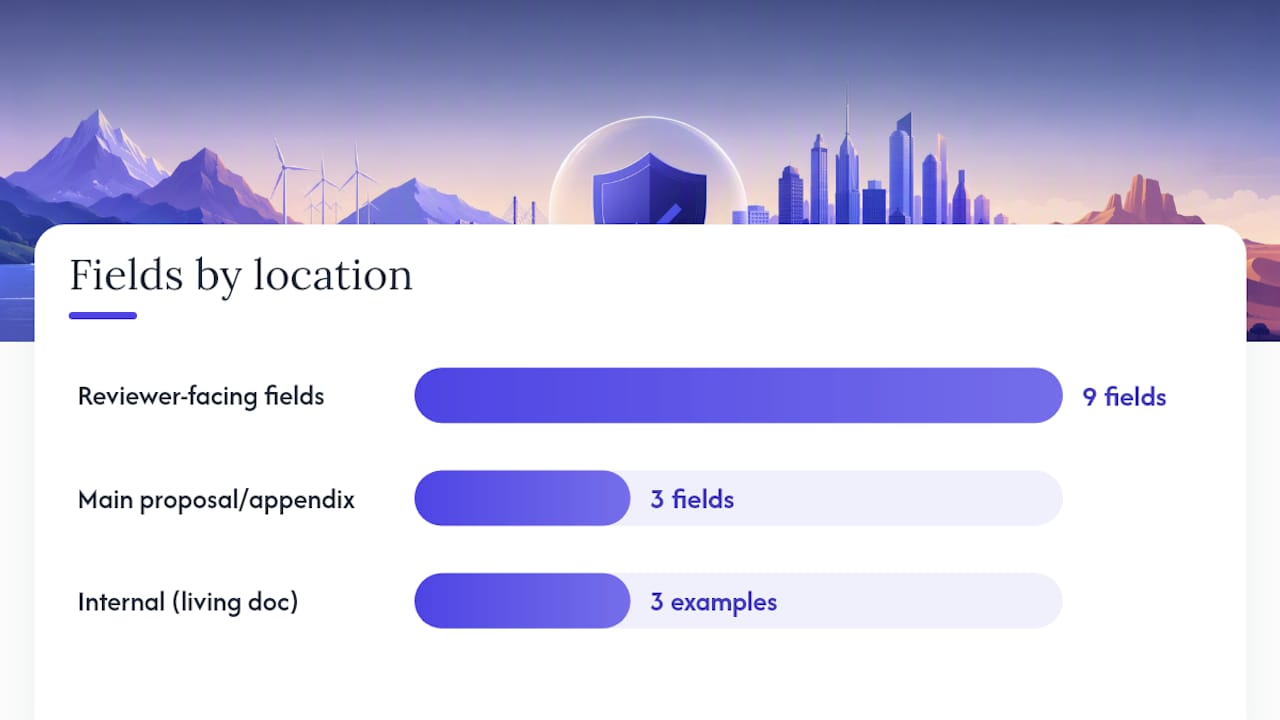
Fields like assumption link, contingency cost, and trigger date belong in the main proposal or appendix. Internal fields (detailed mitigation steps, escalation contacts, historical probability data) stay in the living document.
One-row sample register entry
| ID | Title | Description | Owner | Probability | Cost Impact | Schedule Impact | Priority | Mitigation | Contingency | Trigger Date | Status |
|---|---|---|---|---|---|---|---|---|---|---|---|
| R-01 | Regulatory approval delay | State permit approval may extend 30+ days beyond planned 45-day window | Project Manager | 4 | 3 | 4 | 16 (Red) | Submit permit application 15 days early; assign regulatory liaison | $8,000 buffer; 2-week schedule float | Day 30 post-kickoff | Open |
Pro Tip: Keep the reviewer-facing register to one page. If your risk section runs longer than that, move the detailed mitigation steps to an appendix and put a pointer in the main body. Reviewers score what they can read quickly.
What are your four response options and how do you write mitigations that hold up?
The DoD RIO Management Guide defines four standard mitigation options. Choosing the right one for each risk is what separates a credible risk section from a generic one.
- Accept — acknowledge the risk and absorb the impact if it occurs; appropriate for low-priority risks where mitigation cost exceeds potential impact
- Avoid — change the approach to eliminate the risk entirely; appropriate when a technical choice or dependency is the root cause
- Transfer — shift the financial or operational consequence to another party (insurance, subcontractor warranty, client-held approval); appropriate for risks outside your direct control
- Control — reduce probability or impact through specific actions; the most common choice for medium and high-priority risks
Mitigation plan template
A strong mitigation entry answers five questions:
- Objective — what outcome does this mitigation protect?
- Actions — what specific steps will the team take?
- Timeline — by when, tied to a project milestone or calendar date?
- Owner — who is accountable?
- Estimated cost impact — what does the mitigation cost, and what does it save?
Here is the contrast between weak and strong mitigation language:
- Weak: "The team will monitor regulatory timelines and respond as needed."
- Strong: "The Project Manager will submit the permit application 15 days ahead of the planned window (by Day 30 post-kickoff), assign a dedicated regulatory liaison, and activate a two-week schedule buffer if approval is not confirmed by Day 45. Estimated mitigation cost: $8,000. Trigger: no written confirmation from the agency by Day 45."
The strong version gives the reviewer a named owner, a specific date, a cost figure, and a trigger. The weak version gives them nothing to evaluate.
Pro Tip: Align every mitigation cost to a line item in your budget. If you claim a $10,000 contingency reserve, it should appear in the budget narrative. Reviewers who cannot find the contingency in the budget will question whether it is real.
How should you present risk management inside the proposal itself?
Structure matters as much as content. A risk section buried in an appendix with no mention in the executive summary tells the reviewer the team treats risk as an afterthought.
Recommended placement
- Executive summary — one sentence acknowledging the top risk and your mitigation approach; signals risk awareness without consuming space
- Implementation/approach section — a one-line risk table (ID, title, priority, owner) with a pointer to the appendix
- Appendix — the full register with all fields, the mitigation plan template, and monitoring cadence
For constrained submission formats (page limits, online forms), compress to a single paragraph in the approach section:
That paragraph covers owner, trigger, contingency, and cadence in under 60 words.
Dos and don'ts for reviewer-facing risk language
- Do name the owner and the trigger in every risk statement
- Do tie contingency costs to a percentage of total project budget
- Do reference prior performance data or pilot results as evidence of risk control
- Don't use vague language like "good governance," "best practices," or "proactive monitoring"
- Don't list risks without mitigations — it reads as a problem list, not a plan
- Don't claim zero risks; reviewers interpret that as a lack of analysis, not confidence
For evidence, the strongest signals are: named past projects where a similar risk was managed, pilot data showing the mitigation works, a named subcontractor with a performance guarantee, and milestone-based de-risking (where risk exposure decreases as the project progresses through defined gates).
How does risk management flow from proposal into execution?
The proposal's risk register is not a submission artifact — it is the starting document for execution. WSDOT guidance prescribes integrating risk management into schedule and cost estimates, which means the register you write for the proposal should map directly to the project schedule milestones post-award.
Recommended monitoring cadence
- Pre-submission — initial register complete, all risks scored and owned
- Award to Day 30 — weekly register review; validate assumptions, confirm owner availability
- Days 31–90 — weekly review; track trigger conditions, update status, report to sponsor
- Month 4 onward — monthly review tied to milestone reports; escalate any new red risks immediately
- Project closeout — final register update; document lessons learned for the next proposal cycle
KPIs to track post-award
- Number of open high-priority (red) risks at each milestone
- Average time from trigger event to mitigation activation
- Contingency spend vs. contingency budget
- Trigger response time (days from trigger to documented response)
Monthly status reports should include a one-page risk summary with status changes highlighted. Distribution should cover the Project Manager, project sponsor, finance lead, and any client-side program officer. Quarterly milestone reviews warrant a full register walkthrough with the sponsor.
What are the most common proposal risk mistakes reviewers flag?
Reviewers see the same failures repeatedly. Knowing what they look for — and what they infer from each red flag — lets you fix problems before submission.
Top reviewer red flags
- No risks listed — inferred: the team has not thought through delivery; automatic credibility loss
- No named owners — inferred: accountability is unclear; the mitigation will not be executed
- Token mitigations ("will monitor closely") — inferred: the team has no real plan
- Unrealistic cost or schedule estimates — inferred: the team does not understand the work
- Generic risk lists copied from a template — inferred: the team did not read the RFP carefully
- Risks without triggers — inferred: the team cannot define when a risk becomes a problem
Pre-submission checklist
- Every risk has a named owner (a person, not "the team")
- Every mitigation includes a measurable trigger (date, dollar amount, approval gate)
- Contingency costs appear in both the risk register and the budget narrative
- The risk count is between 5 and 10 — not fewer, not more
- No risk statement uses vague language ("monitor," "ensure," "coordinate")
- The executive summary mentions at least one risk and its mitigation
Running this checklist 48 hours before submission gives you time to rewrite weak entries without rushing. A proposal that passes all six checks reads as a plan, not a wish list.
Concrete examples you can copy into your proposal right now
Three sample risk statements
High priority (Red): "Regulatory approval delay (R-01) — State environmental permit may not be issued within the planned 45-day window, delaying project kickoff by up to 30 days and adding an estimated $12,000 in holding costs. Owner: Project Manager. Mitigation: Submit application 15 days early, assign regulatory liaison, activate 2-week schedule buffer if permit not confirmed by Day 45."
Medium priority (Amber): "Client data quality (R-02) — Source data from the client's legacy system may contain formatting errors requiring additional cleaning, adding up to 5 days of analyst time. Owner: Data Lead. Mitigation: TBD.
Low priority (Green): Owner: Operations Lead. Mitigation: Cross-train one backup resource during onboarding; accept impact if reassignment is less than 5 days."
One-row mitigation plan (copy-paste ready)
| Element | Content |
|---|---|
| Risk | Regulatory approval delay (R-01) |
| Objective | Protect project kickoff date against permit delays |
| Actions | Submit 15 days early; assign regulatory liaison; activate schedule buffer |
| Timeline | Application by Day 30; buffer activated by Day 45 if needed |
| Owner | Project Manager |
| Estimated cost impact | $8,000 mitigation cost; $12,000 avoided if buffer prevents full delay |
| Trigger | No written permit confirmation by Day 45 post-kickoff |
Treating assumptions as actionable items — with a documented owner, review date, and trigger — is what converts a passive risk list into a living management tool. Every assumption in your proposal that cannot be confirmed before submission should appear in the register as a risk.
How Rfpforgeai speeds up proposal risk management
Writing a compliant, reviewer-ready risk section from scratch takes hours. Rfpforgeai cuts that time significantly by automating the parts that are most repetitive: requirements extraction, assumptions detection, and risk-register templating.
Here is what the platform does that directly supports your risk section:
- Requirements extraction — automatically pulls mandatory requirements and constraints from the RFP, giving you the raw material for your risk identification pass
- Assumptions detection — flags language in the RFP that implies unstated assumptions (e.g., "client will provide" clauses), surfacing hidden risks before your team misses them
- Risk register templating — generates a pre-populated register with fields aligned to the scoring model you choose, so you are editing real entries rather than building from a blank spreadsheet
- Mitigation-language generation — produces owner-trigger-contingency language for each risk, which you review and refine rather than write from scratch
- Compliance mapping — connects each risk to the relevant RFP requirement, so reviewers can trace your risk awareness back to the solicitation language
For teams managing multiple concurrent proposals, the knowledge-base reusability feature means your risk taxonomy, owner assignments, and mitigation templates carry over from one submission to the next. Consistency across proposals is one of the strongest signals of a mature proposal operation.
Pro Tip: Use Rfpforgeai's requirements extraction output as the starting point for your assumptions inventory. Every requirement the AI flags as ambiguous or conditional is a candidate risk. You will surface risks in 20 minutes that a manual read might miss entirely.

For a deeper look at how technical proposal writing integrates risk language into the approach section, the Rfpforgeai blog covers reviewer-facing phrasing in detail.
What an experienced proposal manager checks before submission
Before any proposal leaves my desk, I run through five items that have saved credibility more than once:
- Every risk has a named human owner, not a role title or department
- Every mitigation has a dollar figure or calendar-day trigger
- The contingency total appears in the budget narrative, not just the risk register
- The executive summary names the top risk and its mitigation in one sentence
- The risk count is between 5 and 10
Two things I always do: I read the risk section out loud to catch vague language ("will monitor," "as needed") that sounds fine in writing but collapses under a reviewer's scrutiny. And I hand the living risk register to the delivery PM on award day with a 30-minute walkthrough — not an email attachment. The handoff conversation is where assumptions get validated and owners get confirmed. Without it, the register sits in a folder and the risks play out anyway.
Rfpforgeai cuts the time from RFP to risk-ready proposal
Your proposal's risk section is where reviewers decide whether your team can actually deliver. Rfpforgeai gives you a faster path to a credible one: the platform extracts requirements, flags hidden assumptions, and generates templated risk register entries with owner and trigger language already in place. What used to take a proposal team half a day now takes under an hour.
Rfpforgeai and run your next RFP through the platform. You will have a scored, owner-assigned risk register ready before your first team review meeting.
Sources
- Risk Management for Project Development Guide_Final Draft_010514
- Project Risk Management Guide (WSDOT)
- Proposal Risk Assessment: Mitigating Risks
- Risk Assessment Matrix for Grant Proposals | Free Tool
- Managing project assumptions & risks