
Proposal process optimization delivers shorter cycle times, fewer compliance defects, and higher win rates — and the fastest path there is a focused 30–90 day DMAIC sprint (Define, Measure, Analyze, Improve, Control). Teams that have applied this Six Sigma framework to their proposal workflows report that such improvements are possible, including reductions in rework, increased conversion rates, and revenue recovery. Start here:
- Run a capture triage gate. Score every opportunity before committing resources.
- Build a compliance matrix on day one of each pursuit, not during review.
- Match past-performance entries to the RFP's evaluation criteria before writing begins.
- Use AI for one drafting step (first-draft generation or portfolio matching) to prove value fast.
Pro Tip: Don't try to fix everything at once. Pick the single stage where your team loses the most time — usually bid/no-bid or SME delays — and fix that first. Momentum follows.
The lifecycle stages below are where those actions live.
Key Takeaways
A DMAIC sprint with a compliance matrix, portfolio library, and one AI-assisted drafting step is the fastest path to measurable proposal process improvement in 30–90 days.
| Point | Details |
|---|---|
| Start with DMAIC | A structured Define–Measure–Analyze–Improve–Control sprint reduces rework and improves conversion rates. |
| Compliance matrix at kickoff | Assign every RFP requirement an owner on day one to prevent last-minute compliance gaps. |
| Portfolio library compounds gains | Tagged, reusable past-performance entries cut drafting time and improve section consistency each quarter. |
| Track three KPI buckets | Measure efficiency (cycle time), quality (DPMO/Sigma), and outcomes (win rate) from week one. |
| Rfpforgeai accelerates the playbook | Rfpforgeai automates requirements extraction, compliance matrix creation, portfolio matching, and win-rate analytics in one platform. |
Table of Contents
- How the proposal development lifecycle defines what you optimize
- How to apply DMAIC to your proposal process step by step
- Which tools give your proposal team the most leverage
- Which KPIs tell you whether your proposal process is improving
- How to build compliance controls, review gates, and a submission checklist
- Common mistakes that slow proposals and how to fix them fast
- Your 30–90 day roadmap to measurable proposal process improvement
- Process first, then AI: a practitioner's view
- Rfpforgeai cuts your proposal cycle time from day one
- Sources
How the proposal development lifecycle defines what you optimize
A full proposal development lifecycle runs from opportunity qualification through kickoff, writing, design, review, and submission. Each stage has a distinct failure mode, and optimizing the wrong stage first wastes effort.
| Stage | Core activity | Typical loss |
|---|---|---|
| Opportunity qualification | Bid/no-bid scoring, capture planning | Pursuing low-fit bids; no capture log |
| Kickoff | Compliance matrix, role assignments | Missing requirements discovered late |
| Writing | Technical approach, staffing, past performance, cost | SME delays, inconsistent voice |
| Design | Graphics, formatting, page-limit compliance | Last-minute layout rework |
| Review | Red team, Gold team, proofreading | Compliance gaps found too late |
| Submission | Portal upload, timestamp, receipt confirmation | Missed deadlines, wrong file versions |
Swimlane ownership matters as much as the stages themselves. Capture and BD own qualification and kickoff artifacts. SMEs and delivery leads own the technical and staffing sections. Pricing owns the rate card and cost narrative. Approvals (Gold team) sit above all lanes and sign off before submission.
Mandatory artifacts per stage:
- Capture log with Go/No-Go score
- Compliance matrix (RFP requirement, source page, owner, status)
- Project portfolio entries matched to evaluation factors
- SOW spine (deliverables, acceptance criteria, assumptions, exclusions)
- Rate card, single-sourced and version-controlled
Pro Tip: Treat the compliance matrix as a living document, not a checklist you fill out the night before Red team. Assign an owner to each row at kickoff.
How to apply DMAIC to your proposal process step by step
DMAIC is a useful framework for proposal process optimization because it ties improvements to measurable controls, helping prevent teams from sliding back to old habits after the sprint ends.
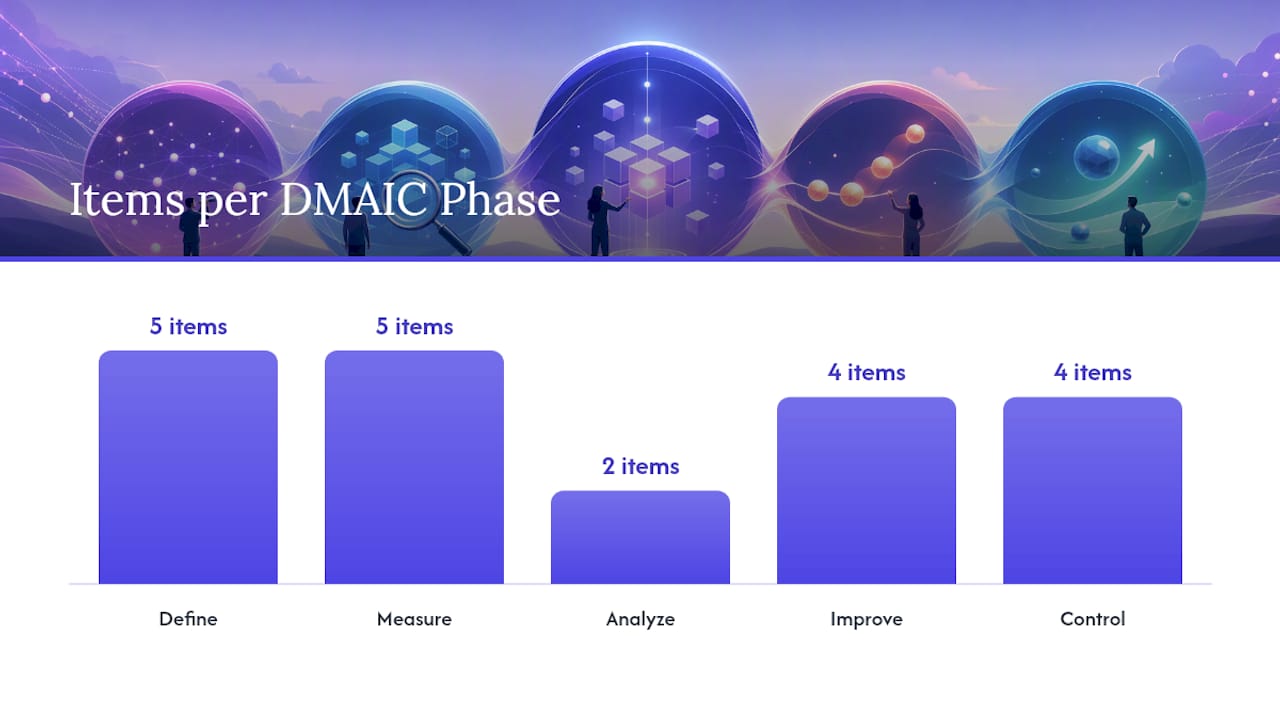
-
Define. Set your bid/no-bid criteria in writing. Document required inputs for a pursuit (incumbent intel, budget range, relationship status, past-performance match). Any opportunity missing two or more inputs gets a No-Go until gaps close.
-
Measure. Track proposal cycle time, defect rates, process quality levels, SLA compliance, and win rate. Run a time-and-motion pass on your last five proposals to find where hours actually go. A Pareto chart of delay sources almost always shows two or three root causes driving 80% of lost time.
-
Analyze. Use a fishbone diagram to map root causes for your top delay. Failure Mode and Effects Analysis (FMEA) ranks each failure by severity and likelihood, so you fix the highest-impact issues first rather than the most visible ones.
-
Improve. Write SOPs for the three highest-impact steps. Build a content library with tagged, reusable sections. Create a portfolio-matching checklist that links past-performance entries to specific evaluation criteria. Roll out changes on one proposal type before scaling.
-
Control. Install Statistical Process Control (SPC) charts for cycle time and DPMO. Run a monthly compliance scorecard review. Close the loop with a debrief after every submission — win or lose — and update the content library based on evaluator feedback.
Pro Tip: AI fits best in the Improve phase, not the Define phase. Use it for portfolio matching and first-draft generation after your SOPs are written — not before. AI amplifies whatever process quality already exists.
Which tools give your proposal team the most leverage
The highest-leverage tool categories are a proposal knowledge library, a compliance matrix engine, an AI drafting assistant, a workflow hub, and an analytics dashboard. Each owns a distinct job.
- Knowledge library: stores tagged past-performance entries, reusable section blocks, and approved rate cards. Quarterly updates compound improvement over time.
- Compliance matrix engine: maps every RFP requirement to an owner and tracks status in real time.
- AI drafting assistant: handles portfolio matching and first-draft generation; human experts own technical approach, pricing, and executive summary calibration.
- Workflow hub: surfaces the next action after each proposal milestone, flags missing inputs, and supports weekly exception reviews so leadership only touches outliers.
- Analytics dashboard: tracks win rate, cycle time, and DPMO across pursuits.
Building an AI-assisted proposal process around a structured Foundation — a project portfolio library, templates, and context packs — can cut drafting time by 60–70% and improve consistency across the team. The compound effect grows each quarter as the library expands.
Rfpforgeai maps directly to this stack. It extracts requirements automatically, builds the compliance matrix, matches portfolio items to evaluation criteria, generates draft sections (executive summary, technical approach, pricing narrative, timeline, compliance), and tracks win-rate analytics — all in one platform. Connect it to your CRM for opportunity data and share rate cards through its knowledge base to keep pricing single-sourced.
For teams evaluating proposal writing software for regulated industries, compliance tracking and audit-ready exports are non-negotiable features.
Pro Tip: Introduce AI after at least one proposal cycle on the new SOP. Own the content that feeds the model — garbage inputs produce garbage drafts, regardless of the tool.
Which KPIs tell you whether your proposal process is improving
Track three buckets: efficiency (how fast), quality (how clean), and outcomes (how often you win).
| KPI | Definition | How to measure | Starter target |
|---|---|---|---|
| Proposal cycle time | Days from kickoff to submission | Workflow timestamps | Reduce by 15% in 90 days |
| DPMO | Defects per million opportunities | Compliance audit counts | Below 281,053 (approximately 2.08 Sigma) |
| Sigma level | Process quality level | DPMO conversion table | Improve Sigma level from baseline |
| SLA compliance | % of milestones hit on time | Workflow hub reporting | 90%+ |
| Win rate | Awards / submissions | CRM outcome tagging | +5 points in 90 days |
| Time-to-first-draft | Hours from kickoff to draft-ready | Version timestamps | Reduce by 30% |
A DMAIC case study reported a baseline DPMO of 281,053 (approximately 2.08 Sigma) before optimization. That figure gives teams a realistic starting benchmark — most proposal processes sit well below 3-sigma before any structured improvement work.
Collect data from workflow timestamps, document versioning, and CRM outcome tags. Manual spreadsheets work for the first 30 days; move to a dashboard before day 60.
How to build compliance controls, review gates, and a submission checklist
A compliance matrix plus strict Red/Gold review gates eliminate the majority of submission errors before they reach the portal.
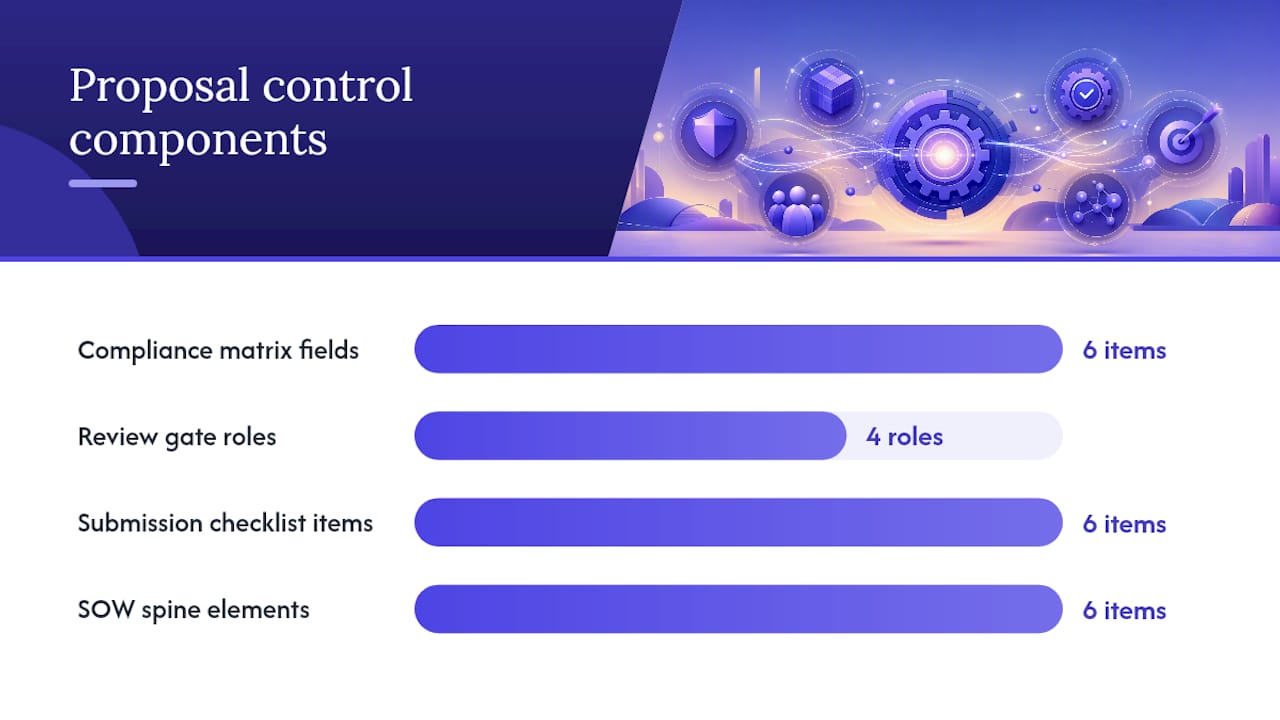
Compliance matrix fields: RFP requirement, source page/section, assigned owner, evidence document, compliance status, page-limit note.
Review gate responsibilities:
- Kickoff owner: confirms compliance matrix is complete and all SMEs are assigned.
- Red team: evaluates technical approach, staffing plan, and past-performance alignment against evaluation criteria. Scope is compliance and win strategy, not copy-editing.
- Gold team: executive sign-off on pricing, risk posture, and final narrative. No new content changes after Gold team.
- Proofreading pass: formatting, page limits, font compliance, file naming.
Submission checklist:
- All required volumes uploaded in correct format
- File names match RFP instructions exactly
- Page limits verified per volume
- Cost/price file separated if required
- Portal submission confirmed with timestamp screenshot
- Receipt confirmation requested from contracting officer
Build a single working file behind each proposal that captures client problem, deliverables, acceptance criteria, assumptions, exclusions, and pricing inputs. That file becomes the SOW spine and prevents downstream delivery rework.
Pro Tip: Set a hard cutoff: no content changes after Gold team sign-off. Teams that allow last-minute edits after Gold review introduce new compliance errors at the worst possible moment.
Common mistakes that slow proposals and how to fix them fast
Late bid/no-bid decisions, SME bottlenecks, broken knowledge management, and pricing misalignment are the four failures that most consistently hold proposal teams back.
- Late bid/no-bid → Enforce a capture validation checklist with a hard deadline 21 days before RFP release.
- SME delays → Block standing SME calendar time for proposal work at the start of each quarter.
- Knowledge management gaps → Mandate content library tagging before any section is marked "complete."
- Pricing misalignment → Single-source the rate card; no proposal goes to Red team with unconfirmed rates.
- No debrief discipline → Schedule the debrief within two weeks of award/no-award notification, every time.
Pricing misalignment deserves a closer look. When a proposal team uses outdated labor rates or unconfirmed subcontractor costs, the cost volume either prices the team out of the competition or erodes margin on award. A single-source rate card, updated quarterly and locked at kickoff, closes that gap without adding process overhead.
Quick operational fixes to implement this week:
- Create a one-page capture validation checklist and make it mandatory for every new pursuit.
- Add a "rate card version" field to the compliance matrix.
- Tag every reusable section in your content library with the evaluation factor it addresses.
- Schedule a standing 30-minute weekly proposal status call with owners and flags only.
Your 30–90 day roadmap to measurable proposal process improvement
A 30–90 day DMAIC sprint with locked roles, defined metrics, and required artifacts produces measurable results — provided you resist the urge to fix everything simultaneously.
| Weeks | Objective | Owner | Success criteria |
|---|---|---|---|
| 1–2 | Define: document current state, set bid/no-bid criteria | BD lead | Capture policy signed off |
| 3–4 | Measure: time-and-motion on last 5 proposals, baseline KPIs | Process lead | Baseline DPMO and cycle time recorded |
| 5–6 | Analyze: Pareto + fishbone on top 3 delay sources | Team | Root causes ranked by impact |
| 7–8 | Improve: SOPs written, content library seeded, AI tool piloted | All lanes | One proposal completed on new SOP |
| — | Control: SPC dashboard live, compliance scorecard active | Process lead | First monthly review completed |
| — | Scale: roll out to second proposal type, update library | BD lead | Portfolio library covers 80% of common sections |
Milestones to track:
- Capture policy approved (Week 2)
- Portfolio library seeded with 10+ entries (Week 6)
- Compliance matrix template rolled out (Week 7)
- Red/Gold pilot completed (Week 8)
- SPC dashboard live (Week 10)
Change management is where most sprints stall. Keep training sessions under 45 minutes. Distribute templates before the session, not during. Assign one process champion per lane who owns questions and escalations.
Pro Tip: Run a focused pilot on one proposal type before scaling. A single workflow fixed completely beats three workflows fixed halfway.
Process first, then AI: a practitioner's view
The teams that get the most out of AI-assisted proposal tools are the ones that already know where their process breaks. They've run the Pareto chart. They've assigned compliance matrix owners. They've locked the rate card. When those teams add AI, the output is genuinely better — faster drafts, tighter alignment to evaluation criteria, and a knowledge base that grows with every submission.
Teams that skip the process work and go straight to AI get faster drafts of the same inconsistent content. The tool isn't the problem. The absence of a repeatable process is.
The 30–90 day playbook in this article is designed to close that gap before you automate anything. Fix the capture gate, build the compliance matrix habit, seed the portfolio library — then let AI do the heavy lifting on first drafts and portfolio matching. That sequence matters more than the specific tool you choose.
Rfpforgeai cuts your proposal cycle time from day one
Rfpforgeai turns a 30-minute RFP upload into a draft-ready proposal — with requirements already extracted, a compliance matrix built, and past-performance entries matched to evaluation criteria before your team writes a single sentence.
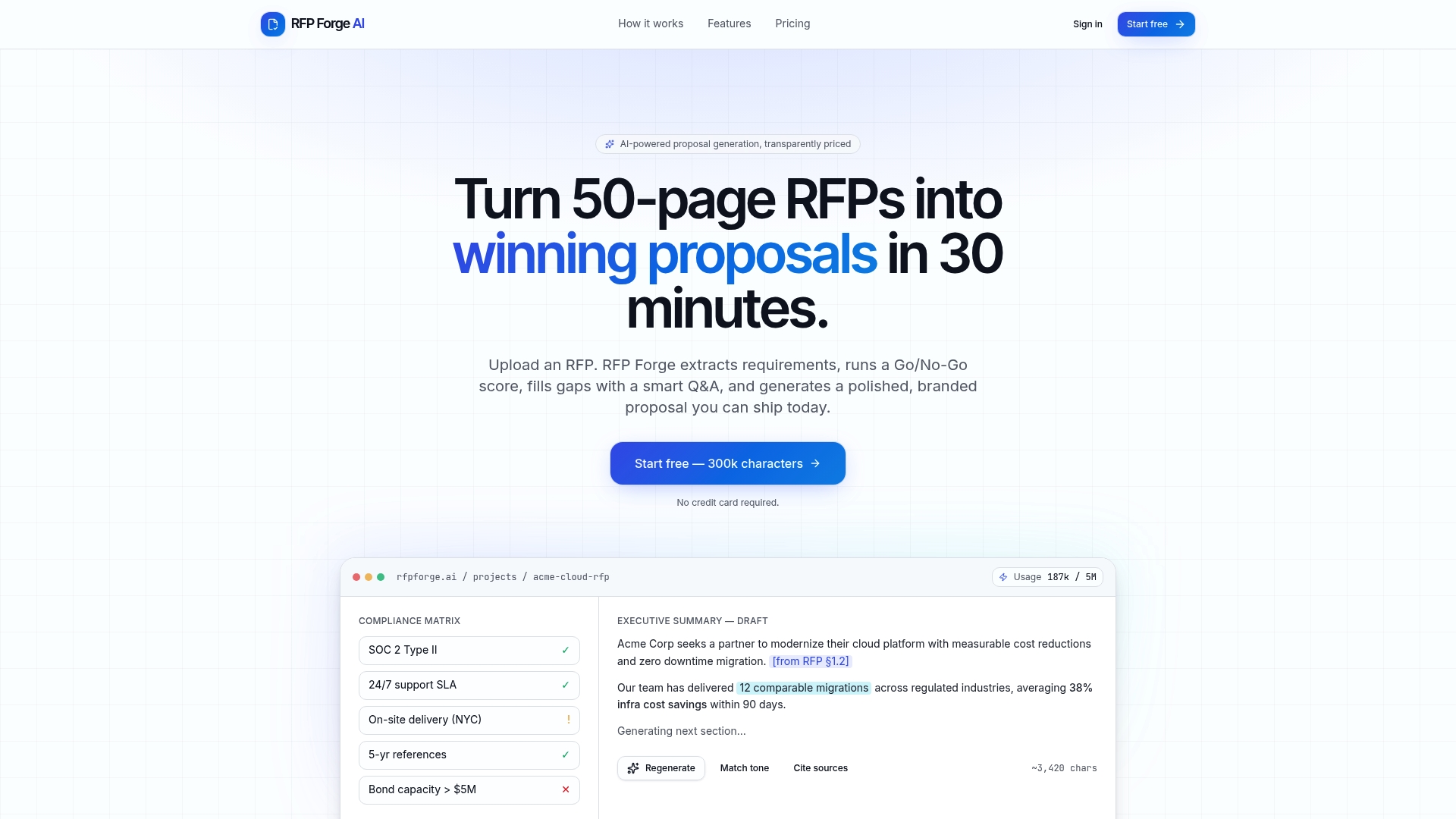
Here's how it maps to the playbook: in the Define phase, Rfpforgeai's Go/No-Go scoring surfaces fit gaps immediately. In the Improve phase, it generates draft sections (executive summary, technical approach, pricing narrative, timeline, compliance) from your knowledge base. In the Control phase, its win-rate analytics feed directly into your monthly scorecard. Clients in regulated industries have reported an average 38% cost reduction in infrastructure migrations using Rfpforgeai's AI-driven approach.
You don't need a six-month implementation. Start a Rfpforgeai and run your next RFP through the platform before your next kickoff meeting.
Sources
- Proposal development lifecycle (Hinz Consulting)
- Build an AI-assisted proposal process (Phosai Labs)
- Proposal workflow (Conversion System)
- How to build a better proposal and SOW workflow (Ubisar)
- How to fix the proposal processes holding you back (Lohfeld Consulting)