
A proposal compliance statement is a signed declaration confirming your proposal meets every mandatory requirement in an RFP, and it needs three things to hold up: a clear RFP reference, affirmative compliance language, and an authorized signature. Skip one, and evaluators may flag your bid before anyone reads your pricing or approach.
Here's what belongs in a minimal, defensible version:
- RFP identifier and addenda references — the solicitation number plus every amendment you acknowledged
- Affirmative compliance language — a direct statement such as "This proposal fully complies with all requirements of RFP [number], including Addenda 1 through 3"
- Authorized signatory name and title — someone with legal standing to bind your company
- Date — tied to the submission, not the draft date
Once signed, this statement becomes a binding representation. Most agencies run it through a pass/fail compliance screen before technical evaluators ever open your narrative.
Key Takeaways
A proposal compliance statement only protects you when it's backed by a locked compliance matrix and a final administrative gate check completed before signature.
| Point | Details |
|---|---|
| Three mandatory elements | Every valid statement needs an RFP reference, affirmative compliance language, and an authorized signature. |
| Matrix comes first | Start the compliance matrix at RFP receipt, not the night before submission, to catch addenda conflicts early. |
| Signature carries legal weight | Only a corporate officer, authorized official, or legal counsel should sign, since it creates a binding representation. |
| Administrative gate catches different risks | Run a separate final checklist for file formats, signatures, and addenda acknowledgments beyond the matrix itself. |
| Automation reduces manual error | Rfpforgeai extracts requirements, builds the matrix, and exports a signature-ready compliance statement automatically. |
Table of Contents
- What Does a Compliance Statement Accomplish, and Who Signs It?
- How Does a Proposal Compliance Matrix Work?
- How Do You Draft an Accurate Compliance Statement?
- What's on the Final Administrative Checklist Before You Sign?
- How Automation Cuts Compliance Risk Before You Submit
- What Most Proposal Teams Get Wrong About Compliance
- Ready to Automate Your Compliance Matrix?
- Sources
What Does a Compliance Statement Accomplish, and Who Signs It?
A compliance statement is an administrative gate, not a technical one. Evaluators use it to confirm you read and accepted the rules before they spend time scoring your approach, pricing, or staffing plan. This is why an otherwise strong proposal can die in the first ten minutes of review, long before anyone assesses your qualifications.
Signature authority matters because the document creates legal exposure. Typical signers include:
- A corporate officer (president, CEO, or vice president with contracting authority)
- An authorized official specifically named in your firm's delegation-of-authority policy
- Legal counsel, in cases involving joint ventures or complex subcontracting
The NSF's PAPPG guidance warns that proposals inconsistent with required preparation instructions may be returned without review, and recommends an internal administrative check before submission. A missing or false statement doesn't just risk disqualification. In some federal contexts, misrepresenting compliance can trigger civil or criminal liability under false claims statutes.
How Does a Proposal Compliance Matrix Work?
A proposal compliance matrix maps every RFP requirement to the exact place your proposal answers it. Think of it as the evidence file behind your compliance statement. You can't honestly sign a statement claiming full compliance unless you can point to where each requirement got answered, and a matrix is how you prove that to yourself before an evaluator asks.
The AcqNotes definition treats the matrix as a cross-reference table that belongs inside each proposal volume when the solicitation requests one. Here's a structure that works for federal, state, or commercial bids alike:
| Column | What Goes In It |
|---|---|
| RFP reference | Section and paragraph number (e.g., "Section L") |
| Requirement summary | One-line paraphrase of what's being asked |
| Proposal location | Volume, section, and page number of your response |
| Evidence reference | Appendix, certification, or attachment number |
| Status | Complete, in progress, or gap |
| Owner | Name of the person accountable for that line |
Build and maintain it in three passes:
- Initial pass — populate every row directly from the RFP text and any addenda before drafting begins
- Drafting and review pass — update status columns as sections get written and reviewed
- Final verification pass — lock the matrix once every row shows "complete," matching page numbers to the actual final document
Pro Tip: Lock the matrix at least 24 hours before submission, then run one more scan against the final PDF. Page numbers shift during last-minute edits, and a matrix pointing to the wrong page is worse than no matrix at all.
The most common pitfalls: missing a late addendum that changed a requirement, letting section numbering drift between the matrix and the final document, and marking a row "complete" when the answer only partially addresses what was asked. Any one of these can undercut the compliance statement you're about to sign.
How Do You Draft an Accurate Compliance Statement?
Writing the statement itself takes minutes once your matrix is locked. The work happens beforehand, in the extraction and verification steps.
- Step 1: Extract every mandatory item from the RFP and addenda into your matrix, then confirm each row shows a status of complete.
- Step 2: Draft a concise statement that names the solicitation ID and every addendum by number, not a vague "as amended" reference.
- Step 3: Attach matrix references or a compliance checklist as supporting documentation, then route the document to your authorized signer.
Here's a copy-ready example you can adapt:
Compliance Statement
Company Name hereby certifies that this proposal, submitted in response to RFP No. [XXXX], including Addenda 1 through [X], fully complies with all mandatory terms, conditions, specifications, and instructions contained therein. Any exceptions are identified and explained in Attachment [X].
Signed: [Name, Title] Date: [MM/DD/YYYY]
For federal solicitations, add a reference to the specific FAR or DFARS clause the RFP cites, since some contracts require a completed Proposal Adequacy Checklist alongside the statement itself. State and commercial RFPs often use simpler certification-sheet language, but the same three core elements still apply.
What's on the Final Administrative Checklist Before You Sign?
Run this gate review in the final hours before submission, when the temptation to skip steps is highest.
- Confirm every mandatory form and attachment is present and signed, including certification sheets and any subcontractor checklists.
- Check the portal or file rules: accepted file types, naming conventions, whether the RFP wants a single combined file or separate volumes, and page limits per section.
- Verify every addendum is acknowledged and that pricing, dates, or quantities reflect the latest amendment, not an earlier draft.
- Review the compliance matrix to confirm every mandatory row shows complete or a documented exception, then confirm the compliance statement carries the authorized signature.
VisibleThread's analysis points out that compliance is frequently binary. A missing signature or a wrong file format disqualifies a proposal exactly as fast as a missing technical requirement does, regardless of how strong the rest of the submission reads.
How Automation Cuts Compliance Risk Before You Submit
Manually building a matrix for a 150-page RFP with four addenda invites the exact mistakes that sink otherwise strong bids: missed line items, mismatched page numbers, and gaps that only surface after submission. Automated extraction reads the solicitation, populates the matrix, and flags gaps before you draft a single paragraph.
Rfpforgeai handles this by extracting requirements automatically, mapping them to a live compliance matrix, and using a guided Q&A to resolve any gaps it finds. That process feeds directly into an export-ready compliance statement, so you sign against evidence rather than memory.
- Requirement extraction and matrix creation in minutes, not hours
- Q&A-driven gap resolution that catches missing items before submission
- Win-rate analytics so you can see which compliance patterns correlate with wins
For readers building their own process first, our compliance matrix guide for government RFPs walks through the manual version step by step.
What Most Proposal Teams Get Wrong About Compliance
Most guidance treats the compliance statement as paperwork, something you knock out the night before submission after the "real work" of writing the technical narrative is done. That ordering is backwards, and it's the single biggest reason strong proposals get disqualified on administrative technicalities.
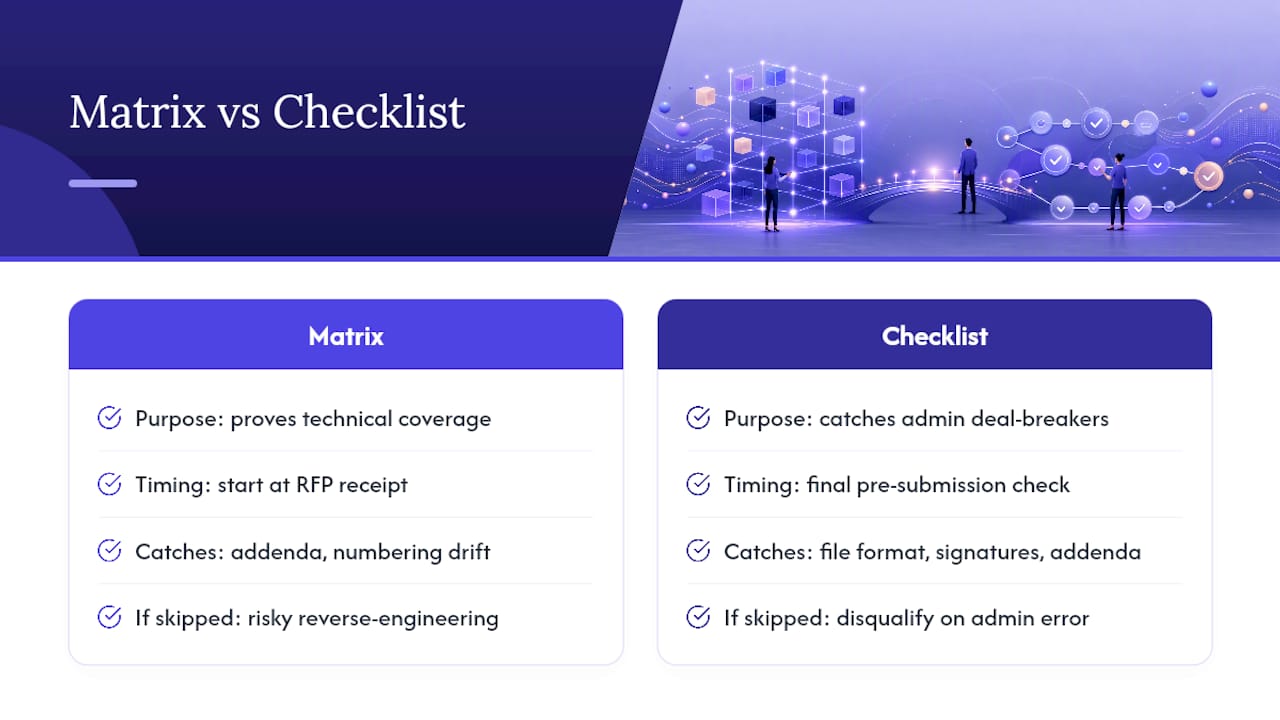
The matrix should be the first document you open after the RFP lands, not the last one you check before hitting submit. Teams that start it at receipt and update it through every draft cycle catch addenda conflicts and numbering drift while there's still time to fix them. Teams that build it retroactively are essentially reverse-engineering evidence for a claim they're about to sign, which is a much riskier position than it sounds.
The other overlooked point: a compliance matrix and a submission checklist solve different problems. The matrix proves technical coverage. The checklist catches the administrative deal-breakers, wrong file format, missing signature, unacknowledged addendum, that have nothing to do with how good your proposal actually is. Skip either one, and you're gambling on the part of the process that has nothing to do with your qualifications.
— Ilyas
Ready to Automate Your Compliance Matrix?
Building a compliance matrix by hand works, but it eats hours you could spend on the narrative that actually wins the evaluation. Rfpforgeai is the faster route to the same outcome: it extracts every mandatory requirement straight from the RFP text, builds the matrix automatically, and flags gaps through a guided Q&A before you've written a single section.
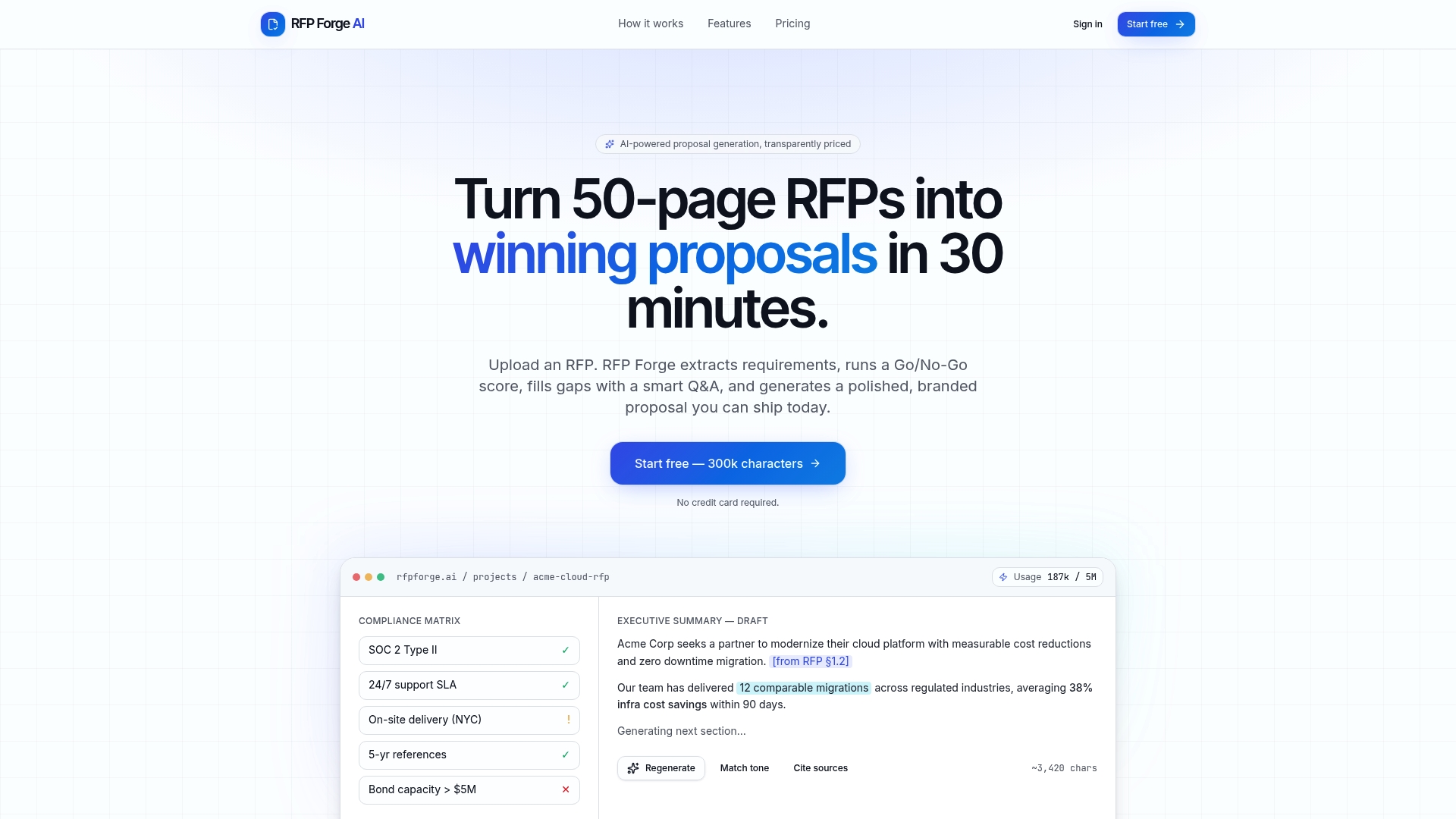
The platform then exports a compliance statement ready for your authorized signer, backed by the matrix data behind it rather than a last-minute memory check. If you're preparing a bid right now, run your next RFP through Rfpforgeai and see the matrix populate in minutes instead of a full afternoon.
Sources
- Exhibit II-1: Proposal Preparation Checklist - PAPPG (NSF)
- Proposal Compliance Matrix — AcqNotes
- Acquisition