
A compliance matrix is a structured spreadsheet that maps every mandatory requirement in an RFP to a specific location in your proposal, a named owner, and a compliance status. If you don't have one, start now: open a shared sheet, pull every "shall" and "must" from Section L and Section M, and assign a single owner to each row before your next team standup.
- What it does: Tracks every requirement from solicitation to response, so nothing falls through the cracks
- Why you need it immediately: A missed mandatory item can disqualify your proposal before evaluators read a single win theme
- Your first action: Extract every "shall" and "must" from the solicitation, drop them into a shared sheet, and assign one owner per row today
Key Takeaways
A compliance matrix is the single most important artifact in a government proposal: it maps every mandatory requirement to a named owner, a response location, and a compliance status, and it's what keeps your team from losing a bid over an avoidable administrative miss.
| Point | Details |
|---|---|
| Extract every "shall" first | Pull all mandatory language from Section L, Section M, and attachments before assigning any writing tasks. |
| One owner per requirement | A requirement owned by a team is owned by no one; assign one named person per row. |
| Federal matrix must capture FAR/DFARS | Include Section L instructions, Section M sub-factors, and the DFARS Proposal Adequacy Checklist as individual rows. |
| Amendments need same-day triage | Major amendments affecting pricing or pass/fail items require a full matrix review the same day they're issued. |
| Rfpforgeai automates the first pass | The platform extracts requirements, tracks compliance status, and exports a review-ready matrix, cutting manual extraction time significantly. |
Table of Contents
- What is a compliance matrix, and how does it differ from a checklist?
- Why does a compliance matrix matter in government contracting?
- What columns should every effective compliance matrix include?
- How do you build a compliance matrix step by step?
- What should your compliance matrix template look like?
- How do federal and commercial solicitations change what you capture?
- When should you use automation and AI to build and maintain your matrix?
- How do you use the compliance matrix during color-team reviews?
- How do you handle amendments and keep the matrix audit-ready?
- What are the most common compliance matrix mistakes, and how do you fix them?
- What does a pre-submission compliance checklist look like?
- What actually fails in large proposals, and how do you prevent it
- Rfpforgeai cuts your time to first-draft matrix significantly
- Sources
What is a compliance matrix, and how does it differ from a checklist?
A compliance matrix is a requirements traceability tool. It doesn't just confirm that a requirement exists; it maps where your response lives, who owns it, what evidence supports it, and whether it's fully addressed. That traceability is what separates it from a simple checklist.
A checklist tells you what to do. A compliance matrix tells you what you did, where you did it, and who is accountable. For a government proposal, that distinction matters at two critical moments: during color-team reviews, when reviewers need to verify responsiveness fast, and after submission, when a contracting officer questions your coverage.
You'll see this tool called several names in the industry:
- Compliance matrix (most common in government contracting)
- Requirements traceability matrix (RTM) (common in software and systems engineering contexts, but functionally identical for proposals)
- RFP compliance checklist (used interchangeably, though a checklist typically lacks the response-location mapping a full matrix provides)
- Proposal compliance matrix (the term most proposal managers use internally)
Use "compliance matrix" when you're building a living document tied to your proposal draft. Use "checklist" when you're running a quick pre-submission scan. Both have a place, but only the matrix gives you the traceability an evaluator or auditor can follow.
Why does a compliance matrix matter in government contracting?
Compliance is the entry ticket. Proposal managers consistently note that missing a mandatory requirement can prevent evaluators from reading your win themes at all. In federal contracting, many solicitations include a pass/fail administrative screening before technical evaluation begins. Fail that screen, and your proposal is returned without review.
The matrix protects you at every stage. During proposal development, it keeps writers focused on what the solicitation actually requires rather than what they assume it requires. During color-team reviews, it gives reviewers a single artifact to verify responsiveness. At submission, it's your audit trail.
Statistic callout: A structured RFP compliance checklist used as a living document throughout the proposal lifecycle reduces the risk of administrative rejection by ensuring every mandatory form, instruction, and signature is addressed before the deadline.
Evaluator behavior reinforces this. Federal evaluators working under FAR Part 15 score proposals strictly against solicitation-stated criteria. If your response doesn't map cleanly to Section M evaluation factors, the evaluator has no obligation to hunt for your answer. The matrix makes that mapping explicit, both for your team and for the evaluator reading your proposal.
Pro Tip: Flag every "shall" and "must" as pass/fail in your matrix before categorizing anything else. These are the items that can disqualify you outright. Address them first, completely, and with traceable evidence.
What columns should every effective compliance matrix include?
The columns you build into your matrix determine how useful it is under pressure. A matrix with vague fields produces vague accountability. Here's the blueprint that works across federal and commercial solicitations.
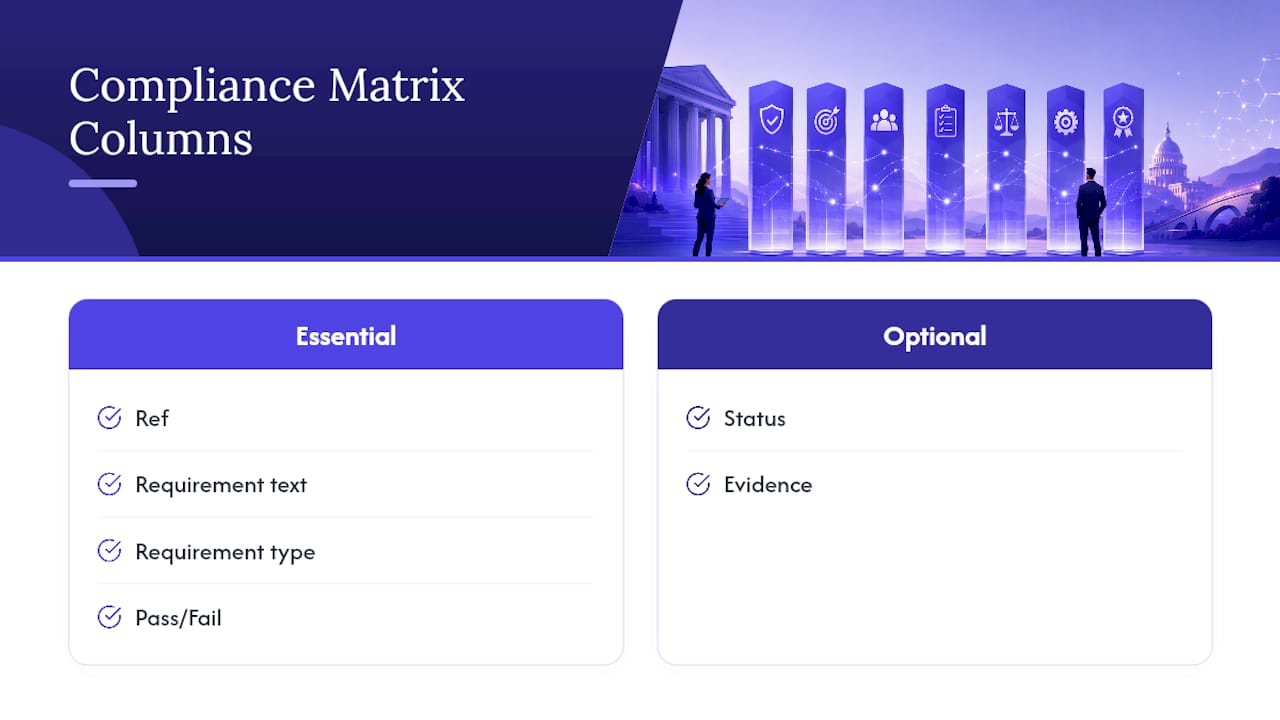
Essential columns
| Column | Purpose | Example value |
|---|---|---|
| Requirement reference | Section/paragraph number from the solicitation | Section L |
| Requirement text | Exact "shall" or "must" phrase, verbatim | "The offeror shall provide a staffing plan..." |
| Requirement type | Administrative, technical, financial, past performance | Technical |
| Priority / pass-fail flag | Whether missing this item causes disqualification | Pass/Fail |
| Single owner | One named person responsible for the response | J. Martinez |
| Response location | Document name, section, page, and paragraph | Vol. II, Sec. 3.2, p. 14 |
| Compliance status | Compliant, Partial, Not Addressed | Compliant |
| Evidence / citation | Artifact filename or URL supporting the claim | staffing_plan_v3.docx |
| Comments / mitigation | Notes on partial compliance or open items | Awaiting subcontractor data |
Optional but high-value columns
- Addendum acknowledged: Tracks whether the requirement came from an amendment and whether the amendment was formally acknowledged
- Dependencies: Flags requirements that rely on another section or subcontractor deliverable
- Target completion date: Keeps owners accountable to internal milestones
- Linked artifact filename or URL: Connects the matrix row directly to the supporting document in your shared drive
Pro Tip: Add dropdown validation to the "Compliance Status" and "Requirement Type" columns in Excel or Google Sheets. Dropdowns prevent typos, make filtering instant, and keep your matrix audit-ready without extra cleanup.
One compact example row, so you can see how this looks in practice:
| Ref | Requirement text | Type | Pass/Fail | Owner | Response location | Status | Evidence |
|---|---|---|---|---|---|---|---|
| Section L | "The offeror shall provide a staffing plan identifying key personnel by name and role." | Technical | Pass/Fail | J. Martinez | Vol. II, Sec. 3.2, p. 14 | Compliant | staffing_plan_v3.docx |
How do you build a compliance matrix step by step?
This workflow is designed to be repeatable across solicitations. Run it in order, and your matrix will be ready for color-team review before the first Pink Team session.
-
Intake and scope check. Confirm you have the final solicitation version, all attachments, and any amendments already issued. Verify the submission portal (SAM.gov, agency portal, or email) and note any portal-specific formatting rules. A requirement buried in Attachment J or a portal submission rule is just as binding as one in Section L.
-
Extract every mandatory clause. Pull every "shall," "must," and "will" from Section L (instructions to offerors), Section M (evaluation criteria), and all attachments. Don't paraphrase. Copy the exact language into your matrix. Ambiguity in the requirement text column is how missed items happen.
-
Normalize and categorize. Sort requirements into types: administrative (forms, certifications, page limits), technical (approach, staffing, past performance), pricing (cost breakdowns, CAS compliance), security/CUI, and socio-economic (small business subcontracting plans). This categorization drives owner assignment and review routing.
-
Assign a single owner per requirement. One owner. Not a team. Not "BD and Tech." One named person who is accountable for the response and the evidence. If a requirement spans multiple sections, the owner coordinates across writers but owns the final compliance check.
-
Map each requirement to the proposal location. For every row, record the volume, section, page, and paragraph where your response lives. This is the citation that lets a reviewer verify compliance in under 30 seconds. Without it, your matrix is just a list.
-
Run a verification pass. Before handing the matrix to color-team reviewers, do one full read-through. Check that every row has a status, an owner, and a response location. Flag any "Partial" or "Not Addressed" items for immediate escalation. Pink-team or intermediate reviews held before the Red Team are the right moment to catch formatting and compliance errors early.
Pre-submission checklist (quick reference):
- All "shall" and "must" items marked Compliant or escalated
- Every row has a single named owner
- Response locations are specific (page and paragraph, not just section)
- All required forms and certifications included
- Amendments acknowledged and reflected in the matrix
- Portal submission rules captured as top-level checklist items
What should your compliance matrix template look like?
A well-structured template saves hours on every new solicitation. The recommended layout uses four tabs in a single Excel workbook or Google Sheets file.
Tab 1: Requirements. The main matrix with all columns described above. Add dropdown validation for Status (Compliant / Partial / Not Addressed), Type (Administrative / Technical / Financial / Past Performance / Security), and Owner (pulled from a named list). Lock the header row and freeze the first three columns so reviewers can scroll without losing context.
Tab 2: Evidence library. A catalog of supporting documents, each with a filename, version, owner, and status. Link rows in Tab 1 to rows here using a shared document ID. This tab is what an auditor reviews when they want to verify that your "Compliant" status is backed by real artifacts.
Tab 3: Owner dashboard. A summary view showing each owner's total requirements, how many are Compliant, Partial, or Not Addressed, and their nearest deadline. This tab drives your daily standup. Owners who see their name on a "Not Addressed" row act faster than owners who receive a generic email.
Tab 4: Change log. Every edit to the matrix, timestamped, with the editor's name and a note on what changed. This tab is your audit trail. When an amendment arrives and you update 12 rows, the change log records exactly what changed and when.
Here are sample rows across three requirement types to model your own entries against:
| Ref | Requirement text | Type | Owner | Response location | Status |
|---|---|---|---|---|---|
| Section L | "Offeror shall acknowledge receipt of all amendments." | Administrative | K. Patel | Cover letter, p. 1 | Compliant |
| Section L | "Offeror shall describe its quality assurance approach in no more than 10 pages." | Technical | R. Singh | Section L | Compliant |
| Section L | "Offeror shall provide a detailed cost breakdown by CLIN." | Financial | D. Chen | Vol. III, Sec. 2, p. 5 | Partial |
Packaging for reviewers: Export a PDF snapshot of the Requirements tab before each color-team review. Reviewers should not edit the live matrix during a review session. They annotate the PDF, and the compliance owner reconciles comments into the live file after the session closes.
A structured checklist with dropdown status fields and owner assignments reduces administrative errors and gives reviewers a clear verification path. Validate your Sam registration status and CAGE code as a top-level administrative row in every federal matrix.
How do federal and commercial solicitations change what you capture?
Federal and commercial RFPs require different matrix configurations. The structure is the same; the content you must capture is not.
Federal solicitations (FAR/DFARS/Section L and M)
Federal proposals carry mandatory capture items that commercial RFPs rarely require. Miss any of these, and you risk disqualification or a deficiency finding:
- FAR clauses: Identify which FAR clauses are incorporated by reference and which require a specific response or certification. FAR Part 15 governs competitive negotiated acquisitions and defines how proposals are evaluated against solicitation criteria. Capture each clause as a row.
- DFARS clauses: For defense contracts, the DFARS Proposal Adequacy Checklist requires offerors to provide the location of requested information or explain why it's omitted. Map every checklist item directly to a matrix row.
- Section L instructions: Every formatting rule, page limit, font requirement, and submission instruction is a compliance item. Capture them all, even the ones that feel minor. A wrong font size has caused proposals to be rejected.
- Section M evaluation criteria: Each evaluation factor and sub-factor in Section M is a requirement. If the solicitation says "the government will evaluate the offeror's management approach," that's a row in your matrix with a response location and an owner.
- Mandatory forms and certifications: SF-33, SF-1449, representations and certifications, small business subcontracting plans, and any agency-specific forms. Each gets its own row with a status and a responsible owner.
- CAS/FAR pricing requirements: Cost Accounting Standards applicability, certified cost or pricing data thresholds, and CLIN structure requirements all belong in the financial section of your matrix.
Commercial solicitations
Commercial RFPs are more flexible, but that flexibility creates a different risk: without mandatory pass/fail clauses, teams sometimes skip the matrix entirely. Don't. For commercial solicitations, shift the matrix focus from pass/fail compliance to decision-point tracking:
- Capture evaluation criteria as rows, even when they're weighted rather than pass/fail
- Flag pricing flexibility items (negotiable terms, discount structures) as decision points with an owner
- Note which requirements are firm and which are "preferred" or "desired," since those distinctions affect how you allocate writing effort
- Track any NDAs, teaming agreements, or portal registration requirements as administrative rows
The matrix is lighter for commercial work, but the discipline of single ownership and traceable response locations applies just as much.
When should you use automation and AI to build and maintain your matrix?
Automation earns its place in the extraction phase. A solicitation with 200 pages and 400 "shall" statements takes a skilled analyst several hours to extract manually. An AI-assisted tool can produce a first-pass extraction in minutes, flagging every "shall," "must," and "will" with its section reference. That speed is real, and it matters when you're working a 10-day turnaround.
What automation does reliably:
- Extracts "shall" and "must" language with section references across long solicitations
- Flags ambiguous language ("should" vs. "shall") for human review
- Tracks addenda and highlights changed or added requirements
- Produces an initial matrix structure you can validate and refine
- Monitors completion status as owners update their rows
What still requires human judgment:
- Verifying that the extracted requirement text matches the evaluator's actual intent
- Assigning the right owner based on team structure and expertise
- Interpreting nuanced evaluation sub-factors that require reading Section M in context
- Validating pricing logic and CAS applicability
- Confirming that evidence artifacts actually support the compliance claim
Recommended workflow: Run automated extraction first, then have a single compliance owner validate every row before the matrix goes to writers. Don't skip the validation step. An auto-extracted matrix with unverified owners and missing response locations is worse than a manual matrix, because it creates false confidence.
Rfpforgeai fits directly into this workflow. The platform automatically extracts requirements from uploaded solicitations, assesses fit against your team's capabilities, and surfaces gaps through an interactive Q&A system. Compliance tracking is built in, so your matrix status updates as proposal sections are drafted. For teams managing multiple concurrent bids, the knowledge base reusability feature means you're not rebuilding the same evidence library from scratch on every proposal.

Pro Tip: After your first proposal using automated extraction, track three metrics: time to first-draft matrix, percentage of requirements auto-mapped without manual correction, and number of missed mandatory items at Red Team. Those three numbers tell you exactly how much the automation is helping and where your validation process needs tightening.
For a broader look at how proposal software fits into a compliance workflow, the best proposal software for RFP teams covers the feature categories worth evaluating.
How do you use the compliance matrix during color-team reviews?
The compliance matrix is the central artifact for every color-team review. Structured red-team reviews improve proposal quality by testing the document from the evaluator's perspective, and the matrix is what makes that test systematic rather than impressionistic.
Before each review session:
- Export a versioned PDF snapshot of the Requirements tab (include the version number and date in the filename)
- Flag all rows with "Partial" or "Not Addressed" status in red so reviewers see open items immediately
- Attach evidence links or artifact filenames to every "Compliant" row so reviewers can spot-check
- Brief the review lead on any requirements where compliance is contested or evidence is thin
During the review:
- Reviewers work from the PDF, not the live matrix. They annotate against specific row references.
- Each reviewer checks: Is the response location accurate? Does the response actually address the requirement, or does it address something adjacent? Is the evidence artifact present and current?
- The review lead tracks which rows generate comments and flags any new compliance gaps the team missed
After the review:
- The compliance owner reconciles reviewer comments into the live matrix within 24 hours
- Every comment that changes a row's status gets logged in the change log tab with the reviewer's name and the date
- Rows that move from "Compliant" to "Partial" after review get a new owner task and a remediation deadline
Signoff governance: Before submission, the proposal manager and compliance owner both sign off on the matrix. If pricing is affected, the finance lead signs too. A go/no-go threshold of zero "Not Addressed" rows for pass/fail items is non-negotiable. "Partial" rows require a written mitigation note before signoff is granted.
How do you handle amendments and keep the matrix audit-ready?
Amendments are where compliance matrices fail most often. An agency issues Amendment 3 at 4:00 PM on a Friday, and by Monday morning, half the team doesn't know three requirements changed. A versioned matrix with a clear amendment triage process prevents that.
Version control rules:
- Name every saved version with the solicitation number, version, and date:
RFP_W912DY-26-R-0042_Matrix_v4_20260318.xlsx - Never overwrite the previous version. Save a new file for every substantive update.
- Only the compliance owner or their designated backup can edit the live matrix. Everyone else works from the exported PDF.
- Every edit goes into the change log tab: row reference, what changed, who changed it, and why.
Amendment triage:
- Download the amendment immediately and compare it against the current solicitation version
- Highlight every changed, added, or deleted requirement in the matrix
- Reassign owners for any requirement that changed scope or moved to a different section
- Set a 48-hour turnaround task for affected owners to update their response locations and evidence
- Log the amendment number and effective date in the change log
Amendment severity and response timelines:
| Severity | Definition | Recommended response time |
|---|---|---|
| Minor | Wording clarification, no scope change | 48 hours; update matrix notes only |
| Moderate | Affects instructions or evaluation criteria | 24 hours; reassign owners, update response locations |
| Major | Affects pricing, scope, or pass/fail requirements | Same day; escalate to proposal manager, full matrix review |
Retention: Archive the final submitted matrix, all version files, and the change log for at least three years post-submission. If a protest or audit arises, this archive is your evidence that you tracked compliance systematically throughout the lifecycle.
What are the most common compliance matrix mistakes, and how do you fix them?
Most compliance failures trace back to a small set of repeatable mistakes. Here's what to watch for and how to prevent each one.
-
Ambiguous ownership. "BD team" is not an owner. When a requirement has no single named person, it gets addressed by everyone and verified by no one. Fix: enforce a one-name rule at matrix creation. If a requirement genuinely spans two people, pick one as the accountable owner and list the other as a contributor in the comments column.
-
Treating the matrix as a static checklist. A matrix built at solicitation intake and never updated is a liability. Requirements change with amendments, team assignments shift, and evidence artifacts get revised. Fix: build a standing agenda item into your daily proposal standup to review any rows that changed status since the previous day.
-
Missing attachments and portal-specific rules. Attachment J items and portal submission rules (file size limits, naming conventions, required metadata) are compliance requirements. They're easy to miss because they don't appear in Section L's main body. Fix: add a dedicated "Portal and Submission Rules" section at the top of your matrix and populate it on day one.
-
Not capturing evaluation sub-factors. Section M often lists evaluation factors with sub-factors beneath them. Teams capture the top-level factor and miss the sub-factors, which are what evaluators actually score against. Fix: read Section M at the sub-factor level and create a matrix row for each one.
-
Inconsistent citations. "Vol. II" is not a citation. "Vol. II, Sec. 3.2, p. 14, para. 2" is. Vague response locations force reviewers to hunt, which slows reviews and creates doubt about whether the requirement is actually addressed. Fix: require page and paragraph specificity as a mandatory field before any row is marked Compliant.
Pro Tip: The two most costly mistakes are missed addenda and unclear evidence links. Prevent both with one habit: every time an amendment is issued, run a 15-minute triage meeting with the compliance owner before anyone updates the proposal draft. And before any row is marked Compliant, the evidence artifact must be named, versioned, and accessible in the shared drive.
What does a pre-submission compliance checklist look like?
Run this checklist in the 48 hours before submission. Every item must be confirmed by a named person before the proposal leaves your hands.
Go/no-go items (all must be "yes" before submission):
- All "shall" and "must" requirements marked Compliant or escalated with a written mitigation
- Zero "Not Addressed" rows for pass/fail items
- Every required form and certification included and signed
- Page limits respected for every volume
- Font, margin, and formatting requirements verified against Section L
- All amendments acknowledged in writing (cover letter or amendment acknowledgment form)
- Portal submission rules confirmed: file format, naming convention, size limits, metadata
- SAM.gov registration active and not expiring within 60 days of submission
Signoff template:
- Compliance owner: Confirms all matrix rows are at Compliant or documented-mitigation status
- Proposal manager: Confirms proposal volumes match matrix response locations and all forms are included
- Finance lead (if pricing affected): Confirms cost volume addresses all financial requirements and CAS applicability is documented
Post-submission: Within two weeks of submission, hold a 30-minute lessons-learned session. Review which matrix rows caused the most rework, which amendments created the most disruption, and which evidence artifacts were hardest to produce. Update your template and evidence library before the next solicitation. This is how your matrix gets better with every bid.
What actually fails in large proposals, and how do you prevent it
The compliance matrix conversation usually focuses on the tool itself. What gets less attention is the human behavior around it, and that's where large proposals actually break down.
The most common failure pattern isn't a missed "shall." It's a matrix that exists but isn't trusted. Writers stop updating their response locations because the compliance owner never follows up. Reviewers stop checking the matrix because it was wrong at the last Red Team. The tool becomes decoration, and the real compliance tracking happens in someone's head or in a separate email thread.
The fix is governance, not a better spreadsheet. Assign the compliance owner role to someone with authority to hold writers accountable, not just someone who's good at Excel. Make the matrix the official record of proposal status, not one of several competing trackers. And run a five-minute matrix check at every daily standup: how many rows changed status, who has open items, and what's the oldest "Partial" in the file.
Two shortcuts that work in practice: first, build an owner dashboard tab (described in the template section above) that shows each person's open items at a glance. Owners who see their name next to a red "Not Addressed" row act without being asked. Second, for pass/fail administrative items, set a "minimum viable evidence" standard: what's the simplest artifact that proves compliance? A signed form, a page reference, a screenshot of a portal confirmation. Don't let writers over-engineer evidence for items that just need to be present.
Integrating the requirements traceability matrix discipline into your daily standup is the single highest-leverage habit a proposal team can build. It takes five minutes and prevents the last-minute scramble that costs you sleep and sometimes costs you the contract.
Rfpforgeai cuts your time to first-draft matrix significantly
Extracting 300 "shall" statements manually from a federal solicitation takes hours you don't have on a 10-day turnaround. Rfpforgeai does it in minutes. Upload your solicitation, and the platform automatically extracts every mandatory requirement, maps it to a compliance matrix structure, and flags ambiguous language for your review. The gap-filling Q&A surfaces missing information before your writers start drafting, so you're not discovering holes at Red Team.
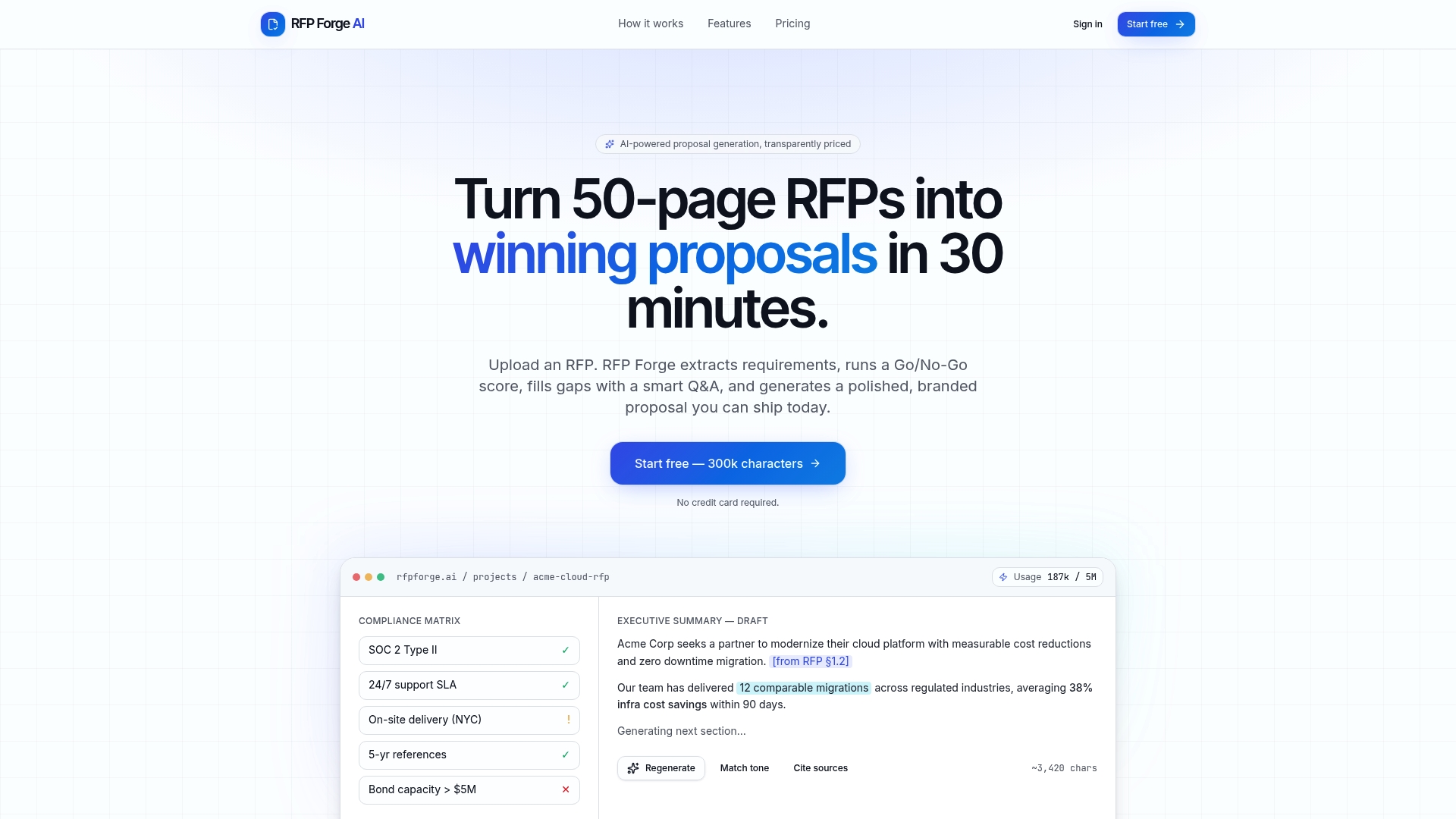
The compliance tracking built into Rfpforgeai updates as proposal sections are completed, giving your compliance owner a live status view without manual row-by-row updates. Exportable templates mean your matrix is formatted and ready for color-team review from day one. For teams managing regulated-industry bids, the knowledge base reusability feature carries your evidence library forward from one proposal to the next.
Start your first automated extraction at Rfpforgeai and see how much of your compliance matrix builds itself.
Sources
The following sources support the guidance in this article and are worth bookmarking for your own solicitation work.
Primary federal references:
- 252.215-7009 Proposal Adequacy Checklist.
- Acquisition
- RFP Checklist for Vendors | Free Template | 2026
- The importance of red-team reviews
Practical resources:
Template and automation: