
Your Approach section has one job: prove you can deliver the exact scope of work on the exact timeline the buyer described, in language that maps directly to their scoring criteria. Evaluators score this against Section M, so vague promises lose points fast. Before you write a word, confirm you can cover:
- Methodology tied to the statement of work (SOW)
- Milestones and a realistic timeline
- Staffing and named roles
- Deliverables with acceptance criteria
- Assumptions and exclusions
- Risk mitigation
- Compliance and QA steps
The technical approach is often the highest-weighted section in the entire evaluation, which means a generic template copied from your last three proposals won't survive contact with a real scoring sheet. You need subject matter experts writing the technical detail, per NIST's own definition of what an SME contributes, and a proposal manager stitching it into compliant, scored language. Tools like RFP Forge exist specifically to compress that handoff.
Key Takeaways
A compliant, review-ready Approach section requires mapping every SOW line to a specific methodology, milestone, and verification step, with SMEs drafting the technical substance.
| Point | Details |
|---|---|
| Structure around Section M | Map methodology, milestones, and deliverables directly to the solicitation's scoring criteria. |
| Use the what/how/verify format | Answer what you'll do, how you'll do it, and how you'll verify it for every deliverable. |
| Split the workload by expertise | SMEs write technical detail, proposal managers handle compliance framing and SOW mapping. |
| Name risks instead of hiding them | Rate likelihood and impact, then give a concrete mitigation for each named risk. |
| Automate extraction, not judgment | RFP Forge drafts requirements and a first-pass Approach section in about 30 minutes, but SME review still confirms accuracy. |
Table of Contents
- What Goes Into a Proposal Approach Section?
- How Do You Build a Fillable Approach Template?
- Who Should Write the Approach Section, and How Fast?
- Where Does AI Actually Help With Drafting?
- What Do Evaluators Flag as Red Flags?
- What Actually Wins: A Proposal Manager's View
- Speed Up Your Approach Section Without Losing SME Accuracy
- Sources
What Goes Into a Proposal Approach Section?
Each component in your Approach section answers a different evaluator question, and skipping one is the fastest way to leave points on the table.
Methodology. Describe the process you'll use to execute the SOW, not your company's general philosophy. Mirror the exact terminology the RFP uses. If the solicitation says "phased deployment," don't write "rollout strategy."
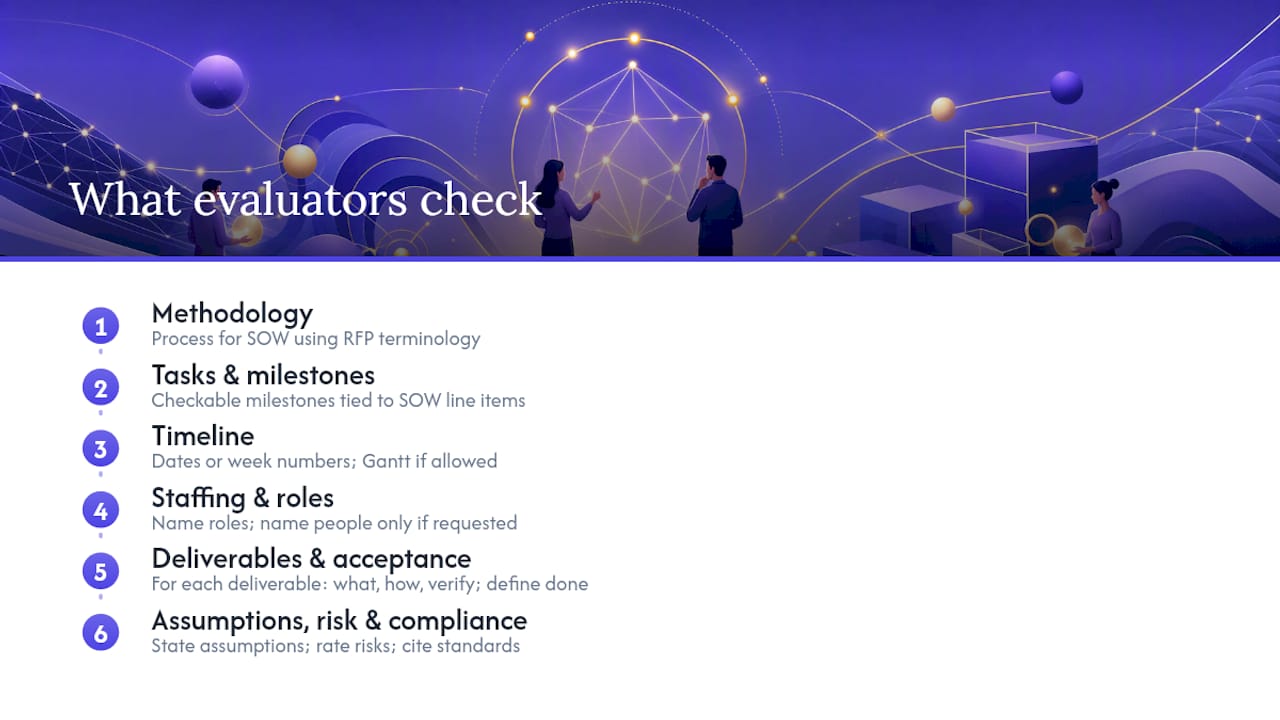
Tasks and milestones. List discrete, checkable milestones tied to SOW line items, not broad phases like "Phase 1: Planning."
Timeline. Give dates or week numbers, not "early" or "as needed." A visual Gantt-style breakdown works if the format allows it.
Staffing and roles. Name specific roles (Lead Systems Engineer, QA Manager) and use named individuals only when the RFP requests key personnel; otherwise, roles keep you flexible without weakening credibility.
Deliverables. For every deliverable, answer three things: what you will do, how you will do it, and how you will verify it. This three-part structure is the backbone of a high-scoring technical approach because it gives evaluators proof, not just intent.
Assumptions and exclusions. State what you're assuming about access, data, or client resources. This protects you contractually and shows evaluators you understand the real-world constraints of the work.
Acceptance criteria. Define what "done" looks like for each deliverable, ideally in measurable terms.
Risk mitigation. Name the risk, rate its likelihood and impact, and give a concrete countermeasure. This structured approach is a documented differentiator that builds evaluator confidence rather than raising doubt.
Compliance and QA. Reference the specific standard or process you'll follow (ISO 9001, internal QA gates, client-specified review cycles).
Pro Tip: Pull the exact verb the RFP uses for each task ("shall provide," "will maintain") and echo it in your response. Evaluators scan for language alignment before they scan for substance, and quantifying outcomes wherever possible beats a well-written paragraph with no numbers in it.
How Do You Build a Fillable Approach Template?
A template only earns its keep if you can drop it into a live proposal and populate it against your compliance matrix with document tooling in one pass. Here's a structure that holds up across most industries:
- Objective statement — one sentence restating the SOW requirement in your own words
- Methodology — two to three sentences on your process
- Task breakdown — bulleted milestones with dates
- Staffing — roles assigned to each task cluster
- Deliverable table — what/how/verify for each item
- Assumptions and exclusions — short bullet list
- Risk and mitigation — risk, likelihood, impact, mitigation
- Acceptance criteria — measurable completion standard
IT migration example: "We will migrate 40 production servers to the client's Azure tenant in three waves (dev, staging, production), using automated validation scripts to verify data integrity after each wave, with rollback procedures tested in advance for each cutover window."
Managed service example: "Our team will monitor network uptime via a 24/7 NOC, respond to Priority 1 incidents within 15 minutes as specified in Section C.4, and report monthly SLA performance through a dashboard reviewed jointly with the client's IT lead."
Notice neither example wastes a sentence on company history or a generic capabilities statement. Evaluators already have your capability statement elsewhere in the proposal; this section is about execution.
- Keep sentences short and active: "We will deploy" beats "Deployment will be executed"
- Use named roles even in a template, so reviewers see accountability, not vagueness
- If page limits are tight, cut adjectives before you cut deliverable detail
Pro Tip: Build your Approach section against the compliance matrix line by line, a habit that noticeably reduces evaluator friction because every claim maps back to a specific requirement instead of floating on its own.
Who Should Write the Approach Section, and How Fast?
The fastest teams split this section by expertise, not by seniority. Your subject matter experts write the technical meat. Your proposal manager writes the compliance framing and SOW mapping. Both collaborate on timeline and acceptance criteria, since those require technical accuracy and contractual precision at once.
A workable time-boxed process looks like this:
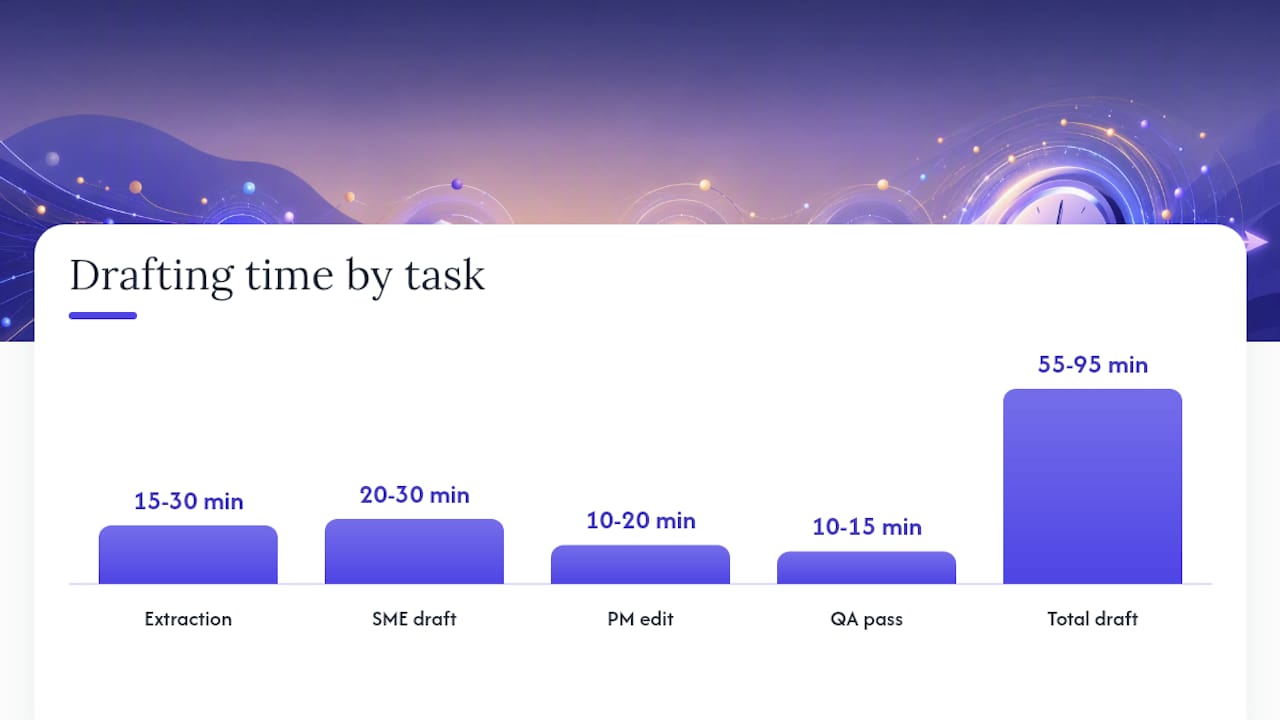
- Extraction (15 to 30 minutes): Pull every SOW requirement into a compliance matrix.
- SME draft (20 to 30 minutes): SMEs write methodology, risks, and technical detail against each matrix line.
- PM edit (10 to 20 minutes): The proposal manager aligns language with Section M and tightens compliance phrasing.
- QA pass (10 to 15 minutes): A final reviewer checks completeness and tone.
That's roughly 55 to 95 minutes for a full draft when the compliance matrix is built first, not after.
- Send SMEs structured prompts ("Answer what/how/verify for SOW item 3.2") instead of open-ended requests
- Set a firm review window so async contributions don't stall the draft
- Require a sign-off checkpoint before the section moves to final formatting
Using the SOW-derived matrix as your populating structure is what keeps the section credible and reduces scoring deductions for omissions far more reliably than writing from memory.
Where Does AI Actually Help With Drafting?
AI handles the mechanical parts of this section well: pulling requirements out of a 150-page RFP, populating a compliance matrix, sketching a first-pass methodology, drafting a timeline skeleton, and formatting the whole thing consistently.
What it can't do is invent your actual technical judgment. An SME still needs to check every AI-generated line for accuracy.
- Does it mirror the RFP's own language, not generic proposal-speak?
- Are roles assigned correctly, not just plausibly?
- Are deliverables named specifically, with real verification steps?
- Are durations realistic for your actual team, not optimistic filler?
- Is risk mitigation specific enough to survive a skeptical reviewer?
RFP Forge is built around this exact division of labor. It extracts requirements automatically, populates a compliance matrix, and generates a first-pass draft of the Approach section, then uses a Q&A system to fill gaps your SMEs need to answer directly. The platform reports turning full RFPs into polished proposals quickly, and claims a significant average cost reduction in infrastructure migrations for clients in regulated industries. Treat both figures as platform-reported until you've run your own drafts through it.
Pro Tip: Never submit an AI first draft without an SME pass. The gap between "sounds right" and "is technically accurate" is exactly where evaluators catch weak proposals.
What Do Evaluators Flag as Red Flags?
Run this check before you submit:
- Does every SOW line have a matching Approach paragraph?
- Does every claim carry evidence, not just assertion?
- Are roles named, not just implied?
- Are milestones measurable, with dates attached?
- Does every deliverable have acceptance criteria?
Common red flags include vague methodology ("we will leverage best practices"), passive voice that hides who does what, missing deliverables, timelines that don't match the SOW's own milestones, absent risk mitigation, and performance claims with no supporting detail.
Pro Tip: Hand your Approach section, and only that section, to someone outside the proposal team. If they can't tell who does what and when, evaluators can't either.
What Actually Wins: A Proposal Manager's View
I've watched teams lose winnable bids because they buried a strong methodology in vague language. What works: map every SOW line to a one-sentence methodology response before writing anything else. It forces clarity early instead of after a draft is already bloated.
The teams that name their weaknesses (a smaller staff means more senior attention, not less capability) consistently outscore the ones that stay silent and hope no one notices.
Speed Up Your Approach Section Without Losing SME Accuracy
If you're already mapping SOW lines to methodology by hand, you know the bottleneck isn't writing skill, it's time. RFP Forge is built to close that gap for teams that can't afford a week per proposal. It extracts requirements straight from the RFP, builds your compliance matrix automatically, and generates a first-pass Approach draft your SMEs can correct instead of starting from a blank page.
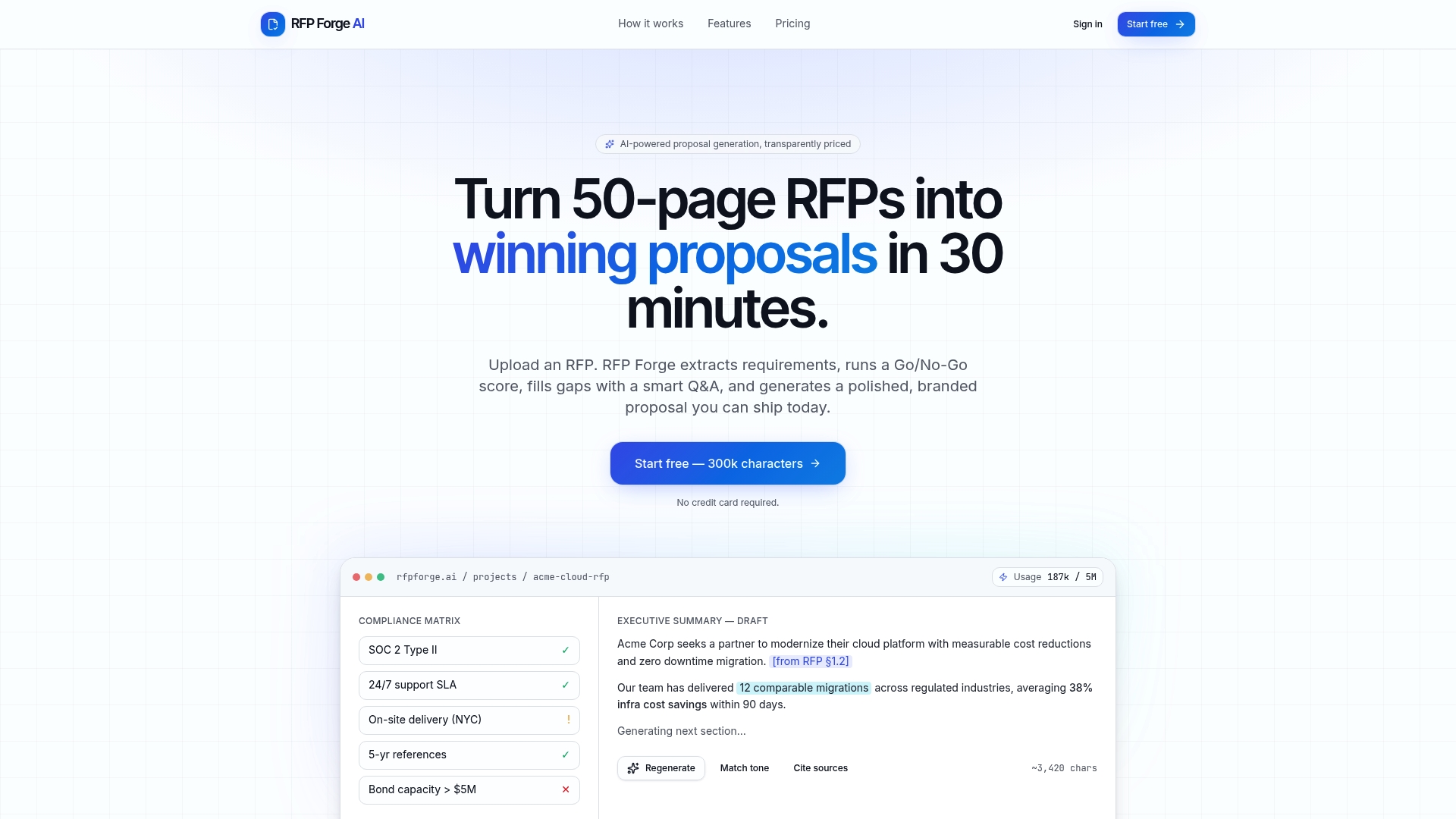
The platform reports full draft turnaround in about 30 minutes and an average 38% cost reduction on infrastructure migrations for regulated-industry clients, figures RFP Forge documents on its own product page. Your SME review step stays exactly where it belongs, on the technical judgment, not on reformatting text. If you're deciding between building templates from scratch or letting a tool built for proposal teams handle the first draft, start a trial and run your next RFP through it before your next deadline.
Sources
- RFP Technical Approach: How to Write the Highest-Scoring Section
- How to Write an RFP Response That Actually Wins
- How to Write a Winning RFP Response (With a Simple Template) | RFPhound