
Use AI-powered RFP response software to cut drafting time, tighten accuracy, and raise win rates. RFP Forge is built specifically for this: it converts a raw RFP into a structured draft quickly by extracting requirements automatically and flagging gaps through an interactive Q&A. Your next move is simple. Run a scoped pilot on one live RFP, measure against your current process, and expand from there.
Here's what a good pilot looks like:
- One real RFP, not a test document
- A rapid first draft turnaround
- A compliance matrix generated automatically, not built by hand
- One clear KPI focused on time saved per response
Quick fact: Firms using AI in the Microsoft-documented RFP workflow follow six structured steps, from review to team revision, that AI can accelerate at nearly every stage.
Key Takeaways
AI RFP response software works when it pairs automated drafting with citation-backed answers and mandatory human review on high-risk sections.
| Point | Details |
|---|---|
| Start with a scoped pilot | Test on one live RFP and measure draft time, reviewer hours, and compliance coverage. |
| Prioritize citation-backed answers | Require visible sourcing on every AI-generated response to reduce reviewer workload and risk. |
| Keep humans on high-risk answers | Route pricing, legal, and security responses through mandatory human approval every time. |
| Build integrations early | Connect document stores and CRMs first to keep the knowledge base accurate and current. |
| RFP Forge fits regulated teams | Its 30-minute drafting, compliance tracking, and win-rate analytics support pilot-to-scale adoption. |
Table of Contents
- How Does AI RFP Response Software Actually Work?
- What ROI and KPIs Should You Expect From AI RFP Tools?
- Which Integrations Keep Your Knowledge Base Accurate?
- What Does a Realistic AI RFP Rollout Timeline Look Like?
- How Do You Prevent AI Hallucinations in RFP Responses?
- What Should You Look for When Evaluating an AI RFP Solution?
- How Does RFP Forge Deliver on These Criteria?
- Where to Learn More
- What This Article Gets Right (And Where Most Advice Falls Short)
- Put AI RFP Response to Work on Your Next Proposal
- Frequently Asked Questions
- Sources
How Does AI RFP Response Software Actually Work?
AI RFP response tools follow a consistent mechanical path: intake, retrieval, drafting, review, and export. Understanding each stage tells you exactly where your team's time gets returned to them.
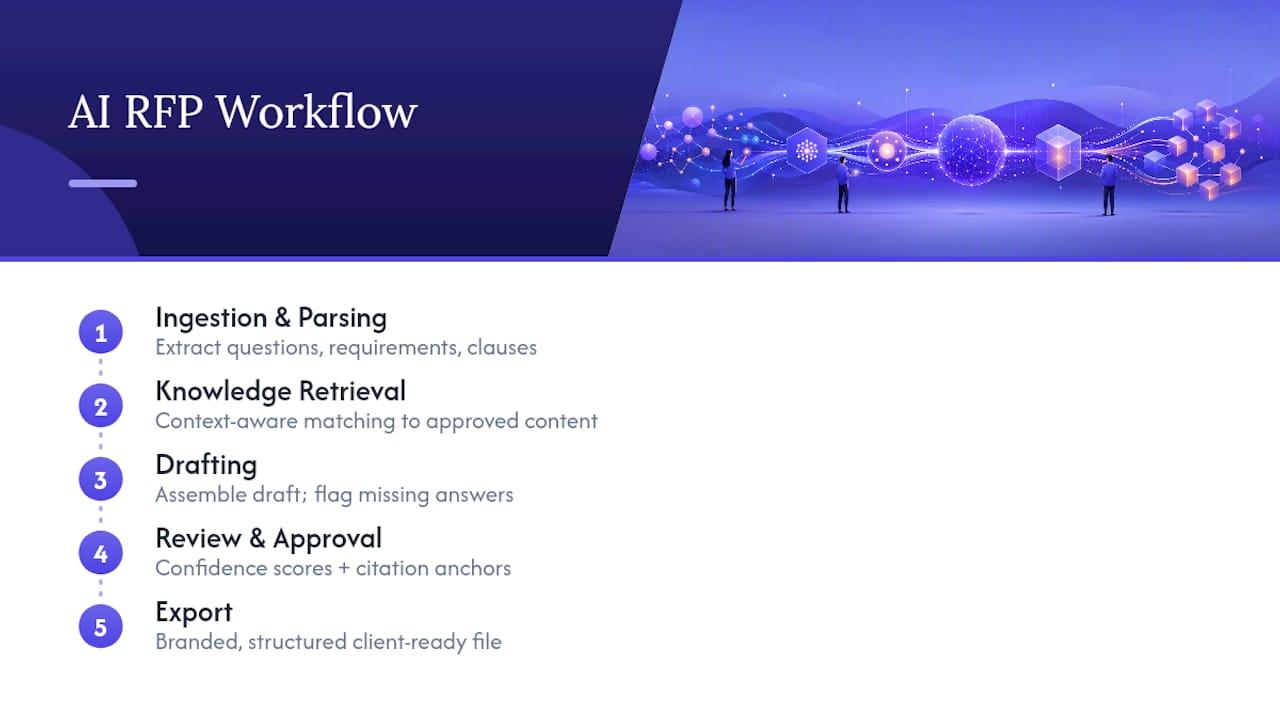
1. Ingestion and parsing. The system reads the uploaded RFP, whether it's a PDF, Word document, or Excel questionnaire, and extracts every question, requirement, and compliance clause. This is the step that used to eat a full day of a proposal manager's week: reading line by line, tagging mandatory versus optional requirements, and building a shell document. Tools built for this, including ResponseHub's ingestion model, are designed to handle Excel and Word uploads directly and turn them into a structured requirements list without manual re-keying.
2. Knowledge retrieval. Once requirements are extracted, the platform searches your approved content library for the best-matching prior answers. This isn't a keyword search. Context-aware retrieval means the system understands that a question about "data retention policy" and one about "how long do you keep client records" are asking the same thing, even when the wording differs.
3. Drafting. The platform assembles a full draft, matching tone, structure, and required sections (executive summary, technical approach, pricing narrative, compliance responses) to what the RFP actually asks for. Where no approved answer exists, a well-built system flags the gap rather than guessing.
4. Review and approval. Confidence scores tell reviewers which answers are safe to accept and which need human eyes. Citation anchors, links back to the source document that justifies each answer, let your reviewers verify claims in seconds instead of re-researching them.
5. Export. The finished proposal exports into a branded, client-ready format that preserves the original RFP's structure, so nothing gets flagged for noncompliance on a formatting technicality.
Pro Tip: Don't skip the citation-anchor step during your pilot. Reviewers who can trace every AI-generated answer back to its source approve drafts roughly twice as fast as those working from an unsourced draft.
Microsoft's own Copilot adoption guidance frames this as a human-in-the-loop model: AI organizes and drafts, people validate and decide. That division of labor is what makes the workflow trustworthy enough for regulated industries to actually use.
What ROI and KPIs Should You Expect From AI RFP Tools?
The value of AI RFP response tools shows up in three places: time, accuracy, and consistency. Each is measurable, and each should be tracked from week one of your pilot, not estimated after the fact.
Time reduction is the most visible outcome. Draft time for a mid-sized RFP typically drops from days to hours when requirement extraction and first-pass drafting are automated. Reviewer hours shrink too, since confidence scoring lets reviewers focus only on flagged, high-risk answers instead of proofreading an entire document line by line.
Accuracy improves through citation-backed answers. When every generated response links to its source, whether that's a prior winning proposal, a technical spec sheet, or a compliance document, reviewers catch errors faster and stale answers get updated instead of recycled indefinitely.
Business outcomes compound over time. More RFPs get answered per quarter without adding headcount. Answers stay consistent across proposals, which matters more than most teams realize. When your data retention answer contradicts itself between two proposals, an evaluator notices, and it costs you points on scoring rubrics.
Track these KPIs starting on day one of any pilot:
- Average time per RFP response, start to submission
- Reviewer hours spent per proposal
- Content reuse rate (percentage of answers pulled from the knowledge base versus written from scratch)
- Win rate, tracked before and after adoption
- Cost per bid, including labor hours
Quick fact: Aggregated buyer research from listings like Capterra's RFP software reviews consistently ranks knowledge base quality and integration depth among the top factors driving measurable time savings for proposal teams.
Which Integrations Keep Your Knowledge Base Accurate?
An AI RFP tool is only as good as the knowledge base feeding it. Get the integrations and governance wrong, and you'll spend more time correcting outdated answers than you saved by automating the draft.
The integrations that matter most connect directly to where your team already stores content:
- Document stores and file systems, including SharePoint, Google Drive, and Notion, so approved content stays synced without manual re-uploads
- CRMs, so past client context and win history feed into new proposals automatically
- Collaboration platforms, so reviewers can comment and approve without leaving their existing workflow
User feedback on platforms like Loopio's G2 reviews repeatedly flags integration depth and knowledge base import speed as the deciding factor in adoption speed, not the AI model itself.
Structure matters as much as connection. A knowledge base needs canonical answers (one approved version per question, not five near-duplicates), clear metadata and tags for fast retrieval, and access policies that control who can edit versus who can only reference content.
Decide early whether your sync model is scheduled or live. Scheduled syncs (nightly or weekly) work fine for stable content like company certifications. Live connectors make more sense for fast-changing data, like current project references or pricing, where a stale answer could cost you the bid. Either way, build in governance: assign content owners, require approval gates before an answer becomes "canonical," and schedule quarterly audits to retire outdated responses before they resurface in a live proposal.
What Does a Realistic AI RFP Rollout Timeline Look Like?
Rolling out AI RFP response software works best as a staged process, not a single switch-flip. Here's a realistic path from pilot to full team adoption.
- Run a preflight checklist. Inventory your existing proposal content, pick two or three representative past RFPs to test against, and get sign-off from proposal, legal, and sales stakeholders before you start.
- Design a tight pilot. Scope it to one team and one RFP type. Set success metrics up front (draft time, reviewer hours, accuracy rate) and define which answer categories always require human sign-off, like pricing and legal terms.
- Run the pilot for two to four weeks. That's typically enough time to surface knowledge base gaps and refine reviewer workflows without losing momentum.
- Scale deliberately. Expand the knowledge base, automate recurring templates, and start pulling win-rate analytics to prove impact to leadership.
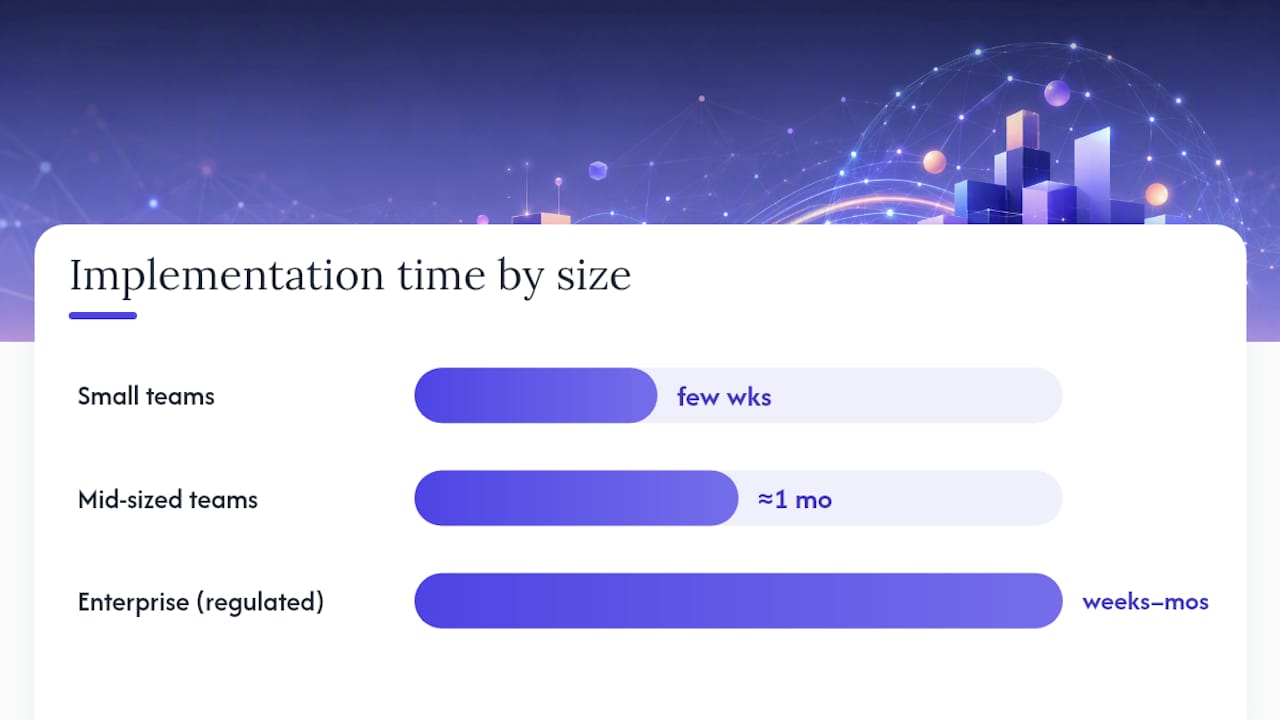
Timelines vary by team size. Small teams of two to five users can often get from pilot to daily use within two to three weeks, since there's less content to migrate and fewer approval layers. Mid-sized teams of six to twenty-five users usually need four to six weeks, mostly for knowledge base buildout and reviewer training. Enterprise deployments, particularly in regulated industries with multiple approval tiers, typically run eight to twelve weeks, with most of that time spent on governance setup rather than the technology itself. Microsoft's Cloud Adoption Framework reflects the same pattern for enterprise tooling generally: pilot small, validate governance, then scale.
How Do You Prevent AI Hallucinations in RFP Responses?
The single biggest risk in AI-assisted proposal writing is a confidently wrong answer that slips past review. The fix isn't avoiding AI. It's building guardrails around it.
Citation-backed answers are the first line of defense. Every AI-generated response should link back to the source document or prior approved answer it came from. If the platform can't cite a source, that's the signal to flag it for human drafting rather than accepting a generated guess. ResponseHub's approach to citation-backed answers reflects this standard: confidence indicators paired with visible sourcing reduce reviewer workload while keeping trust intact.
Certain answer categories should never be auto-approved. Pricing, legal terms, and security or data-handling commitments need a human sign-off every time, regardless of how high the confidence score reads. A 95% confidence score on a liability clause is still not a substitute for legal review.
Compliance matrix checks should run automatically. The system should flag any RFP requirement that doesn't have a matched, approved answer, so nothing falls through unnoticed. Exportable audit logs matter too, especially in regulated industries where you need a documented trail of who approved what and when.
Pro Tip: Set your confidence threshold conservatively at first. It's far cheaper to review a few extra "high confidence" answers early on than to let one unreviewed answer make it into a submitted proposal.
- Route pricing, legal, and security answers through mandatory human review
- Require visible citations on every generated answer
- Run automated compliance matrix checks before export
- Keep audit logs exportable for regulated-industry reviews
What Should You Look for When Evaluating an AI RFP Solution?
Choosing the right platform comes down to five practical categories, whether you're comparing tools formally or just kicking the tires on a free trial.
- Functional fit: Does it parse complex RFP formats accurately, manage a real knowledge base, and export into your required templates without breaking formatting?
- Security and compliance: Look for role-based access controls, exportable audit trails, and clear data handling policies, especially if you work in regulated industries.
- Operational fit: Confirm it supports your existing reviewer roles and approval workflows, and integrates with the document stores and CRMs your team already uses.
- Commercial model: Pricing should be transparent, with clear pilot terms and defined support SLAs, not a black-box quote after a sales call.
- Proof of value: Ask for pilot success metrics or references from teams in a similar industry before committing to a full rollout.
If you're building a broader shortlist, our comparison of RFP response software walks through feature tradeoffs across the category in more depth.
How Does RFP Forge Deliver on These Criteria?
RFP Forge is built around the exact workflow this article describes: intake, gap-filling, drafting, and export, with compliance and analytics layered throughout.
- 30-minute first drafts. RFP Forge extracts requirements automatically and uses an interactive Q&A to fill gaps where no approved answer exists yet, converting a raw RFP into a structured draft in about 30 minutes.
- Compliance tracking built in. A compliance matrix generates alongside your draft, so requirement coverage is visible before you submit, not discovered during a client's evaluation.
- Win-rate analytics. Teams can track proposal performance over time and see which sections or strategies correlate with wins.
Quick fact: Clients in regulated industries using RFP Forge for infrastructure migration proposals have reported significant cost reductions, a concrete signal of what disciplined AI-assisted drafting can return.
To run your own proof-of-value pilot: pick one upcoming RFP, set a target draft time, track reviewer hours against your current baseline, and confirm the compliance matrix catches every mandatory requirement before export.
Where to Learn More
- ResponseHub's product overview for knowledge-base drafting
- RFP Forge to start a pilot
What This Article Gets Right (And Where Most Advice Falls Short)
Most guidance on AI RFP tools treats every platform as interchangeable, differing only in price. That misses the point entirely. The real differentiator is whether a tool forces good governance, citation-backed answers, mandatory review gates, compliance matrices, or leaves you to build those guardrails yourself after something goes wrong in a submitted proposal.
The conventional advice to "just try a few tools and see what sticks" wastes weeks. You need a scoped pilot with real KPIs from day one: draft time, reviewer hours, reuse rate. Without numbers, you're making a gut decision dressed up as evaluation.
What I'd prioritize first isn't the AI drafting quality; most modern tools handle that reasonably well. It's the review workflow. A platform that makes reviewers faster and more confident, through confidence scores and citation anchors, will outperform one with slightly better prose generation every time. Speed without trust just means faster mistakes.
Put AI RFP Response to Work on Your Next Proposal
RFP Forge AI gets you a full draft in about 30 minutes instead of the days a manual process usually takes, and it does that without asking your team to abandon the review standards regulated industries require. If you've been weighing whether an AI RFP platform can actually hold up under compliance scrutiny, RFP Forge answers that directly: automated requirement extraction, an interactive Q&A that closes content gaps, a built-in compliance matrix, and win-rate analytics that show what's actually working across your proposals.
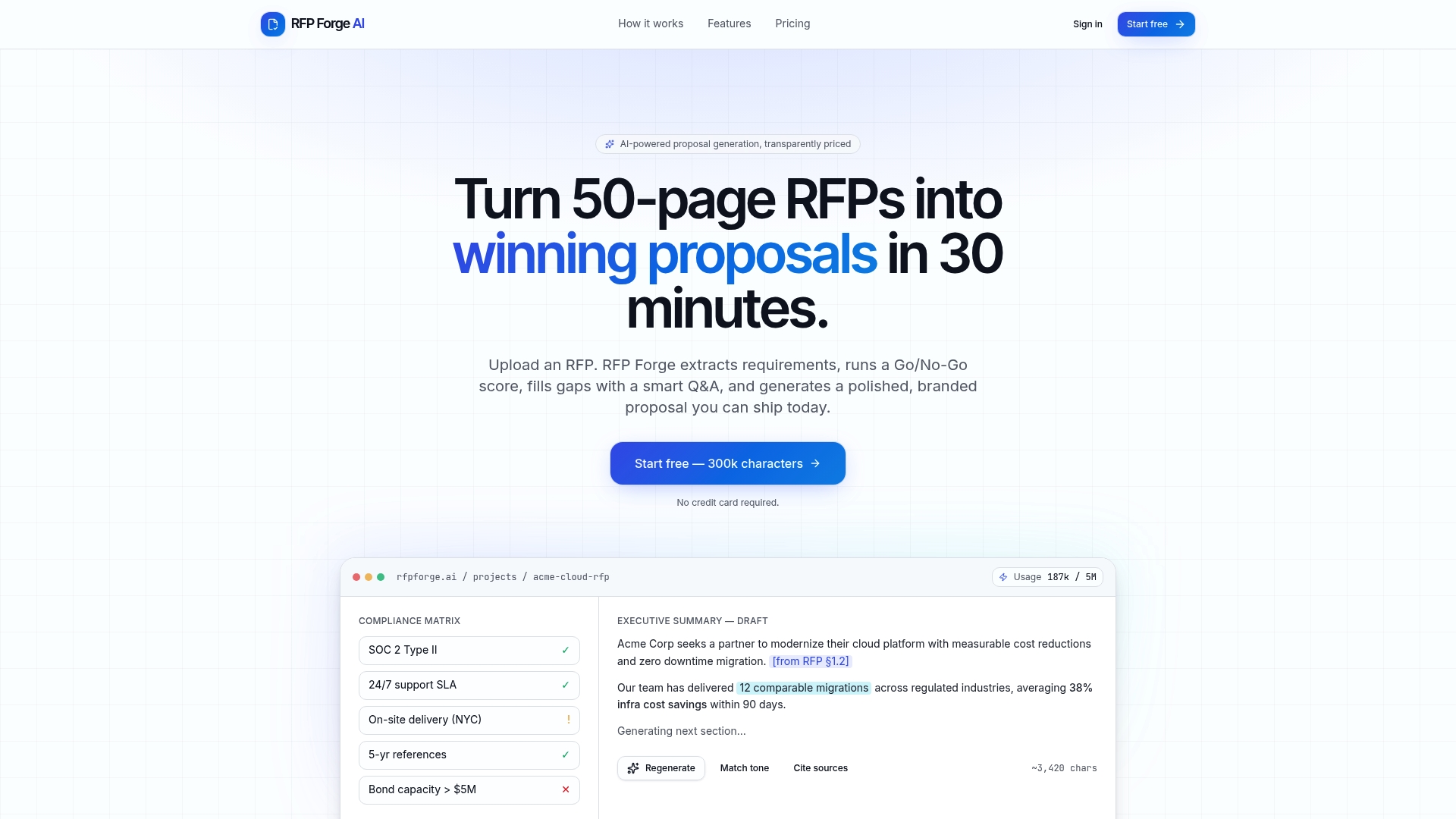
If your team is still deciding, our breakdown of proposal software options for 2026 can help you compare approaches before you commit. But if you're ready to see the workflow firsthand, start a pilot with RFP Forge on your next live RFP and measure the results against your current process.
Frequently Asked Questions
What is AI RFP response software? It's a platform that reads an incoming RFP, extracts requirements automatically, matches them against an approved knowledge base, and generates a structured draft response, flagging gaps that need human input.
How accurate are AI-generated RFP answers? Accuracy depends heavily on knowledge base quality and citation practices. Platforms that link every answer back to a verified source let reviewers catch errors quickly, which is why citation-backed answers matter more than raw AI model quality.
Can AI RFP tools handle regulated industries? Yes, provided the platform includes mandatory human approval gates for pricing, legal, and security answers, plus exportable audit logs for compliance review. RFP Forge's compliance matrix was built with this requirement in mind.
How long does it take to implement AI RFP software? Small teams often see full adoption within a few weeks. Mid-sized teams typically need about a month, and enterprise deployments in regulated sectors usually take several weeks to a few months, mostly for governance setup.
What KPIs prove AI RFP software is working? Track average time per RFP, reviewer hours per proposal, knowledge base reuse rate, win rate, and cost per bid, starting from the first pilot RFP.