
For business development and proposal teams, the top shortlist of seismic alternatives for automated RFP response is Rfpforgeai, enterprise platforms, specialist RFP managers, and lightweight AI-assisted drafting tools. Rfpforgeai is the recommended pick. It delivers a full first draft quickly, combines a compliance matrix with win-rate analytics, and connects to your ERP and knowledge base so pricing stays current and content stays approved. One documented case shows average proposal time dropping significantly after deploying an AI agent with indexed archives and live pricing integration, demonstrating a notable reduction in drafting time.
The shortlist at a glance:
- Rfpforgeai — best for regulated environments and teams that need ERP-linked pricing, governance controls, and win-rate tracking in one platform
- Enterprise platforms — best for high-volume, multi-department rollouts with deep CRM and SSO requirements, though typically higher cost and longer implementation
- Specialist RFP managers — best for teams that want a managed service layer on top of AI, trading some speed for human editorial oversight
- Lightweight AI-assisted drafting tools — best for freelancers or low-volume teams (roughly 1–10 proposals per month) where a general-purpose LLM plus structured templates delivers strong ROI without a platform subscription
SOC 2 compliance is a baseline trust signal worth confirming for any platform on your shortlist, especially if you handle federal or regulated-sector RFPs.
Table of Contents
- How do seismic alternatives compare across the criteria that actually matter?
- How do you pick the right RFP automation platform for your team?
- What do RFP automation platforms actually do under the hood?
- Why Rfpforgeai is the recommended pick among the alternatives
- Key Takeaways
- The part most teams get wrong about AI proposal tools
- Rfpforgeai turns your next RFP into a 30-minute proposal
- Useful sources
How do seismic alternatives compare across the criteria that actually matter?
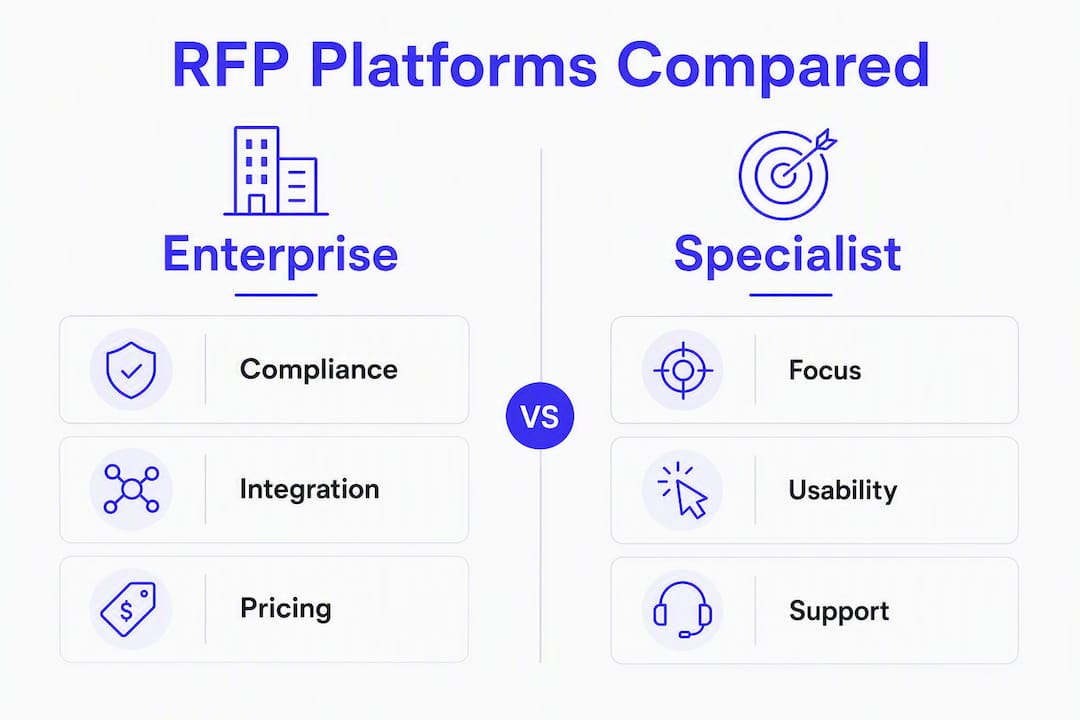
The table below uses generic vendor categories rather than competitor brand names; evaluate each category against your team's actual volume, governance requirements, and integration stack.

| Evaluation Dimension | Rfpforgeai | Enterprise Platforms | Specialist RFP Managers | Lightweight AI Drafting Tools |
|---|---|---|---|---|
| AI RFP parsing & accuracy | Automated extraction with gap-filling Q&A | High accuracy; varies by configuration | Human-assisted extraction | Prompt-dependent; no dedicated parser |
| Time to first draft | fast turnaround | 1–4 hours (setup-dependent) | 4 hours (managed) | 30 minutes (manual prompting) |
| Compliance matrix | Built-in, auto-generated | Available; often add-on | Manual or semi-automated | Not native |
| Knowledge base / reuse | Indexed approved content library | Strong; enterprise content repos | Managed library, human-curated | Template files only |
| Integrations | CRM, ERP, SSO | CRM, ERP, SSO, full API | Varies by provider | Minimal; API or export only |
| Analytics & win-rate tracking | Native win-rate dashboard | Advanced; BI integrations | Reporting on request | None |
| Security & compliance | SOC 2 | SOC 2 common | Varies | Depends on underlying LLM |
| Pricing model | Subscription tiers; usage-based quotas | Per-seat or enterprise contract | Project or retainer fees | Per-token or free tier |
| Support & onboarding | Guided onboarding; tiered support | Dedicated CSM; longer onboarding | Managed; high-touch | Community or self-serve |
| Best for | Regulated industries, BD teams, consultants | Large enterprises, multi-team | Teams needing editorial oversight | Freelancers, very low volume |
Pros and cons by category
Rfpforgeai
- ✅ Fast first draft with built-in compliance matrix
- ✅ ERP-linked live pricing reduces rework
- ✅ Win-rate analytics built in, not bolted on
- ❌ Best value at mid-to-high proposal volume; lighter teams may not use all features
Enterprise platforms
- ✅ Deep integrations and enterprise governance
- ✅ Scales across departments and geographies
- ❌ Higher cost; implementation timelines of 3–6 months are common
- ❌ Overkill for teams under ~50 proposals per month
Specialist RFP managers
- ✅ Human editorial quality control on every draft
- ❌ Slower turnaround; cost scales with volume
- ❌ Less repeatable; quality depends on individual contributors
Lightweight AI drafting tools
- ✅ Low cost; fast to start
- ❌ No governance controls, audit trail, or compliance matrix
- ❌ General-purpose AI works well for 1–10 proposals per month; beyond that, dedicated platforms justify their cost
Pricing snapshot
Subscription-based platforms typically charge per seat or per usage quota, with annual discounts of 15–25% common. Enterprise contracts add setup, integration, and CSM fees that can double the headline price. Managed RFP services price per project or on retainer. When comparing total cost, factor in internal time saved: senior SME and solution architect hours are the largest cost drivers in proposal operations, and automating first-draft work shifts that time to strategic review.
Pro Tip: When requesting a demo, bring one of your own active RFPs. Ask the vendor to run extraction live on that document and show you the compliance matrix output. A vendor who insists on a scripted demo with their own sample document is telling you something.
How do you pick the right RFP automation platform for your team?
Buyer checklist
- Requirements extraction accuracy — Can the platform parse your specific RFP format (PDF, Word, structured portals) and extract every requirement, not just section headers?
- Semantic retrieval tied to approved content — Does the knowledge base retrieve at the section level, not just the document level? Section-level chunking significantly improves retrieval relevance for specific scope items.
- ERP/CRM integration — Can pricing pull live from your ERP rather than from indexed historical documents? Live pricing retrieval is a governance requirement in many firms.
- Governance controls — Are there role-based access, mandatory human review checkpoints, and a full audit trail? Workflow orchestration that coordinates deadlines, assigns ownership, and maintains auditability separates enterprise-ready platforms from drafting tools.
- Analytics outputs — Does the platform track win rates, bid/no-bid decisions, and revision reasons so you can improve over time?
- Pricing model fit — Does the cost structure match your volume? A per-seat model penalizes occasional users; a usage-based model penalizes high-volume teams.
Questions to ask in demos
- "Show me extraction latency and accuracy on this RFP I brought today — how many requirements did it miss?"
- "How are knowledge blocks managed, versioned, and retired when content becomes outdated?"
- "Can you demonstrate live ERP pricing integration, not a static pricing table?"
- "What human review controls exist, and where are the mandatory checkpoints?"
- "Show me the audit trail — can I see who approved which section and when?"
- "What SSO and role-based access options are available, and is there an on-premise or private cloud deployment path?"
- "What are your SLAs for data retention, deletion, and breach notification?"
Red flags to watch for
- No demo on your documents; vendor insists on their own sample set
- No audit trail or content provenance tracking
- Pricing that excludes integration and onboarding costs from the headline figure
- Single-person support model for an enterprise rollout
- No governance model for high-risk sections like pricing and legal commitments
Realistic implementation timeline
A typical phased rollout runs: pilot (weeks 1–4) on a sample pipeline with one RFP type, phased rollout (weeks 5–12) adding content types and integrating CRM/ERP, then full integration (months 4–6) with governance checkpoints and feedback loops active. A tightly scoped pilot that measures time-to-first-draft and reviewer edit rates is the fastest way to prove ROI before committing to a full rollout.
Pro Tip: During your pilot, sandbox a single active RFP. Measure time-to-first-draft, count reviewer edits, and tag the reason for each substantial rewrite. Those tags become your retrieval improvement roadmap.
What do RFP automation platforms actually do under the hood?
The core capability stack has five layers. First, AI RFP parsing ingests the document and extracts every requirement, deadline, evaluation criterion, and certification reference. Second, semantic retrieval pulls relevant approved content from your indexed library, matched at the section level for precision. Third, first-draft generation assembles the executive summary, technical approach, SOW, pricing narrative, and compliance matrix. Fourth, gap analysis flags requirements with no matching content so reviewers know exactly where to focus. Fifth, win-rate analytics track outcomes and feed improvement signals back to the retrieval model.
AI's commercial value is strongest when it connects RFP workflows to CRM, ERP, knowledge systems, and analytics rather than operating as a standalone drafting layer. That integration is what produces durable win-rate improvement, not just faster drafts.
Representative implementation metrics
| Metric | Before AI | After AI (pilot quarter) | Source |
|---|---|---|---|
| Average time per proposal | — | 30 minutes | Nodeblue case study |
| Monthly proposal volume | Baseline | notable increase | Nodeblue case study |
| First-draft approval rate | notable improvement | significant improvement (refined categories) | Nodeblue case study |
A feedback loop that tags revision reasons and routes them back to the retrieval model is what drives the approval rate improvement over time. Without it, first-draft quality plateaus.
Why Rfpforgeai is the recommended pick among the alternatives
Rfpforgeai addresses the specific pressure points that BD and proposal teams in regulated industries face: speed, compliance coverage, pricing accuracy, and measurable outcomes.
Core strengths tied directly to buyer priorities:
- Fast first-draft generation — full proposal draft in 30 minutes, including executive summary, approach, pricing narrative, and compliance matrix
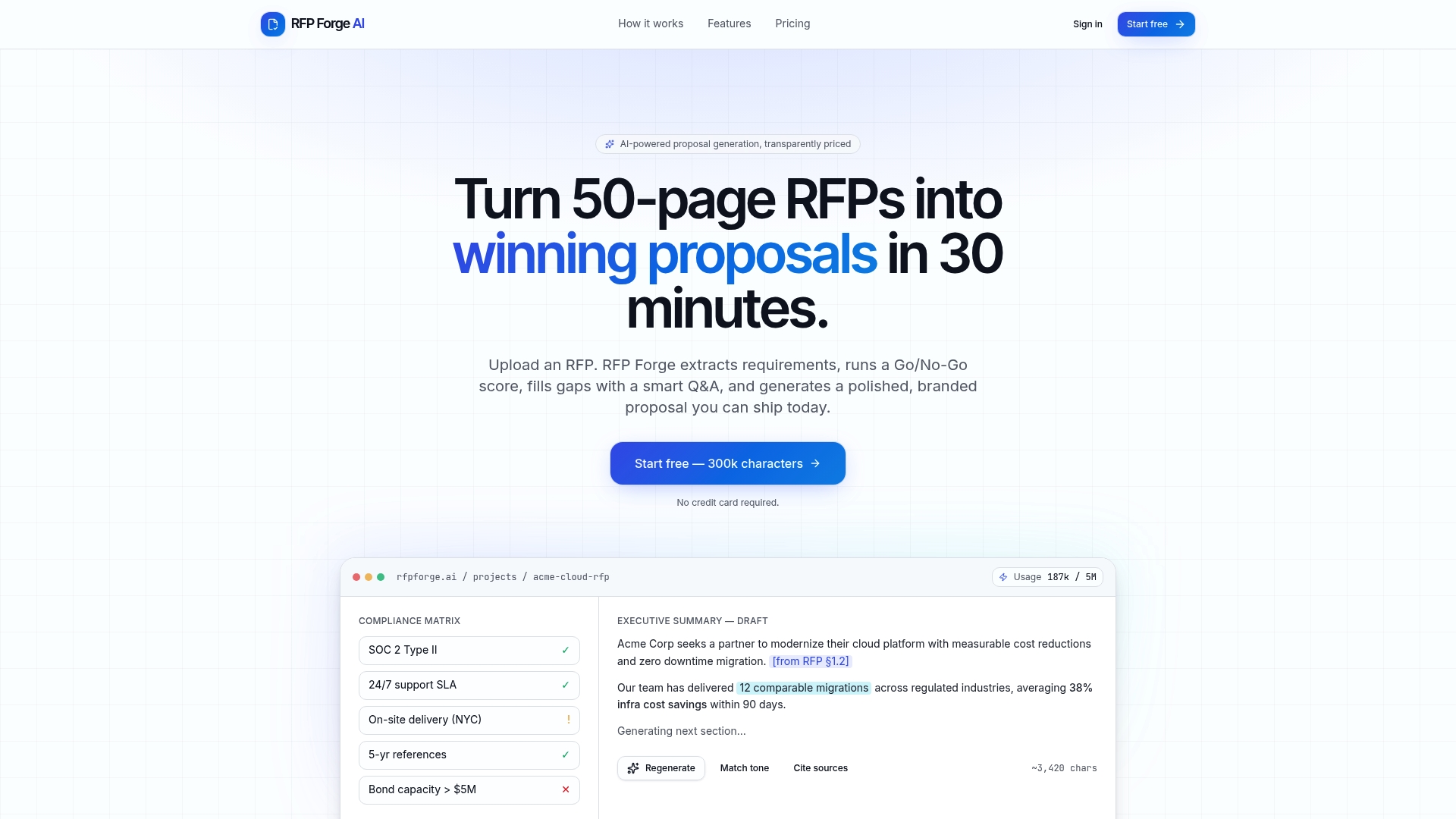
- Automated requirements extraction — AI parses the RFP and surfaces every requirement, with an interactive Q&A to fill gaps
- Integrated compliance matrix — auto-generated, not a manual checklist you build after the fact
- Knowledge-base reuse — approved content indexed and retrieved at the section level for relevance
- ERP-linked pricing — live pricing integration so proposals reflect current margins, not historical rates
- Win-rate analytics — native dashboard tracking bid outcomes and pursuit selectivity
Rfpforgeai clients in regulated industries report a substantial cost reduction in infrastructure migrations — a result that reflects both faster drafting and reduced rework from accurate compliance tracking. The platform's SOC 2 posture and role-based access controls make it a credible choice for teams handling sensitive procurement documents.
The trial and sandbox path lets you validate extraction accuracy on your own RFPs before committing. That proof-on-your-documents approach is the right way to evaluate any platform in this category.
Key Takeaways
AI-driven RFP automation delivers its strongest ROI when ERP integration, governance controls, and win-rate analytics work together — not when drafting speed is the only metric.
| Point | Details |
|---|---|
| Recommended pick | Rfpforgeai fits regulated-industry BD teams best, combining compliance matrix, ERP pricing, and analytics in one platform. |
| Pilot first | Run a 4-week sandbox on one active RFP type; measure time-to-first-draft and reviewer edit rate before full rollout. |
| Governance is decisive | Platforms without audit trails, role-based access, and mandatory review checkpoints carry real risk for high-stakes proposals. |
| Volume drives platform choice | Lightweight AI tools suit 1–10 proposals per month; dedicated platforms justify their cost above that threshold. |
| Rfpforgeai's proof point | Clients report significant draft-time and cost reductions in regulated-industry migrations. |
The part most teams get wrong about AI proposal tools
The conventional wisdom says the best RFP automation platform is the one with the most accurate AI model. That framing is wrong, and it leads teams to pick tools that perform well in scripted demos and disappoint in production.
The real differentiator is governance architecture. A platform that generates a fast first draft but has no audit trail, no approved content library, and no mandatory review checkpoint for pricing and legal language is a liability in a regulated-sector bid. You are not just automating drafting; you are automating a process that produces contractual commitments. The governance layer is where the risk lives.
The second thing teams underestimate is the feedback loop. Tracking revision reasons and tagging substantial rewrites improves retrieval relevance and identifies gaps in your approved content library. Without that loop, the platform's quality plateaus after the first few proposals. With it, first-draft approval rates improve measurably over a single quarter.
Adopt AI for the first draft, the compliance check, and the retrieval of approved content. Keep humans in the loop for pricing sign-off, legal commitments, and any claim that could be held against you in a contract dispute. That division of labor is not a limitation of current AI — it is the right operational model regardless of how capable the underlying model becomes.
Rfpforgeai turns your next RFP into a 30-minute proposal
Thirty minutes from RFP upload to a polished, compliant first draft — that is the concrete difference Rfpforgeai delivers over manual drafting or general-purpose AI tools. Your trial shows you exactly what that looks like on your own documents, not a vendor sample.
To run a proof-of-concept, follow these steps:
- Select a representative active RFP from your current pipeline
- Prepare your approved content assets (past proposals, boilerplate, approved language blocks)
- Schedule a sandbox demo and upload your RFP to see extraction and compliance matrix output live
- Define your pilot success metrics upfront: time-to-first-draft, reviewer edit count, and pursuit volume
Start your trial at Rfpforgeai and see requirement extraction, first-draft generation, and win-rate analytics working on your actual RFP.
Useful sources
| Source | What it supports |
|---|---|
| Nodeblue AI case study — notable proposal time reduction | Draft-time reduction metrics, pilot rollout data, feedback loop design, section-level chunking |
| SysGenPro — Generative AI in Professional Services | ERP/CRM integration rationale, governance model, cost driver analysis, operational automation ROI |
| AI Smart Ventures — AI for proposals and SOWs | Volume-based platform selection, compliance mapping, general-purpose AI vs. dedicated platform trade-offs |
| Rfpforgeai product page | Platform capabilities, trial/demo path, pricing tiers, SOC 2 trust signals |