
Five categories of RFP bidder questions decide whether your proposal lands on target or misses it: strategic questions about buyer motivations, scope and deliverable questions, commercial and pricing questions, contract and compliance questions, and evaluation and selection questions. Ask across all five and you compress guesswork before you write a single page.
Asking targeted questions early does three things at once: it tightens compliance, cuts rework after the deadline pressure hits, and signals to evaluators that you actually read the document. Buyers notice which bidders ask sharp questions and which ones ask nothing at all.
Before you draft a single question, do this:
- Submit questions early, ideally in the first half of the Q&A window.
- Reference the exact section and page number for every question.
- Classify each question (strategic, scope, commercial, contract, or evaluation) so it routes to the right reviewer.
Pro Tip: Batch your questions into one submission instead of trickling them in over several days. One organized list reads as prepared. Five separate emails read as disorganized.
Key Takeaways
Strong RFP bidder questions succeed when they target compliance risk, pricing accuracy, and evaluation mechanics early, and when every question is tracked against an auditable compliance record.
| Point | Details |
|---|---|
| Ask across five categories | Cover strategic, scope, commercial, contract, and evaluation questions before drafting your proposal. |
| Submit early, one batch | File questions in the first half of the Q&A window to leave time for a usable response. |
| Reference section and page | Cite the exact clause for every question so buyers can respond precisely and quickly. |
| Never reveal your approach | Phrase questions to extract clarity, not to signal pricing or methodology to competitors. |
| Track answers against compliance | Use a tool like Rfpforgeai to log addenda and keep your compliance matrix current after every published answer. |
Table of Contents
- What Is the RFP Q&A Process, and What Can It Change?
- When Should You Submit Your RFP Clarification Questions?
- Which Strategic Questions Reveal the Buyer's Real Priorities?
- What Scope and Deliverable Questions Should You Ask?
- Which Commercial and Pricing Questions Protect Your Margin?
- What Contract and Compliance Questions Prevent Late Surprises?
- What Should You Ask About Evaluation, Scoring, and Demos?
- How Should You Phrase RFP Bidder Questions Without Revealing Strategy?
- Sample RFP Question Templates You Can Copy
- Which Questions Should You Prioritize First?
- How Do Winning Bidders Scale Their Q&A Process?
- How Experienced Proposal Teams Handle the Q&A Window
- Scale Your RFP Q&A Workflow Without the Manual Grind
- Where to Find Official RFP Question Templates
- Frequently Asked Questions About RFP Bidder Questions
- Sources
What Is the RFP Q&A Process, and What Can It Change?
The RFP Q&A process is a formal, recorded exchange that clarifies requirements and, in some cases, actually changes the solicitation through an addendum. It is not a negotiation channel. You cannot use it to pitch your pricing model or lobby for a scope change that benefits your approach specifically.
Every solicitation names who can legally answer questions, usually a single procurement officer or a designated contact listed in the document. This exists to protect the silent period, the stretch of the procurement cycle where bidders are barred from contacting evaluators, project managers, or anyone outside the named channel. Reach out to the wrong person and you risk disqualification, not just a missed answer.
Here's the part bidders forget: every answer gets published to every bidder. That fairness principle, confirmed in guidance on how the clarification period works, means:
- Your competitors will read your question word for word.
- A question that reveals your pricing strategy or technical approach hands your competitors free intelligence.
- Vague questions get vague answers, and vague answers help nobody.
Pro Tip: Ask "what does the buyer need clarified" not "what do I want to tell the buyer." The second framing leaks strategy disguised as a question.
When Should You Submit Your RFP Clarification Questions?
Submit early. Ideally, get your questions in during the first half of the Q&A window, and never after the stated cutoff unless the solicitation explicitly allows late submissions. Guidance on when to submit solicitation questions is blunt about this: questions filed too close to the deadline may simply go unanswered, leaving you to price and write around an ambiguity you could have resolved.
Follow this sequence:
- Read the full solicitation once, cover to cover, before drafting a single question.
- Route every question through the exact channel named in the document, whether that's a procurement portal, a designated email, or a formal RFP response communication form. Skip the required format and your question may never reach a reviewer.
- Build in buffer time after the expected response date to revise your draft proposal around whatever the buyer answers.
- Watch for addenda. Published answers frequently modify the original requirements, and you're on the hook to incorporate them whether or not you noticed the update.
Institutional buyers, including university procurement offices, often publish exact supplier question deadlines and expected turnaround windows. Treat those posted timelines as the floor, not a suggestion.
Which Strategic Questions Reveal the Buyer's Real Priorities?
Strategic questions change how you position your proposal. They rarely change the technical spec, but they reshape your win theme, your executive summary, and which capabilities you lead with.
Ask questions that dig at motivation and success criteria rather than mechanics:
- "What prompted this RFP now, rather than six months ago or six months from now?"
- "How will the buyer define success for this engagement one year after award?"
- "Of the stated evaluation criteria, which two carry the most weight in practice?"
- "Is this a first-time procurement, a renewal, or a replacement for an underperforming incumbent?"
The answers matter more than they look. A buyer replacing a failed vendor cares about risk mitigation and references more than price. A buyer launching a first-time initiative cares about vision and roadmap. Reviewing published RFP evaluation criteria frameworks beforehand helps you frame these questions so they read as informed, not fishing.
Once you get answers, rewrite your win theme around them. If leadership says stability matters most, your executive summary should open with proof of stability, not a features list.
What Scope and Deliverable Questions Should You Ask?

Scope questions exist for one reason: to stop you from pricing an assumption instead of a requirement. Ambiguous deliverables are the single most common cause of underbidding, and underbidding kills margins even on proposals you win.
Structure every scope question with a direct reference, then a specific ask:
- "Section 4.2, page 12: does 'ongoing support' include weekend coverage, or is that a separate line item?"
- "What constitutes formal acceptance of a deliverable, and who signs off on it?"
- "Are there existing systems or data sets this solution must integrate with, and can sample data be shared before award?"
- "What are the handover conditions at contract close, including documentation and knowledge transfer requirements?"
- "Which assumptions in Section 3 are fixed requirements versus illustrative examples?"
Requesting sample inputs or representative data early is worth the ask even if the buyer declines. A "no" still tells you the complexity is higher than the document implies, which should show up in your risk pricing.
Which Commercial and Pricing Questions Protect Your Margin?
Commercial clarity keeps you from pricing blind. Ambiguity here doesn't just cost you the bid, it costs you money on the contract you win.
Ask questions that expose the budget shape and billing mechanics without asking the buyer to reveal a number they're not permitted to disclose:
- "Is there an established budget range or ceiling for this engagement?"
- "How will invoices be reviewed and approved, and on what cadence?"
- "Are fixed-price, time-and-materials, or hybrid cost models all acceptable, or is one preferred?"
- "How is out-of-scope work identified, authorized, and priced during the contract term?"
- "What change-order process applies once the contract is signed, and is a contingency allowance built into the evaluation?"
Payment milestone questions belong here too. If the RFP is silent on invoicing cadence, ask directly. Net-30 versus net-90 changes your cash flow modeling more than most bidders admit.
What Contract and Compliance Questions Prevent Late Surprises?
Clarify contractual non-negotiables before you submit, not after you're awarded and staring at terms you can't meet. Legal surprises discovered post-award are expensive and often irreversible.
Standard questions worth asking every time:
- "What insurance coverage levels and certificate types are required at contract signing?"
- "Who retains intellectual property rights for custom deliverables created under this engagement?"
- "What data protection or security certifications are mandatory (SOC 2, HIPAA, FedRAMP, or others named in the solicitation)?"
- "Are the indemnification clauses in Section 9 negotiable, or are they standard and non-negotiable?"
Watch for red flags: unlimited liability clauses, one-sided termination rights, and IP assignment language that claims ownership of your pre-existing methodology. Phrase your question as a request for confirmation, not a demand for a rewrite: "Can the buyer confirm whether Section 9.3's liability cap applies to both parties equally?" reads far better than "This clause needs to change."
What Should You Ask About Evaluation, Scoring, and Demos?
Know the scoring model, the weighting, and the demo format before you finalize your submission, because a proposal built for the wrong evaluation lens loses points it should have earned — detailed guidance in the accounting software evaluation checklist can help you get this right.
Useful questions include:
- "How many evaluators sit on the review panel, and do they score independently or reach consensus?"
- "What percentage weight does price carry relative to technical approach?"
- "If finalist demos are part of the process, what is the expected format and duration?"
- "Is there a published evaluation timeline between submission and award notification?"
One detail bidders overlook: some buyers score demos separately from the written proposal, meaning a strong document can still lose if the demo team wasn't briefed on the same win theme. Ask early enough to schedule internal rehearsal time.
How Should You Phrase RFP Bidder Questions Without Revealing Strategy?
Be specific, cite the exact section and page, and stick to one issue per question. That single rule filters out half the mistakes bidders make in the Q&A phase.
Do this:
- Mirror the RFP's own language and terminology rather than paraphrasing loosely.
- Classify each question by type (technical, contractual, or pricing) so it reaches the right reviewer fast.
- State the impact if the ambiguity goes unresolved: "Without clarification, bidders may price this requirement inconsistently."
Avoid this:
- Compound questions that bundle three issues into one paragraph, guaranteeing a partial answer.
- Any question that reveals your proposed methodology, staffing model, or price point.
- Questions about competing bidders. Buyers won't answer them, and asking makes you look uncertain rather than sharp.
A best-practice guide to tender clarification questions makes the same point: specificity and restraint separate bidders who look prepared from bidders who look like they're fishing for hints.
Sample RFP Question Templates You Can Copy
Paste these into your official communication form, then customize with the solicitation number, section and page reference, and your question classification.
Strategic:
- "What outcomes will define success for this engagement at the 12-month mark?"
- "Is this procurement a renewal, replacement, or first-time initiative?"
Scope:
- "Section [X], page [Y]: please confirm whether [deliverable] includes [specific activity] or is that separately scoped?"
- "What are the formal acceptance criteria for each major deliverable?"
Commercial:
- "Is a budget range established for this engagement, and how will cost proposals be weighted against technical scoring?"
- "What is the process for authorizing and pricing out-of-scope work?"
Contract:
- "What insurance and certification requirements apply at contract execution?"
- "Who holds IP rights for custom deliverables created under this contract?"
Evaluation:
- "What is the relative weighting between technical approach and price in the scoring model?"
- "Is a finalist demo part of the process, and if so, what format is expected?"
Data requests:
- "Can representative sample data be shared to inform technical approach and pricing accuracy?"
If your solicitation permits marking questions as commercially sensitive, use that flag sparingly, and only for questions that would expose pricing strategy if published verbatim.
Which Questions Should You Prioritize First?
Prioritize any question that affects compliance, price accuracy, or a core deliverable. Everything else waits.
- Rank every draft question by impact (does an unanswered question change your price or your compliance status) versus certainty (how confident are you in your current assumption).
- Submit the highest-impact, lowest-certainty questions first. These are the ones that could sink your bid if you guess wrong.
- Cap your list at roughly 8 to 12 well-structured questions unless the solicitation states a lower limit. A shorter, sharper list gets read more carefully than a 30-item dump.
- Cut any question you could answer yourself by rereading the document once more.
This isn't about asking fewer questions to look agreeable. It's about making sure the buyer's limited time answering questions goes toward the things that actually move your bid.
How Do Winning Bidders Scale Their Q&A Process?
Bidders who win consistently treat the Q&A phase as both an intelligence-gathering exercise and a compliance-control checkpoint, and they batch their questions early rather than trickling them in.
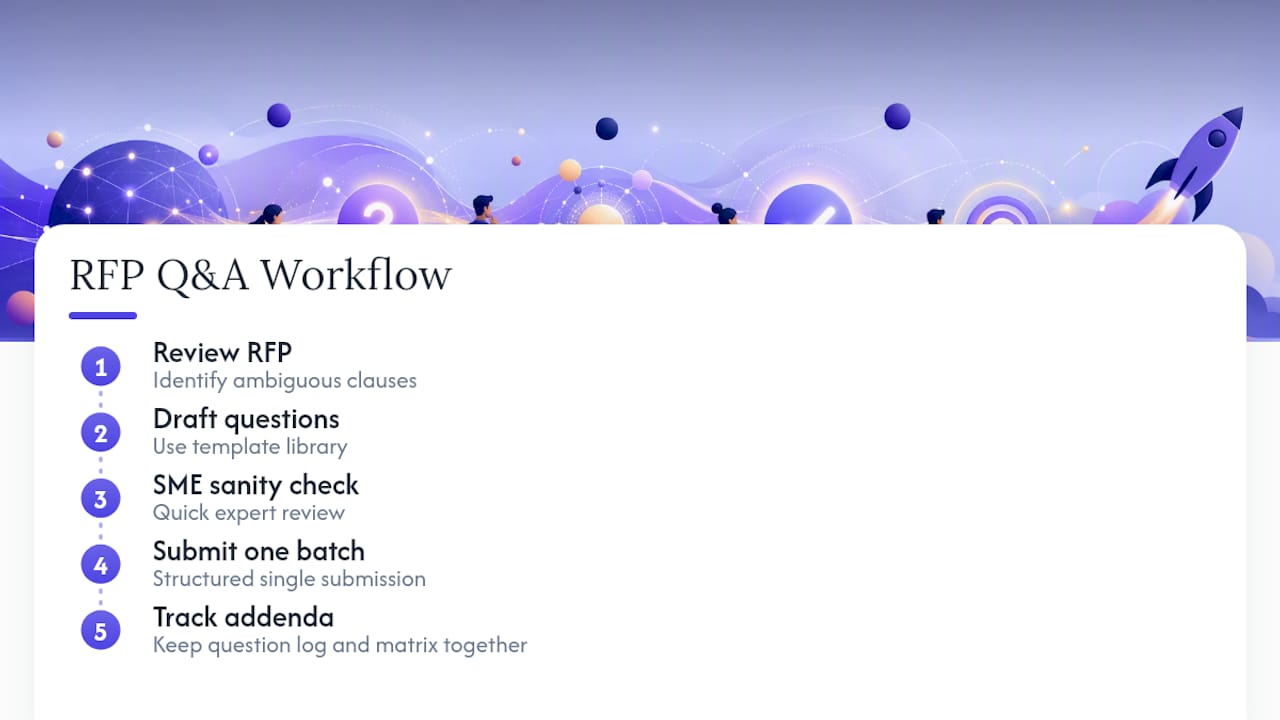
The repeatable workflow looks like this: review the full document for ambiguous clauses, draft candidate questions against a template library, route drafts to subject-matter experts for a quick sanity check, submit one structured batch, then track every published addendum against your compliance matrix.
That last step is where most teams lose track. Addenda pile up, question logs live in scattered email threads, and by submission week nobody remembers which answer changed which requirement. A workflow built around RFP evaluation criteria frameworks and structured tracking, rather than memory, is what separates teams that catch every addendum from teams that miss one and get marked non-responsive.
Pro Tip: Keep your question log and your compliance matrix in the same document. When an addendum changes a requirement, you want that change visible next to the compliance row it affects, not buried in a separate spreadsheet.
Bidders who ask three or four precisely targeted questions and track every published answer against their compliance matrix consistently submit tighter, more responsive proposals than bidders who ask a dozen scattered ones and lose track of the addenda entirely.
How Experienced Proposal Teams Handle the Q&A Window
Experienced bid teams treat the Q&A window as a scheduled milestone, not an afterthought squeezed in between drafting sessions. The question log has one owner, usually the capture lead, who routes technical questions to SMEs and legal questions to contracts staff before anything gets submitted.
One recurring pattern: a single clarification about billing cadence or acceptance criteria often reshapes pricing more than any other question type. Teams that build in time to revise pricing after answers arrive consistently submit tighter numbers than teams that lock pricing before the Q&A window closes.
Scale Your RFP Q&A Workflow Without the Manual Grind
Rfpforgeai gives bid teams a faster path through the exact bottleneck this article covers: turning a dense solicitation into a clear list of clarification questions and a tracked compliance matrix, without a week of manual document review. Instead of assigning someone to reread 80 pages hunting for ambiguous clauses, the platform's AI extracts requirements automatically, flags gaps through an interactive Q&A system, and keeps every answer tied to the compliance row it affects.
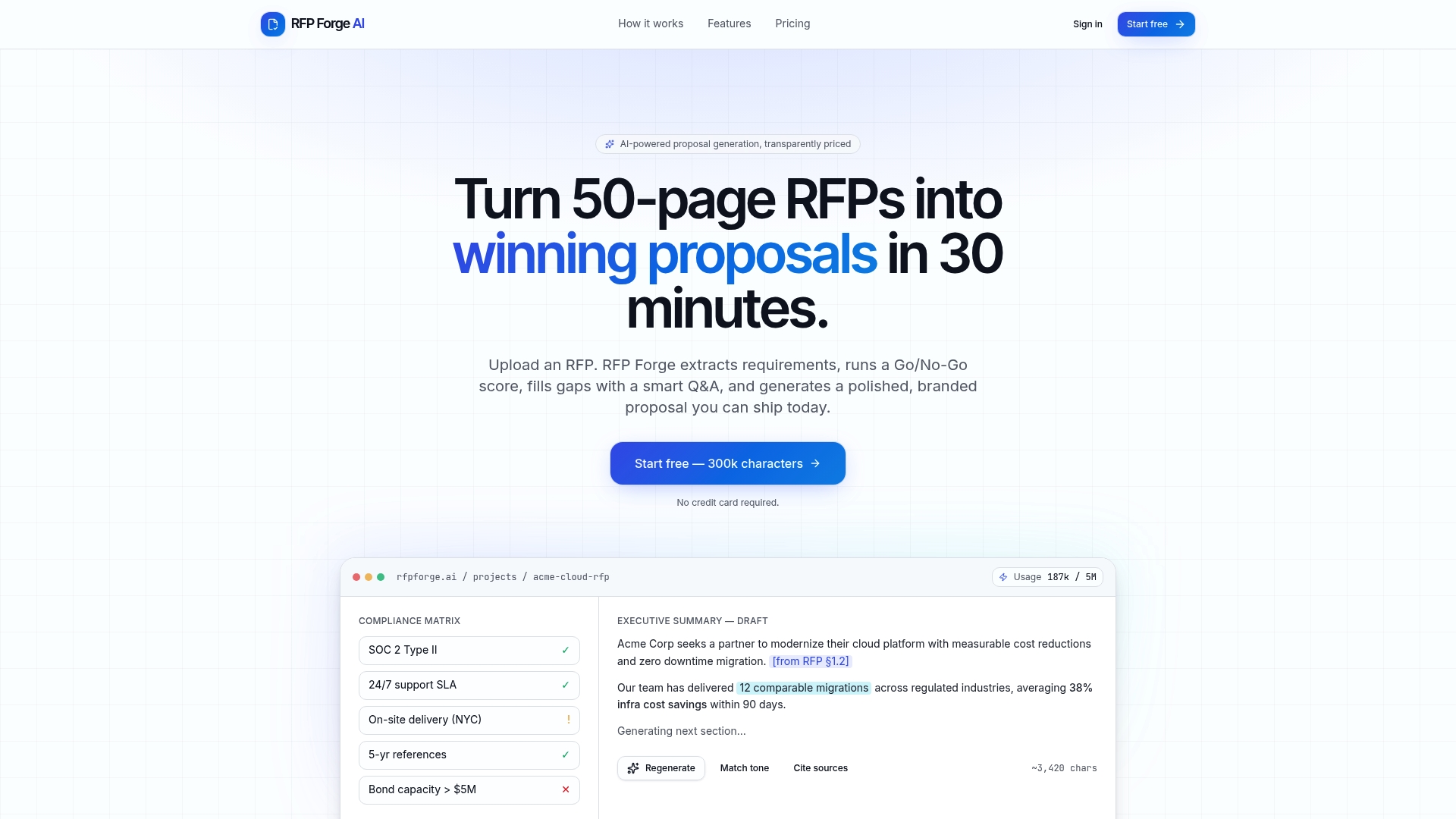
For teams juggling multiple active solicitations, that means less time spent reconstructing what changed after an addendum drops, and more time spent on the parts of the proposal that actually win, the narrative and the pricing strategy. Clients in regulated industries using the platform's infrastructure-focused proposals have reported cost reductions during migration projects, a direct result of catching scope gaps before submission instead of after award.
If your bid calendar has more than one RFP open at a time, try RFP Forge AI and see how much of your Q&A prep the platform can handle before your next deadline.
Where to Find Official RFP Question Templates
- Review RFP templates from university procurement offices for structured formats.
- Check pre-conference question guidance for classification fields that route questions correctly.
- Use the solicitation's own communication form rather than a generic template.
Frequently Asked Questions About RFP Bidder Questions
How many questions should a bidder submit for an RFP? Most bid teams submit between 8 and 12 well-structured questions unless the solicitation sets its own limit. Prioritize questions that affect compliance, pricing, or core deliverables over minor clarifications you could resolve by rereading the document.
Can I ask about other bidders during the RFP Q&A period? No. Buyers won't answer questions about competitors, and asking signals uncertainty rather than preparation. Keep every question focused on your own understanding of the solicitation's requirements.
What happens if I miss the Q&A submission deadline? Late questions often go unanswered, leaving you to price and draft around an unresolved ambiguity. Submitting in the first half of the Q&A window gives the buyer time to respond before your proposal deadline.
Are RFP Q&A answers shared with every bidder? Yes. Fairness rules require buyers to publish answers to all bidders, which is why questions should stay factual and avoid revealing your proposed approach or pricing strategy.
What's the difference between a clarification question and an addendum? A clarification question gets a published answer that explains existing requirements. An addendum formally changes the solicitation itself, and bidders are typically required to acknowledge every addendum before the deadline closes.
Sources
- How to Fill Out and Submit an RFP Response Communication Form - LegalClarity
- The Tender Clarification Period: How to Use It Properly (2026)
- Supplier Submitted RFP Questions - ASU Enterprise Technology
- Silent period (ASU procurement guidance)