
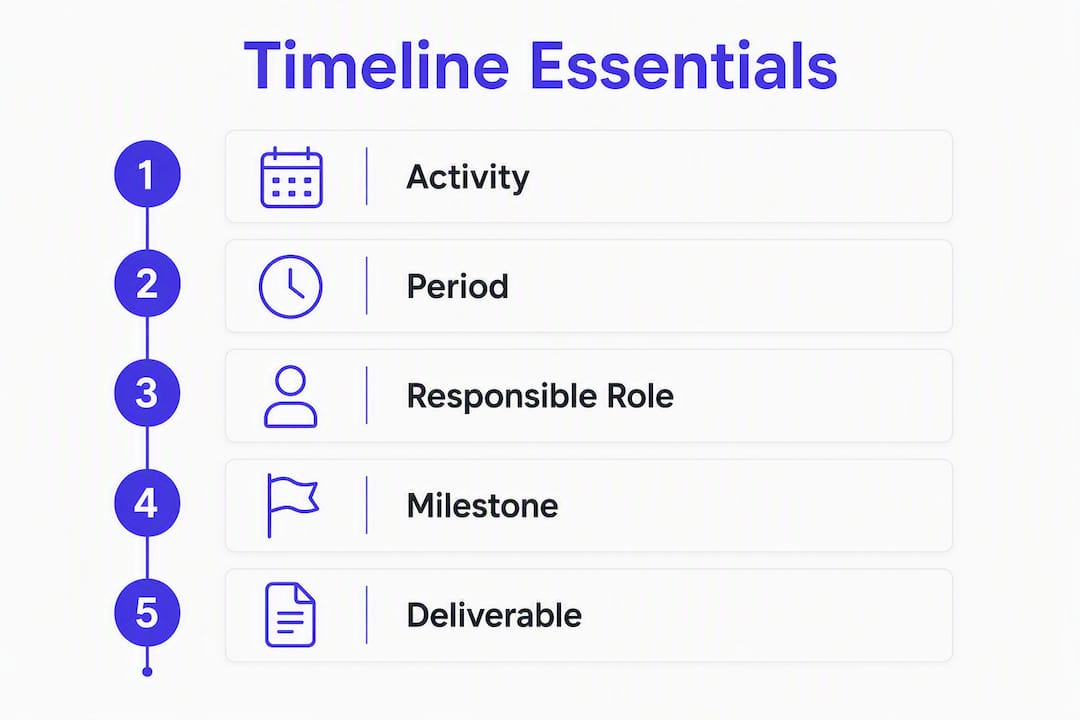
A strong proposal timeline section includes phases and activities, start and end periods, responsible staff positions (not individual names), key milestones, deliverables, and evaluation or reporting points. Reviewers at agencies like NIH, NSF, SAMHSA, and HRSA use the timeline to judge whether your project is operationally feasible before they finish reading the narrative. A clear, visual schedule signals maturity, sets expectations, and protects you from scope creep after award.
Here is a compact, copyable sample you can model immediately:
| Activity | Period | Responsible Role | Deliverable |
|---|---|---|---|
| Project kickoff and staff onboarding | Month 1 | Project Director | Signed subcontracts, onboarding plan |
| Baseline data collection | Months 2–3 | Evaluator | Baseline data report |
| Program implementation begins | Month 3 | Program Manager | Participant enrollment log |
| Mid-project assessment | Month 6 | Evaluator | Progress report to funder |
| Final evaluation and closeout | Month 12 | Project Director, Evaluator | Final report, data archive |

Paste this into your draft, swap the roles and activities for your project, and you have a working foundation.
Table of Contents
- What a timeline section is and why reviewers evaluate it
- Core components every proposal timeline section must include
- What do realistic schedule lengths look like for different project types?
- Which format should you use: table, Gantt chart, or CPM?
- How to connect the timeline to your proposal narrative and budget
- When and how to show dependencies and critical path
- Three full, copyable timeline templates you can adapt now
- What reviewers at SAMHSA, HRSA, ACF, NIH, and NSF actually look for
- Common timeline mistakes that reduce reviewer confidence
- Key Takeaways
- Why a realistic timeline is your best defense against scope creep
- Rfpforgeai builds your timeline section in minutes, not hours
- Authoritative sources and further reading
What a timeline section is and why reviewers evaluate it
A proposal timeline section, also called a project schedule or workplan, is the part of your proposal that maps every major activity to a specific period, assigns responsibility, and shows how the work connects to your deliverables and budget. Reviewers read it to answer three questions fast: Is the sequence logical? Are the durations realistic? Does the plan match what the budget funds?

Federal reviewers at agencies operating under 2 CFR 200 expect the timeline to demonstrate that you understand the funded period, not just the project concept. NIH and NSF reviewers score feasibility as a distinct criterion, and an implausible schedule — major deliverables compressed into the final quarter, for example — can trigger faster rejection than a weak narrative because it suggests operational immaturity. SAMHSA and HRSA reviewers specifically look for evaluation activities on the timeline; missing them signals that evaluation is an afterthought rather than an integrated component.
The timeline also functions as a cross-reference tool. Budget reviewers check whether the staff positions shown in Month 1 of the timeline match the salary lines in Budget Year 1. A mismatch between those two sections is one of the most common red flags in federal grant applications.
Core components every proposal timeline section must include
Every timeline section, regardless of project length or funder, needs these elements:
- Activities and phase names. Label each phase clearly (e.g., "Planning," "Implementation," "Evaluation") and list the major activities within each.
- Time periods. Use months, quarters, or specific dates depending on project length and funder preference. Avoid vague labels like "early" or "later."
- Responsible staff positions. List the role (Project Director, Evaluator, Data Analyst), never a person's name. Staff turn over; positions do not.
- Milestones. Mark the completion of a phase or a critical decision point. For a 3-year grant, plan for 8–12 measurable milestones.
- Deliverables. Name the tangible output tied to each milestone (report, database, training curriculum).
- Dependencies. Show which activities cannot start until another finishes, especially external ones like IRB approval or partner MOUs.
- Evaluation and reporting points. Baseline data collection, mid-project assessments, and progress reports must appear explicitly on the timeline.
- External approval dates. IRB submissions, data use agreements, and subcontract executions all have lead times. Build them in.
Pro Tip: Tie every milestone explicitly to a budget line item and to your evaluation plan. Reviewers cross-check these three sections; consistent labels across all three eliminate doubt about whether your plan is integrated or assembled from separate drafts.
For multi-institutional projects, add a column showing the responsible institution or subaward lead for each activity. Reviewers use this to assess coordination and realistic division of labor across partners.
What do realistic schedule lengths look like for different project types?
Scale and granularity depend on project length and funder expectations. Use monthly detail for projects of 12 months or fewer and quarterly breakdowns for multi-year federal applications, unless the Notice of Funding Opportunity (NOFO) specifies otherwise. Quarterly timelines align with federal reporting periods and keep the table readable.
Short project (2–3 months)
Appropriate for small contracts, pilot studies, or scoping work. Monthly columns work well.
| Activity | Month 1 | Month 2 | Month 3 | Responsible Role | Deliverable |
|---|---|---|---|---|---|
| Kickoff meeting and work plan finalization | ✓ | Project Manager | Approved work plan | ||
| Data gathering and stakeholder interviews | ✓ | ✓ | Analyst | Interview notes | |
| Draft report preparation | ✓ | Analyst | Draft report | ||
| Client review and revisions | ✓ | ✓ | Project Manager | Revised draft | |
| Final report delivery | ✓ | Project Manager | Final report |
Medium project (6–12 months)
Use monthly columns through Month 6, then shift to two-month blocks if the table gets crowded.
| Activity | Months 1–2 | Months 3–4 | Months 2–3 | Months 4–6 | Months 10–12 | Responsible Role | Deliverable |
|---|---|---|---|---|---|---|---|
| Planning and hiring | ✓ | Project Director | Staffing plan | ||||
| IRB submission and approval | ✓ | ✓ | PI | IRB approval letter | |||
| Participant recruitment | ✓ | ✓ | Outreach Coordinator | Enrollment log | |||
| Program delivery | ✓ | ✓ | Program Manager | Session logs | |||
| Baseline and mid-assessment | ✓ | ✓ | Evaluator | Assessment reports | |||
| Final evaluation and reporting | ✓ | Evaluator, Project Director | Final report |
Multi-year grant (3 years)
Quarterly columns are standard. Plan for 15–25 activities and 8–12 milestones across the full period. Fewer activities suggest under-planning; more suggest task-level detail that belongs in an internal work plan, not a proposal.
| Activity | Y1 Q1–Q2 | Y1 Q3–Q4 | Y2 Q1–Q2 | Y2 Q3–Q4 | Y3 Q1–Q2 | Y3 Q3–Q4 | Responsible Role | Milestone |
|---|---|---|---|---|---|---|---|---|
| Hire and onboard staff | ✓ | Project Director | Staff hired | |||||
| Finalize MOUs and subcontracts | ✓ | Grants Manager | Executed agreements | |||||
| Baseline data collection | ✓ | Evaluator | Baseline report | |||||
| Implement core program | ✓ | ✓ | ✓ | ✓ | Program Manager | Quarterly logs | ||
| Annual progress reports | ✓ | ✓ | ✓ | Project Director | Submitted reports | |||
| Mid-project evaluation | ✓ | Evaluator | Mid-term report | |||||
| Final evaluation and dissemination | ✓ | Evaluator, PI | Final report, publications |
Which format should you use: table, Gantt chart, or CPM?
The right format depends on project complexity, page limits, and what reviewers can parse in about 60 seconds. Reviewers scan timelines quickly; visual clarity and consistent labels are decisive.
| Format | Best for | Strengths | Watch out for |
|---|---|---|---|
| Milestone table | Grant proposals, short contracts | Easy to read, maps to budget, fits page limits | Does not show overlaps or dependencies |
| Gantt chart | Medium to large contracts, technical proposals | Shows duration, overlap, and sequence visually | Can exceed page limits; needs clear labeling |
| CPM network diagram | Multi-workstream, complex bids | Shows dependencies, float, and critical path | Requires explanation; can confuse non-technical reviewers |
| Activity-based workplan | Federal grants (SAMHSA, HRSA, ACF) | Cross-references budget and evaluation plan | Needs consistent role labels across sections |
Practical formatting rules:
- Use months or quarters as column headers, never vague labels like "Phase 1 period."
- Limit shading to two tones (active period vs. milestone marker); avoid color schemes that disappear in black-and-white printing.
- Embed the timeline as a table inside the proposal document rather than as a separate figure when page limits are tight.
- Caption every Gantt or CPM figure with a one-line description and reference it in the narrative ("see Figure 1").
- Keep font size at 10pt minimum so reviewers can read it without zooming.
For complex bids, CPM-based schedules demonstrate dependencies, float, and risks more effectively than simple bar charts. Reserve CPM for proposals where multi-workstream dependency logic genuinely matters to the reviewer's feasibility assessment.
How to connect the timeline to your proposal narrative and budget
The timeline should sit inside the Methods or Approach section, not buried in an appendix. A timeline embedded in the narrative tells a cohesive story and increases reviewer confidence because it links logic to logistics.
Use short, paste-ready sentences to cross-reference the timeline from the narrative and budget:
- "As shown in the project schedule, the Evaluator will complete baseline data collection in Months 2–3; corresponding personnel costs are included in Budget Year 1, Line 2."
- "Participant recruitment begins in Month 3, following IRB approval (see Timeline, Row 4); the Outreach Coordinator's salary is reflected in the Year 1 budget at 0.3 FTE."
- "The mid-project assessment in Q4 of Year 2 aligns with the funder's required progress report; see the Evaluation Plan for instrument details."
Three placement principles matter here. First, reference the timeline by name in the narrative at least twice, once in the Approach section and once in the Evaluation section. Second, use the same role titles in the timeline, the budget, and the narrative. A "Data Analyst" in the timeline who appears as "Research Associate" in the budget creates reviewer doubt. Third, place the timeline table immediately after the paragraph that describes the methodology, not at the end of the section.
Pro Tip: Run a three-column check before submission: list every role in the timeline, find that role in the budget, and confirm the same label appears in the narrative. This 15-minute audit catches the most common cross-section inconsistencies before a reviewer does.
For more on integrating timeline commitments into a full technical proposal, the technical proposal writing guide covers evaluation activity placement in detail.
When and how to show dependencies and critical path
Dependencies matter most in proposals with external approvals, partner organizations, or procurement steps that control when substantive work can begin. Showing them explicitly tells reviewers you have thought through the sequencing, not just the activities.
Common dependency types to include:
- IRB or ethics board approval before any data collection or participant contact begins.
- Executed MOUs or subcontracts before partner organizations can bill or deliver services.
- Procurement or contracting for equipment or software needed in early implementation phases.
- Hiring and onboarding before any activity that requires that staff position to be filled.
- Data use agreements before accessing secondary data sets.
- Funder approval of key personnel changes if required by the award terms.
The Critical Path Method (CPM) identifies the longest chain of dependent activities, which determines the earliest possible project completion date. For proposals with three or more parallel workstreams, a CPM network diagram shows reviewers that you understand which delays will cascade and which have float. Visual CPM tools reduce schedule build time from days to hours and preserve network logic into execution schedules, making them practical even during a compressed proposal phase.
For simpler proposals, a dependency column in your workplan table is sufficient. Label it "Depends on" and list the preceding activity number or name.
Pro Tip: If you include a CPM diagram, highlight the critical path in one color and annotate the two or three highest-risk nodes with a one-line mitigation note. Reviewers who are not schedulers will focus on those annotations, not the network logic.
Three full, copyable timeline templates you can adapt now
These templates are structured as activity-based workplans, the format preferred for grant applications because they cross-reference the budget directly. Recreate them in Word or Excel, then adapt durations, roles, and deliverables to your project.
Template 1: Short contract proposal (3 months)
Use for consulting engagements, scoping studies, or short-term service contracts.
| # | Activity | Responsible Role | Month 1 | Month 2 | Month 3 | Deliverable |
|---|---|---|---|---|---|---|
| 1 | Kickoff and scope confirmation | Project Manager | ✓ | Signed scope document | ||
| 2 | Research and data collection | Analyst | ✓ | ✓ | Raw data file | |
| 3 | Analysis and draft report | Analyst | ✓ | Draft report | ||
| 4 | Client review cycle | Project Manager | ✓ | ✓ | Annotated draft | |
| 3 | Final delivery and closeout | Project Manager | ✓ | Final report |
Adaptation steps: change "Analyst" to your specific role title, add a row for any required approval (legal review, client sign-off), and confirm that Month 1 salary costs in the budget match the roles active in that column.
Template 2: Medium multi-phase project (12 months)
Use for program implementation grants, pilot projects, or phased service contracts.
| # | Activity | Responsible Role | Q1 | Q2 | Q3 | Q4 | Milestone | Deliverable |
|---|---|---|---|---|---|---|---|---|
| 1 | Hire and onboard staff | Project Director | ✓ | Staff hired | Onboarding plan | |||
| 2 | IRB submission | PI | ✓ | IRB approved | Approval letter | |||
| 3 | Baseline assessment | Evaluator | ✓ | Baseline complete | Baseline report | |||
| 4 | Program delivery | Program Manager | ✓ | ✓ | Mid-point reached | Session logs | ||
| 3 | Mid-year progress report | Project Director | ✓ | Report submitted | Progress report | |||
| 6 | Final evaluation | Evaluator | ✓ | Evaluation complete | Final eval report | |||
| 3 | Closeout and dissemination | PI, Project Director | ✓ | Project closed | Final report |
Template 3: Three-year federal grant
Use for SAMHSA, HRSA, ACF, NIH, or NSF applications with multi-year funding periods.
| # | Activity | Responsible Role | Y1 | Y2 | Y3 | Milestone | Deliverable |
|---|---|---|---|---|---|---|---|
| 1 | Staff hiring and onboarding | Project Director | ✓ | Staff in place | HR records | ||
| 2 | Finalize MOUs and subcontracts | Grants Manager | ✓ | Agreements executed | Signed MOUs | ||
| 3 | Baseline data collection | Evaluator | ✓ | Baseline complete | Baseline report | ||
| 4 | Core program implementation | Program Manager | ✓ | ✓ | ✓ | Ongoing | Quarterly logs |
| 3 | Annual progress reports | Project Director | ✓ | ✓ | ✓ | Reports submitted | Annual reports |
| 6 | Mid-project evaluation | Evaluator | ✓ | Mid-eval complete | Mid-term report | ||
| 3 | Sustainability planning | Project Director | ✓ | ✓ | Plan finalized | Sustainability plan | |
| 8 | Final evaluation and closeout | Evaluator, PI | ✓ | Project closed | Final report |
Live, shareable templates with version control let your team update durations and roles without emailing new files, which matters when a proposal deadline compresses your revision cycle.
What reviewers at SAMHSA, HRSA, ACF, NIH, and NSF actually look for
Federal reviewers use the timeline as a feasibility checklist. Knowing their criteria lets you preempt objections before submission.
Reviewer expectations across these agencies:
- Alignment to the budget period. Every funded year must have corresponding activities. A Year 3 with only "closeout" suggests under-planning.
- Evaluation activities explicitly named. SAMHSA, HRSA, and ACF reviewers prioritize evaluation on the timeline; baseline collection, mid-project assessments, and final evaluation must appear as distinct rows.
- Named responsible positions. Reviewers want to see who owns each activity, not just that it will happen.
- Realistic sequencing. No substantive program activities before IRB approval, MOU execution, or key staff are hired.
- Granularity matched to award length. Monthly detail for one-year awards; quarterly for multi-year. Excessive granularity in a 3-year proposal wastes page space and obscures the big picture.
- Reporting milestones. Progress reports, annual reports, and final reports must appear on the timeline with the responsible role named.
Red flags reviewers flag quickly:
- Activities concentrated in the final quarter of each year.
- No evaluator listed anywhere in the timeline or budget.
- Timeline activities that do not match the narrative description of the approach.
- Missing external approval steps (IRB, MOUs) with no lead time built in.
- Identical activity rows repeated across all three years with no progression.
- A "no-cost extension" referenced as a planned fallback in the timeline itself.
When the NOFO cites specific review criteria for feasibility or project management, reference those criteria by name in the narrative paragraph that introduces the timeline. That one sentence signals to reviewers that you read the guidance.
Common timeline mistakes that reduce reviewer confidence
Most timeline problems fall into five categories, and most can be fixed in under 30 minutes.
Implausible durations. Hiring a full team in two weeks or completing a literature review in one month signals that the writer has not done this work before. Cross-check your durations against real hiring timelines (typically 6–10 weeks for federal-funded positions) and IRB review periods (often 4–8 weeks for expedited review).
Missing owners. A timeline with activities but no responsible role is a list of wishes. Add a "Responsible Role" column if one is absent, and confirm every row has an entry.
Mismatch with the budget. If the Project Director appears in Month 1 of the timeline, that salary must start in Month 1 of the budget. Cross-checking the timeline against the budget before submission catches the most common red flag reviewers see.
No evaluation milestones. Add at minimum three evaluation rows: baseline, mid-project, and final. Each needs a responsible role and a named deliverable.
Over-simplification or excessive granularity. A 3-year proposal with five rows is under-planned. One with 60 rows buries the reviewers. Aim for 15–25 activities for a multi-year grant.
Quick fixes you can implement before submission:
- Add role names to every activity row (10 minutes).
- Insert a buffer of 25–50% more time than the nominal duration for activities with external dependencies, such as IRB review or procurement, and note the rationale in one sentence.
- Shift at least one major deliverable into Year 1 or Month 3 so the timeline does not look back-loaded.
- Add an explicit "Funder progress report" row for each reporting period.
- Run the three-column label check (timeline, budget, narrative) described in the writing section above.
One thing to avoid: never list a no-cost extension as a planned contingency in the proposal timeline. Reviewers read that as an admission that the schedule is already unrealistic.
Key Takeaways
A proposal timeline section that includes evaluation activities, aligned budget roles, realistic sequencing, and explicit dependencies is the single most effective way to pass a reviewer's feasibility check.
| Point | Details |
|---|---|
| Include evaluation milestones | Baseline, mid-project, and final evaluation rows are required by SAMHSA, HRSA, and ACF reviewers. |
| Match roles across all sections | Use identical position titles in the timeline, budget, and narrative to eliminate reviewer doubt. |
| Scale granularity to award length | Monthly columns for projects under 12 months; quarterly for multi-year federal grants. |
| Show dependencies explicitly | List IRB, MOU, hiring, and procurement steps with lead time before dependent activities begin. |
| Use Rfpforgeai for timeline generation | Rfpforgeai extracts schedule requirements from the RFP and generates reviewer-aligned timeline sections with budget consistency checks built in. |
Why a realistic timeline is your best defense against scope creep
The conventional wisdom treats the proposal timeline as a formality, something you fill in after the narrative is done. That framing gets proposals rejected and projects derailed.
A timeline built before the narrative forces you to confront whether the work is actually achievable in the funded period. When you write the activities first and then draft the narrative around them, the two sections stay consistent. When you write the narrative first and retrofit a timeline, you almost always end up with a schedule that is either back-loaded or missing the approval steps that real projects require.
The deeper issue is that a timeline is a negotiating document, not just a planning one. After award, your timeline becomes the baseline against which a program officer measures your progress. A vague or optimistic timeline gives a program officer grounds to question every delay. A specific, defensible timeline with built-in buffers for external approvals gives you a documented rationale for any adjustment you need to make.
The one tip that consistently separates strong timelines from weak ones: add a brief narrative sentence for every external dependency. Not a paragraph, just one sentence: "IRB approval is anticipated in Month 2 based on the institution's standard 4-week expedited review timeline." That sentence does two things. It shows the reviewer you have done this before, and it gives you a documented basis for a timeline adjustment if the IRB takes longer.
Rfpforgeai builds your timeline section in minutes, not hours
Writing a reviewer-safe timeline from scratch takes time you rarely have at the end of a proposal sprint. Rfpforgeai changes that equation. The platform reads your RFP or NOFO, extracts the schedule requirements and reporting milestones automatically, and generates a structured timeline section with the right granularity, role assignments, and deliverable labels already in place.
Budget alignment is built into the output: Rfpforgeai flags mismatches between the timeline roles and the budget line items before you export, so the cross-section inconsistencies that trip up reviewers get caught at the draft stage. You get a compliant, formatted timeline section in the same 30-minute window the platform uses to generate the full proposal. Whether you are responding to a SAMHSA NOFO or a federal IT contract, the timeline output is ready to paste, review, and submit.
Start your first proposal on Rfpforgeai and see how fast a reviewer-ready timeline section comes together.
Authoritative sources and further reading
These sources cover U.S. funder expectations, scheduling methods, and template formats. Reference them in your proposal when citing timeline guidance.
- Suggested Proposal Timeline Guidance — Michigan State University OSP: Covers pre-submission milestones and internal review deadlines; useful for framing your proposal development schedule.
- Sample Timelines — Ohio State University ORIC: Provides downloadable sample timeline documents for grant proposals across multiple formats.
- How to Write a Grant Project Timeline — Grantsights: Covers activity counts, milestone targets, granularity rules, and evaluation activity placement for federal grants.
- Grant Proposal Timeline: How to Write One — CASRAI: Addresses CPM usage, multi-institutional coordination columns, and dependency logic for complex research proposals.