
A strong proposal follows a predictable sequence: cover page, executive summary, introduction and problem statement, background, objectives, methodology, proposed solution or deliverables, timeline, budget and justification, significance and evaluation, references, and appendices. That sequence is not arbitrary. It mirrors the exact order in which reviewers ask their questions, and every section answers one of those questions — "why you?", "how does it work?", "what is the proof?", "what is the investment?"
The executive summary is the most-read section of any proposal and should be concise. Reviewers often read only that page before deciding whether to continue. Write it last, but place it first, and treat it as a standalone persuasive case, not a table of contents.
The structure adapts slightly depending on proposal type:
- Research proposals add a literature review, preliminary studies, and specific aims that map directly to experimental design.
- Project or business proposals replace the literature review with a context or precedent section and add a deliverables scope table and acceptance criteria.
- Grant applications follow the funder's prescribed format exactly; when no format is specified, the standard structure is title page, abstract (200 words or less), technical narrative, budget and justification, personnel, facilities, and appendices.
- RFP responses mirror the solicitation's section order and numbering so reviewers can cross-reference your response against their requirements without hunting.
- Short proposals or letters of intent compress the full structure into a two- to three-page version, keeping executive summary, objectives, methods, and budget as the non-negotiable core.
Key Takeaways
A strong proposal outline structure ties every section to a specific reviewer question, with the executive summary doing the heaviest persuasive work in 200–300 words or less.
| Point | Details |
|---|---|
| Executive summary first | Write it last, place it first, and keep it to one page — reviewers often read nothing else. |
| Objectives drive everything | Number your aims and cross-reference them in methods, timeline, and evaluation so reviewers can verify alignment. |
| Budget needs justification | Every cost line needs a narrative sentence tying it to a specific task or deliverable. |
| Compliance is non-negotiable | Assign one person to a final compliance pass against the solicitation checklist before submission. |
| Rfpforgeai automates structure | The platform extracts requirements, builds a compliance matrix, and scaffolds key sections so teams focus on the argument. |
Table of Contents
- What goes on the cover page and how to write an executive summary
- How to frame the introduction and problem statement
- Background and literature review: how deep should you go?
- How to write objectives and specific aims reviewers can verify
- Methodology and research design: linking methods to objectives
- Proposed solution, deliverables, and scope
- Timeline, milestones, and the work plan
- Budget and budget justification: tying every cost to a task
- Significance, evaluation, and dissemination: showing your impact
- References, appendices, and supporting documents
- Tailoring the outline to funder or client instructions
- Common pitfalls and a final review checklist
- A one-page template and suggested word counts
- What most proposal guides get wrong about structure
- How Rfpforgeai turns a blank outline into a compliant draft
- Sources
What goes on the cover page and how to write an executive summary
The cover page is administrative, but missing a field can disqualify a submission before a reviewer reads a word. At minimum, include: project title, principal investigator or project lead, institution or company name, contact information, submission date, and any proposal reference number the funder assigned. Optional additions — a logo, a confidentiality statement, or a version number — depend entirely on what the funder or client instructions specify.
The executive summary is a different matter. Its job is to make the investment case in one page, answering five questions in sequence:
- What is the problem or opportunity?
- Why does it matter now?
- How will you solve it?
- Who is doing the work, and why are they qualified?
- How much will it cost, and what does the funder get in return?
A weak executive summary reads like this: "This proposal describes a project to improve community health outcomes through a series of targeted interventions." It says nothing a reviewer can act on.
A strong one reads: *"Preventable hospital readmissions cost the region's three largest health systems an estimated $42 million annually.
The difference is specificity. Every sentence in the strong version gives a reviewer something to evaluate: a problem with a number, a method with a scope, an outcome with a metric, and a deliverable with a use case.
Pro Tip: Write the executive summary after you finish every other section. By then, the numbers, methods, and outcomes are locked, and you can pull the sharpest lines from each section rather than guessing at them up front. Aim for 200–300 words. If it runs longer, cut the background, not the outcomes.
For annotated examples of high-impact executive summaries, the executive summary examples guide on the Rfpforgeai blog is a practical reference.
How to frame the introduction and problem statement
The introduction's only job is to make the reviewer agree that the problem is real, significant, and worth solving before they read another word. One focused paragraph is usually enough. Start with the problem, not with your organization's history.
A strong introduction answers four things for the reviewer:
- What is the specific problem or gap you are addressing?
- Who is affected, and at what scale?
- Why has the problem not been solved already?
- What is the scope of this proposal — what will and will not be addressed?
Existing monitoring tools require capital investment beyond the reach of farms under 500 acres. This proposal addresses that gap by designing and piloting a low-cost, sensor-based monitoring system for farms in the 50–500 acre range.*
Notice what that paragraph does not do: it does not explain the history of agriculture, it does not list every stakeholder, and it does not preview the methodology. Those belong in later sections. The introduction sets the problem; everything after it builds the case for your solution.
Background and literature review: how deep should you go?
The answer depends on the proposal type. For a research proposal, the literature review demonstrates that you know the field, identifies the gap your study fills, and justifies your methodological choices. For a project or applied proposal, this section is better framed as "context" or "precedent" — a brief account of what has been tried before, what worked, and why your approach is different.
Either way, three principles hold:
- Synthesize, don't summarize. Reviewers do not need a chronological list of every relevant paper. They need to see how the existing evidence points toward your specific gap or opportunity.
- Connect every cited source to your objectives. If a citation does not directly support a claim in your aims or methods, cut it. Reviewers notice when a literature review reads like a bibliography dump.
- Keep full citations in the references section. The narrative should carry author-year in-text citations (APA, APA 7th, or whatever style the funder specifies); the complete bibliographic entries go at the end. The USC Libraries research proposal guide offers practical advice on citation style and what belongs in the narrative versus the appendix.
For applied proposals, two to three paragraphs of context is usually sufficient. For NIH or NSF research proposals, the background and significance section typically runs one to two pages and must explicitly state the gap in current knowledge that your specific aims will address.
How to write objectives and specific aims reviewers can verify
Vague objectives are the single most common reason proposals fail at the review stage. A reviewer reading "improve community health" cannot check whether your methods will achieve it.
Write each objective so it passes four tests:
- Specific: names the population, setting, or system being changed
- Measurable: includes a metric or indicator the reviewer can track
- Achievable: supported by the methods and resources you are proposing
- Time-bound: tied to a milestone or completion date in your timeline
The generic six-slot structure — current situation, objectives, project plan, qualifications, costs, benefits — is a useful check: your objectives slot should answer "what will change and by how much?" in terms the costs and benefits slots can later validate.
Number your aims. Label them "Number your aims and use those labels consistently in the methods, timeline, and evaluation sections. That cross-referencing makes it easy for reviewers to verify that every aim has a corresponding method, a milestone, and a success metric. It also signals organizational maturity, which reviewers interpret as a proxy for delivery capability.

Methodology and research design: linking methods to objectives
Every method in this section should trace back to a specific aim. Start each subsection with a one-sentence claim: "To achieve Aim 2, we will conduct a randomized controlled trial across four clinical sites." Then follow with the detail.
A complete methods section covers:
- Study or project design — experimental, observational, quasi-experimental, iterative delivery, or phased implementation
- Population or sample — who or what is being studied, inclusion and exclusion criteria, and how you will recruit or access them
- Data sources and instruments — surveys, sensors, databases, interviews, or existing administrative records
- Analysis approach — statistical methods, qualitative coding frameworks, or engineering validation protocols
- Feasibility evidence — preliminary data, pilot results, or analogous completed projects that demonstrate the approach is viable
- Risk mitigation — known risks (recruitment shortfalls, supply chain delays, regulatory approvals) and specific contingency steps for each
For technical proposals, the MIT general proposal structure guidance recommends including a management requirements subsection here, covering team roles, decision-making authority, and reporting lines. Reviewers use this to assess delivery capability, not just technical merit.
Flowcharts, decision trees, or process diagrams belong in the methods section or in a clearly labeled technical appendix. If the figure is essential to understanding the design, put it inline. If it is supporting detail, move it to an appendix and reference it by number.
Pro Tip: If your methods section runs long, use a numbered task list that maps each task to an aim and a timeline phase. That format lets reviewers scan for completeness without reading every paragraph.
Proposed solution, deliverables, and scope
For project proposals, this section answers the question reviewers care about most: exactly what will we receive, and when? For research proposals, it answers: what outcomes or findings do you expect, and what evidence will support them?
A deliverables checklist should map each item to three things: a description, an acceptance criterion, and a target delivery date. Without acceptance criteria, "final report" means something different to you than it does to the client.
When defining scope, be explicit about what is included and what is not. A scope table with two columns — "In scope" and "Out of scope" — takes five minutes to write and prevents months of rework. State your assumptions and dependencies in the same section: "This timeline assumes regulatory approval is received by Month 4. A delay beyond Month 6 will require a revised schedule."
For research proposals, replace the deliverables table with a hypotheses-and-outcomes section that states each expected finding, the evidence that will support or refute it, and the analytical method that will generate that evidence.
Timeline, milestones, and the work plan
A timeline does more than show dates. It tells reviewers whether you understand the sequencing of your own work, whether you have built in realistic lead times, and whether the project is achievable within the proposed period.
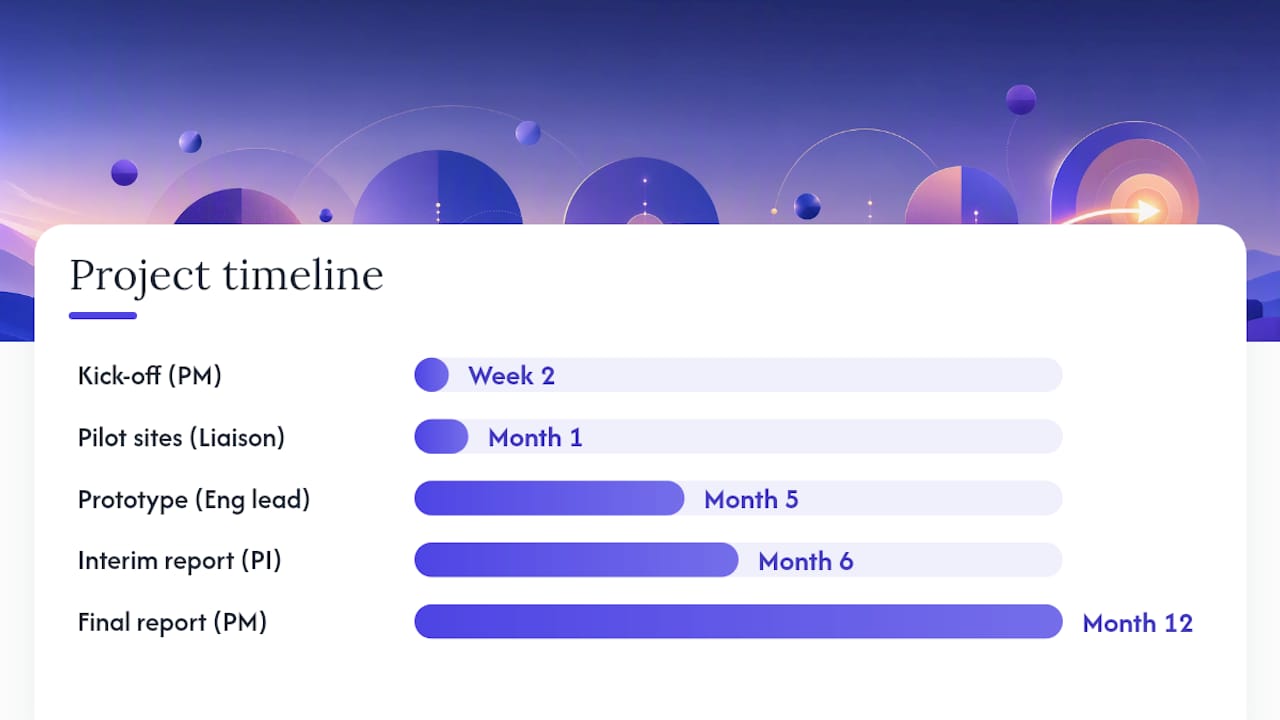
Link every milestone to a deliverable and, where relevant, to a payment or review gate. A simple milestone table is more useful to reviewers than a dense paragraph of dates.
| Milestone | Target date | Owner | Success criteria |
|---|---|---|---|
| Kick-off meeting completed | Week 2 | Project manager | Signed project charter |
| Pilot sites confirmed | Month 1 | Site liaison | Three sites with signed MOUs |
| Prototype delivery | Month 5 | Engineering lead | Field validation passed |
| Interim report submitted | Month 6 | PI / project lead | Accepted by funder |
| Final report and closeout | Month 12 | Project manager | Funder sign-off received |
A compact Gantt chart — even a simple bar chart in a Word table — adds visual clarity for phased projects. Keep it to one page. Reviewers do not need hour-level granularity; they need to see that phases are logically sequenced and that the critical path is realistic.
Pro Tip: Add a contingency buffer of 10–15% of total project duration, and call it out explicitly. Reviewers who see a 12-month project with no slack built in will question whether the team has done this before. Naming the buffer signals planning maturity, not padding.
Budget and budget justification: tying every cost to a task
A budget that cannot be traced to a task will not survive a program officer's review. Build the budget line by line, and write a justification sentence for every category.
Standard budget categories for most proposals:
- Personnel: list each role, effort level (percentage of full-time equivalent or hours per week), and salary basis. Reference current institutional or market rates.
- Fringe benefits: apply the rate your institution or organization uses; cite it explicitly.
- Equipment: itemize anything over the funder's capitalization threshold (often $5,000 per item) and explain why it is necessary for the project.
- Travel: specify destination, purpose, number of travelers, and estimated cost per trip.
- Subcontracts: name the subcontractor, their role, and their deliverable. Attach a separate budget and justification for each subcontract.
- Indirect costs (overhead): apply the negotiated rate if one exists; if not, use the funder's published rate and cite the source.
- Contingency: some funders allow a contingency line (typically 5–10%); confirm allowability before including it.
Round all figures to whole dollars. Do not use inflation assumptions unless the funder's cost guidance explicitly permits them. When a funder publishes a cost guide or allowable-cost policy, reference it by name in the justification narrative. That one step signals compliance awareness and saves time during audits.
The justification narrative should be a short paragraph per category, not a repeat of the line-item numbers. Its job is to explain why the cost is necessary, not to restate what it is.
Significance, evaluation, and dissemination: showing your impact
Reviewers want to know two things beyond the technical plan: why this project matters, and how you will know it worked. This section answers both.
Impact falls into four broad categories. Identify which ones apply to your project and be specific:
- Scientific or knowledge impact: new findings, validated methods, or datasets that advance the field
- Economic impact: cost savings, revenue generation, or efficiency gains with estimated magnitudes
- Operational impact: process improvements, reduced error rates, or faster cycle times
- Social or community impact: health outcomes, equity improvements, or quality-of-life gains
For evaluation, propose 3–5 metrics that map directly to your objectives. Vague metrics ("increased awareness") are not evaluable.
Dissemination planning follows a logical sequence:
- Internal reporting to the funder or client at agreed milestones
- Peer-reviewed publication or technical report for scientific or applied research
- Conference presentation or workshop for practitioner audiences
- Commercial handoff, licensing, or policy brief for projects with scale-up potential
Where the funder requires a knowledge-transfer or sustainability plan, address it here. Explain who will maintain the outputs after the grant period ends, how the project will be funded beyond the initial award, and what institutional or organizational structures will support continuation.
References, appendices, and supporting documents
The references section is not optional, and it is not a place to pad word count. Every citation in the narrative needs a complete, consistent bibliographic entry. Use the citation style the funder specifies — APA 7th, Chicago, Vancouver, or the funder's own format — and apply it without variation.
Appendices carry the supporting material that would interrupt the narrative if placed inline. A standard appendix checklist:
- CVs or biosketches for key personnel (follow the funder's format exactly — NIH biosketches, for example, have a strict two-page limit)
- Letters of support or commitment from partner organizations
- Prior publications or preliminary data reports
- Data management plan (required by NSF, NIH, and most federal agencies)
- Instrument specifications, survey instruments, or interview guides
- Subcontractor statements of work and budgets
- Facilities and resources description
Not every funder allows unlimited appendices. Some cap the total page count including appendices; others specify exactly which attachments are permitted. Confirm the rules before adding anything. An appendix that violates page limits can trigger administrative rejection even when the technical content is strong. The Portland State University proposal outline resource lists the institutional elements — facilities, current and pending support, budget justification — that reviewers expect to find in appendices for academic proposals.
Tailoring the outline to funder or client instructions
Funder instructions override every default in this guide. When an RFP or grant solicitation specifies section order, page limits, font size, margin width, or required forms, those specifications are the only rules that matter. Follow the agency's specific instructions exactly — a proposal that ignores formatting requirements signals that the team will also ignore project requirements.
A pre-submission compliance checklist should cover:
- Page limits respected for each section (including appendices)
- Font, size, and margin requirements met throughout
- Required forms completed and signed (cover sheet, certifications, assurances)
- File format and naming conventions match the submission portal's requirements
- All required attachments present and in the correct order
- Abstract length within the specified limit (typically two paragraphs or 200 words)
- Budget totals match across the narrative, the budget form, and the budget justification
Common disqualifiers include missing signatures on certification forms, wrong file types (PDF when Word is required, or vice versa), and omitted required attachments such as a data management plan or a human subjects protocol. Assign one person on the team to own the final compliance pass — not the PI or the technical lead, but someone whose only job at that stage is to check the submission against the solicitation checklist line by line.
Common pitfalls and a final review checklist
Most proposals that fail do not fail because the idea was bad. They fail because the presentation gave reviewers a reason to doubt the team's competence or commitment.
The most common pitfalls:
- Overlong executive summary that restates the table of contents instead of making the investment case
- Mismatched aims and methods — an aim that promises X while the methods only deliver Y
- Weak or missing acceptance criteria for deliverables, leaving the client with no way to confirm completion
- Unsupported budget items with no justification narrative tying the cost to a task
- No governance or management section, which leaves reviewers guessing about who makes decisions and how problems will be escalated
- Vague dissemination plan that says "results will be published" without naming a journal, conference, or timeline
Before submission, run three distinct review passes:
- Peer read: a colleague who was not involved in writing reads the proposal for clarity, logical flow, and whether the argument is persuasive to someone unfamiliar with the project.
- Domain expert check: a subject-matter expert reviews the technical sections for accuracy, feasibility, and whether the methods are appropriate for the stated aims.
- Compliance and administrative pass: one person checks every submission requirement against the solicitation, confirms all forms are signed, and verifies file formats and naming conventions.
For RFP responses specifically, the project proposal sections guide notes that the "next step" section — what you want the client to do after reading — is frequently omitted, leaving proposals without a clear call to action. Include it.
A one-page template and suggested word counts
Copy this template into your document and fill in the bracketed prompts. The word counts are targets, not hard limits — follow funder instructions when they specify otherwise.
Proposal outline template:
- Cover page: [Project title | PI/lead name | Institution/company | Contact | Date | Reference number]
- Executive summary (200–300 words): [State the problem, your solution, key outcomes, team qualifications, and total cost in one page.]
- Introduction / problem statement (200–400 words): [Describe the problem, who is affected, why it has not been solved, and the scope of this proposal.]
- Background / literature review (400–800 words): [Synthesize relevant evidence, identify the gap, and connect findings to your objectives.]
- Objectives / specific aims (150–300 words): [List 3–5 numbered, measurable aims with time-bound targets.]
- Methodology / design (600–1,200 words): [Describe design, sample, data sources, instruments, analysis, feasibility, and risk mitigation by aim.]
- Proposed solution / deliverables (200–400 words): [List deliverables with acceptance criteria and dates; include scope table.]
- Timeline / milestones (100–200 words + table): [Milestone table with dates, owners, and success criteria; add Gantt if phased.]
- Budget summary (100–200 words + table): [Line-item budget by category; justification paragraph per category.]
- Significance / evaluation / dissemination (200–400 words): [Impact categories, 3–5 evaluation metrics, dissemination plan.]
- References: [Complete citations in funder-specified style.]
- Appendices: [CVs, letters of support, data management plan, instruments, subcontractor budgets.]
| Section | Suggested word count |
|---|---|
| Executive summary | 200–300 words |
| Introduction / problem statement | 200–400 words |
| Background / literature review | 400–800 words |
| Objectives / specific aims | 150–300 words |
| Methodology / design | 600–1,200 words |
| Timeline (narrative) | 100–200 words |
| Budget summary (narrative) | 100–200 words |
| Significance / evaluation | 200–400 words |
These ranges reflect guidance from university proposal offices and the standard structure recommended when funders do not specify their own. For a typical 10–15 page research proposal, the methodology section carries the most weight and should receive the most attention.
What most proposal guides get wrong about structure
The conventional advice is to treat a proposal outline as a checklist: fill in each section, submit, repeat. That framing misses what actually separates funded proposals from rejected ones.
Reviewers are not reading for completeness. They are reading for confidence. Every section is a trust signal, and the question is not "did you include a budget?" but "does this budget make me believe you have done this before?" The management and governance section is the clearest example. Most proposal guides treat it as an afterthought — a paragraph about team roles buried near the end. Experienced reviewers use it to assess delivery maturity. A proposal with a clear governance structure, named decision-makers, and an escalation path reads as operationally credible. One without it reads as a good idea with no one in charge.
The same logic applies to the budget justification. Isolating qualifications and cost explanations in their own sections is the default approach, but the slot method — weaving team credentials, cost rationale, and benefit evidence throughout the narrative — produces a more persuasive document. When a reviewer reads about your methodology and simultaneously understands why your team is uniquely positioned to execute it and what it will cost, the argument lands as a single coherent case rather than a series of disconnected sections.
The executive summary mistake is equally common. Many writers treat it as a compressed version of the full proposal, hitting every section in miniature. That produces a document that reads like a table of contents with sentences. The better approach: write the executive summary as a standalone persuasive argument that a busy decision-maker could read in three minutes and understand exactly what you are asking for, why it matters, and what they get in return. If the rest of the proposal disappeared, the executive summary should still make the case. For technical proposal writing, that discipline is especially important because technical detail can crowd out the persuasive argument entirely.
Structure is the scaffolding. Confidence is what gets funded.
How Rfpforgeai turns a blank outline into a compliant draft
Pulling together a compliant, well-structured proposal from scratch takes hours of formatting, cross-referencing, and compliance checking before a single persuasive sentence gets written. Rfpforgeai cuts that setup time sharply by doing the structural work automatically.
Upload your RFP or grant solicitation and the platform extracts every requirement, builds a compliance matrix, and flags gaps through an interactive Q&A. From there, it scaffolds the executive summary, methodology, timeline, and budget sections using your inputs, so your team spends time on the argument, not the architecture.
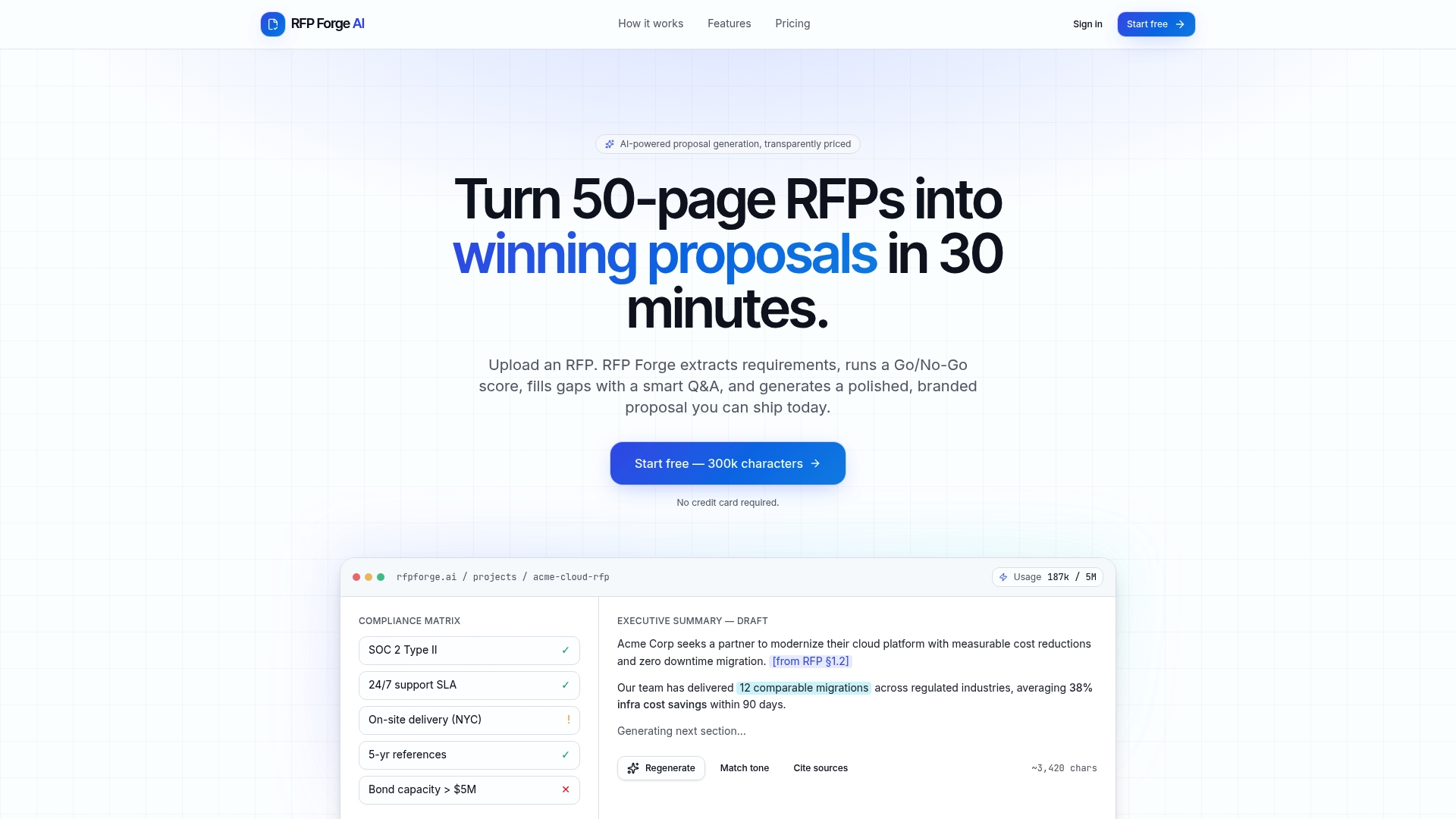
The compliance tracking runs throughout the drafting process, not just at the end, so formatting errors and missing attachments surface before they become disqualifiers. Win-rate analytics let you track which proposal structures and approaches perform best across submissions, turning each bid into data for the next one.
If your team responds to RFPs regularly, start a free trial at Rfpforgeai and see how much of the outline-and-compliance work you can hand off on your next submission.
Sources
These resources offer authoritative guidance on proposal structure across academic, scientific, and project contexts. Follow your funder's specific instructions first; use these for format guidance and deeper reference.
- Proposal Sections | Research and Innovation
- Proposals--General Structure (MIT)
- Grant outline (generic proposal structure)
- Grant-writing tip: reading the RFP