
The price volume states what the government will pay. The cost volume proves that price is realistic. Evaluators use the price volume to check reasonableness (is this too high, too low, or out of line with the market?) and the cost volume to check realism (does the math actually support the technical plan?). Your single highest-return action is making the Basis of Estimate tie labor hours and rates directly to your technical approach, backed by sources an evaluator can verify without asking you a single clarifying question.
Get that link right and most other pricing risks shrink on their own. Get it wrong, and you invite a cost realism finding that can push your price up in the government's evaluation model, even if your proposed number was competitive.
Before you build a single spreadsheet, confirm your team knows:
- The exact difference between price reasonableness and cost realism
- Which volume answers which evaluator question
- Where your BOE currently breaks the chain between hours, rates, and technical scope
Key Takeaways
A defensible price volume RFP submission wins on traceability: every labor hour and rate must connect visibly to the technical approach and to a named, verifiable source.
| Point | Details |
|---|---|
| Price vs. cost volume | Price answers reasonableness; cost answers realism, and evaluators check both differently. |
| BOE traceability | Link every hour and rate to a named source: historical actuals, parametric models, or dated quotes. |
| FAR anchors | FAR 15.408 Table 15-2, 15.404-1(d), and 15.403-4 define structure, realism checks, and documentation thresholds. |
| Cross-volume alignment | Staffing plans, key personnel seniority, and technical schedule must match priced labor exactly. |
| Rfpforgeai for BOE speed | Automates requirement extraction, BOE scaffolding, and compliance matrix creation for faster, traceable pricing. |
Table of Contents
- What Goes Into a Price Volume RFP Response?
- How Do You Build a Defensible Basis Of Estimate?
- Which FAR Rules Govern the Cost and Price Volume?
- Why Do Evaluators Flag Cost Realism Problems?
- What Are the Most Common Price Volume Mistakes?
- How Do You Build the Cost and Price Volume Step by Step?
- Can AI Speed Up Basis of Estimate Development?
- What This Playbook Actually Rewards
- Get Your Cost Volume Audit-Ready Faster
- Frequently Asked Questions About Price Volume RFPs
- Sources
What Goes Into a Price Volume RFP Response?
A compliant price volume RFP submission has five load-bearing components: pricing tables, direct labor, indirect rates, other direct costs (ODCs) and subcontractor costs, and fee or profit. Under FAR 15.408, Table 15-2 organizes cost proposals around exactly these elements, and each one needs its own supporting documentation trail. Miss one, and your compliance matrix has a hole an evaluator will find before lunch.
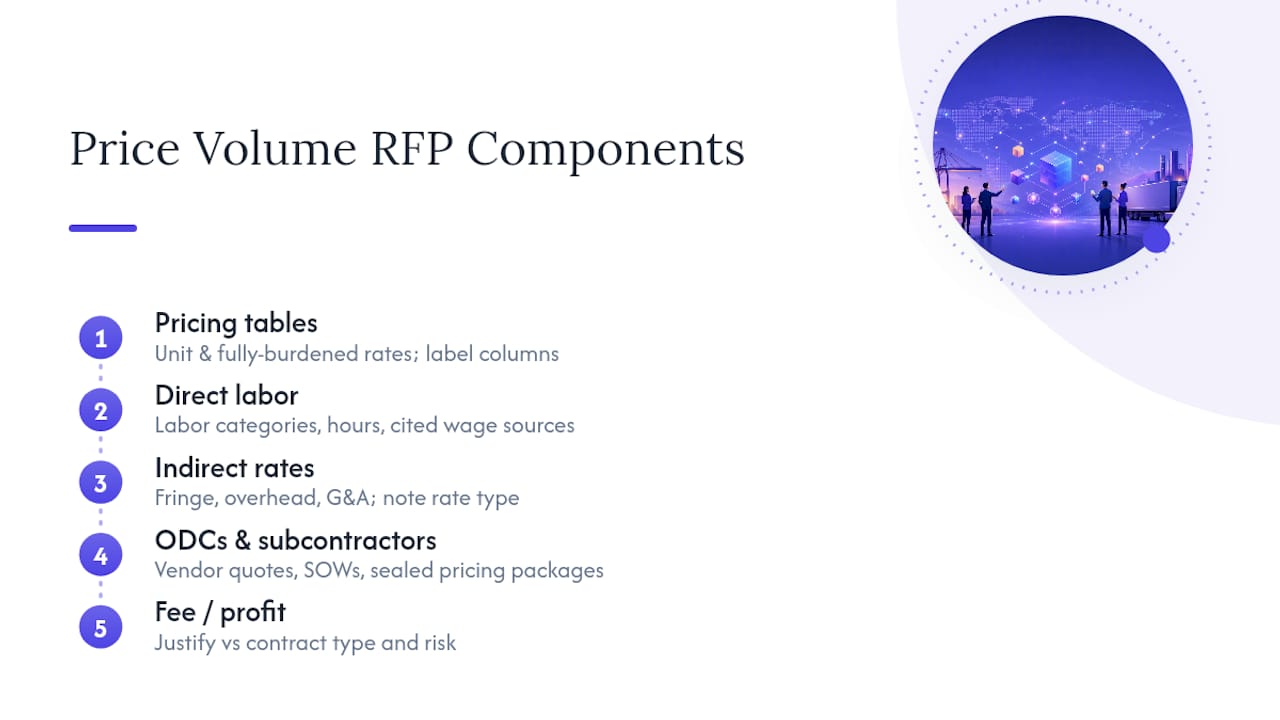
1. Pricing tables. Present both unit rates and fully burdened rates, and make clear which line items are firm and which are optional (option years, surge capacity, contract line item number variations). Evaluators scan these tables first, so label every column plainly. A table with unlabeled "rate" columns invites the wrong assumption about whether fringe and overhead are already baked in.
2. Direct labor. List every labor category, projected hours, and the fully burdened rate for each. Acceptable supporting sources include Bureau of Labor Statistics occupational wage data, third-party salary surveys, and internal compensation studies tied to your actual payroll bands. A rate with no cited source is an invitation for an evaluator to assume you guessed.
3. Indirect costs. Fringe, overhead, and General and Administrative (G&A) rates need their own line in your documentation, with a clear note on whether each is provisional, negotiated, or a Forward Pricing Rate Agreement rate. Agencies want to see the math, not just the final percentage.
4. ODCs and subcontractor costs. Support these with actual vendor quotes, signed statements of work, and, where required, sealed subcontractor pricing packages submitted separately from the prime's cost volume. A data-call template sent early to subcontractors saves you from chasing numbers during the final 48 hours.
5. Fee or profit. Justify your proposed fee relative to contract type, risk assumed, and any structural incentives in the solicitation. A cost-plus-fixed-fee bid and a firm-fixed-price bid warrant very different fee narratives, and reviewers notice when that distinction is missing.
How Do You Build a Defensible Basis Of Estimate?
A defensible Basis of Estimate reads like a short technical memo attached to every number in your cost buildup, not a spreadsheet with no explanation behind it. The strongest BOEs share four components: stated assumptions, task-based hour derivations, a visible calculation example, and a short note explaining any variance from prior periods or similar efforts.
You have four permissible bases for most estimates, and each carries its own documentation burden.
- Historical actuals, tied to a named contract number, showing how past performance informs the current bid
- Parametric models, with the formula and inputs disclosed, not just the output
- Factored or analogous estimates, referencing a comparable effort and explaining the scaling logic
- Vendor quotes, dated and attached, especially for subcontracted or ODC line items
The Cornell Legal Information Institute's text of FAR 15.403-4 makes clear that documentation expectations don't disappear just because you're below the certified cost or pricing data threshold. Traceability still matters. A BOE built around GovEagle's guidance shows this best: each major estimate should point to a named source or method, whether that's a historical contract ID, a parametric formula, or a dated vendor quote, so an evaluator or auditor can follow the logic in under a minute.
Pro Tip: Write your BOE assumptions in plain declarative sentences an auditor could quote back to you word for word. "We assumed 1,880 productive hours per FTE based on the prime's timekeeping data for Contract XYZ" survives review. "Hours were estimated using standard industry practice" does not.
Which FAR Rules Govern the Cost and Price Volume?
Three FAR citations do most of the work in shaping what evaluators expect from your cost volume, and knowing them cold changes how you write every line.
FAR 15.408, specifically Table 15-2, maps directly onto the structure your cost volume should follow: direct labor, indirect rates, materials and ODCs, subcontractor costs, and fee, each with documentation attached. If your table of contents doesn't mirror this structure, you're forcing evaluators to hunt for information that should already be organized their way.
FAR 15.404-1(d) requires agencies to perform cost realism analysis on cost-reimbursement contracts, and permits them on other contract types when needed. This analysis gives the government explicit authority to adjust your proposed costs upward for evaluation purposes if your BOE doesn't convincingly support the price you bid. That adjustment happens in their model, not on your invoice, but it can still knock you out of the competitive range.
FAR 15.403-4 sets the thresholds that determine when certified cost or pricing data is required. Even below that threshold, agencies still expect documentation that supports price reasonableness. Don't read "no certification required" as "no documentation required."
Cost realism analysis exists specifically to test whether your proposed costs reflect a credible plan, not just a competitive number.
Practical compliance steps:
- Follow Section L instructions to the letter, including table formats and page limits
- Build a compliance/cross-reference matrix linking every cost element back to its Section L requirement
- Keep BOE support files organized and ready for audit before you submit, not after
Why Do Evaluators Flag Cost Realism Problems?
The most common cost realism failure is a disconnect between what your technical volume promises and what your cost volume actually funds. A senior-heavy technical narrative staffed with mid-level labor rates in the pricing tables is the single most cited misalignment in practitioner reviews of pricing and cost volume evaluations, and it's an easy pattern for reviewers to spot.
Other frequent failure modes include:
- Labor mix that doesn't match the staffing plan described in the technical volume
- Rates priced noticeably below market with no BOE explanation for the gap
- A thin BOE that states a number without tracing it to a source or method
- Indirect rates that shift between volumes or don't match your current provisional rate agreement
Run these four alignment checks before submission:
- Staffing versus hours. Confirm every position mentioned in the technical volume has a corresponding, correctly labeled labor category and hour count in the cost volume.
- Key personnel seniority versus priced labor. If you named a PhD-level lead in your resumes section, make sure that role is priced at the matching labor category, not a junior rate.
- Technical schedule versus resource phasing. Hours should ramp and taper in the cost volume the same way effort ramps and tapers in your technical timeline.
- Indirect rate consistency. The same fringe, overhead, and G&A rates should appear identically in every volume and appendix.
When these checks fail, agencies don't reject your proposal outright. They adjust your evaluated cost upward, which can push a competitive bid out of the award range. A reconciled summary table cross-referencing technical staffing to priced labor is the cheapest insurance policy against this outcome.
What Are the Most Common Price Volume Mistakes?
Most cost realism findings trace back to a small set of repeatable errors, and nearly all of them are catchable with a checklist run 48 hours before submission.
Watch for these first:
- A BOE that states a number with no link to a source, method, or prior contract
- Labor category counts in the pricing tables that don't match the staffing plan in the technical volume
- Indirect rates pulled from an outdated rate agreement instead of your current provisional or negotiated rate
- Subcontractor inputs that arrived late and never got reconciled into the prime's cost buildup
Your pre-submission checklist should include:
- Cross-reference every cost table against its Section L requirement, line by line
- Confirm sign-offs from the cost lead, pricing strategist, and a finance reviewer
- Reconcile every subcontractor data call against what actually landed in the final cost buildup
- Verify BOE completeness for every labor category and ODC line, not just the largest ones
Three templates are worth building once and reusing on every proposal: a BOE structure with assumptions and calculation examples pre-formatted, a pricing schedule template matched to your typical contract types, and a subcontractor sealed-package checklist that spells out exactly what each teammate needs to submit and by when.
Pro Tip: If you make a last-minute assumption change (a labor rate update, a revised hour count), document it in a one-line memo attached to the BOE the same day. A dated, explained change survives an audit. An unexplained discrepancy between your draft and final BOE does not.
How Do You Build the Cost and Price Volume Step by Step?
Building a defensible price volume RFP submission works best as a four-phase process with clear role ownership at each stage, starting well before the solicitation drops.
1. Capture phase. Bring your pricing lead into capture discussions early, not after the RFP releases. Set your labor category taxonomy and BOE template now, and start planning data calls to subcontractors and vendors so quotes aren't a last-minute scramble.
2. Estimating phase. Collect vendor quotes, calculate wrap rates (fringe plus overhead plus G&A, layered onto raw salary data), and reconcile your labor hours against the technical team's staffing plan as it develops. This is the phase where misalignment gets baked in or caught.
3. Mid-cycle pricing. Draft your pricing tables and BOE narratives in parallel with the technical volume, not after it's finalized. Cross-check assumptions weekly so both volumes evolve together.
4. Final QA cycle. Compile your compliance matrix, reconcile every volume against Section L, and route the package through finance and leadership sign-off. Prepare your BOE support files as if an audit could start the day after submission, because sometimes it does.
Assign these roles clearly:
- Cost lead owns the cost buildup and indirect rate documentation
- Price strategist owns pricing strategy, fee positioning, and competitive analysis
- BOE writer owns the narrative memos linking hours and rates to technical scope
- Finance reviewer owns final sign-off and audit readiness
Handoffs between these roles are where most errors creep in, so build a shared tracker that shows exactly who owns which line item at every stage.
Can AI Speed Up Basis of Estimate Development?
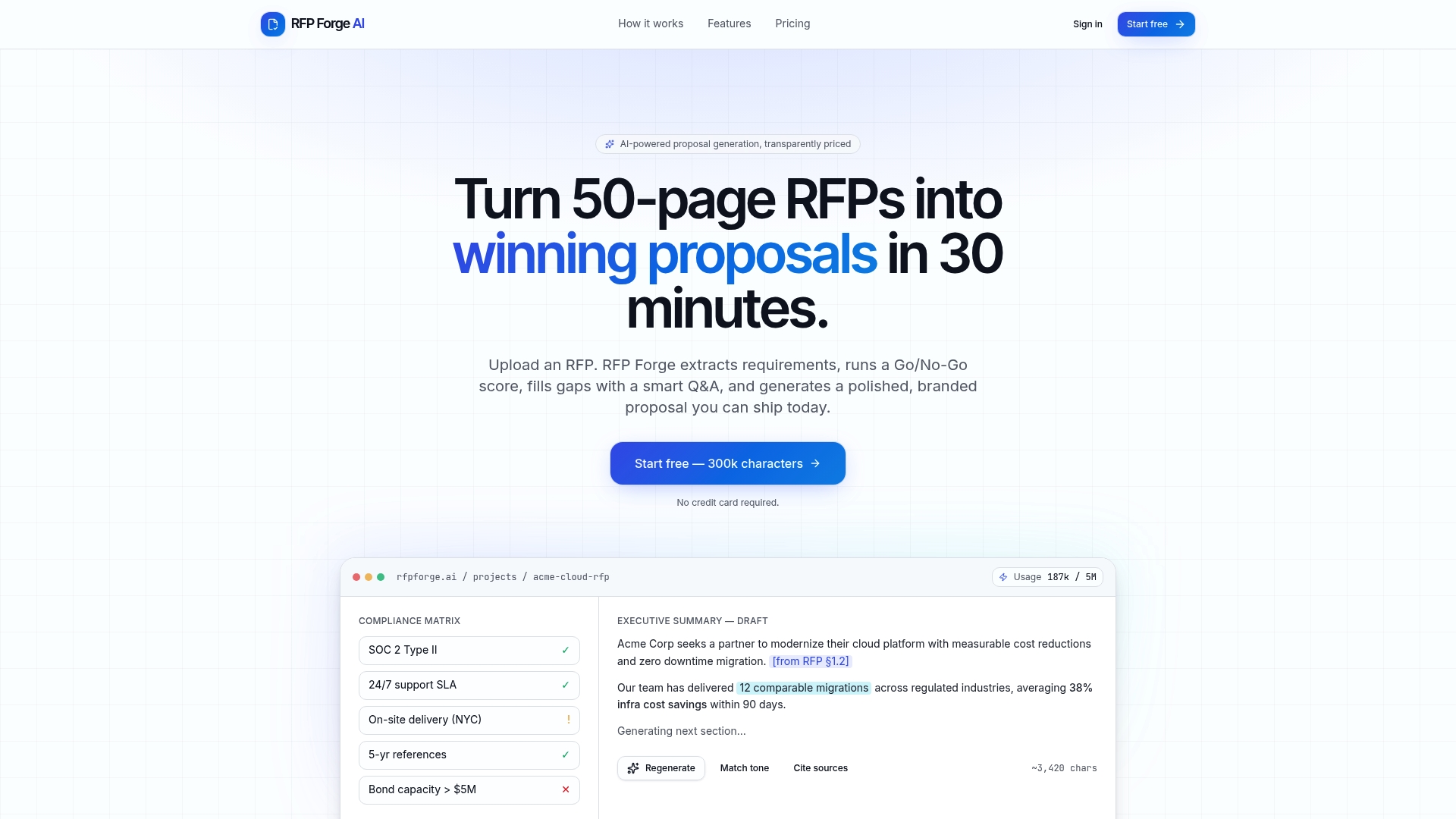
Building a traceable BOE by hand across a dozen labor categories and a stack of subcontractor quotes eats days that most pricing teams don't have. Rfpforgeai extracts requirements from the solicitation automatically, scaffolds BOE structure around your labor categories, builds the compliance matrix that cross-references Section L, and populates pricing tables from your existing rate data.

For proposal teams in regulated industries, that automation isn't just about speed.
To integrate it into an existing capture cycle:
- Feed the RFP into the platform during capture to get an early Go/No-Go read on requirements
- Use the compliance matrix output as your Section L cross-reference from day one
- Export pricing tables directly into your existing cost model for BOE narrative attachment
What This Playbook Actually Rewards
Most pricing guidance treats the cost volume as a math exercise: get the rates right, sum the columns, submit. That framing misses what evaluators are actually scoring. A cost volume isn't graded on arithmetic. It's graded on whether the story it tells matches the story your technical volume already told.
The conventional advice to "price competitively" undersells the real risk. A competitive number attached to a thin BOE gets adjusted upward in the government's evaluation model anyway, which erases whatever pricing advantage you thought you had. The teams that consistently avoid this outcome aren't the ones with the lowest rates. They're the ones whose BOE reads like a memo an auditor could verify in five minutes, with every hour traced to a named source.
If you take one thing from this: build your BOE traceability infrastructure before you need it on a live proposal, not during the final 72 hours. That's exactly the gap tools like Rfpforgeai are built to close, and it's worth testing on your next cycle before your busiest one arrives.
Get Your Cost Volume Audit-Ready Faster
Building traceable BOEs by hand, cross-referencing Section L manually, and reconciling subcontractor packages the night before submission costs your team hours it doesn't have during a live pursuit. Rfpforgeai is the faster alternative to manual pricing assembly for federal proposal teams: it extracts requirements straight from the solicitation, scaffolds your Basis of Estimate around your labor categories, and builds your compliance matrix automatically, so your cost lead spends time validating numbers instead of formatting tables.
Teams in regulated industries have reported meaningful cost reductions using the platform's automated approach to infrastructure and technology-related proposals. If your next cost volume includes ODC line items like equipment disposition, pairing your pricing tables with a documented vendor like BuyBackBear's IT equipment disposal service gives you a clean, quotable source for that section instead of an estimate with no paper trail. Start a trial run on your next solicitation at Rfpforgeai and see how quickly your compliance matrix and pricing tables come together before your next deadline.
Frequently Asked Questions About Price Volume RFPs
What's the difference between a price volume and a cost volume in an RFP?
The price volume states the number the government would pay; the cost volume proves that number is realistic by showing the labor hours, rates, and indirect costs behind it. Some solicitations combine both into a single "cost/price volume."
Do RFQs require the same cost realism documentation as RFPs?
Not always. RFQs typically standardize pricing when the scope is already well defined, so the government focuses more on price comparison than on realism analysis, unlike RFPs where technical approach and cost realism are both evaluated factors.
What triggers a cost realism analysis under FAR?
FAR 15.404-1(d) requires cost realism analysis for cost-reimbursement contracts and permits it for other contract types when the contracting officer determines it's needed, particularly when a proposed price looks inconsistent with the technical approach.
How do I calculate a fully burdened labor rate?
Start with the base salary, then layer on fringe, overhead, and G&A as a wrap rate. Document each component's source, whether it's a negotiated rate agreement or a provisional rate pending final adjustment, so evaluators can trace the math.
What happens if my proposed price is below the certified cost or pricing data threshold?
Under FAR 15.403-4, you may not need certified cost or pricing data below the threshold, but agencies still expect documentation that supports price reasonableness. Traceable BOEs remain necessary even when formal certification isn't.
Sources
- FAR 15.408 - Cost or pricing data and cost representations
- CFR 48 — 15.403-4 (cost or pricing data guidance)