
Follow your solicitation and client agreement first. Beyond that: disclose AI assistance when AI-generated material materially shapes your final deliverable, when client data was fed into an AI tool, or when the deliverable falls into a high-risk category like legal, financial, or compliance-heavy work. Every other disclosure decision flows from those three triggers.
You need a named person to verify the output before it goes out the door. That's not optional caution, it's the standard law firms are already being told to follow when using AI for proposal work.
The three triggers that should stop you and make you think about disclosure:
- AI-generated content appears in the final deliverable, not just an early draft
- Client data, documents, or confidential materials were uploaded into an AI tool
- The deliverable is Category A: legal, medical, financial, or safety-critical work where errors carry real consequences
Skip to the templates below if you need copy right now. If you want the reasoning first, keep reading.
Key Takeaways
Disclosing AI assistance in proposals means following solicitation and contract terms first, then applying named-reviewer verification whenever AI content, client data, or high-risk deliverables are involved.
| Point | Details |
|---|---|
| Solicitation language rules | Always check the RFP or client agreement for AI clauses before deciding whether to disclose. |
| Three disclosure triggers | Disclose when AI content reaches the final deliverable, client data was uploaded, or the work is high-risk. |
| Named reviewer required | Assign and log a specific person responsible for verifying AI-assisted content before submission. |
| Match template to context | Use minimal, standard, or contract-grade disclosure language depending on procurement formality. |
| Build it into closeout | Rfpforgeai's compliance tracking and audit trail help document sign-off without extra manual steps. |
Table of Contents
- When Do You Need to Disclose AI Use in Proposals?
- What Should Your AI Disclosure Statement Actually Say?
- Ready-to-Copy AI Disclosure Language for Proposals
- How Do You Build a Disclosure Checklist Into Your Workflow?
- What Are the Legal Risks of Not Disclosing AI Use?
- Where RFP Forge Fits Into Your Disclosure Workflow
- Sources
When Do You Need to Disclose AI Use in Proposals?
Solicitation and contract language always wins. If an RFP explicitly asks whether AI tools were used in preparing the response, or a client agreement bans third-party AI processing of their data, that clause overrides any general policy you'd otherwise apply. Read every solicitation for an AI clause before you touch a proposal-generation tool.
Beyond contract language, three situations shift disclosure from optional to necessary:
- The deliverable is Category A. Governance frameworks built around risk tiers put legal opinions, financial projections, medical claims, and safety compliance documents in the highest tier, where disclosure and verification are mandatory, not discretionary.
- Client data went into the tool. Uploading a client's internal documents, financials, or proprietary specs into an AI system without permission creates liability whether or not you disclose it later.
- A client asks directly. Once a procurement contact or client asks "did you use AI for this," a vague or evasive answer damages trust more than the AI use itself ever would.
Roughly a third of proposal teams now use some form of AI drafting assistance, and buyer-side procurement practitioners increasingly expect vendors to state that plainly rather than find out during due diligence. Category B deliverables (internal process docs, standard marketing collateral) call for recommended disclosure but allow more judgment. Category C, low-stakes formatting or grammar assistance, rarely needs a mention at all.
What Should Your AI Disclosure Statement Actually Say?
Your disclosure line needs to do three things: state that AI was used, name what it touched, and confirm a human verified the result. Beyond that, the right level of detail depends entirely on who's reading it.
A minimal disclosure works for low-stakes situations: "This proposal was drafted with AI assistance and reviewed by our team prior to submission." That single sentence covers the basics without inviting a follow-up interrogation.
A standard disclosure adds specificity: naming which sections used AI support, confirming no confidential client materials were uploaded to third-party systems, and identifying who signed off. This is the version most procurement evaluators actually want to see, because it answers the data-handling question before anyone has to ask it.
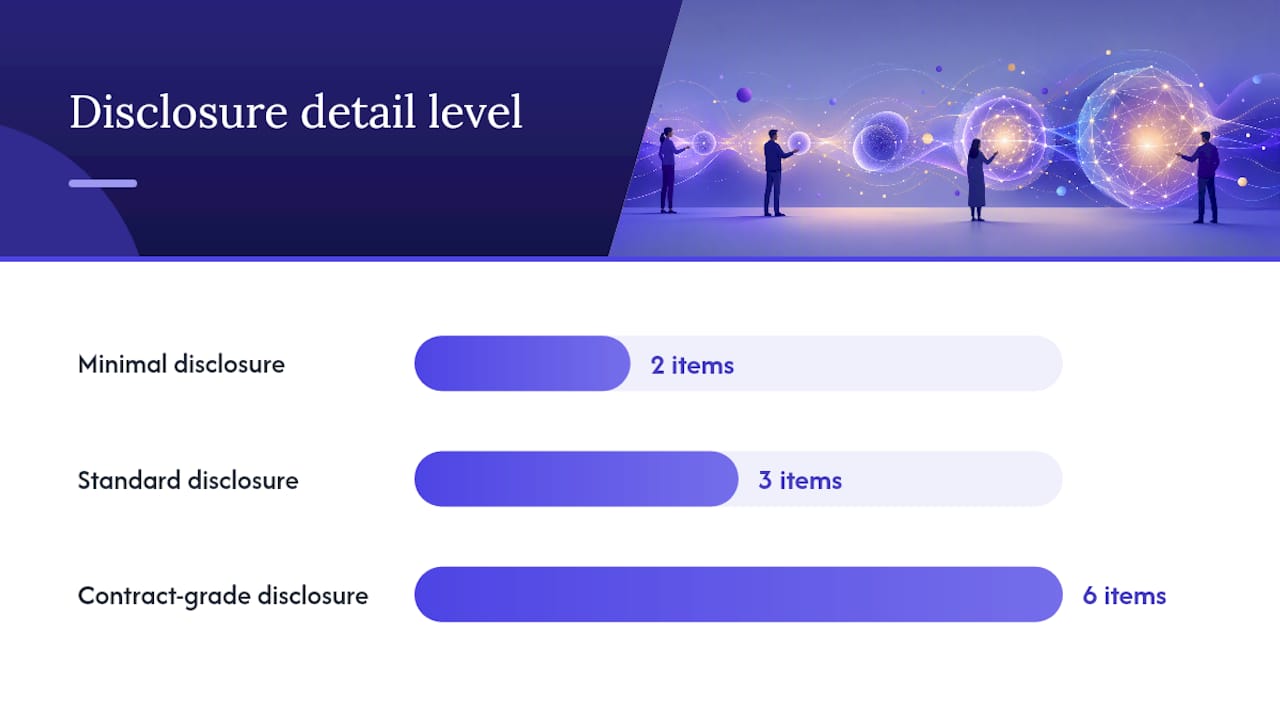
A contract-grade disclosure belongs in an appendix or a dedicated clause, spelling out the specific tool category used, the verification process applied, and the point of contact for questions. Government and enterprise procurement teams tend to expect this level of detail, and it pairs well with the compliance-first structure covered in government RFP response guidance.
Where you place the statement matters almost as much as what it says:
- Cover letter or transmittal memo, for a brief, general statement
- A dedicated methodology or process section in the proposal body, for standard disclosures
- A signed appendix or contract attachment, for formal, contract-grade language
- Delivery notes, for project-specific work products delivered after contract award
Pro Tip: Match your tone to the buyer, not to your own comfort level. A federal agency wants formal, specific language with a named reviewer. A small business client mostly wants to know their data wasn't uploaded somewhere it shouldn't be. Write two versions and pick the one that fits the room.
Ready-to-Copy AI Disclosure Language for Proposals
Copy one of these, adjust the bracketed details, and move on. None of these require a lawyer to draft, though the third one benefits from a quick legal read before it goes into a signed contract.
- Minimal (one sentence): "AI tools assisted in drafting portions of this proposal; all content was reviewed and verified by [name/role] before submission."
- Standard (one to two sentences): "This proposal was developed with the assistance of AI drafting tools for [sections/tasks]. No confidential client information was submitted to any third-party AI system, and all final content was reviewed by [name/role] for accuracy and compliance with [solicitation/contract] requirements."
- Contract-grade clause: "The Vendor discloses that AI-based tools may be used in the preparation of proposal and deliverable content under this agreement. Any such content is subject to human review and verification by a qualified [role] prior to delivery. No Client confidential information will be processed by third-party AI systems without prior written consent. Vendor will maintain records of AI use and verification for the duration of the engagement."
Keep the language factual. State what happened and what you did about it, without over-explaining or sounding defensive. A disclosure that reads like an apology raises more questions than one that reads like a routine process note. The contract clause examples in public disclosure guides follow this same plain, procedural tone for good reason.
How Do You Build a Disclosure Checklist Into Your Workflow?
Turn the decision into a five-minute step at closeout, not a debate you have every time. Ask three questions before any proposal goes out: Was AI used in this deliverable? Was client data uploaded to any tool? Does this fall into Category A?
A named reviewer signs off on the answers, and that sign-off gets logged, not just remembered. Inline markers like "[GAP, needs verification]" flag AI-assisted sections during drafting so nothing slips through in the rush before a deadline. Keep the record for as long as your engagement or contract retention policy requires, since it's the first thing procurement or legal will ask for if a dispute ever surfaces.
- Confirm AI use and note which sections it touched
- Confirm no unauthorized client data entered a third-party tool
- Flag Category A content for mandatory human verification
- Log the reviewer's name, date, and sign-off method
- Retain the record per your standard document retention policy
| Checklist Step | Who Owns It | Documented Where |
|---|---|---|
| Confirm AI use and scope | Proposal writer | Draft file or tracking tool |
| Verify no unauthorized data upload | Team lead / account manager | Client intake notes |
| Category A review and sign-off | Named reviewer/manager | Sign-off log |
| Final disclosure language check | Proposal manager | Submitted proposal copy |
What Are the Legal Risks of Not Disclosing AI Use?
No federal law forces disclosure across every proposal as of 2026, but that's not the same as a green light. Solicitation-specific clauses already require it in many cases, and draft government procurement rules point toward broader mandates soon.
- Read every solicitation line by line for AI-related language before assuming silence means permission
- When a solicitation is ambiguous, ask the contracting officer directly rather than guess
- Involve legal counsel for Category A deliverables, high-value contracts, or any client agreement with strict data-handling clauses
- Document your disclosure rationale in writing, even for proposals where you decide disclosure isn't required
How the Author's Practice and RFP Forge Support This Approach
Rfpforgeai turns lengthy RFPs into polished proposals in roughly 30 minutes, extracting requirements and flagging gaps through an interactive Q&A rather than a black-box draft.
- Every extracted requirement and AI-assisted section stays traceable, which supports the audit trail governance frameworks recommend
- The platform's compliance tracking helps teams document sign-off the way organizational conflict-of-interest guidance recommends for sensitive proposal work
A Note on Speed, Trust, and Getting This Right
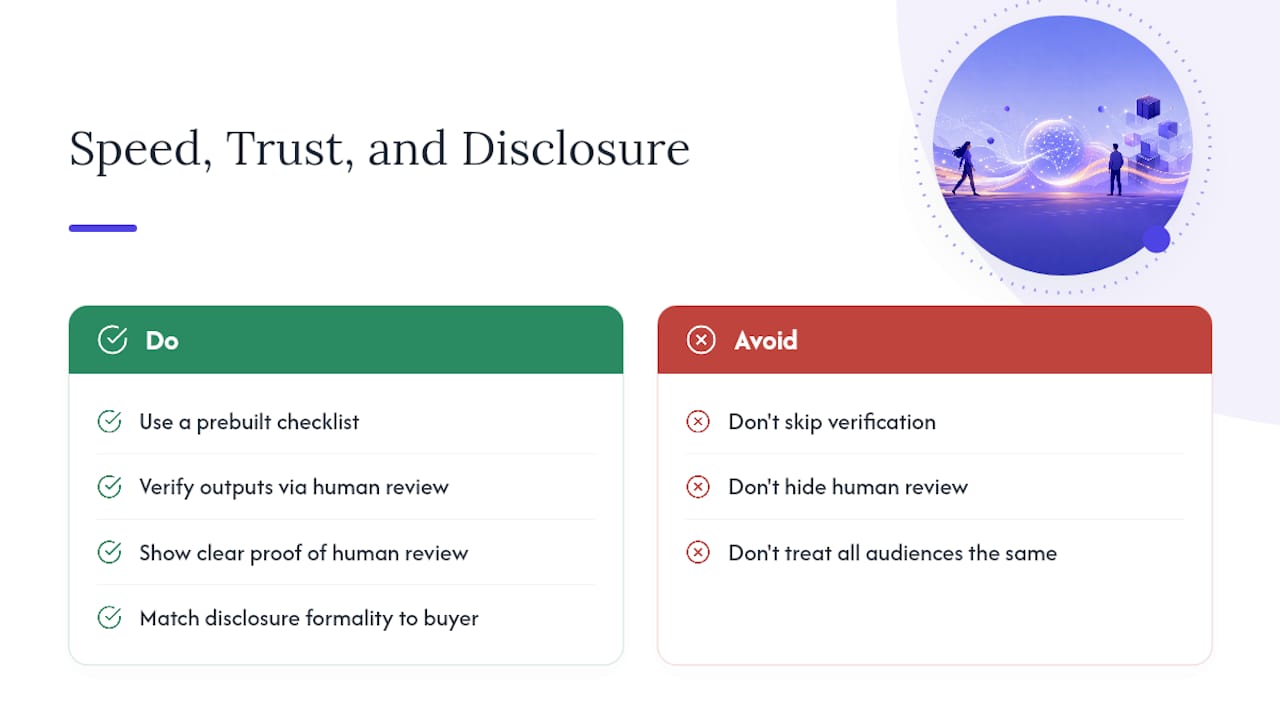
Speed and accuracy aren't in conflict here. The teams that move fastest are the ones with a checklist already built, not the ones skipping verification. Buyers accept AI use readily when you pair it with clear proof of human review. Match your disclosure's formality to the procurement culture you're responding to. A federal agency and a small business client are not the same audience.
Where RFP Forge Fits Into Your Disclosure Workflow
Rfpforgeai cuts the manual work out of the exact checklist this guide walks through, so disclosure stops being a scramble on submission day. Instead of hunting through a draft to figure out which sections an AI tool touched, the platform's requirement extraction and Q&A process leave a built-in record of what was generated, what a human filled in, and what still needs review.
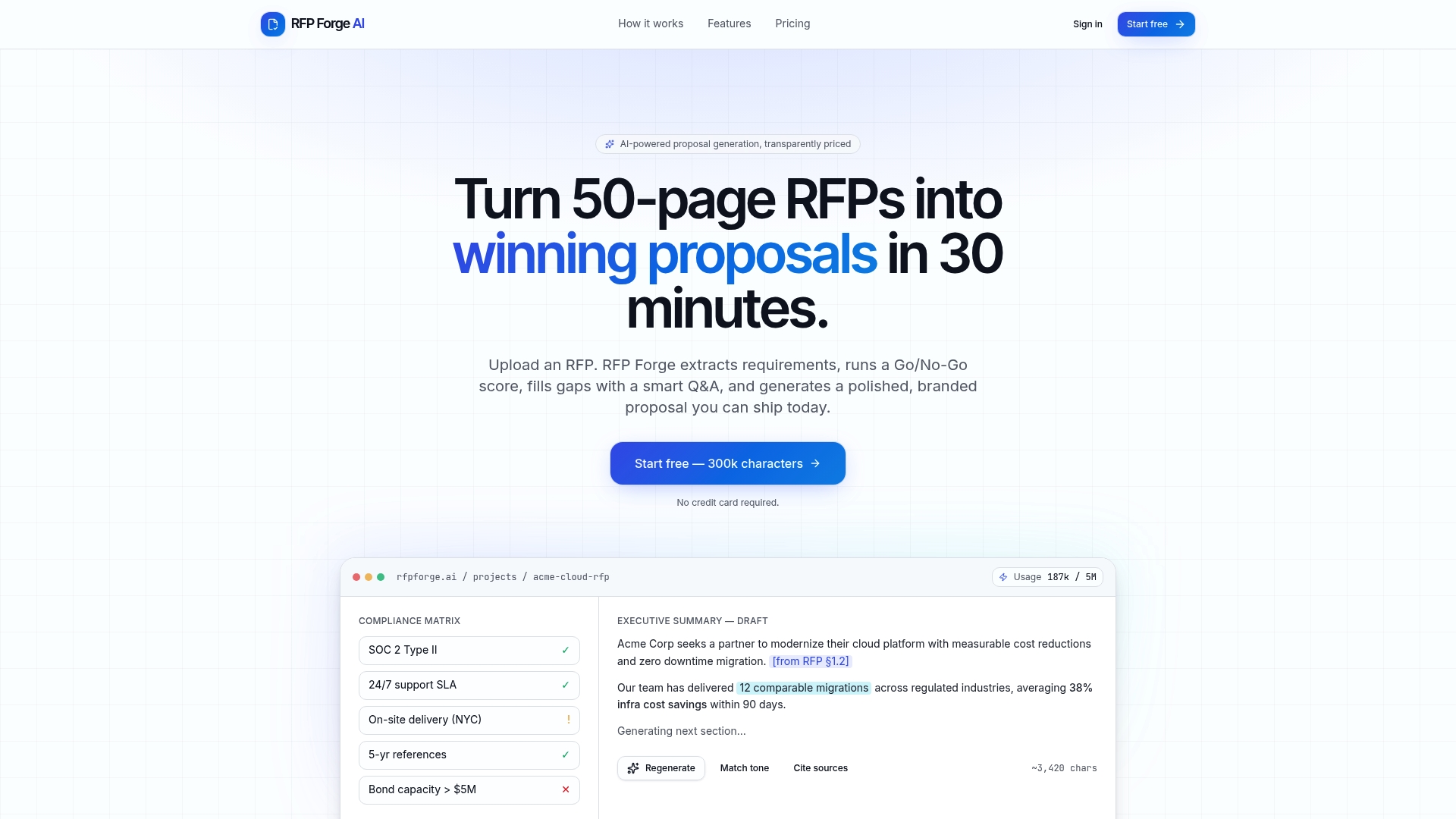
That audit trail matters more than most teams realize until a procurement officer asks for it. Rfpforgeai's compliance tracking keeps that documentation organized alongside your win-rate analytics, so sign-off isn't a separate scramble bolted onto the end of a proposal cycle. It's part of the same workflow you're already running. If your team is still assembling disclosure records by hand, it's worth seeing how Rfpforgeai's proposal generation platform handles that documentation automatically. Start a trial and run your next RFP response through it before your next deadline hits.
Sources
- Using AI to Write RFP Responses: Benefits, Risks & Rules
- Should Freelancers Tell Clients They Use AI? A Practical Disclosure Policy for 2026
- AI-Generated Deliverable Disclosure and Citation Standards — Model & Program Governance AI Governance Control | AI Governance Institute